The Holy See Press Office confirmed that the Nov. 6-17, 2026 apostolic journey will proceed according to the previously published program.
"It fills me with joy to return to the continent where I have lived through so many moments of my life," Pope Leo XIV wrote on his X account on Oct. 26, confirming his upcoming trip to Uruguay, Argentina and Peru, which will take place in November.
"May this journey be an opportunity to open our hearts to one another, strengthen our communion as brothers and sisters, and renew our commitment to proclaiming the Gospel with joy," the Holy Father wrote, nearly two weeks after undergoing lung surgery on Oct. 13.
In addition, an Oct. 26 Vatican statement indicated that "Based on his current clinical status, as well as the results of the diagnostic tests and laboratory analyses performed, there are no contraindications that would prevent him from undertaking his upcoming apostolic journey to Latin America as planned."
"The Pope is following medical recommendations with great care and diligence, and with a deep determination to continue serving the Church," it added.
"In this respect, the Holy See Press Office confirms that the Apostolic Journey of Pope Leo XIV to Uruguay, Argentina, and Peru, scheduled for November 6-17, 2026, will proceed according to the program previously published," the Vatican statement said.
"The Holy Father remains deeply grateful for the prayers and affection he has received from throughout the world and for the dedicated care of the medical professionals who have accompanied him during his recovery," the statement said.
"Dr. Luigi Carbone confirms that the Holy Father's recovery after the surgery continues, and the latest medical examinations attest to his good health," the Vatican added.
"As previously reported, the surgical procedure was successful and without complications. Subsequent medical examinations confirmed that the condition was localized and that no further oncological treatment is necessary," the Vatican stated.
Archbishop Hicks said the settlement puts the archdiocese "on the verge of being able to … bring some measure of healing and reconciliation to all victim-survivors."
The Archdiocese of New York will pay out $800 million in a settlement with sexual abuse victims.
The settlement, first announced in May, required unanimous agreement of all 1,300 victims, which has been established, attorneys for hundreds of victims said on Oct. 24.
The agreement comes after years of litigation following New York's 2019 passage of the New York Child Victims' Act, which permanently extended the civil statute of limitations so victims of childhood sexual abuse can file claims until age 55, and opened a temporary revival window (extended through August 2021) that allowed previously time-barred claims to be filed by victims of any age.
The settlement also requires the archdiocese to maintain and update a list of credibly accused clergy on its website, attorneys said.
The archdiocese and a plaintiffs' liaison committee, composed of attorneys from eight law firms representing the majority of claimants, negotiated for months to arrive at the agreement.
Archbishop Ronald Hicks called the news of the settlement "encouraging" in an Oct. 24 letter to priests provided to EWTN News by the archdiocese.
"We are on the verge of being able to, please God, bring some measure of healing and reconciliation to all victim-survivors," Hicks wrote. "This agreement will also allow the archdiocese to turn its full attention once again to its mission of preaching the Gospel, healing the sick, caring for the poor and needy, welcoming the stranger, and educating our children."
He instructed priests to assure their parishioners that parish life "should continue uninterrupted" if asked about the settlement, saying they will be informed through a message when the deal is finalized. The settlement agreement is scheduled to be signed Nov. 6.
In his letter to priests, Hicks thanked Cardinal Timothy Dolan, "under whose leadership the process began."
The settlement amount is the second highest in history, near the record $880 million the Archdiocese of Los Angeles paid in 2024 and half a billion dollars higher than the $300 million settlement Dolan announced in December 2025.
Dolan said at the time that the archdiocese had made "a series of very difficult financial decisions" to help fund the then-$300 million settlement, including staff layoffs, a 10% reduction in the archdiocese's operating budget, and the sale of real estate holdings, including the $100 million sale of the former diocesan headquarters in Manhattan.
The settlement allows the Archdiocese of New York to avoid filing for Chapter 11 bankruptcy. Along with the Diocese of Brooklyn, it is one of only two of New York's eight Catholic dioceses that have not sought bankruptcy protection.
The archdiocese confirmed to EWTN News that is is still engaged in litigation with its longtime insurer Chubb, which it sued in 2024, claiming the company was "attempting to evade their legal and moral contractual obligation" to pay out claims to sex-abuse victims.
"Despite accepting millions in premiums from the archdiocese, Chubb has steadfastly refused to honor the policies it issued," Dolan said in December 2025.
King Charles III was given the title royal confrater and Pope Leo XIV was given the title papal confrater.
Pope Leo XIV and King Charles III of England have bestowed honorary religious titles upon each other, the first time this has happened in 500 years according to the official website of the British Royal Family.
"With the gracious approval of His Majesty the King, the Dean and Canons of Windsor are delighted to announce that His Holiness Pope Leo XIV has become Papal Confrater of the College of St. George at St. George's Chapel, Windsor," states the text published on Oct.23.
The announcement highlights that both leaders sought to underscore the ties between Christian traditions, within a global context marked by polarization and conflict.
"Mindful of the value of Christian unity, in an increasingly polarised and turbulent world, The King and The Pope have joined together in Christian brotherhood and, for the first time in half a millennium, are receiving religious titles which underscore what unites rather than what separates the Roman Catholic Church and the Church of England," the text notes.
The statement adds that this gesture represents "a visible sign of spiritual fellowship, ecumenical friendship and Christian fraternity."
It also acknowledges the historical ties between the college and St. George's Chapel, Windsor, and the Holy See, as well as the progress made in relations between the Catholic Church, the Church of England, and the Anglican Communion.
The text notes that October marks one year since the "historic state visit to the Holy See" made by King Charles III and his wife, Queen Camilla. On that occasion, the British monarch was received as a "royal confrater" of the papal basilica and abbey of St. Paul Outside the Walls in Rome. At that time, the Holy Father had already been invited to become a "papal confrater" of St. George's at Windsor.
Just as there is already a chair for the King of England at the basilica of St. Paul Outside the Walls, a similar chair for the pope will soon be unveiled in St. George's Chapel at Windsor. It will be consecrated in the European autumn, alongside a "mosaic icon of Christ of Cefalù, gifted to His Majesty by His Holiness during the State Visit," the statement concluded.
The historic 2025 meeting
On Oct. 23, 2025, Pope Leo XIV and King Charles III prayed together in the Sistine Chapel, marking the first time a pope and a British monarch have prayed together during a state visit to the Vatican.
During the visit, King Charles conferred upon the pope the title of Knight Grand Cross of the Order of the Bath, while the pontiff bestowed upon the monarch the honor of Knight Grand Cross with Collar of the Vatican's Order of Pius IX, and upon Queen Camilla the distinction of Dame Grand Cross of the same order.
The connection of the King of England to the papal basilica of St. Paul Outside the Walls
Following the arrival in England of Roman missionary monks such as St. Augustine of Canterbury and St. Paulinus of York during the sixth and seventh centuries, Saxon kings including Offa and Æthelwulf contributed to the upkeep of the apostles' tombs in Rome.
Toward the end of the Middle Ages, the kings of England were recognized as "protectors" of the basilica and abbey of St. Paul Outside the Walls; its coat of arms came to include the insignia of the Order of the Garter, the oldest and most prestigious order in the United Kingdom. This tradition was interrupted by the Reformation and the centuries of estrangement that followed.
A new chair, bearing the royal coat of arms and the Latin inscription Ut unum sint (That they may be one), has been placed in the basilica of St. Paul Outside the Walls for King Charles and his successors to use during future visits.
This story was first published by EWTN News Español, the Spanish-language sister service of EWTN News. It has been translated and adapted by EWTN News English.
Cardinal Paolo Romeo served in the diplomatic service of the Holy See for nearly four decades before being appointed archbishop of Palermo, Sicily.
Pope Leo XIV sent a message of condolence Monday on the death of Cardinal Paolo Romeo, archbishop emeritus of Palermo, who died Oct. 25 in Catania, Sicily, at the age of 88.
The pontiff said the cardinal "served the Gospel and the Church generously," and recalled "with gratitude his dedicated ministry, first as a priest of the Diocese of Acireale, then in the diplomatic service of the Holy See, especially as pontifical representative in Haiti, Colombia, Canada, Italy, and the Republic of San Marino, and finally as the devoted archbishop of Palermo."
Romeo was born in Acireale, Sicily, on Feb. 20, 1938. After studying theology and canon law in Rome, he was ordained a priest in Acireale on March 18, 1961.
He later attended the Pontifical Ecclesiastical Academy, entering the diplomatic service of the Holy See in 1967 and working in the pontifical representations in the Philippines, Belgium and Luxembourg, to the European Communities, Venezuela, Rwanda, and Burundi.
In 1976, he was transferred to the Secretariat of State, where he was responsible for Latin America and the Latin American Episcopal Council (CELAM).
On Dec. 17, 1983, he was elected titular archbishop of Vulturia by St. Pope John Paul II and appointed apostolic nuncio to Haiti.
In 1990, he was transferred to the Apostolic Nunciature in Colombia, and in 1999 he was appointed head of the nunciature in Canada.
On April 17, 2001, he was appointed apostolic nuncio to Italy and the Republic of San Marino.
On Dec. 19, 2006, Benedict XVI appointed him metropolitan archbishop of Palermo. The same pope created him a cardinal of the Holy Roman Church in the consistory of Nov. 20, 2010, assigning him the titular church of Santa Maria Odigitria dei Siciliani.
In 2013, he participated in the conclave that elected Pope Francis.
Between 2013 and 2015, he also served as apostolic administrator sede vacante et ad nutum Sanctae Sedis of the Eparchy of Piana degli Albanesi in Sicily.
On Oct. 27, 2015, he became archbishop emeritus of Palermo upon reaching the age limit for retirement.
The Diocese of Acireale announced that the cardinal's mortal remains will lie in state beginning at 9:30 a.m. on Tuesday, Oct. 27, in the cathedral basilica, where a prayer vigil will be held at 8 p.m. The funeral Mass will be celebrated at 11 a.m. on Wednesday, Oct. 28, in the Acireale Cathedral.
This story was first published by ACI Stampa, EWTN News' Italian-language sister service. It has been translated and adapted by EWTN News English.
The bishops oppose a policy that "does not build but destroys," Archbishop Tadeusz Wojda said, as historian Piotr Franaszek takes the helm of the Church's abuse commission.
Poland's Catholic bishops on Oct. 24 spoke out against two bills that would ease the country's abortion law and named a historian to lead their long-planned commission on the sexual abuse of minors in the Church.
The decisions came at the close of the bishops' 406th plenary assembly in Zakopanel.
In their final communiqué, the bishops said the bills passed by the Sejm, the lower house of parliament, weaken the legal protection of unborn children. Even if the bills fail later, "the mere fact of processing them fosters the shaping of social acceptance of abortion as a morally neutral solution," they wrote. The bishops also urged lasting help for women in difficult circumstances.
The Sejm passed both bills on Oct. 20. The first, a penal code amendment approved 217-213, would remove the offense of helping or persuading a woman to have an abortion outside the law. It would also shield medical staff from prosecution for abortions performed to protect a woman's life or health or in cases of severe fetal impairment.
The second bill, approved 233-203, would restore abortion up to viability when tests show a high likelihood of severe and irreversible fetal impairment or an incurable life-threatening illness. It would make abortion free in the public health system and require it within 72 hours of consent.
Since a 2020 Constitutional Tribunal ruling, abortion in Poland has been legal only when the pregnancy threatens the woman's life or health or results from a crime.
The bills went to the Senate on Oct. 21, but no vote date has been set. President Karol Nawrocki said in January 2025, before his election, that he would not sign a law restoring the rules in place before the 2020 ruling.
"The bishops express their opposition to such a policy, which does not build but destroys," Archbishop Tadeusz Wojda of Gdansk, the conference president, told a press conference.
Abuse commission
The bishops also approved a revised statute for the Commission of Independent Experts to Study the Sexual Abuse of Minors in the Catholic Church in Poland and chose Piotr Franaszek, a historian at the Jagiellonian University in Kraków, as its chairman.
The commission, established in March after three years of preparation, is to study abuse since 1945. It cannot begin work until it gains legal status, which requires approval from the Interior Ministry. The revised statute answers the ministry's comments and will be resubmitted; it will be published only after government review.
"We are at the very beginning, but we have an appointed commission, a statute and a chairman," Franaszek told reporters.
The pontiff held a private audience on Monday with the Sisters of Charity of St. Jeanne-Antide Thouret.
Pope Leo XIV emphasized the need for charity to heal societal divisions and uphold human dignity.
The pontiff held a private audience on Monday with the Sisters of Charity of St. Jeanne-Antide Thouret, an international community of nuns founded after the French Revolution. The community, dedicated to serving the poor, is also marking the 200th anniversary of Thouret's death this year.
In his address, Leo praised Thouret for establishing the community and encouraged others to continue her legacy of charity to promote human dignity.
"In this regard, I would like to emphasize another important aspect of the charismatic legacy left to you by your saintly Foundress: to pay attention to the integral good, spiritual and temporal, of one's neighbor," Leo said.
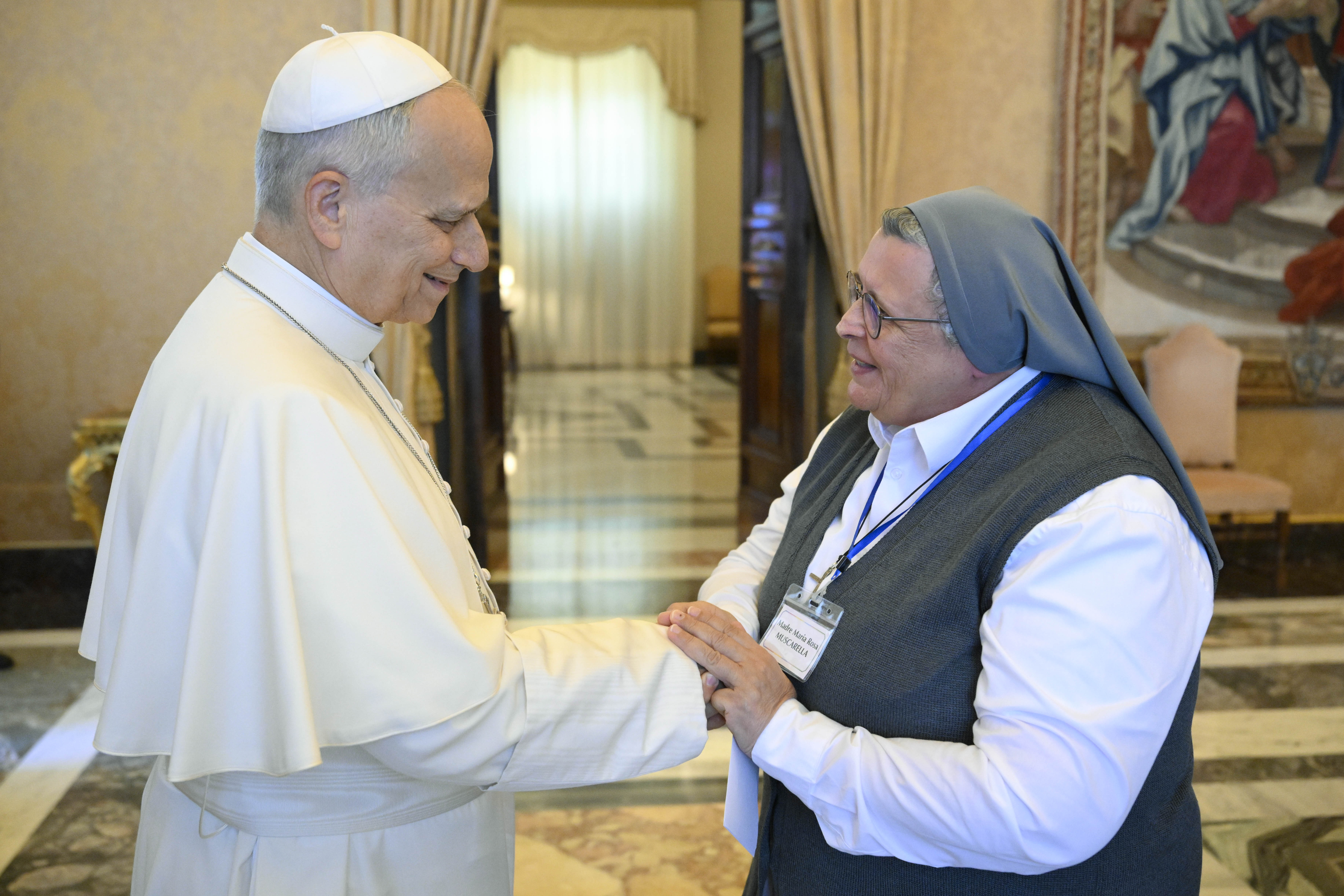
Pope Leo XIV greets a member of the Sisters of Charity of Saint Jeanne-Antide Thouret after his private audience with the community at the Apostolic Palace in the Vatican on Oct. 26, 2026. | Credit: Vatican Media
"I mention this because, in a society such as ours, which tends to fragment the person, dividing people not only from one another but also, and more gravely, within themselves, this dimension of charity is fundamental for the restoration, promotion and authentic respect for the dignity of every person, especially the poorest and most in need. Treasure it, nurture it and spread it," the pope added.
Leo also reflected on the theme the sisters chose for their general chapter, "In Christ, the roots; in the world, the mission," and encouraged them, like Thouret, to put Christ at the center of their charitable work.
"To be rooted in Christ means, in fact, following the example of Saint Jeanne Antide, to place Him alone at the center of one's existence and thoughts, growing accustomed to sensing and celebrating His presence at every moment, confident that, united to Him, we will grow ever closer to one another and be better able to help others according to His plans," Leo said.
Sometimes referred to in France as the "sisters of the soup kitchen," the Sisters of Charity of St. Jeanne-Antide Thouret were approved by Pope Pius VII in 1819. Following nationalist pressure in France, the order split into branches in France and Italy before reuniting in 1954, and now operates in over 25 countries worldwide.
Apostolic almoner Archbishop Luis Marín will travel to Kyiv, Zaporizhzhia, Dnipro, and Fastiv, Ukraine from Oct. 27-30.
The Vatican will step up its support for Ukraine ahead of the coming winter with a new humanitarian mission led by the prefect of the Dicastery for the Service of Charity, Archbishop Luis Marín de San Martín.
"A very harsh winter is expected, and as Christians, as the Church, we cannot remain indifferent or passive. My journey is a mission of solidarity and closeness, a witness of love," the archbishop confirmed to EWTN News Español, the Spanish-language sister service of EWTN News.
Archbishop Marín will travel to Ukraine from Oct. 27-30 on a visit "coordinated through the Apostolic Nunciature," during which he will visit Kyiv, Zaporizhzhia, Dnipro, and Fastiv.
The itinerary includes meetings with Latin-rite and Greek Catholic communities as part of the Holy See's efforts to accompany a population that has been deeply affected by a war that will mark its fifth year in February.
"I want to understand firsthand the needs of the population and, above all, make present the concern and closeness of Pope Leo XIV. Ukraine is in our hearts, and through the Dicastery for the Service of Charity, in the name of the Holy Father, we seek to respond with concrete assistance," he said.
The mission coincides with a collection drive organized among Vatican employees in collaboration with the Governorate of Vatican City State.
"The response has been magnificent. We have collected, above all, warm clothing, canned food, blankets, sheets, sleeping bags, and other garments," Archbishop Marín explained.
Archbishop Luis Marín de San Martín, prefect of the Vatican Dicastery for the Service of Charity. | Credit: Courtesy of Archbishop Luis Marín de San Martín.
The supplies will be transported to Ukraine by road through the international TIR transit system and then distributed through local Church structures. Rome's Holy Wisdom (Santa Sofia) Parish, the reference point for the Ukrainian Catholic community in Rome, has once again served as the operational hub where aid from various locations has been gathered before being sent to Ukraine.
The initiative is part of the broad network of assistance promoted by the Dicastery for the Service of Charity since the beginning of the war. In recent years, the Holy See has organized convoys carrying medicines, financial assistance for vulnerable families, and various relief projects, channeled through the apostolic nunciature and the local Churches.
Once in Ukraine, the aid will be distributed by the Church's charitable structures in Kyiv.
"This aid collection effort has made us face our personal responsibility and has enabled a concrete response to the suffering of the Ukrainian people. I thank the Governorate of Vatican City for its cooperation, the employees of the Dicastery for the Service of Charity for their commitment in collecting and sorting the materials, and all the donors for their generous response," Marín said, also asking people not to cease praying that the Lord may grant the gift of peace.
Intense diplomatic activity by the Holy See
The visit of the prefect of the Dicastery for the Service of Charity also comes at a time of intense diplomatic and humanitarian activity by the Holy See regarding the war in Ukraine.
From Rome's Gemelli Hospital, where he was recovering after surgery to remove a malignant tumor from his right lung, the pope called Russian President Vladimir Putin on Oct. 16 to ask for "a ceasefire to allow the delivery of humanitarian aid."
According to the Vatican, the pontiff referred in particular to the "extremely grave situation" in Oleshky, a besieged city where approximately 2,000 civilians remain, surviving without access to drinking water or electricity.
Cardinal Matteo Maria Zuppi, president of the Italian bishops' conference, had also traveled to the city on a humanitarian mission.
The following Monday, back at the Vatican, the pope spoke by phone with Ukrainian President Volodymyr Zelenskyy and expressly asked him to cooperate with Moscow in order to achieve a humanitarian truce in the city.
The pontiff's diplomatic efforts bore fruit. As announced by Melania Trump, wife of U.S. President Donald Trump, the ceasefire intended to facilitate the rescue of civilians trapped in Oleshky will begin on Oct. 27, according to Moscow.
Captured by Russian forces at the start of the war, the city has suffered for months from severe shortages of food and medical supplies. In order to leave the city, many residents have had to travel for miles along partially mined roads.
Against this backdrop, on Oct. 23 Pope Leo XIV received Major Archbishop Sviatoslav Shevchuk, major archbishop of Kyiv-Halych and leader of the Ukrainian Greek Catholic Church, in a private audience.
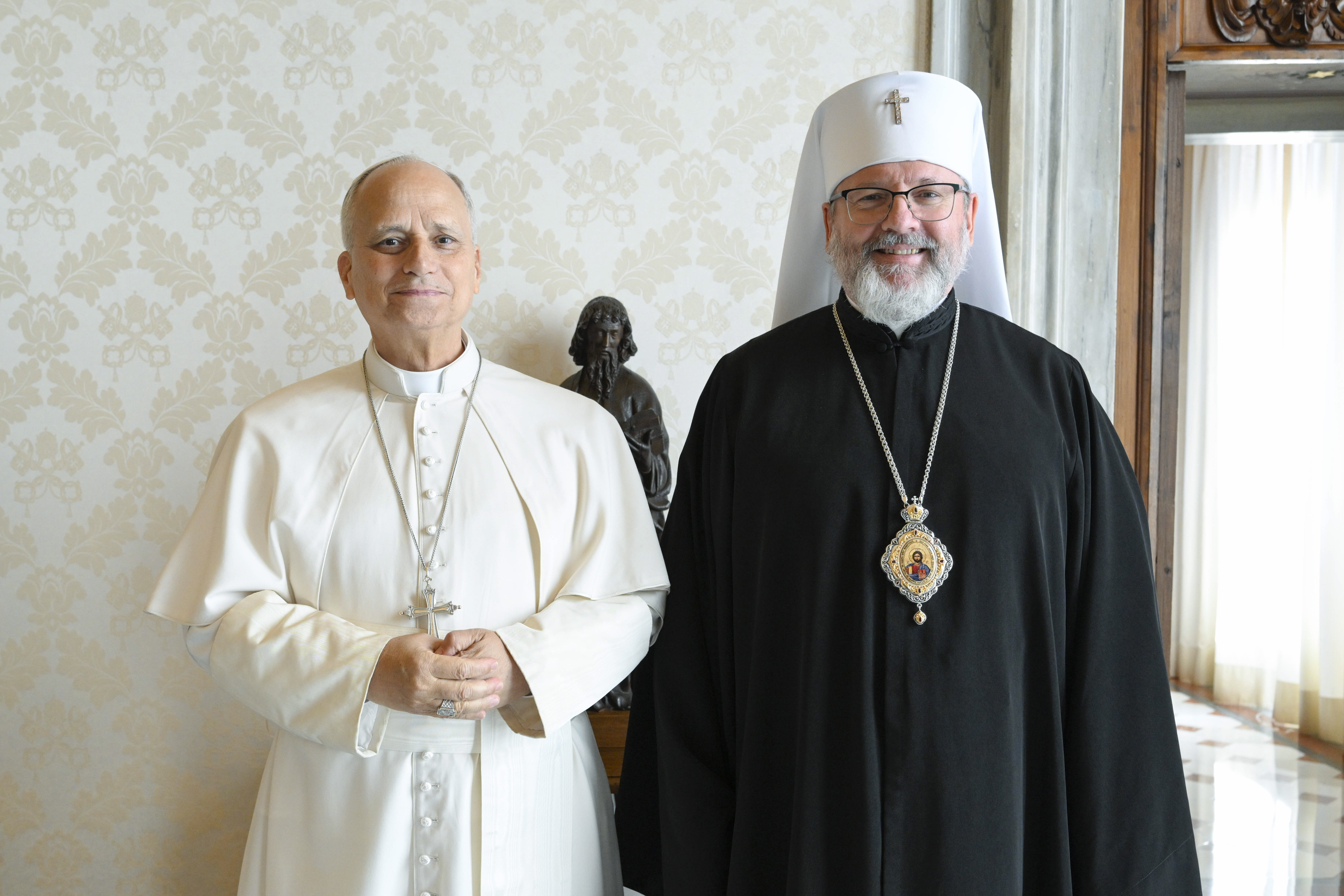
Pope Leo XIV meets with Archbishop Sviatoslav Shevchuk, major archbishop of Kyiv-Galicia and primate of the Ukrainian Greek Catholic Church, at the Vatican on Oct. 23, 2026. | Credit: Vatican Media
During the meeting, according to Vatican News, the primate thanked the pontiff for the Holy See's constant support for his country and requested the mobilization of the international Catholic community in view of what is expected to be an especially difficult winter for millions of people affected by the war.
In addition, during the meeting Shevchuk presented the pope with lists of Ukrainian prisoners of war so that the Holy See could pass them on to the Russian authorities in an effort to facilitate a prisoner exchange.
U.S. bishops said AI could expand surveillance and persecution of religious groups and urged that human dignity remain central to protecting religious freedom.
Marking International Religious Freedom Day on Oct. 27, two U.S. bishops said rapid advances in artificial intelligence underscore the need to keep human dignity at the center of efforts to protect religious freedom.
Bishop A. Elias Zaidan, bishop of the Maronite Eparchy of Our Lady of Lebanon of Los Angeles, and Archbishop Alexander Sample of Portland, Oregon, said in a joint statement that "millions of people continue to suffer violations of the basic human right to religious freedom, and rapidly developing technological tools, such as artificial intelligence, have the potential to expand such abuses, increasing the scope of surveillance and persecution of religious groups."
"In this era of technological change, all of society—including the private sector—is called to work together to ensure that technological tools are not used to facilitate new and intensified forms of religious discrimination," the statement said.
Zaidan chairs the U.S. Conference of Catholic Bishops' Committee on International Justice and Peace, and Sample chairs the Committee for Religious Liberty.
The bishops noted Pope Leo XIV's encyclical Magnifica Humanitassaid the"right to religious freedom is rooted in human dignity, providing 'decisive criteria' for protecting individuals and societies. As brother bishops, we affirm that, in the age of AI, human dignity remains at the heart of defending religious freedom."
Zaidan and Sample pointed to the bishops' conference's collaboration with the U.S. Commission on International Religious Freedom as an example of how government and faith leaders can work together to address religious freedom violations worldwide.
"This partnership is a testament to the power of joint efforts by government and faith leaders to protect this most cherished right," the bishops said.
"In this 250th year commemorating American independence, may the Sacred Heart of Jesus, burning with love for all of humanity, make us beacons of hope for our brothers and sisters through the world by defending religious freedom in the digital age," the bishops said.
On the advice of his doctors, the pontiff's participation during the final day of the Oct. 25-27 gathering was canceled.
Pope Leo XIV will not attend the prayer meeting in Assisi on Tuesday on the advice of his doctors following his surgery earlier this month, according to the Holy See Press Office. It would have been the pontiff's second visit to Assisi this year, following his August visit for the GO! Franciscan Youth Meeting.
Instead, the prayer meeting will feature a special message of peace from the pope as well as remarks from Patriarch Bartholomew I, ecumenical patriarch of Constantinople. The patriarch and other world religious leaders will gather to pray for peace in the Lower Basilica in Assisi on Tuesday.
According to Vatican News, the interreligious meeting will mark 40 years after St. John Paul II invited world religious leaders to the birthplace of St. Francis of Assisi for a historic Day of Prayer for Peace.
For Leo, the milestone anniversary is far more than a historical commemoration; it serves as a vital blueprint for addressing today's fractured world. Emphasizing what he calls a "disarmed and disarming peace," the pope consistently insists that true security cannot be built on military force or political maneuvering alone. Drawing on the Franciscan legacy of nonviolence and care for creation, he urges faith leaders across the globe to disarm their hearts and harness prayer as a transformative force for international reconciliation.
Interreligious center
A central pillar of Pope Leo XIV's vision for interreligious dialogue is turning symbolic encounters into lasting structural realities. This commitment was realized in Assisi with the official opening of the Global House of Friendship and Hope in August, when the pontiff met with Rabbi Alon Gotten Gottestein.
Conceived as a permanent interreligious center in the heart of the city, the House translates 40 years of periodic gatherings into an active, daily practice. Designed to serve as a living sanctuary, it provides a dedicated space where believers of Christian, Jewish, Muslim, Hindu, Buddhist, and other traditions can gather under one roof. The House, which enjoyed backing from Pope Francis and Pope Leo, features cross-cultural forums, peace education programs, and spaces for quiet reflection, ensuring that dialogue between traditions remains a continuous, structured pursuit rather than an occasional event.
In his addresses, the pontiff frequently stresses that genuine dialogue does not mean diluting theological identities, but rather uniting on common moral ground to tackle shared human crises — including poverty, war, and ecological degradation.
By anchoring his pontificate in these efforts, Pope Leo XIV has revitalized the legacy begun in 1986. Supported by his active leadership and embodied by the new Global House of Friendship and Hope, Assisi reaffirms its standing as a world capital of peace, offering a clear message that building a reconciled world is a shared journey faith leaders must walk together.
Archbishop Jeffrey Grob said his "intention was never to cause confusion, anger, or disappointment among the people entrusted to my care" and that the meeting was publicized without consent.
Grob said that over the last few days, he had "received many questions and comments about the October 22 meeting I and 11 other bishops attended at the White House, which was soon thereafter publicized by the administration without the consent of the participants."
He went on to say that his "intention was never to cause confusion, anger, or disappointment among the people entrusted to my care" and that he issued the Oct. 25 statement to provide context for the meeting.
The meeting "was in no way an endorsement of the president, his policies, or his party," Grob said.
Last month, Grob explained, he was invited along with other bishops to a meeting to discuss "matters of importance to the Church and our people, including immigration enforcement, religious worker visas, and human dignity." The meeting was the second of two such gatherings organized by the Heritage Foundation, he said.
"We were told the meeting was to be a private discussion, that several Catholic members of the cabinet might make an appearance, and that there could be an opportunity to pray privately with the president," he continued.
After about an hour and a half of meeting on Oct. 22 with White House staff and policy advisers, the archbishop said, the group entered the Oval Office, where they were greeted by President Donald Trump. After being presented with commemorative tokens, Grob said, the group was directed to stand behind the president to pray, and photos were taken afterward.
"Unbeknownst to the group of bishops a video was also taken. But permission for the public distribution or posting of either the video or photos was not given by the bishops," Grob said in his statement. Not long after, photos and the video of the prayer were posted online.
"I soon began receiving messages of serious concern over the possibility that I had inadvertently participated in a political event less than two weeks before a national election," Grob said. "I also heard from some who felt wounded because of the ways they or their family had been harmed by the president's policies."
"I feel a heavy sadness, not only over the pain I caused, but also for the fact that something so sacred to a group of religious leaders, prayer to our Heavenly Father, would be manipulated in that way," he continued. "We came in good faith to try to work for the betterment of our fellow human beings, to ease their suffering, to build up the common good, and to pray with a president, not to pose for a political photo opportunity to benefit the few. We should never have been put in that position by the White House."
Grob concluded his statement by saying that he did not go to the meeting "without reservations" and that he wished he "had heeded them."
"I apologize for any damage my actions have done," he said.
Grob's statement comes after another participant at the Oct. 22 meeting, Denver Archbishop James Golka, who led the prayer in the Oval Office, defended his participation in the event.
Golka said he "knew people might be upset" at the event and that it could be "use[d] for political purposes."
"But as I prayed about it, I thought that this is what Catholics do. We pray for people. No matter whether we agree or disagree on anything, we always pray for our country and leaders," he said in remarks to the Denver Catholic on Oct. 23.
Golka, like Grob, also denied that the meeting was in any way an endorsement of the president or his policies.
"The bishops of the United States teach that the Church cannot champion any candidate or party," Golka said. "I hold to that. However you vote, you ultimately belong to Jesus who loves you infinitely more than you can imagine."