Pope Leo XIV has appointed Bishop Octavi Vilà Mayo of Girona, Spain, as the new archbishop of Barcelona, succeeding Cardinal Juan José Omella, who turned 80 in April.
This is the first in what is expected to be a long list of pending episcopal appointments in the Catholic Church in Spain. With Barcelona now filled, attention turns again to Girona — a diocese in eastern Spain — which was without a bishop for more than two years before Vilà's arrival and is now once again awaiting a new shepherd.
The bishop who entered a monastery at age 45
Born in 1961, Vilà entered the Spanish Monastery of Santa Maria of Poblet in 2005 and made his solemn profession on Aug. 15, 2010. Five years later, he was elected abbot, a position to which he was reelected until 2021, when he reached the canonical age limit.
Holding a degree in geography and history and a diploma in library and information science from the University of Barcelona, he was appointed bishop of Girona by Pope Francis in February 2024 and was ordained bishop in Girona Cathedral on April 21, 2024.
Within the Spanish bishops' conference, he serves as a member of the Episcopal Commission for Consecrated Life. His episcopal motto, "Lead in Order to Serve," comes from an expression of St. Bernard of Clairvaux.
In a letter to his new diocese, Vilà said he had been called by Pope Leo XIV "to share with you a part of the journey toward the Kingdom of God" and expressed his intentions: "I come to Barcelona ready to work courageously for the future of our Church and to do so together with each and every one of you."
He also underscored the need to "live the faith in communion," praised the richness of charisms in the Archdiocese of Barcelona, encouraged Catholics never to "give up evangelizing" and to do so "through our lives, through our words, and by living the faith consistently."
Drawing on his monastic experience, he encouraged his new flock to keep Christ as their "center, model, and goal" and to cultivate intimacy with the Lord.
Before concluding, Vilà entrusted himself "to the many saints our archdiocese has produced throughout the centuries and especially to the martyrs who, both in ancient times and in the 20th century, are a source of inspiration for all of us."
An Aragon native who arrived in Barcelona by way of Zaire
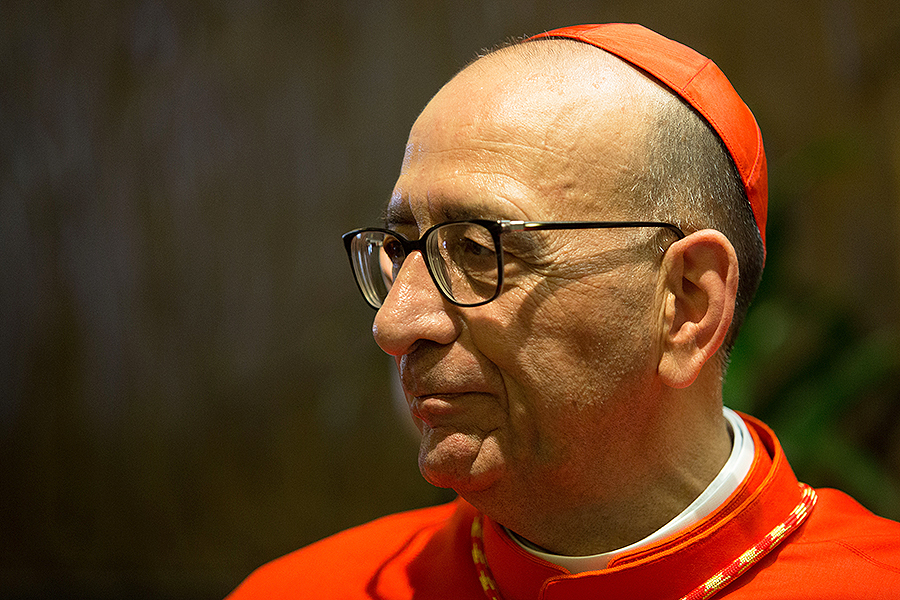
With this appointment, the long pastoral ministry of Omella comes to an end. Born in the Aragonese town of Cretas in 1946, he studied at the Seminary of Zaragoza and at the formation centers of the White Fathers in Leuven and Jerusalem before being ordained a priest in 1970.
He served in various pastoral roles in the Archdiocese of Zaragoza during his early years as a priest, including a year as a missionary in Zaire. In 1996 he was named auxiliary bishop of Zaragoza and three years later was appointed bishop of the Diocese of Barbastro-Monzón.
Between 2001 and 2003, he also served as apostolic administrator of the dioceses of Huesca and Jaca. In 2004 he was appointed bishop of Calahorra and La Calzada-Logroño, where he remained until the end of 2015, when he was named archbishop of Barcelona.
A trusted collaborator of Pope Francis
Following Pope Benedict XVI's resignation and the election of Pope Francis, Omella's presence in Roman institutions steadily increased. In 2014 he joined the Congregation, now Dicastery, for Bishops, where he served until June 2026. He has also been a member of the Supreme Tribunal of the Apostolic Signatura.
That same year, he was created a cardinal by Pope Francis, and in October 2018 he joined the Ordinary Council of the Synod of Bishops. In March 2023 he was appointed to the Council of Cardinals, the advisory body established by Pope Francis.
In Spain, he was elected president of the Spanish bishops' conference from 2020 to 2024, years marked by the parliamentary investigation into abuse committed within the Catholic Church. Earlier, he had served as a member of its executive committee, on various commissions, and as national ecclesiastical adviser to Manos Unidas — a nongovernmental organization of the Catholic Church in Spain for development cooperation — from 1999 to 2005.
In a letter addressed to the faithful of Barcelona, the cardinal said that "the arrival of a new bishop is always a moment of grace for a diocese. People change, new stages begin, but the one Shepherd of the Church, Jesus Christ, remains."
He also emphasized that welcoming the new prelate "also means being ready to walk with him" and therefore urged the faithful to offer their fullest cooperation.
'In love with this land and its people'
"I feel that I leave deeply in love with this land and its people," Omella said after the appointment of his successor was announced. During a public appearance, he revealed that he will not remain in Barcelona but will retire to a priests' residence in Zaragoza: "I am not staying in Barcelona because I do not want to cast a shadow."
Asked by journalists to assess his years in Barcelona, which were marked by strong political and religious tensions in society, the cardinal declined to offer a personal evaluation. However, he said that in the face of these difficulties he had sought "to bring opposing sides together, that is, to build bridges and foster dialogue."
Of his successor, he said he is "a simple man with a solid intellectual formation. ... A man of prayer, a man who loves this land and its people, and who wants to evangelize."
'I neither confirm nor deny it'
Asked whether he had played any role in promoting Vilà's appointment, the cardinal replied that if he answered, "it might seem that I am revealing secrets. I neither confirm nor deny it."
"Who was the person I had in mind and proposed as my successor? I cannot say. Who was the person I had in mind as pope when I entered the conclave? I cannot say that either. But I had a second choice, and it was the same person who was ultimately elected," he said, referring to Pope Leo XIV.
This story was first published by EWTN News Español, the Spanish-language sister service of EWTN News. It has been translated and adapted by EWTN News English.