Not many literary works in medieval Europe could lay claim to the status of "bestseller." Among them was "The Mirror of the Blessed Life of Christ."
That text, which was translated by English monk Nicholas Love from a 14th-century devotional work, enjoyed immense popularity among English Catholics in the years leading up to the Reformation; a few hundred surviving manuscripts attest to the public's love of the book.
One incomplete manuscript of the work, meanwhile, has finally been reunited with several long-lost pages thanks to recent work by English researchers Katie Walter and James Wade.
The two professors, who teach at the University of Sussex and Girton College at the University of Cambridge, respectively, recently published their findings in the journal Notes and Queries in which they detailed what Wade described as their successful effort to "piece together the history" of the manuscript.
Wade told EWTN News that it was known for years that the East Sussex public records office held fragments of a "Mirror" manuscript, though "no one knew where."
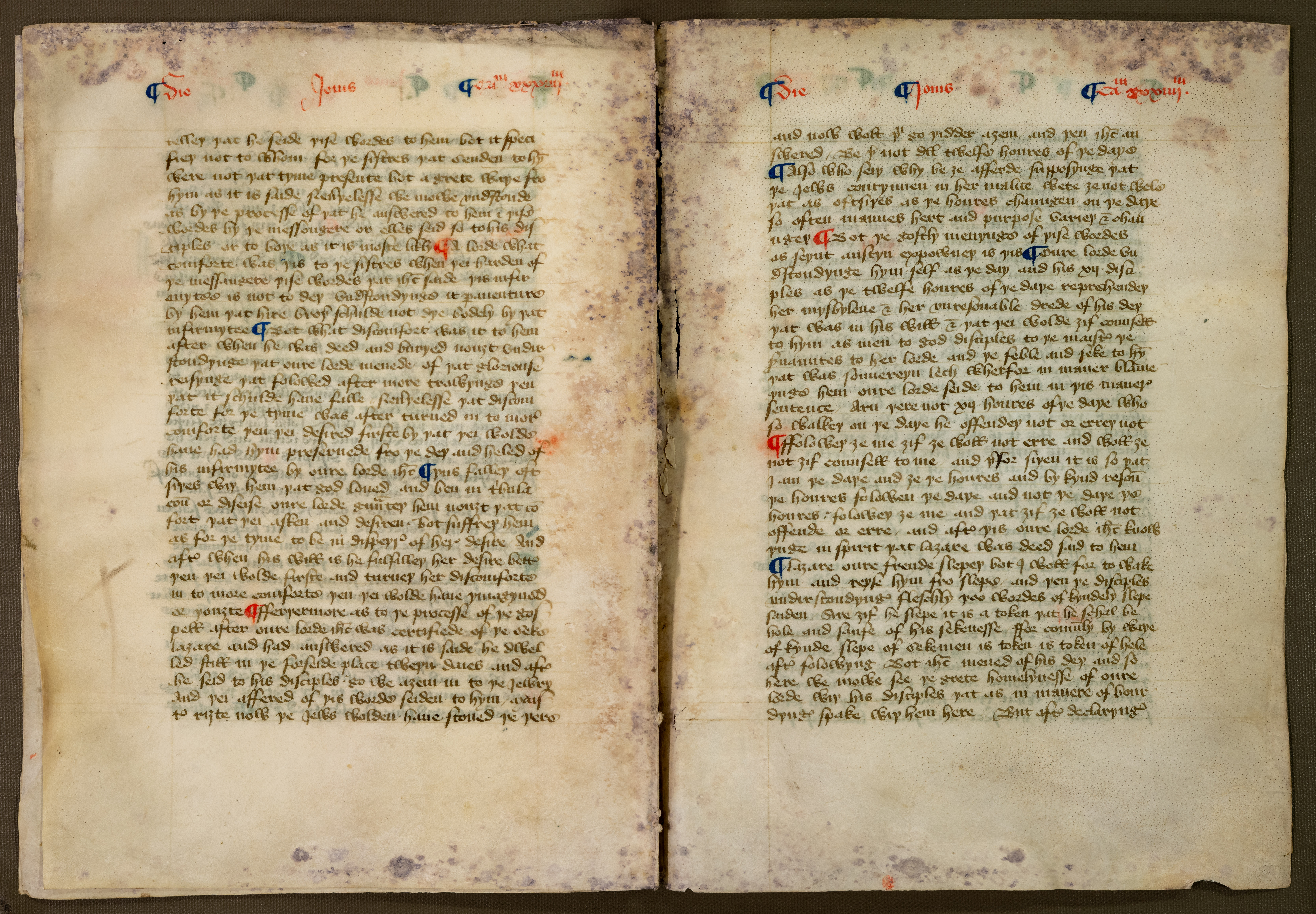
The researchers eventually identified the manuscript pages in the archive. Further investigation revealed that a fuller "Mirror" manuscript held at the Beinecke Rare Book and Manuscript Library at Yale University was missing those exact pages.
That copy in the Beinecke archive had been known to scholars for years as having been owned by John Gage. A royal courtier in Tudor-era England, Gage's life was "almost cut in half by the English Reformation," Wade said.
"Half of his life he spent as a Catholic who was considered orthodox by the Church and the state," Wade said. "After the Reformation, he remained a Catholic and he didn't convert."
Such individuals were known as "recusants." Wade said that though Gage lived in post-Reformation England the rest of his life, he "refused to convert, he lived his life, didn't go into exile, wasn't executed, and didn't lose his job."
Gage is a notable historic figure, Wade said, in no small part because he worked for the king even as a practicing Catholic.
"There were plenty of people at the time of the Reformation who kept their Catholic faith," the researcher said. "But Gage was an administrator who was tasked with orchestrating the dissolution of the monasteries, which meant physically going into monastic houses and basically claiming all their properties for the Crown."
The "Mirror" manuscript is the only book historians can verify that Gage actually owned, Wade said. It likely came into his possession at the time of the dissolution of the monasteries.
The book would have been seen as heretical in post-Reformation England, as it affirms the validity of numerous sacraments including confession and the Eucharist.
Gage's signature is found in the manuscript, along with the names of two nuns who historians think owned the book prior to it coming into Gage's possession.
The book stands as a testament not just to its popularity during the time of its publication but also to Gage's faith during a period of extraordinary persecution of the Church — a persecution in which Gage himself took some part even as he maintained that faith.
Wade told the University of Cambridge that Gage may have gone to a monastic library and brought the book home. "Another [possibility] is that someone else smuggled it out, and it briefly circulated from hand to hand until Gage acquired it."
"The key thing is," Wade said, "he kept it safe when he was meant to destroy books precisely like this one."