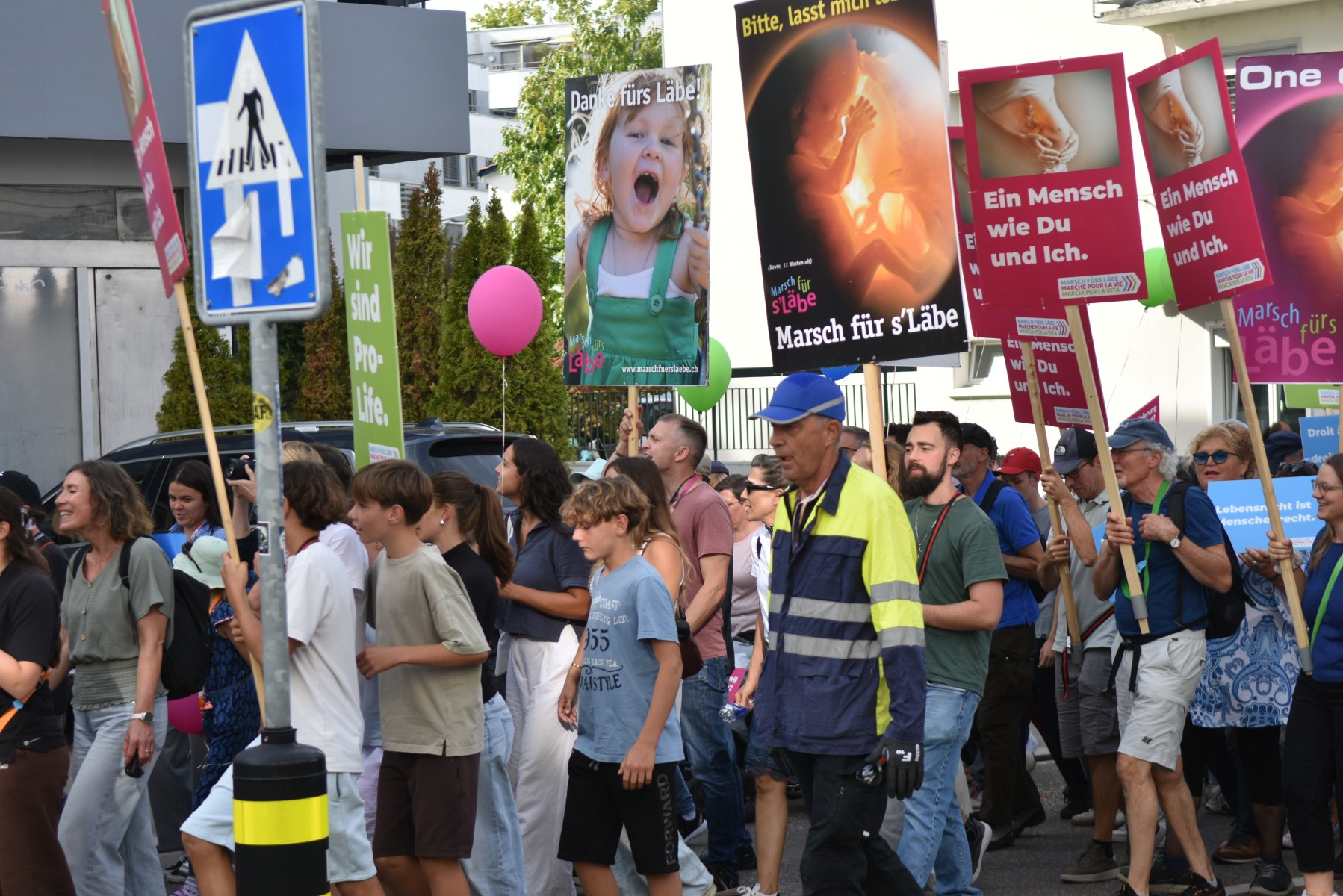
An estimated 2,200 pro-life advocates gathered in Zurich's outer district of Oerlikon on Saturday for the annual March for Life, delivering a message focused on restoring family life and encouraging fatherhood under the banner "Together for Life!"
For six consecutive years, municipal authorities have barred the march from gathering in Zurich's city center, citing security risks posed by the threat of hostile counterprotesters. Organizers pointed out that municipal officials routinely permit other demonstrations in the heart of the city, applying a clear double standard to the pro-life witness.
Similar to previous years, the Sept. 19 event faced opposition. One group of roughly 200 masked protesters on bicycles attempted to disrupt the event by setting off firecrackers, overturning trash bins onto the roadway, and attempting to block the route.?
Swiss police maintained control of the situation by shielding marchers, conducting identity checks, and using two water cannons to disperse protesters. The Zurich March for Life proceeded without any reported injuries to participants.
While organizers estimated about 2,200 advocates, police counted more than 1,000 participants.
The fact that security was maintained in Oerlikon shows that law enforcement can manage counterprotests, undermining the city's justification for keeping the march out of central Zurich, according to observers. ?
Restrictions prompt legal challenge
Speaking previously to CNA Deutsch, the German-language sister service of EWTN News, Beatrice Gall, president of the Swiss March for Life, pointed out that municipal officials routinely allow other groups permits to hold demonstrations in Zurich city center yet relocate the Zurich March for Life to the city outskirts. This results in reduced visibility and logistical issues, Gall said.
By restricting the march to the commercial and residential district of Oerlikon, city officials argue they are minimizing potential public order disruptions and protecting urban infrastructure.
Critics argue that authorities are effectively rewarding the violence of counterprotesters by allowing hostile agitators to veto a peaceful group's constitutional rights to freedom of assembly and free expression.
To challenge this policy, organizers have launched a public petition and initiated legal proceedings against the City of Zurich, demanding equal access to the city center and insisting that police maintain law and order without suppressing peaceful pro-life voices.
Breaking the silence
Speaking to EWTN News, Gall described the current social climate surrounding abortion in Switzerland as "one of silence."
"There is no public debate and no objective examination of the facts; instead, people remain silent about the high abortion rates, the suffering this causes many people, and the consequences thereof," Gall said.
She noted that since Switzerland introduced its 12-week deadline regulation in 2002, at least 200,000 abortions have taken place. Estimating that five or more people are affected per procedure, including fathers and extended family, Gall stressed that over 1 million Swiss citizens carry the impact, making public awareness vital. This further justified the march in the city center so that greater "communication, dialogue, and discussions with people can begin."
Pushing back against opponents and media outlets attempting to portray the pro-life movement as regressive, Gall rejected the stereotype. "Advocating for human life is not backward — it's forward-looking!" she asserted, pointing to a "new wave of interest and strong commitment" among the younger generation.
Gall stressed that a mother's womb should be "the safest place in the world, not the most dangerous," calling on men to support their partners rather than leaving them isolated or pressuring them into abortion. "Even if you're surprised by the pregnancy, be there for your partner and your child," Gall urged. "They need you, even before birth."
Call for responsibility and dialogue
Nicolas Kolly, a Swiss People's Party national councilor and former member of the Pontifical Swiss Guard, addressed participants, encouraging society to "give a voice to those who do not yet have one," and summarized his core message simply as "Protect life."
He also urged comprehensive support for women facing difficult pregnancies, arguing that offering viable alternatives must be a societal duty. Furthermore, Kolly stressed paternal duty, stating that a man's priority is "to take responsibility. To support. To listen. To protect." Ultimately, Kolly framed maternal assistance and child protection as inseparable priorities, concluding that "these two ideas must go hand in hand: the protection of the child and the support of the mother."
Among those who addressed the crowd was also Jonas Streule, regional director of ProLife Europe in Switzerland. Speaking to EWTN News, Streule acknowledged the broader hurdles facing pro-life advocacy in Switzerland, pointing specifically to distorted social media stereotypes that damage public perception.
"What people associate with the word 'pro-life' comes from screaming videos in the TikTok world of short clips," Streule said. "That is not what actually happens when you engage in pro-life work."
Turning to ProLife Europe's outreach on university campuses, Streule explained that the organization prioritizes personal encounters over hostility. "Abortion is a severe matter, and it deserves to be touched face to face, in a loving way," he noted, stressing that compassion and clarity go hand in hand.
According to Streule, few students he encounters actively view abortion as desirable. Instead, the primary challenge lies in helping young people realize they can play an active role in building a culture that supports life.
"We rarely leave a conversation without having made someone think about an opinion they simply adopted from the dominant culture," Streule said. He added that across numerous Swiss campus outreaches, he has "never once received a bad word from the person I was talking to."
For Streule, direct street outreach serves as a vital bridge to those personal conversations. By creating spaces for face-to-face dialogue, he said, he believes advocates can break through online misconceptions, encourage people to reconsider deep-seated assumptions, and foster genuine reflection on the value of human life.