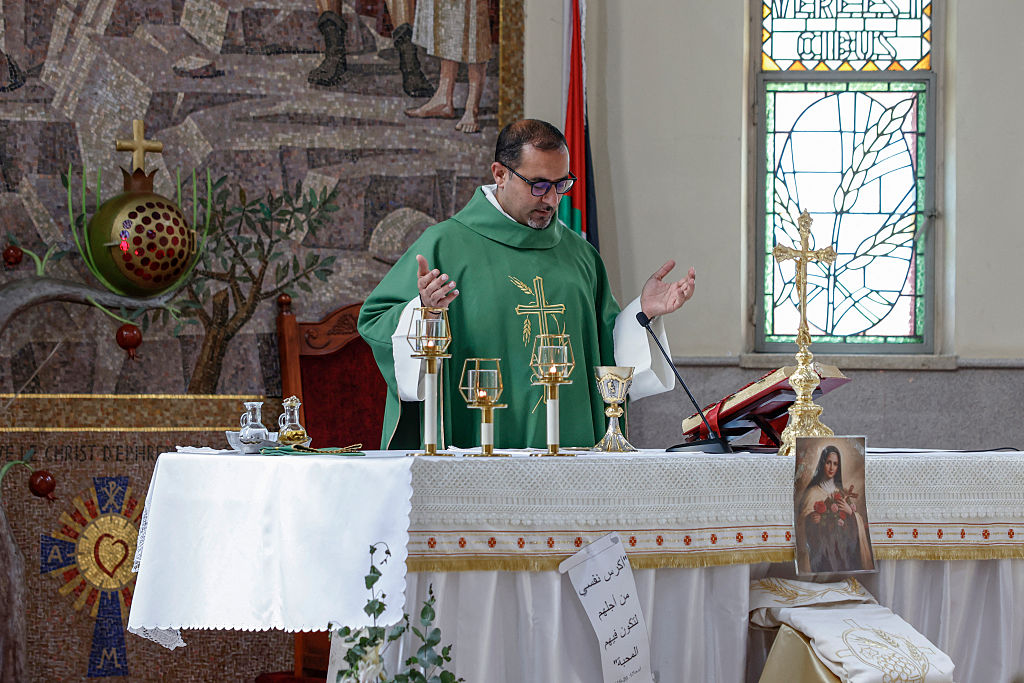
Cardinal Pierbattista Pizzaballa visited Christian communities in the West Bank, where he celebrated Mass on the solemnity of the Assumption of the Blessed Virgin Mary and assured local Christians that the Church will not abandon them.
His visit to Taybeh and Jenin followed an Israeli order issued in July declaring "the area of Taybeh and Rimon" a closed military zone, prohibiting Israelis and foreign nationals from entering or remaining there. The designated area includes part of Taybeh's built-up area, agricultural land, and religious and historical sites.
Taybeh "represents a place which has been inhabited by followers of Jesus, by Christians, for 2,000 years," said Monsignor Peter Vaccari, president of the Catholic Near East Welfare Association (CNEWA), a papal agency that provides humanitarian and pastoral support to Christians across the Middle East.
Taybeh "highlights the indigenous Christian population and remains to this day the only really Christian village that is left throughout the West Bank," Vaccari said in interview Aug. 24, an excerpt of which was broadcast on "EWTN News Nightly."
The persecution of the Christian population has "increased" as "radical settlers will take it upon themselves to either deface religious symbols, to interfere with the business enterprises of the people of Taybeh," or "insert themselves in whatever way they feel they have the right to — which is a violation of international law," Vaccari said.
Amid the conflict, on Aug. 15, Pizzaballa celebrated Mass at the Latin Church of Christ the Redeemer.
In his homily, Pizzaballa referred to the people of Taybeh as the "Christian voice, speaking out for justice, speaking out for the desire for dialogue with all people," Vaccari said.
"He urged the people of Taybeh to guard their hearts ... against any kind of despair. Guard their hearts against any kind of contamination. Guard their hearts in a way that they would be those who would fight for justice and fight for the principles of justice," Vaccari said.
"I may not have answers at the human and worldly level, but I believe in God," Pizzaballa said. "And I am certain that, in him, we can continue to give birth to life, even here in Taybeh."
"We will continue to do everything within our power to preserve the ecclesial presence here, at every level throughout the Holy Land," he said.
Christian persecution continues to rise
In a separate interview with "EWTN News Nightly" on Aug. 21, Michael J. L. LaCivita, communications director at CNEWA, detailed the importance of Pizzaballa's visit.
As Christians in the Holy Land "feel that they're in danger of losing their homes and their livelihoods," Pizzaballa was able "to assure them that they will not be abandoned" and "that we have not forgotten them," he said.
Taybeh is "historically an agricultural village," LaCivita said. "It's surrounded by agricultural lands, olive groves, and oranges, and things of that nature. It's quite a bustling place."
Now, though, "they are under siege" and there is "violence," LaCivita said.
"Their fields are being torched," he said. "Even an ancient church dedicated to St. George, who was a very popular saint in the Palestinian community among Muslims as well as Christians ... was vandalized last year [and] set afire."
"So they're very much concerned about their livelihoods, especially now that the IDF has basically surrounded the village and said that it's militarily closed off and will not permit either people in or out," he said.
While the conflict continues, Catholics can "pray, because as we know, prayer moves mountains, and so we need to pray and pray for all people of goodwill," LaCivita said.
"We need to work for justice so that there can be peace and unity. Because without justice we cannot have peace," he said.
The faithful can also support the efforts of organizations like CNEWA, which work to "get the supplies and the food and the water that is needed" in the area, he said.