Pope Leo XIV on Aug. 22 arrived in San Marino, launching a pastoral visit on the occasion of the country's 100th anniversary of diplomatic relations with the Holy See.
The Holy Father was also scheduled to visit the Italian city of Rimini, where the Meeting for Friendship Between Peoples takes place.
The pope left Rome by helicopter around 8 a.m. and arrived 45 minutes later at the Torraccia airfield in San Marino. There he was received by the Captains Regent Alice Mina and Vladimiro Selva who were accompanied by various local officials.
Also present in the welcome delegation was the apostolic nuncio in Italy and the Republic of San Marino, Monsignor Edgar Peña Parra, as well as Monsignor Domenico Beneventi, the bishop of San Marino-Montefeltro.
In a telegram addressed to Italian President Sergio Mattarella — sent by custom as the pope was leaving Italian territory — Leo expressed his greetings, accompanied "with fervent wishes for the spiritual, civil and social progress of my beloved Italy."
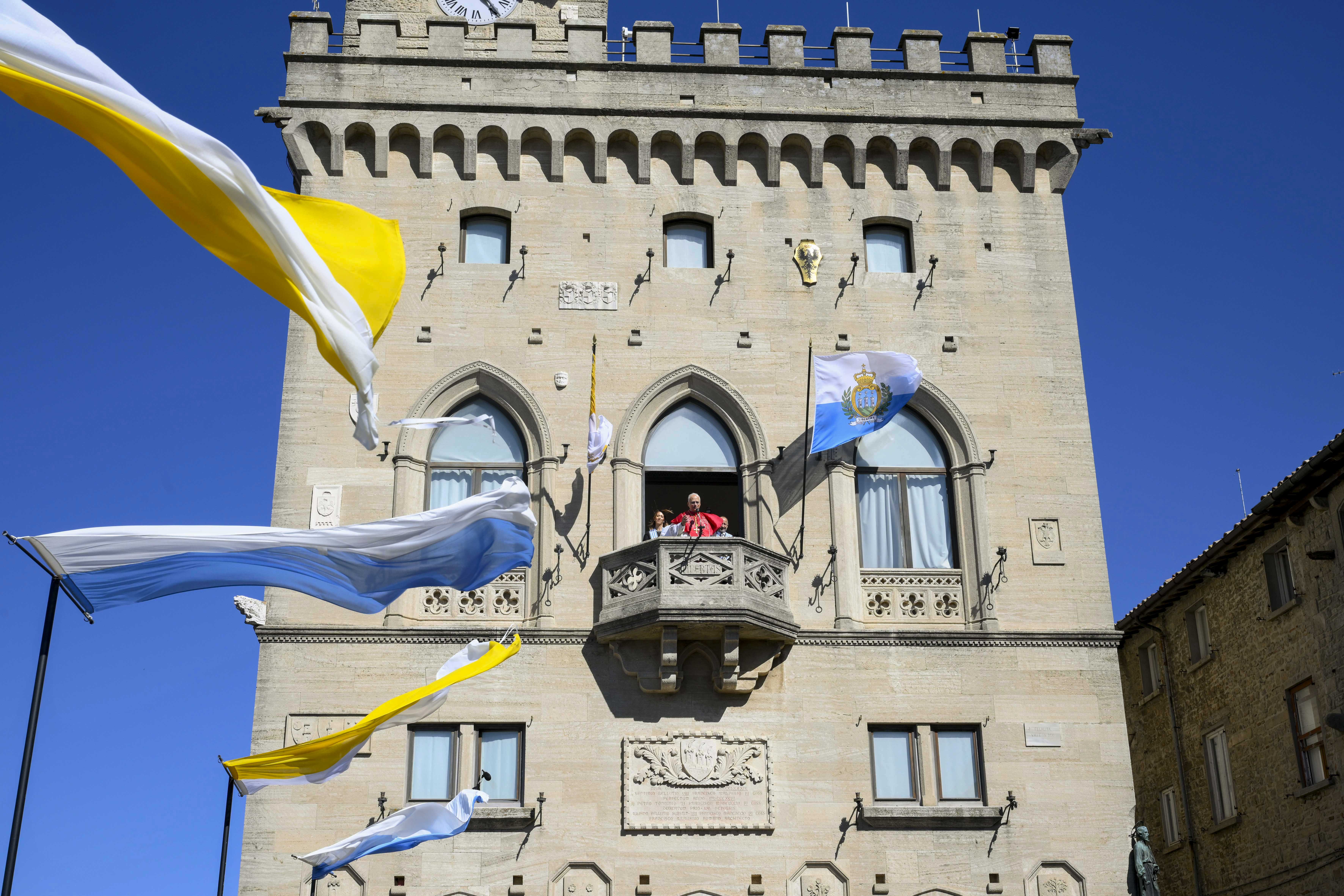
Upon his arrival, military honors were given to the pope, after which a private conversation was held between the pontiff and the captains regent in the Palazzo Publico. The Holy Father also met with local authorities and representatives of civil society.
Later, the captains regent addressed a few words to the pope, who in turn gave a speech in which he said he was enormously pleased to visit San Marino, which has the honor of being "the oldest republic in the world."
The pope thanked the captains regents for their invitation and for the warm welcome they gave him. He stressed the importance of the 100 years of relations between the Vatican and San Marino.
"This connection is old due to its long historical coexistence, but at the same time recent if we consider that just a century ago, in April 1926, diplomatic relations between the Holy See and the serene Republic of San Marino were formalized," he said.
The pope then reflected on the value of freedom in personal life and in the events of a nation, pointing out that "there is no true civil freedom without personal freedom."
"This freedom is granted and guaranteed, ultimately, by God, whose voice resonates in the consciousness of every human being," he said.
"Promoting freedom means defending the space of consciousness. And here our thoughts are addressed to the many men and women who, in all times and places, are martyrs of freedom because they testify to the primacy of conscience," he added.
The pope highlighted the value of figures such as Saint Thomas More, patron saint of rulers and politicians, who inspire those who exercise power to remain faithful to their consciences "even in times of great adversity, witnesses of true freedom, the freedom that comes from being sons and daughters of God."
At the same time, Pope Leo remarked that freedom is realized "in giving, in communion, in encounter and in dialogue," being lived according to the Gospel. In addition, he continued, freedom is also "a constant commitment to active and positive participation in peacebuilding."
Finally, the Holy Father pointed out that San Marino can be a "laboratory" of good policies, highlighting the "human care" that is expressed in "the protection of every life, at every stage, from conception to natural death."
"This concern for others has been a distinctive feature of the history of San Marino since its beginnings," he said.
"This sensitivity is also the result of the Christian tradition of this country and the constant and positive collaboration between the political authorities and the bishop in the pursuit of the common good," he said.
This story was originally published by ACI Prensa, EWTN News' Spanish-language news partner. It has been translated and adapted by EWTN News English.