MALABO, Equatorial Guinea — Pope Leo XIV on Tuesday warned against invoking God to justify oppression and violence, telling civil authorities and diplomats in Equatorial Guinea that "his holy name must not be profaned by the will to dominate, by arrogance, or by discrimination; above all, it must never be invoked to justify choices and actions of death."
Speaking at the presidential palace in Malabo on April 21, the pope framed his address around the Church's social doctrine, calling it a guide for addressing the "new things" destabilizing human coexistence, including widening inequality, the exploitation of natural resources, and the misuse of technology.
Leo said the world is facing developments that "shake the very foundations of the human experience" and reiterated that it is "the imperative duty of civil authorities and of sound politics to dismantle the obstacles to integral human development — a mission grounded in the fundamental principles of solidarity and the universal destination of goods."
The pope pointed to rapid technological development as one factor worsening global imbalances.
"It cannot be ignored, for example, that the rapid technological evolution we are witnessing has accelerated speculation regarding raw materials," he said. "This shift seemingly overshadows fundamental imperatives such as the safeguarding of creation, the rights of local communities, the dignity of labor, and the protection of public health."
Recalling Pope Francis on the first anniversary of his death, Leo repeated his predecessor's condemnation of unjust economic systems, saying: "Today we also have to say 'thou shalt not' to an economy of exclusion and inequality. Such an economy kills."
He added that armed conflicts are increasingly tied to the exploitation of oil and mineral reserves.
"In fact, it is even more evident today than in years past that the proliferation of armed conflicts is often driven by the exploitation of oil and mineral deposits, occurring with no regard for international law or the self-determination of peoples," he said.
Leo also warned that new technologies are often developed and deployed chiefly for military purposes rather than for the common good.
"On the contrary, the destiny of humanity risks being tragically compromised without a change of direction in the assumption of political responsibility and without respect for institutions and international agreements," he said.
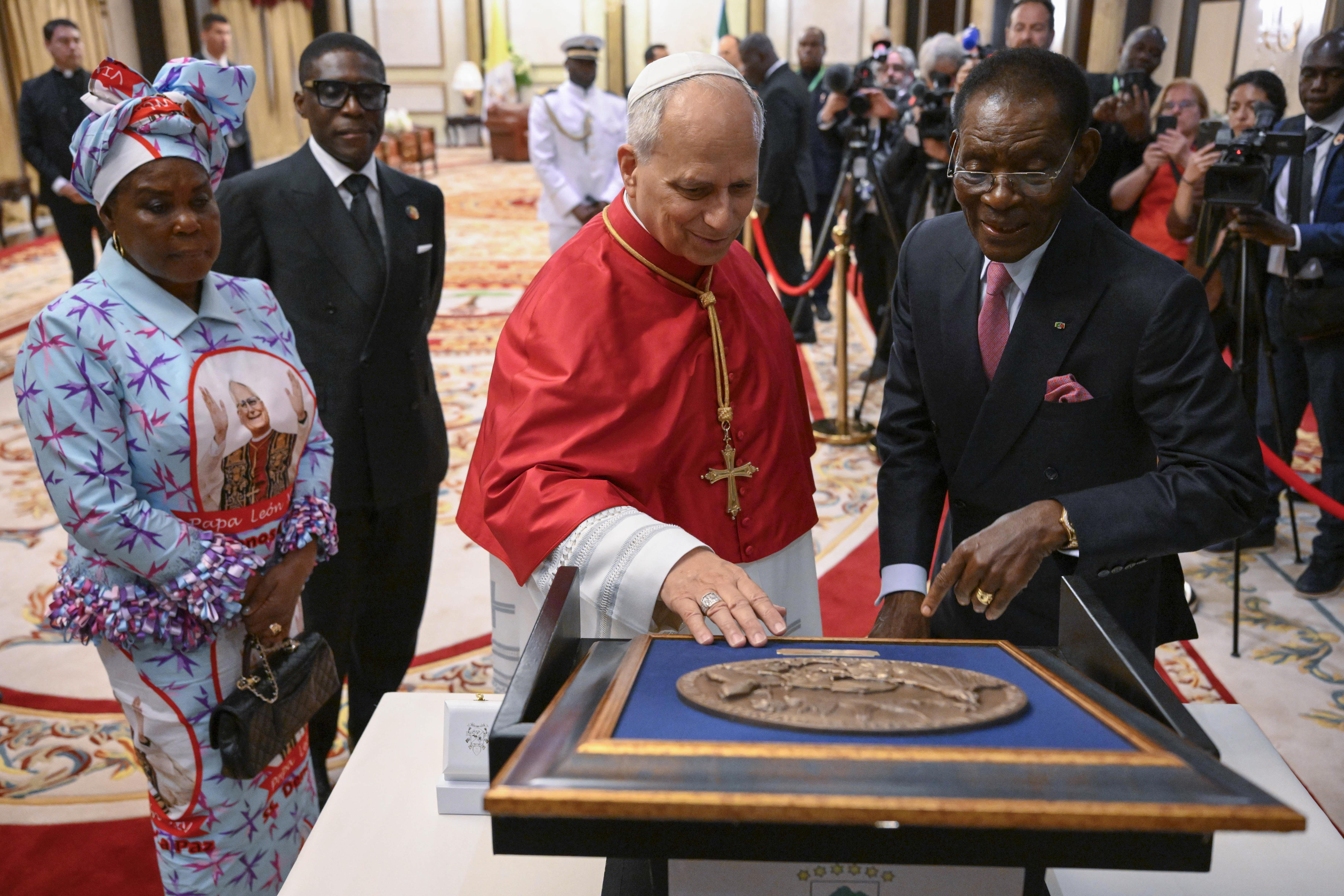
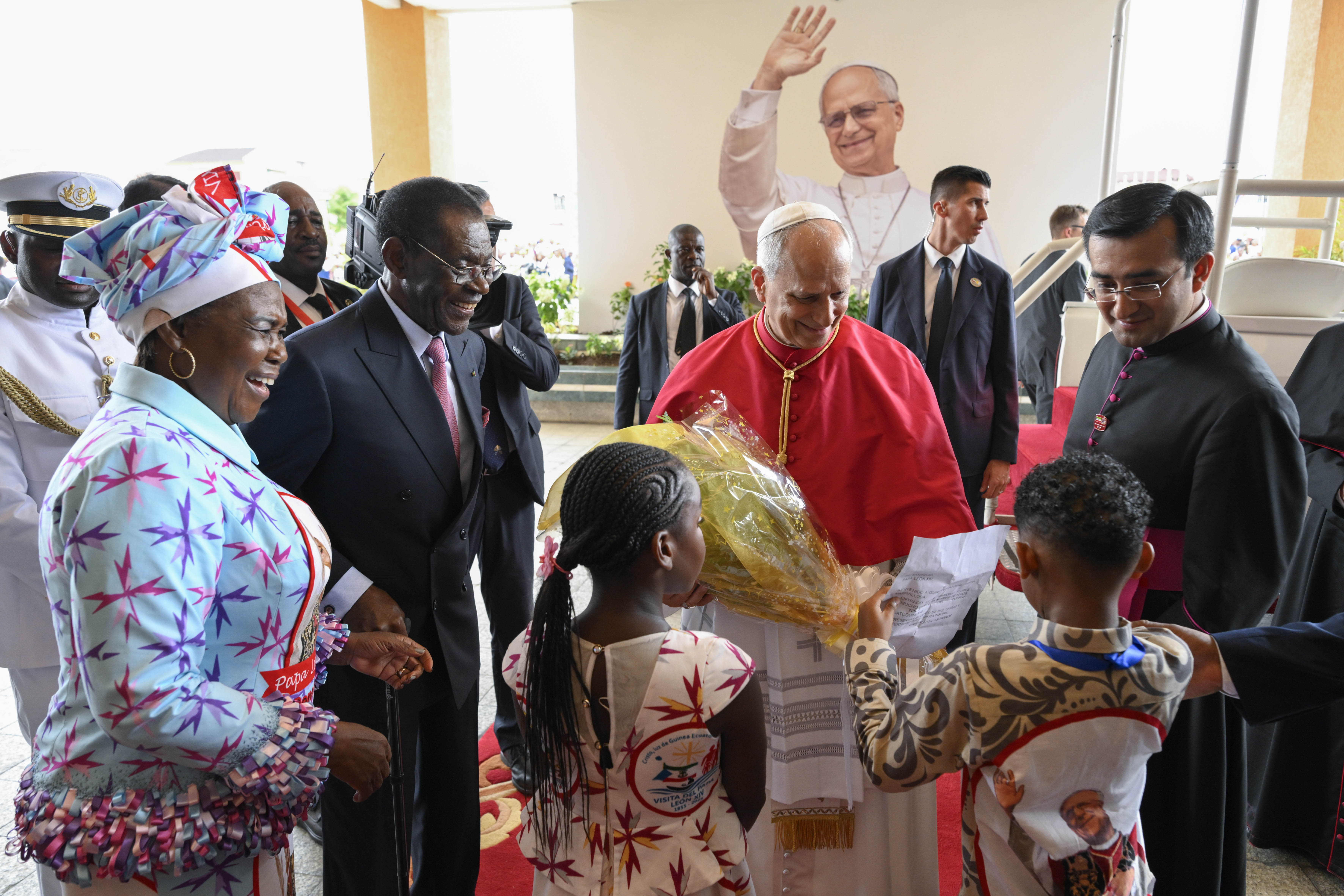
The pope arrived in Malabo to a festive welcome from crowds lining the streets of the capital. He later held a private meeting of about 30 minutes with President Teodoro Obiang Nguema Mbasogo, who has led the country since 1979 and also received St. John Paul II during his 1982 visit.
In his address, Leo recalled that John Paul II had described the president as "the symbolic center to which the living aspirations of a people converge" for liberty, justice, and respect for rights — words Leo said "remain timely and that challenge anyone entrusted with public responsibility."
The pope also reflected on St. Augustine's image of the "city of God" and the "earthly city," noting that every person shows by daily decisions to which city he or she belongs.
Referencing Equatorial Guinea's planned new capital, Ciudad de la Paz, Leo said its name "seems to echo the biblical city of Jerusalem" and should prompt each person to ask "which city they wish to serve."
He said Christians are called to live in the earthly city while keeping their hearts fixed on their true homeland, the heavenly city, and urged freedom from "the pursuit of unjust wealth and the illusion of dominion."
Leo presented the Church's social doctrine as a resource not only for Catholics but also for all seeking to respond to modern upheavals while putting "the kingdom of God and his justice" first.
"This is a fundamental dimension of the Church's mission: to contribute to the formation of consciences through the proclamation of the Gospel, the provision of moral criteria, and authentic ethical principles — all while respecting individual freedom and the autonomy of nations and their governments," he said.
Calling Equatorial Guinea "a young country," Leo said the Church stands ready to help form "free and responsible consciences" to build a just future.
"In a world wounded by arrogance, people hunger and thirst for justice," he said. "It is necessary to encourage those who believe in peace and to dare to engage in 'countercurrent' politics — those which place the common good at their very center."
He concluded with an appeal for youth formation and moral courage: "What is urgently needed is the courage of new visions and an educational pact that gives young people space and trust."
"Let us walk together, with wisdom and hope, towards the city of God, which is the city of peace," the pope said.
In remarks welcoming the pope, Obiang noted that the visit comes during the 170th anniversary of evangelization in Equatorial Guinea, where he said about 90% of the population is Catholic, making it "a favorable enclave for Christianity in central Africa."
This story was first published by ACI Stampa, the Italian-language sister service of EWTN News. It has been translated and adapted by EWTN News English.