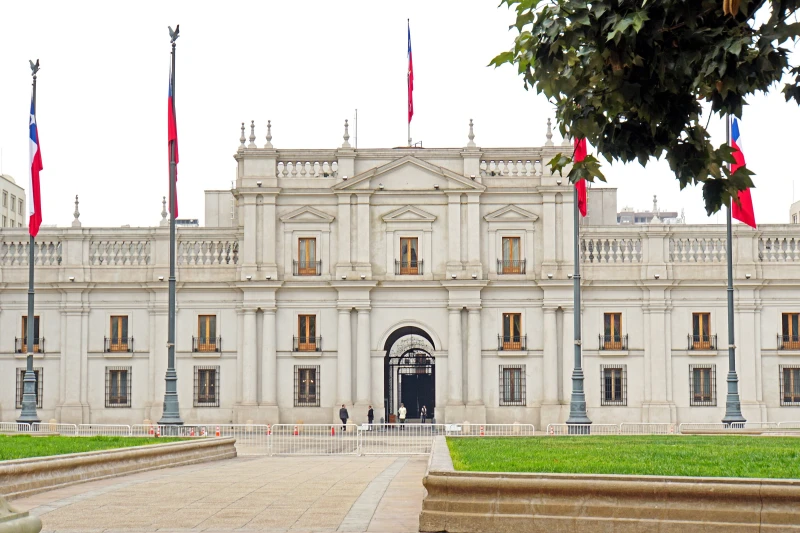
 La Moneda Presidential Palace in Santiago, Chile. / Credit: Dennis G. Jarvis, CC BY-SA 2.0, via Wikimedia Commons
ACI Prensa Staff, Dec 4, 2025 / 07:00 am (CNA).
Chileans are preparing to go to the polls once again to elect their president. Following the general elections, two candidates will be vying to replace the current president, Gabriel Boric: Jeannette Jara, a former government official, and the opposition candidate José Antonio Kast of the Republican Party.
In a climate marked by insecurity, rising crime rates, and the migration crisis, citizens are closely watching the proposals of both candidates to address these problems.
The archbishop of Concepción, Sergio Pérez de Arce, addressed the debate over the situation of immigrants without legal status in the country in a column titled "It's Either 'You Leave or We Expel You'?" in which he maintains that migration policy cannot be reduced to these two options.
The question that titles his column refers to the warning that candidate José Antonio Kast gave to immigrants who are residing illegally in Chile, whom he assured that they have "100 days" to each make "the appropriate decision and leave our country" before being expelled, a measure he will implement if he takes office as president on March 11, 2026.
Jara, the Communist Party candidate, adopted the idea of ??the liberal Franco Parisi — a candidate in the first round of elections for president — to address the problem of illegal immigration by means of a proposal "very focused on technological control of the border" and proposes "creating a digital wall" with tools such as biometric control.
Regarding Kast's countdown for immigrants to leave the country, she considers it "a campaign stunt."
In recent weeks, Peru, which lies on Chile's northern border, has strengthened border control there by deploying military forces, resulting in nearly a hundred migrants being stranded in northern Chile.
In response, the archbishop of Concepción stated that "the response to migrants in an irregular situation [not legally present] in the country cannot be simply 'you leave now, voluntarily, or we will expel you with nothing but the clothes on your back' in 100 days."

"There are foreigners who have been in Chile for years, who work and contribute to the country, who have family and emotional ties here, and who even have children born in Chile (who are therefore Chilean citizens). Many of them have wanted to regularize their situation, but they have been given almost no alternatives," he lamented.
"On the other hand, leaving Chile today means exposing oneself only to uncertainty, since neighboring countries are closing their borders, Venezuela is still in a political and social crisis, and is also in conflict with the United States. It means exposing people and families to new, painful, and unsafe displacement," he warned.
"Can Chilean society offer as the only solution: 'Either you leave or we'll kick you out'? Can politics be reduced solely to threats and a punitive response to human realities [in such precarious situations]?" he asked.
"It's not humane, it's not rational, it is not in keeping with the Gospel. It's not the best policy. There are other paths to explore that are more in line with human dignity. That is what is expected of governments and presidential candidates," he asserted.
This story was first published by ACI Prensa, CNA's Spanish-language news partner. It has been translated and adapted by CNA.