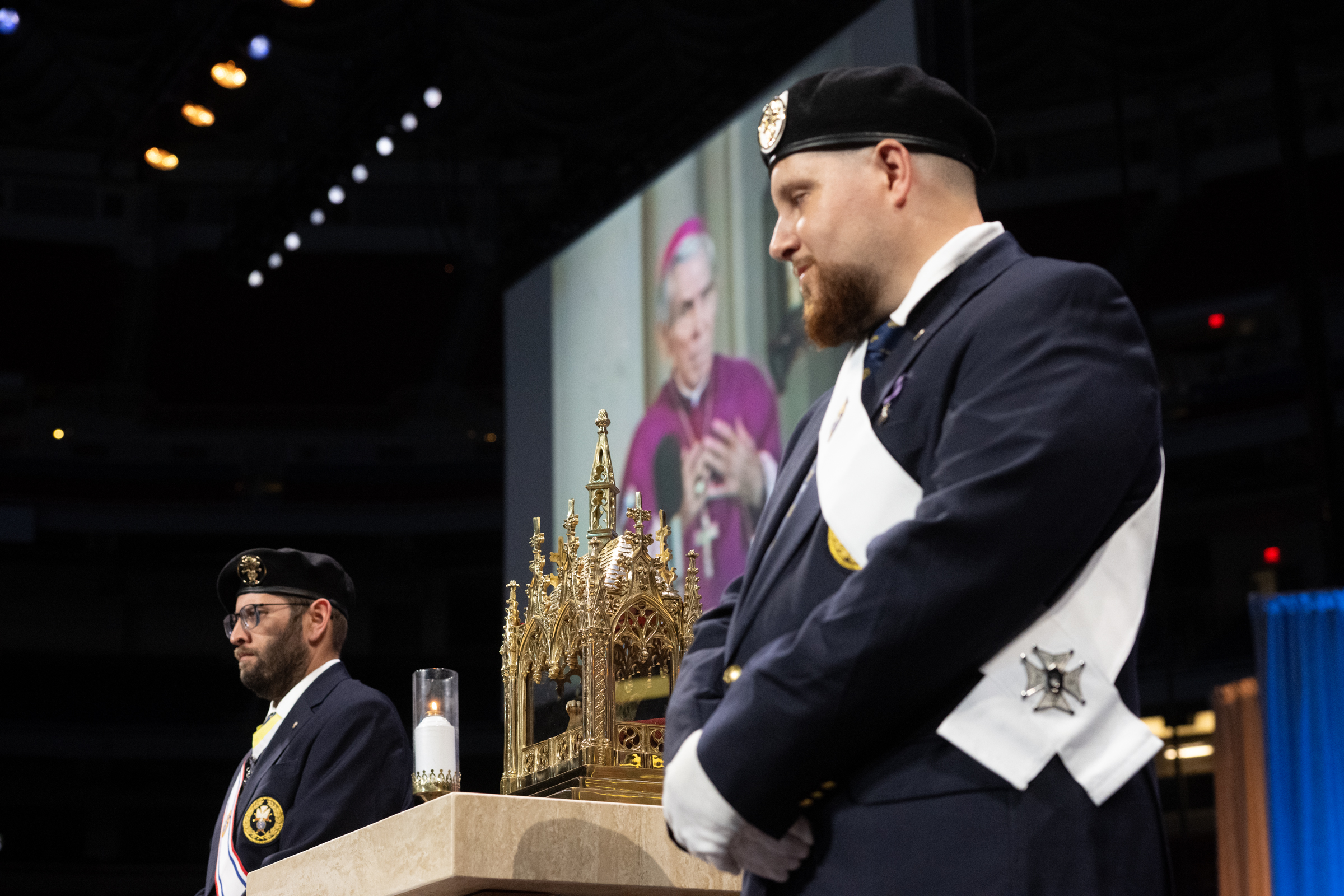
For Archbishop Fulton Sheen's beatification in St. Louis, teenager James Fulton Engstrom presented Cardinal Luis Tagle, the main celebrant, with a first-class relic of Sheen: the mandible, the jawbone that forms the chin and lower jawline and is the only moving bone in the human skull.
Engstrom was the recipient of the miracle in 2010 for Sheen's beatification. Minutes after being born, he was not breathing nor could emergency workers or hospital staff help him. He was dead for 61 minutes — and as doctors were about to record his time of death, James came to life. As the Church has officially proclaimed, through Sheen's intercession, the baby began breathing and was healed of any abnormalities that could occur in a way medical science could not explain.
The mandible was chosen because of Sheen's speaking prowess.
"Using the jawbone is very significant because of his ability to communicate the faith," Bishop Louis Tylka of Peoria, Illinois, Sheen's home diocese, told the National Catholic Register, a sister publication of EWTN News.
"And, of course, his ability to proclaim the faith, to speak out, the faith to preach and to teach" was paramount for Sheen, Tylka, who concelebrated the beatification Mass, said.
"It's pretty common for the one who was healed, if they're available, to have some part to play," Msgr. Jason Gray, the executive director of the Archbishop Fulton J. Sheen Foundation in Peoria, Illinois, told the Register.
Part of preparing for a beatification or canonization is obtaining first-class relics of the new blessed or saint. Msgr. Gray explained how the Diocese of Peoria obtained these first-class relics that are always parts or fragments of the body.
Now-Blessed Fulton Sheen died on Dec. 9, 1979.
"The important thing is to know that he's been buried for 47 years at this point, and the body does decompose," Msgr. Gray noted. "In his case, we're not dealing with an incorrupt body, so after 47 years, essentially, all the soft tissue had decomposed. When we did the actual canonical recognition, which is always done in a very respectful way and following the norms that are laid out by Rome, and we did open the casket, essentially, it was just bones. Pretty much everything else had disintegrated. We were able to take some bone that we could use for first-class relics."
The diocese received permission from Rome to take something more sizable because Bishop Tylka wanted to make sure that there was a significant relic given to the Archdiocese of New York, where Sheen served as an auxiliary bishop from 1951 until 1966, and to the Diocese of Rochester, New York, where Sheen served from October 1966 to October 1969. "Both [Rochester] Bishop John Bonnici and [New York] Archbishop Ronald Hicks have been very happy to have that news," Gray said.
Gray described those relics as the longest bones in the palm area of both right and left hands (the second metacarpal bone of the index finger).
"Those are going to be given to Rochester and New York," he said. "They will have a significant relic."
Tylka explained that they were "taking the relics from particularly his right hand because he was right-handed. It was always an iconic image of him writing, especially the 'JMJ' on the blackboard as part of his" "Life Is Worth Living" television program. It seems a significant opportunity to use bones from his right hand. That was such a familiar and iconic image of him that so many people knew."
"The reality is that although Fulton Sheen was a priest of the Diocese of Peoria, his episcopal ministry and much of his life centered around being in New York," noted Tylka to the Register.
"And, of course, he was the diocesan bishop of Rochester. So it seems important to me that those two dioceses, in particular the Archdiocese of New York and the Diocese of Rochester, each have a significant relic for their use and veneration in the diocese. And knowing that they've been supportive of our efforts to move the beatification forward and the cause of Fulton Sheen, I just thought it would be an important gesture that I, myself, as the bishop, would go and present those relics."
Tylka will personally present the relics to Bishop Bonnici in Rochester next Tuesday and to Archbishop Hicks in New York next Thursday.
"Each of those dioceses are planning celebrations on those days," he said. "They both have great devotion and support of the cause for Fulton Sheen, so they'll be the first two dioceses to receive a relic, a substantial relic," Tylka explained.
He elaborated on the particular choice of relics for these two dioceses. "Knowing that Fulton Sheen was so demonstrative in not only writing 'JMJ,' but often he would make his gesture pointing up to heaven, each of them will receive a bone from his hand. One gets the left and one gets the right."
In addition to these bones, Msgr. Gray explained another longer bone was also taken to prepare small relics. Each will be in a theca (small round reliquary) in which a tiny chip of bone is placed with the inscription ex ossibus Beati Fultoni Sheen — from "the bones of Blessed Fulton Sheen." None could be distributed until Sept. 24.
Gray clarified these relics are not for private collections but meant for public veneration. Requests from Catholic institutions such as a parish, seminary, religious house, convent or shrine must include a testimonial letter from a diocesan bishop.
"We need to know that this is a legitimate request from an institution that will respectfully preserve the relic and that it is meant to be made available for veneration by the faithful," he said.
Second-class relics — an item the blessed or saint owned, wore or touched, such as a shirt or book or pieces of these — are available from the foundation, which has a number of Sheen's vestments (ex indumentis, "from the clothing"). Such second-class relics can be given to private individuals.
"That's perfectly fine," Gray said. "We just ask people to make some sort of a donation because it takes us time to prepare these things — either a relic card, where we actually tape the fragment of vestment inside a holy card; or if people have contributed and been more generous, we've prepared an actual theca with a fragment of cloth in it from the vestments of Fulton Sheen."
"We have an ample supply, so there's no difficulty in honoring that," he said. Because of the many requests the foundation receives, "we do ask people to be a little patient because we're trying to fulfill them as best we can." (People may make requests and include a donation by mail to the Archbishop Fulton J. Sheen Foundation, 419 NE Madison Ave., Peoria, IL, 61603, or via the website CelebrateSheen.com.)
There are also third-class relics — items like holy cards, religious medals and rosaries that have been touched to a first-class relic.
"Right now, the principal means of creating a third-class is by touching something to the tomb," explained Msgr. Gray of the current resting place of Bishop Sheen's mortal remains in a side chapel at the Cathedral of St. Mary of the Immaculate Conception in Peoria. "The tomb itself is a first-class relic." People touch their "rosaries and holy cards all the time when they come to Peoria and make a visit in front of the tomb."
During the beatification at St. Louis' The Dome at America's Center, more than one first-class relic was available for the faithful to venerate.
Another major relic will also travel to Rome — and will be presented to Pope Leo XIV. "That is planned," Tylka confirmed to the Register. "I've received confirmation that I will be given an audience to do so on Oct. 5."
Because Leo grew up only about 168 miles from Peoria, he might have visited Bishop Sheen's home diocese and cathedral church growing up.
"Quite possibly," said Tylka. "He grew up in the south suburbs of Chicago, as I did. And certainly, as an Augustinian, we did have a parish where the Augustinians were serving for a part of some time. So it's very likely that he probably could have come down for a visit."
This article was first published by the National Catholic Register, an EWTN News sister publication, and has been adapted for EWTN News English.