David Willey, a BBC correspondent whose career in Rome spanned more than 50 years and five papacies, died July 11 in Italy at the age of 93.
From being a student taking in the pomp of Pope Pius XII carried in a ceremonial throne to traveling the world with St. John Paul II to writing about the changes brought by Pope Francis, Willey saw "a complete revolution so that people saw the pope much more as a personality rather than in a hierarchical sense," the journalist told EWTN News at his home in February.
Catholic background
David Douglas Willey was born in High Wycombe, in the county of Buckinghamshire, northwest of London, in December 1932. He grew up Catholic in nearby Marlow.
Willey's first experience of Rome was a visit as a student, when he witnessed Pope Pius XII being carried through crowds in a gestatorial chair. "For me, the Vatican, St. Peter's in Rome, was a spectacle, it was almost operatic," he noted.
After studying law and modern languages at Cambridge, he moved to Rome as a trainee for Reuters.
He then left for stints in Algeria as a freelancer and subsequently East Africa as a correspondent for BBC. He also reported from Asia, including Saigon and Beijing, and then spent some time in London as the BBC's assistant diplomatic correspondent.
He returned to Italy as BBC's Rome correspondent in 1972 — and he never left.
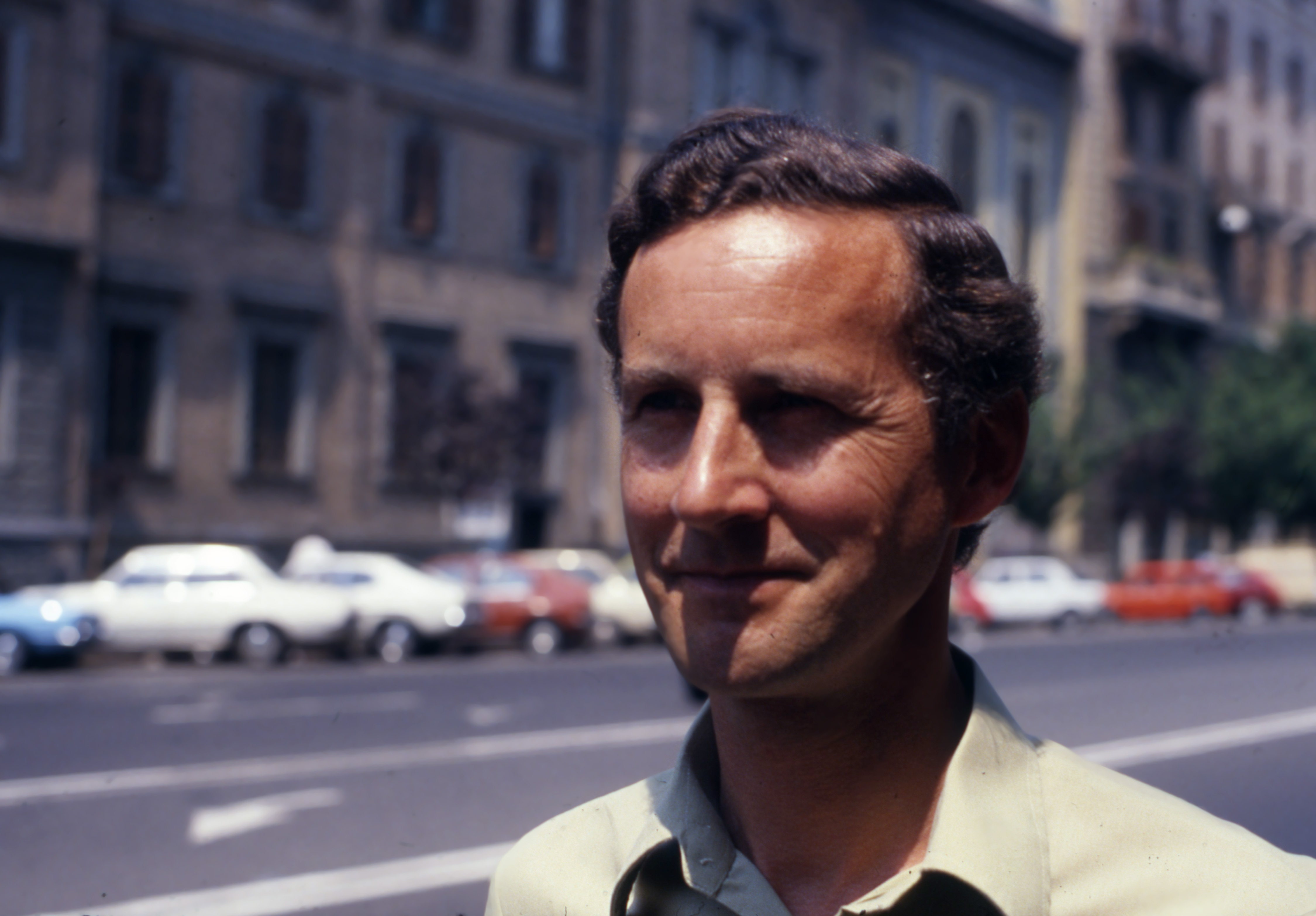
"I never imagined I would be covering the Vatican [as a] correspondent when I was an altar boy at St. Peter's Church in Marlow," he said.
Willey explained that he no longer practiced the Catholic faith of his childhood but that he had "the greatest respect for the Catholic religion."
His reporting on the Vatican was through this lens. "I always treated reporting for the Vatican as a secular matter rather than a religious one," he said, adding that he still found "inspiration and pleasure in covering Vatican affairs" because he thought the pope and the Church had an important message in a world "torn by war and discord."
Lengthy Rome career
During his more than five decades covering Rome and the Vatican, Willey witnessed dramatic technological changes both to journalism and to the Vatican's own operations and communication.
Two episodes from his early days in Rome illustrate this, including a call to the Vatican switchboard asking to be connected to a cardinal.
He was immediately put through to Cardinal Agostino Casaroli, who would later become the pope's No. 2 as the Vatican secretary of state.
"An important cardinal in the Vatican because he dealt with what was called the Ostpolitik, the Vatican's policy towards Eastern Europe, communist Eastern Europe, during the years of the Cold War," Willey said, noting that he asked to speak and the cardinal invited him that very afternoon to his "palatial" apartment for what would become a three-and-a-half-hour conversation.
Willey recalled how, while a Reuters apprentice in the 1950s, international news agencies would pay a Vatican official for information. Once, on Easter Sunday, he was sent to wait at a bar close to the Vatican to pick up a text of the pope's "urbi et orbi" blessing.
"That was how the system worked. The changes wrought by Vatican II were extraordinary in the sense that a whole department was set up in the Vatican dealing with relations with the media," he noted.
During the pontificate of St. John Paul II, Willey joined the Polish pope on at least 40 of his international trips, nearly half of the jet-setting pope's total apostolic journeys.
"We went all over the world," Willey noted. "It added to my knowledge of the world immeasurably, but it also enabled me to see the Catholic Church as an international, worldwide body of believers, which you don't always understand when you live here in Europe or in Rome in particular."
Veering from the prevailing idea that the faithful should come to see the pope in Rome, John Paul II went out "to meet his flock in person. And he did this with great panache," the British journalist said.
"And by allowing journalists like me to join him on the papal plane; one day, for example, I found him sitting next to me at breakfast on the plane," Willey recalled. "He used to get bored during his very long journeys across the Atlantic or Pacific Oceans and he mingled with the journalists and sat down and actually talked to them."
"I remember talking to him once about the usefulness of the United Nations, for example. He had some quite interesting things to say."
Willey said he also had a memorable encounter with another living saint — Mother Teresa of Calcutta.
One day he rang up the Sisters of Charity in Rome to ask if he could interview Mother Teresa and was told they could arrange a meeting at the airport, in between her landing in Rome from India and before she would immediately depart again for Canada.
"We sat down together, and she was, I must say, great fun," Willey recalled. "We had a very lively conversation in which she confided all sorts of little secrets to me, such as I said, 'What do you do when you normally arrive in a new country?' 'Oh,' she said, 'I go to the local phone box and call up the head of state and ask him to send a car to meet me. I ring up the pope and he sends me a car.'"
"She was this combination of extreme saintliness and piety — and of course her work among the poor in India was completely a subject of which she was prepared to talk endlessly — but what I found was her sense of fun and her sense that the world was completely open to her," the journalist said.
In 2003, Willey was appointed an officer of the Order of the British Empire for services to broadcast journalism.
He wrote several books, including "God's Politician," a 1992 biography of John Paul II's global impact. He also wrote about the start of Pope Francis' pontificate in "The Promise of Francis: The Man, the Pope, and the Challenge of Change" in 2015.
Willey continued to be active into his 90s — including writing a final reflection on the Vatican following Pope Francis' death in April 2025. Willey spent his final years in the quiet lakeside town of Trevignano Romano, about 30 miles north of Rome. He died on July 11 from heart failure, the BBC reported.