Jesus in the Eucharist visited the streets of America's most historic city Saturday, drawing thousands of people on a sunny morning in Boston.
The procession, which lasted two hours and 15 minutes, went by portions of the Freedom Trail, a 2 ½-mile-long red line of paint and bricks begun in 1951 that helps visitors find many of the most famous sites in the city, including many associated with the American Revolution.
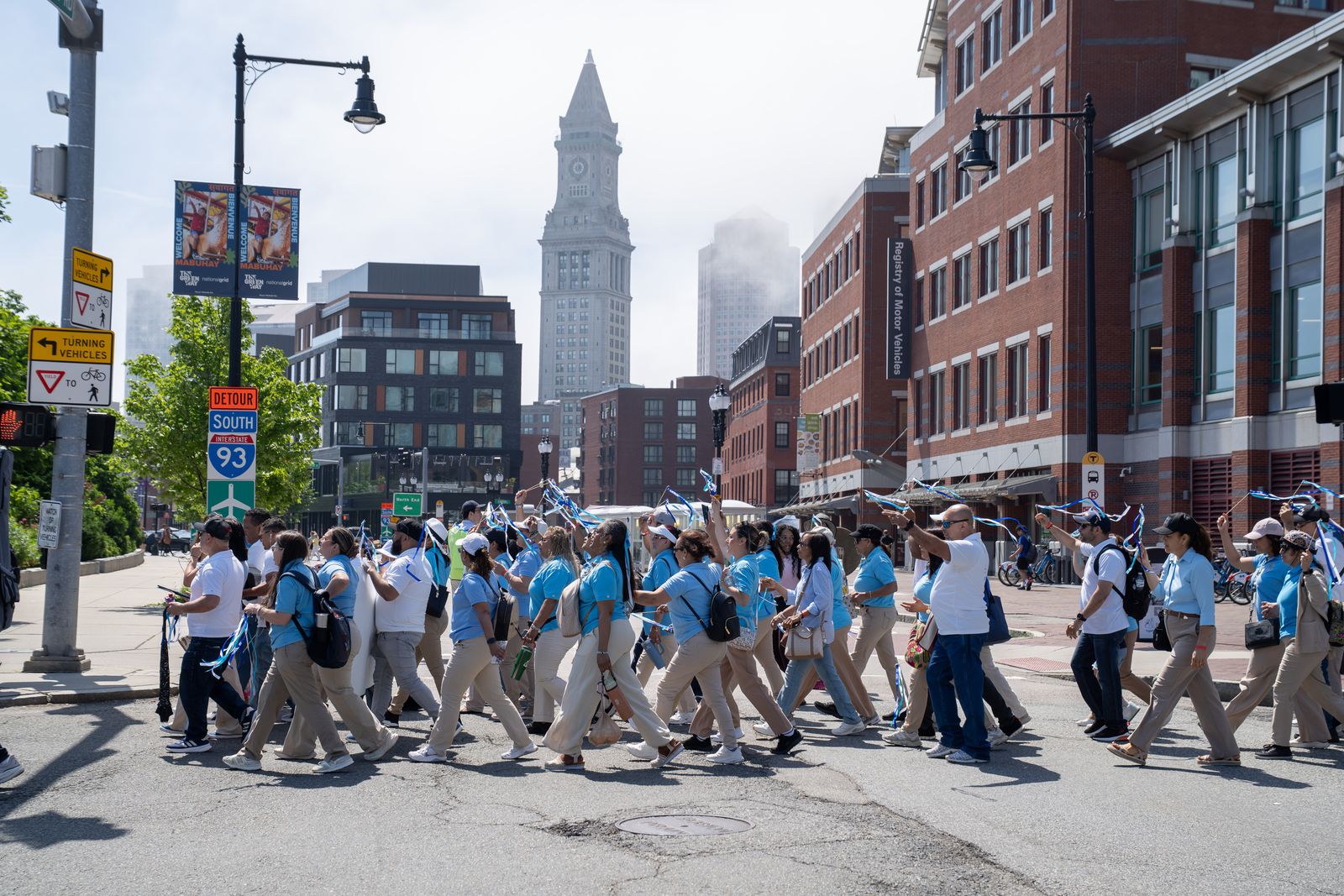
Boston Archbishop Richard Henning pointed out to the crowd before the procession began that they would be walking by some of the most historic places in the country. But then he added: "We will make history."
"Because this will be the first time that we journey along the Freedom Trail as the people of God, led by our Lord and savior, Jesus Christ," Henning said.
A National Eucharistic Pilgrimage official estimated the crowd at 2,500 to 3,000. Archbishop Henning said later that whenever he turned around from the front he could never see the end of it in the back.
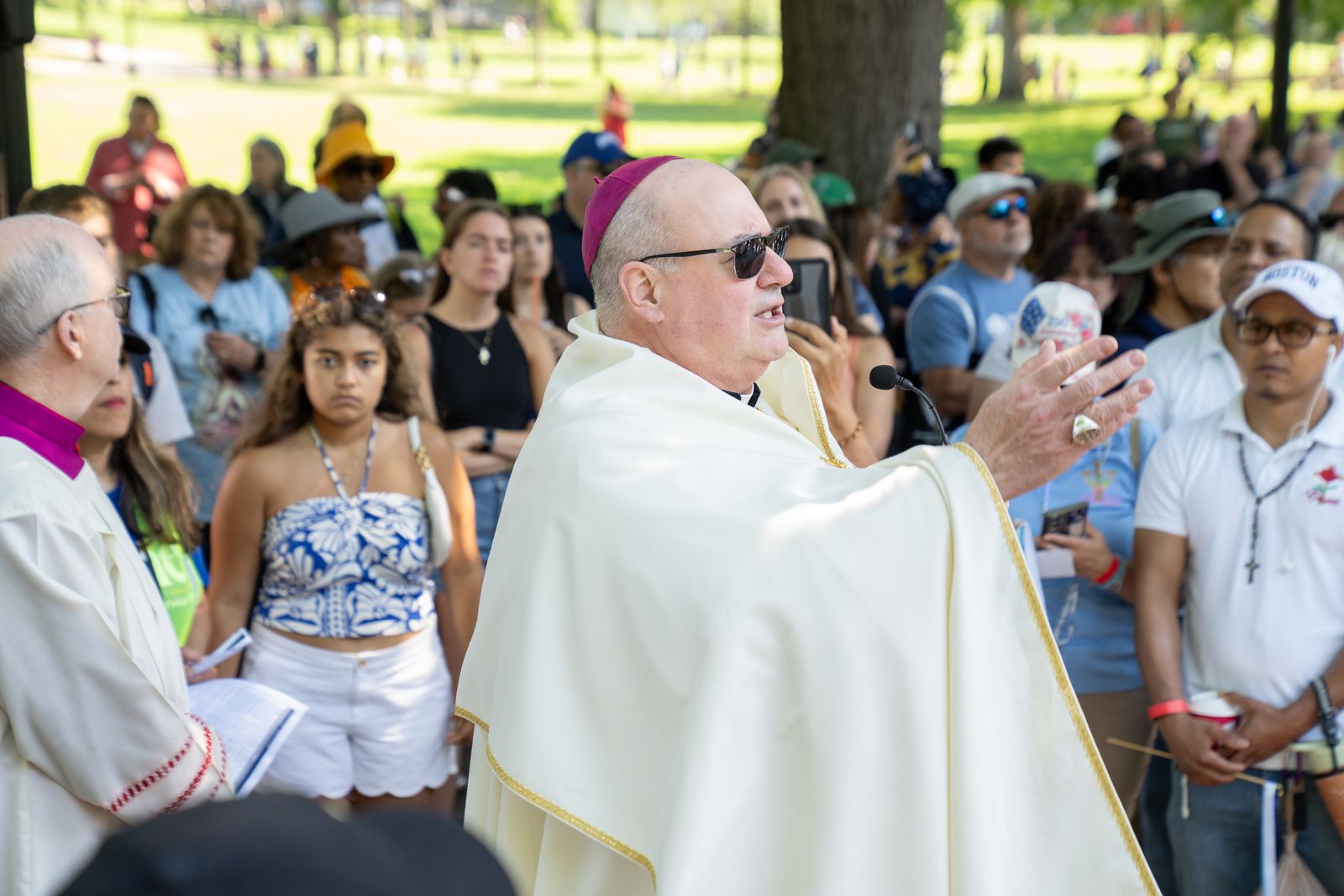
Jason Shanks, president of National Eucharistic Congress, which oversees the National Eucharistic Pilgrimage, said the crowd in Boston was the largest since this year's version up the East Coast began May 24 in St. Augustine, Florida.
"It was a beautiful moment to see the people of God sort of show up for Jesus, and you could really hear their voices," Shanks said during a press conference Saturday afternoon at the Cathedral of the Holy Cross in the South End of Boston.
Hymns and prayers through a portable loudspeaker were led by Polish, Latino, Vietnamese, and Cape Verdean groups, among others, along with English speakers.
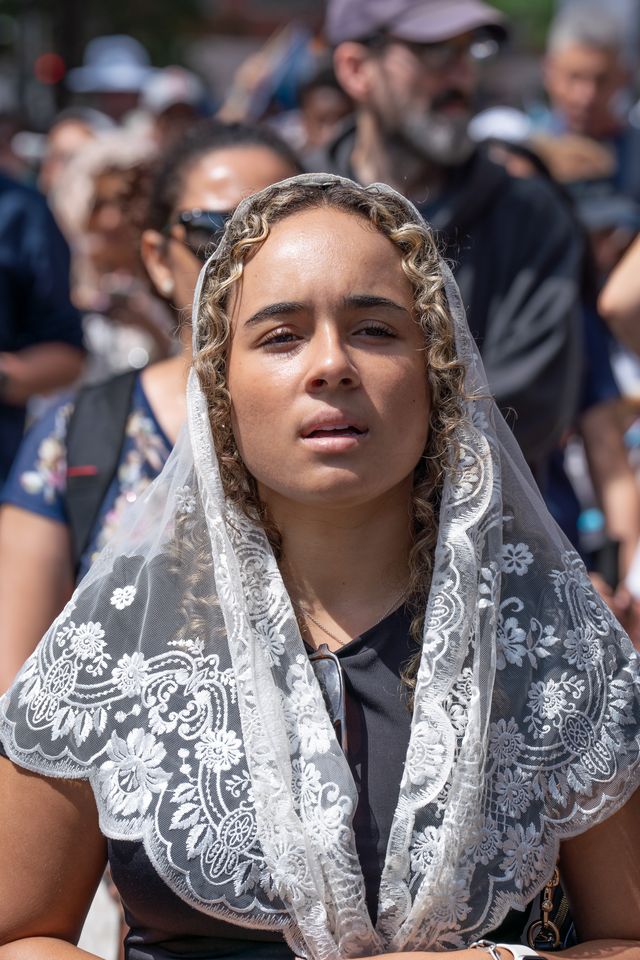
Participants experienced the sights and sounds of the city. When Archbishop Henning spoke at the beginning, near the visitors center on Boston Common, he occasionally competed with a jackhammer on nearby Tremont Street.
The beginning point was about a two-minute walk from where another group of organizers was setting up a Hare Krishna festival, and about a three-minute walk away from where St. John Paul II celebrated Mass on Oct. 1, 1979 before an estimated 1 million people in the pouring rain.
Saturday's procession included a portion of the route on Commercial Street that the canonized pope took in an open vehicle through the North End more than 46 years ago.
The procession also proceeded from the top of Old South Meeting House, the former Congregational church (now museum) where the Boston Tea Party began in December 1773, and on a house in Charlestown, near where the Battle of Bunker Hill took place in June 1775.
The walk began on Boston Common at about 10 a.m. amid sunny skies and with the temperature at 72 degrees, with a slight breeze. It turned warmer as the morning went on. Unseasonal fog covered large portions of Boston Harbor near the North End, but procession route remained clear, with high visibility.
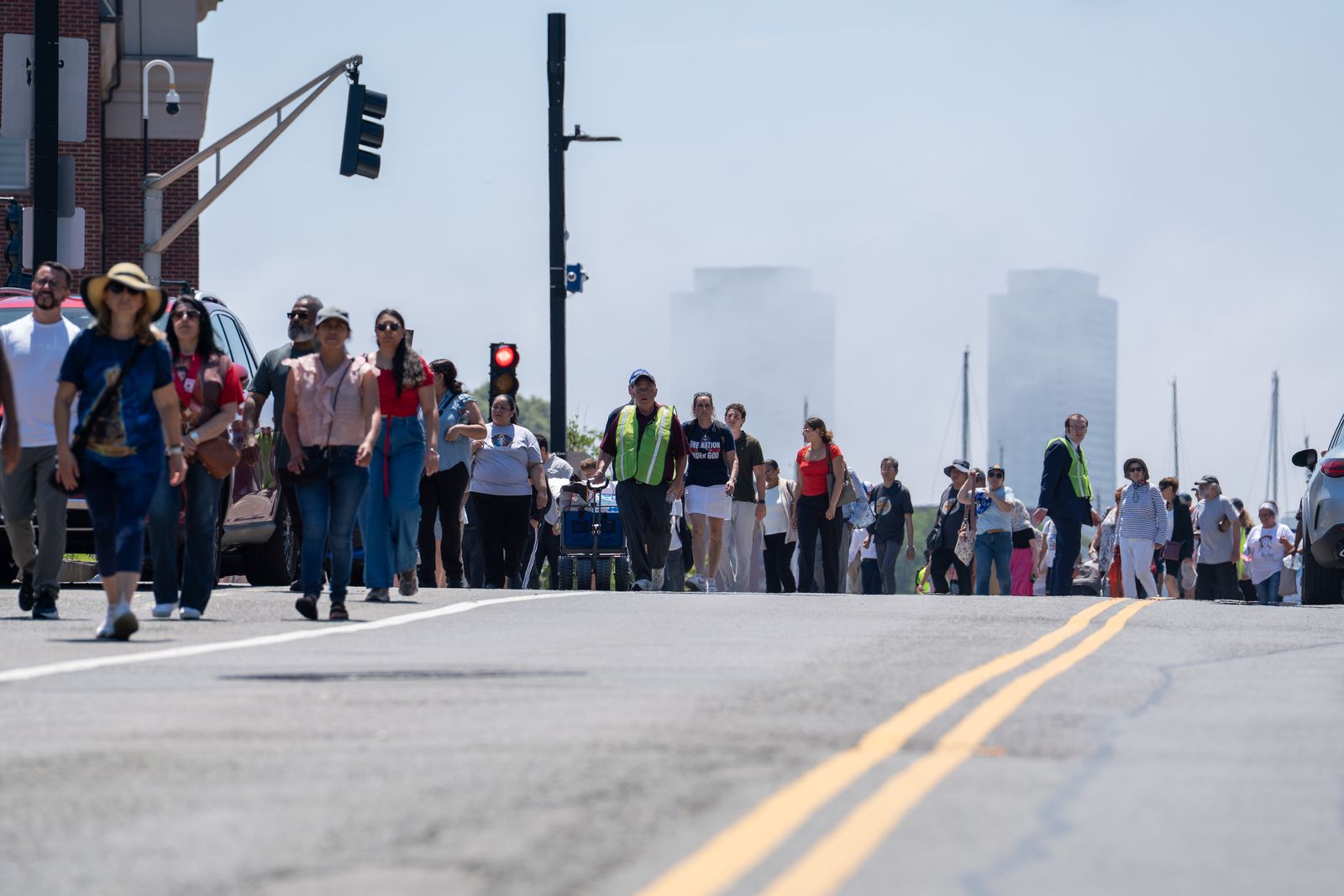
Participants said the first three decades of the Joyful Mysteries of the rosary on waterside sidewalks along Commercial Street, near where the molasses flood of January 1919 killed 21 people after a poorly constructed tank collapsed during a thaw.
As the rosary blared out over an artificial turf field along the harbor, players on a women's softball team occasionally looked away from a team huddle to watch. A short distance to the north, sunbathers on the outfield grass of a Little League field also took notice.
The people
EWTN News spoke with several participants, including some who noted that the United States is about to celebrate the 250th anniversary of the Declaration of Independence on July 4.
Nancy Goggin, a parishioner of Immaculate Conception and St. James in Stoughton, which is southwest of Boston, was asked why she came.
"Because I love our Lord. And I just think it's really such a beautiful thing to celebrate our 250th anniversary of the country in this way," Goggin said. "To process with Jesus through the Thirteen Colonies is so important."
English Puritans who wanted to purify the Church of England from all Catholic influences founded Boston in 1630 and laid out Boston Common, where the Eucharistic pilgrimage began, in 1634. Goggin was asked what the Puritans would make of a Catholic procession of the Blessed Sacrament.
Goggin, who was passing out rosaries as a member of the World Apostolate of Fatima, said she is a descendant of an English Separatist Puritan who sailed to the then-new Plymouth Colony in the early 1620s, not long after the Pilgrims arrived.
"They came here for religious freedom, and they came here to worship God," she said. "And so I think it's really fitting."
Asked what she hoped will come from the Eucharistic procession, she corrected the question.
"It's not 'come from it.' It's happening," she said. "There's a resurgence in the Catholic Church that is so beautiful. So many people are entering."
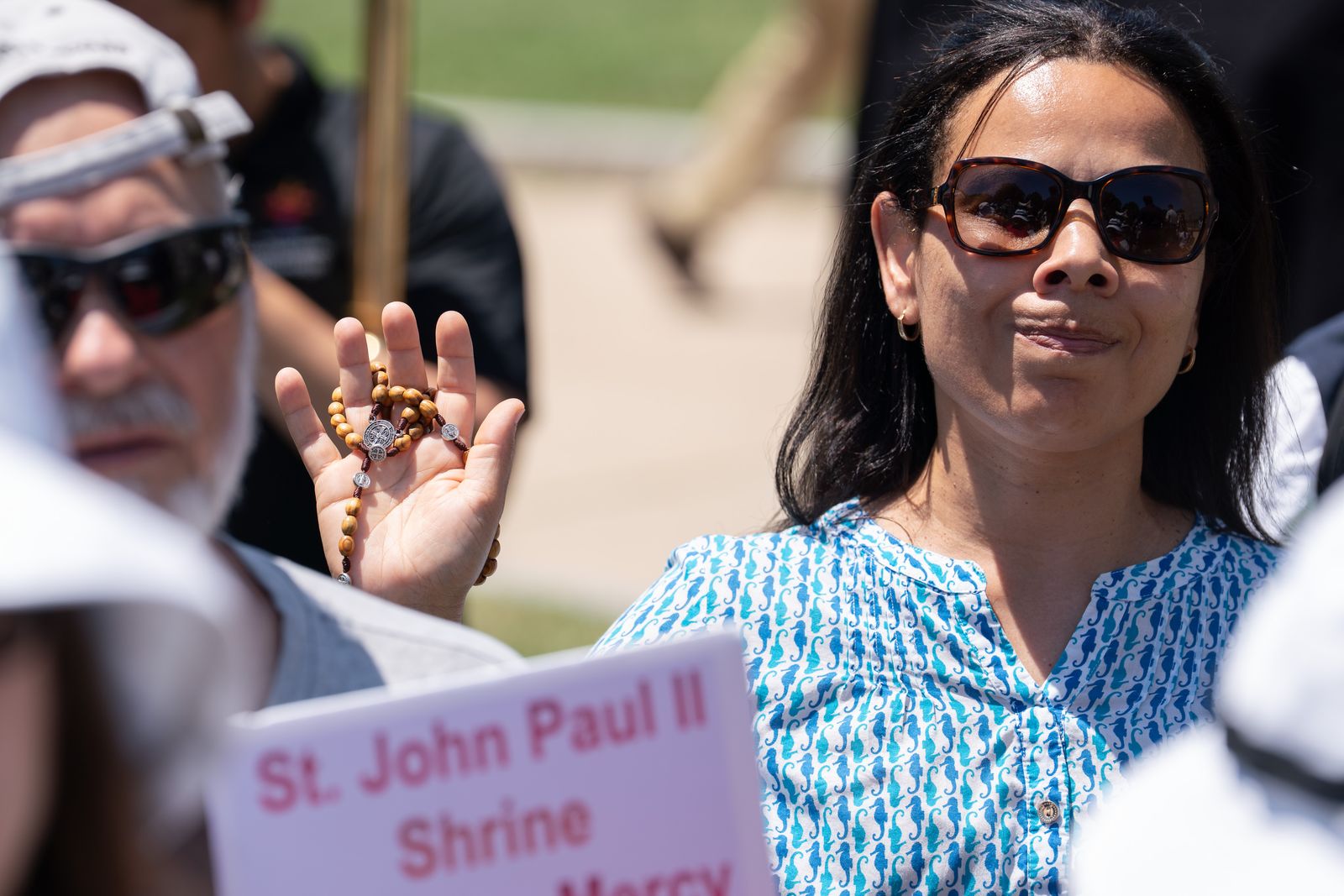
Tho Dinh, 57, who lives in Quincy, attended with a contingent from St. Ambrose, a Vietnamese parish in Dorchester, which is the largest section of Boston.
He told EWTN News he left Vietnam as one of the Boat People after Communist North Vietnam took over South Vietnam, spending three years in a refugee camp in Malaysia and then six months in the Philippines learning English and American culture before coming to Boston in September 1991.
"We have to worship God and thank God for all the blessings we have," Dinh said, explaining why he came for the procession.
He said a Eucharistic procession far from church has different meaning from ordinary parish worship.
"It's community, so it's more connection. It's unity of the Church, so it's good," he said.
"We hope for peace in the world. And we pray for peace, and people unified with each other," Dinh said. "We hope for a better future for young children. And people coming back to the Church."
Valentina Zamora, 15, a member of St. Anthony's in Everett, whose parents are from El Salvador, said she hoped the faith would become "stronger than it already is" because of the procession.
She also told EWTN News the outdoor setting, which included the grass and trees and hills of Boston Common, was a good place for it.
"Because this is what God created, so it would be nice to hear more about God in his creation," she said.
Marice Moline, 57, of St. Michael the Archangel Parish in Winthrop, said the procession offers people a chance to see Jesus in the Eucharist who might not otherwise see him.
"It's an opportunity for public display of Christ," Moline said.
"To remind people that there's hope. To remind people that there's something greater in the world than themselves right now," she added.
Filomena Brandao, 69, of Randolph, who told EWTN News she came to the United States from Cape Verde alone at age 22, said she came to the Eucharistic procession in Boston partly out of patriotism.
"Because we're celebrating independence — 250 years. All the history, all the stories. As an immigrant, I wanted to experience it much more," said Brandao, who now has a husband, four children, and six grandchildren.
"We have a lot to thank God for," she said.