YAOUNDE, Cameroon — Pope Leo XIV on Friday encouraged Catholic university students in Cameroon to let their study be informed by "the light of faith, joined to the truth of love" as St. John Henry Newman taught.
"Professors and students are called to embrace as both their aim and their way of life the common search for truth, for, as St. John Henry Newman wrote, 'All true principles run over with God, all phenomena converge to him,'" the pope said during an encounter at the Catholic Academic Institution of Central Africa (UCAC) in Yaoundé, Cameroon's capital.
UCAC, founded following an agreement between the Holy See and the Republic of Cameroon in 1989, serves more than 2,000 students from the six countries of central Africa: Cameroon, the Central African Republic, Congo-Brazzaville, Gabon, Equatorial Guinea, and Chad.
To mark the pope's visit April 17, the university inaugurated a square on campus, naming it after St. Augustine in honor of Leo.
Plans are also underway for the construction of a university hospital dedicated to the pope: It will become the Leo XIV Catholic University Center.
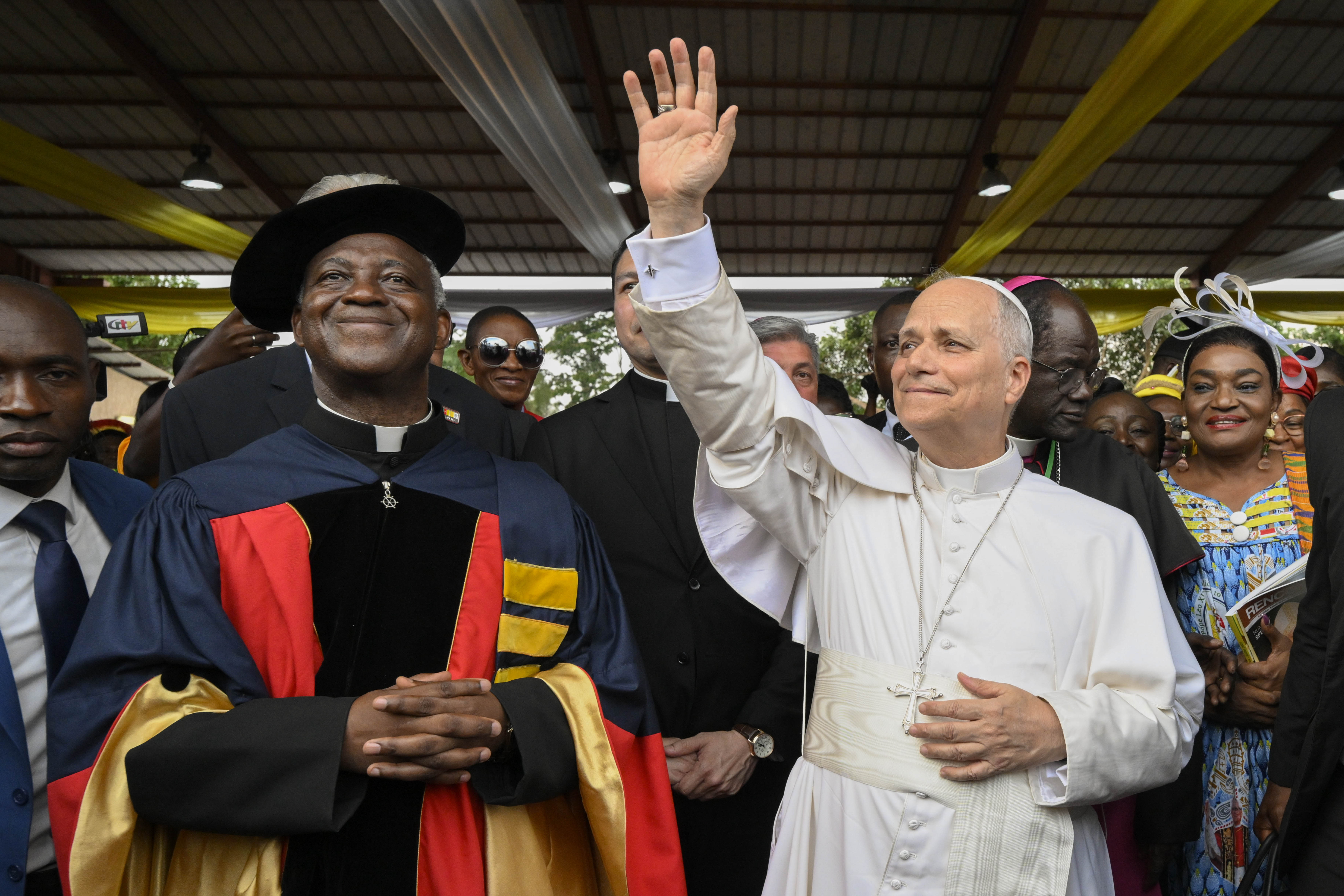
Upon Pope Leo XIV's arrival, songs of joy and jubilation filled the air. A celebration of music and chanting erupted as the pope arrived at the campus, where many of the young people were wearing yellow and green T-shirts, the colors of Cameroon. Authorities say 8,000 people were in attendance.
In his address, the pontiff responded to the concerns of many young people, emphasizing that universities — Catholic universities in particular — can become "true communities of life and research," introducing "students and professors alike to a fraternity in knowledge."
Through knowledge — which above all means dialogue — it becomes possible to set aside individualism, superficiality, and hypocrisy: "The university stands out as a privileged place of friendship, cooperation, and, at the same time, of interiority and reflection," Leo underscored.
What makes a university truly significant, he recalled, is the shared search for truth. Quoting from Pope Francis' encyclical Lumen Fidei, he said, faith, in this way, succeeds in "illuminating" the gaze of science: "Faith encourages the scientist to remain constantly open to reality in all its inexhaustible richness. Faith awakens the critical sense by preventing research from being satisfied with its own formulae and helps it to realize that nature is always greater."
Speaking about the African continent, he added: "Today, moreover, there is an urgent need to think about faith within the framework of contemporary cultural contexts and present challenges, so that its beauty and credibility may emerge in diverse settings, especially in those most marked by injustice, inequality, conflict, and both material and spiritual degradation."
AI and a new humanism
"Christians, and especially young African Catholics, must not be afraid of 'new things,'" the pope said, a reference to Pope Leo XIII's encyclical Rerum Novarum.
He invited African youth to become pioneers of "a new humanism in the context of the digital revolution."
"While the African continent is well acquainted with its alluring aspects, it also knows the darker side of the environmental and social devastation caused by the relentless pursuit of raw materials and rare earths," Leo said. "Do not look the other way: This is a service to the truth and to all humanity. Without this demanding educational effort, passive adaptation to dominant paradigms will be mistaken for competence, and the loss of freedom for progress."
He said the spread of artificial intelligence systems, "like every great historical transformation," call for not only "technical competence but also for a humanistic formation."
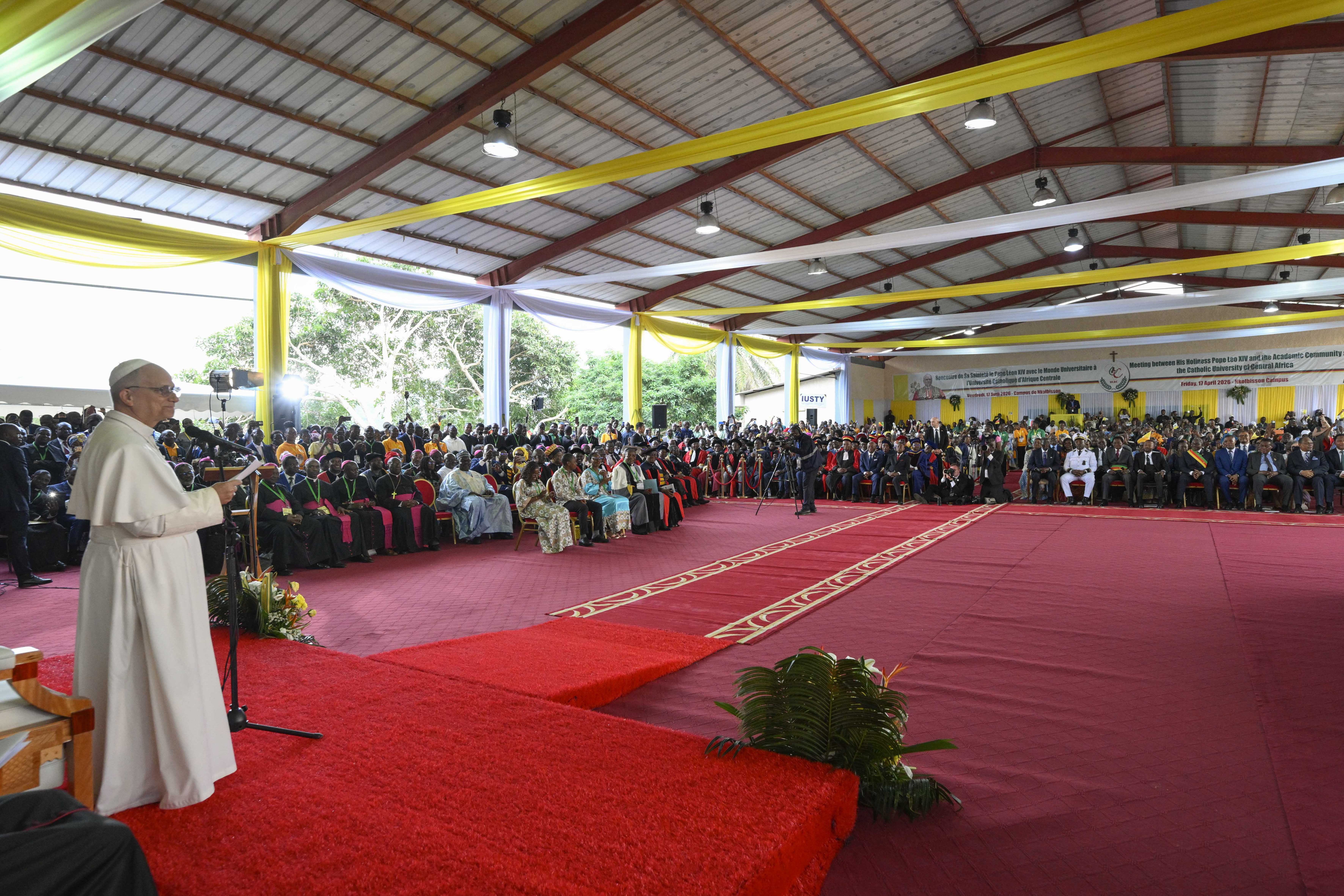
He warned against superficial misunderstandings of this new digital tool: "When simulation becomes the norm, it weakens the human capacity for discernment. As a result, our social bonds close in upon themselves, forming self-referential circuits that no longer expose us to reality. We thus come to live within bubbles, impermeable to one another."
"Feeling threatened by anyone who is different, we grow unaccustomed to encounter and dialogue," he said. "In this way, polarization, conflict, fear, and violence spread. What is at stake is not merely the risk of error but a transformation in our very relationship with truth."
Hence, he invited Catholic universities to "assume a responsibility of the highest order. For it does not merely transmit specialized knowledge but shapes minds capable of discernment and hearts ready for love and service."
One of the many challenges facing Cameroon is the "understandable tendency to migrate — which may lead one to believe that elsewhere a better future may be more easily found," the pope said.
The Holy Father instead invited young people "to respond with an ardent desire to serve your country and to apply the knowledge you are acquiring here to the benefit of your fellow citizens."
This, he said, is the very reason for the existence of a major African university like the one he is visiting today.
Addressing the university's faculty and leadership, he said: "Spiritual and human accompaniment constitutes an essential dimension of the identity of the Catholic university."
"Whatever our role or our age, we must always remember that we are all disciples — that is, fellow learners with one Teacher, who so loved the world that he gave his life," the pope concluded.
This story was first published by ACI Stampa, the Italian-language sister service of EWTN News. It has been translated and adapted by EWTN News English.