More than half a century after humans last traveled beyond Earth's orbit, a new National Aeronautics and Space Administration (NASA) project for lunar exploration has begun, marking a historic day in the United States.
"The feeling is really palpable that now America is on its way back to the moon after more than five decades of waiting and planning," Jonathan Lunine, chief scientist at NASA Jet Propulsion Lab (JPL) and the founding vice president of the Society of Catholic Scientists, said in an interview with "EWTN News Nightly."
On April 1 at 6:35 p.m. ET, the Artemis II rocket lifted off from NASA's Kennedy Space Center in Florida with four astronauts on board.
"Everyone's very excited at JPL, at NASA headquarters," Lunine said. "Artemis II is a 10-day mission which will send four astronauts around the moon, and they will go as far, or farther, than any humans have, even during the Apollo program, and then return to the Earth."
The mission is the first time astronauts have flown aboard NASA's Space Launch System rocket and Orion spacecraft, which has key systems designed to support future missions to the lunar surface.
The mission is part of NASA's Artemis program, which "will send astronauts on increasingly difficult missions to explore more of the moon for scientific discovery, economic benefits, and to build on our foundation for the first crewed missions to Mars," according to NASA.
"The United States has not been back to the moon, and no country has been to the moon, since 1972. So this is really developing completely new hardware with the technologies that we have today to build a lunar program for the United States that's going to be long-lasting," Lunine said.
Apollo 8 and Artemis II are 2 different journeys around the moon
Many space enthusiasts have wondered if Artemis II is just a rerun of Apollo 8, but Lunine clarified "this is not like Apollo."
"The NASA administrator made it clear, and the president has made it clear as well, that this is the start of the United States staying on the moon and having a presence there in the long term," he said. "And that means that the technologies that are required … for being able to bring astronauts and significant amounts of cargo to the moon, need to be developed."
Despite the difference in the missions, Apollo 8 and Artemis II undoubtedly have similarities as both were developed primarily for testing purposes to help NASA refine the systems needed for future lunar landings.
In 1968, Apollo 8's success paved the way for Apollo 11, which landed astronauts on the moon just seven months later. Similarly, Artemis II is expected to set the stage for Artemis III, which is intended to test docking capabilities between Orion and commercial spacecraft needed to land astronauts on the moon.
"The idea is to test out all of the systems necessary for bringing astronauts to the moon in a lunar landing, hopefully in a couple of years," Lunine said.
An unexpected — and unplanned — similarity between the missions is that both will have had astronauts in space for significant Christian holidays. Apollo 8 traveled Dec. 21–27, 1968, and was in space on Christmas Eve and Christmas Day.
On Christmas Eve, the astronauts recited from the Book of Genesis in what was the most-watched broadcast in history at the time. Following the launch of Artemis II, the astronauts and rocket will be in space during Easter.
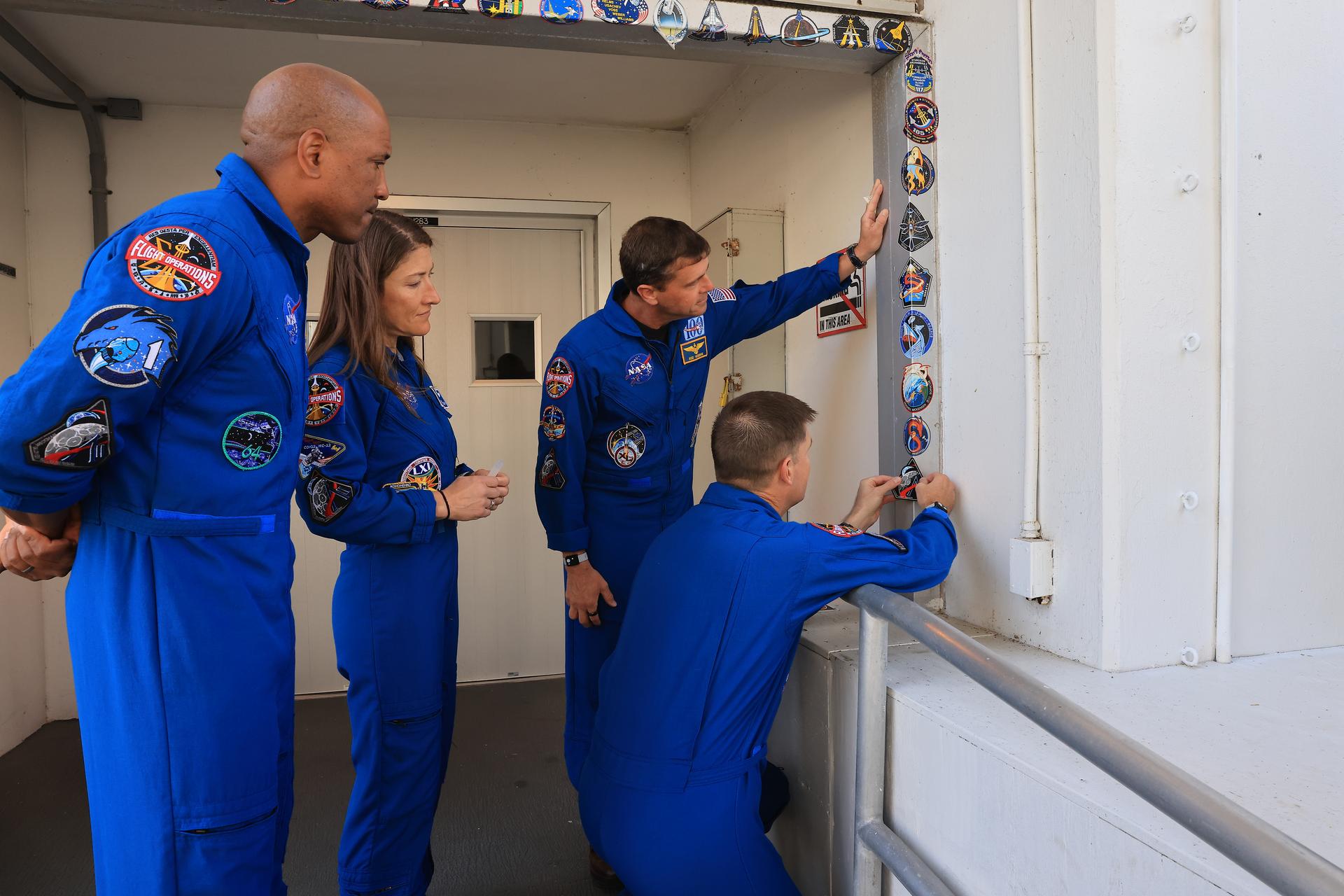
The missions share similar crew sizes, as Apollo 8 carried three astronauts, and Artemis II is carrying four. The Artemis crew is made up of commander Reid Wiseman, pilot Victor Glover, and mission specialists Christina Koch and Jeremy Hansen.
Wiseman, Glover, and Koch have all been astronauts with NASA for more than a decade, and Hansen became the first Canadian to be entrusted with leading a NASA astronaut class — training astronaut candidates from the U.S. and Canada.
A mission for 'humanity'
During a March 29 press conference, 49-year-old Glover brought attention to the importance of the mission being for all human beings, calling it a "story of humanity."
Koch is the first female astronaut to travel to the moon and Glover is the first Black astronaut to do so. Hansen is also set to make history as the first Canadian to travel on a lunar mission. Despite the many firsts, Glover said he hopes the mission is more representative of "human history" as a whole rather than specific demographics.
Glover said it's "great" that "young brown boys and girls can look at me and go, 'Hey, he looks like me, and he's doing what?' I love that, but I also hope we are pushing the other direction, that one day we don't have to talk about these firsts," he said.
"It's about human history. It's the story of humanity, not Black history, not women's history, but that it becomes human history," Glover said.
In a CBS broadcast, former astronaut and Catholic Mike Hopkins, who spoke at the National Eucharistic Congress, said to the Artemis crew: "Godspeed to Reid and Victor and Christina and Jeremy. They're taking the hopes and dreams of an entire planet with them right now."