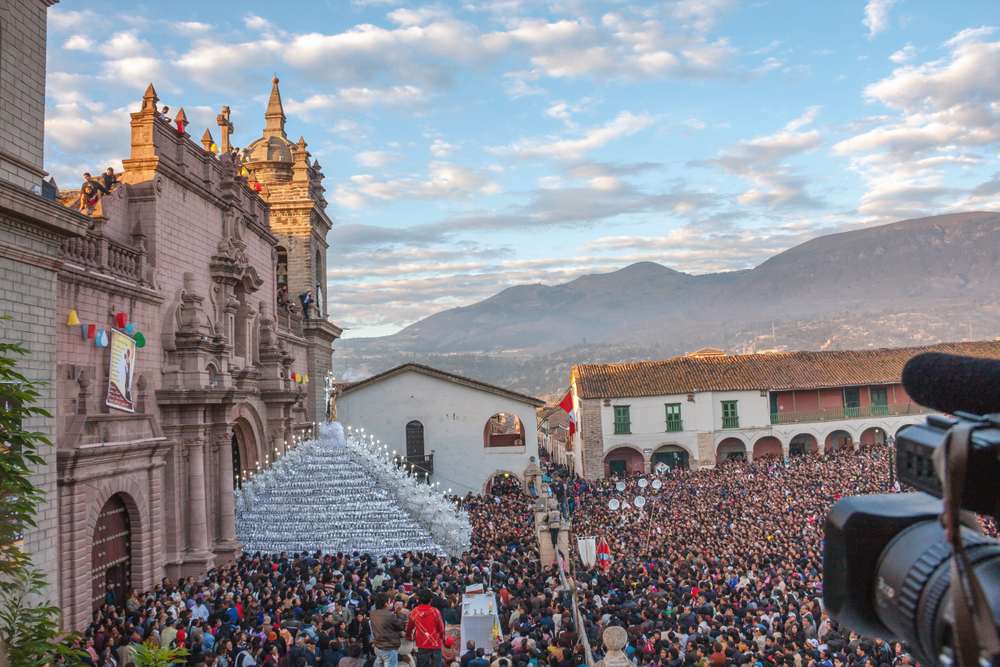
 The traditional procession of Holy Week takes place annually in Ayacucho, Peru. | Credit: Milton Rodriguez/Shutterstock
Jan 21, 2026 / 10:00 am (CNA).
A Pew Research Center report found Catholics remain the largest religious group across Latin America despite increases in other religious identities.
The report, "Catholicism Has Declined in Latin America Over the Past Decade," draws on a nationally representative face-to-face survey of 6,234 adults conducted from Jan. 22 to April 27, 2024, in Argentina, Brazil, Chile, Colombia, Mexico, and Peru.
The analysis was produced by Pew Research Center as part of the Pew-Templeton Global Religious Futures project, which analyzes religious change and its impact on societies around the world.
The research released Jan. 21 found that Latin American adults are more religious than adults in many other countries Pew has also surveyed in recent years, especially in Europe where many adults have left Christianity since childhood.
Pew analyzed the changes in religion among adults in Latin America from 2013 to 2024. It found Latin Americans are about as likely to believe in God as they were a decade ago. Even among those who identify as religiously unaffiliated, most said they believe in God.
Of those surveyed, 97% of adults in Peru said they believe in God, 98% in Brazil, 94% in Mexico, 97% in Colombia, 90% in Argentina, and 89% in Chile.
Most adults are active in their faith, poll showed
Catholicism remains the largest religion in Latin America. In 2024, roughly half of Brazilians (46%) and Chileans (46%) identified as Catholic, and the majority of all adults in Peru (67%), Mexico (67%), Colombia (60%), and Argentina (58%) identified as such.
In those countries, most adults are active in their faith. In 2024, the majority of adults in Brazil (76%), Colombia (71%), and Peru (58%) said they pray "daily or more often."
Since 2013–2014, the Catholic population in all six countries surveyed decreased. Colombia experienced the largest decline in Catholics, with a drop of 19 percentage points. Peru had the lowest drop with a 9-point decrease.
Former Catholics in Latin America tend to identify as either religiously unaffiliated or Protestant, while former Protestants tend to have become "nones." As of 2024, there were more religiously unaffiliated adults than Protestants in Argentina, Chile, Colombia, and Mexico.
The report noted a reason for the decline of Catholicism and growth of religiously unaffiliated populations in Latin America is religious switching by adults who were raised Catholic but no longer identify with the religion. Across the six Latin American countries surveyed, around 20% or more adults said they were raised Catholic but have since left the religion.
The research found that Brazil is the only country surveyed where former Catholics are more likely to have become Protestant (13%) than to be religiously unaffiliated (7%). It also found that in Peru there is a roughly equal number of former Catholics who have become Protestants (9%) and "nones" (7%).
Pew also found that about half or more of adults surveyed in Brazil, Colombia, Mexico, and Peru said religion is very important in their lives. Prayer is fairly common, as majorities of Brazilian, Colombian, and Peruvian adults said they pray at least once a day.
Hispanic Catholics in the U.S.
Similar to the religious changes in Latin America, fewer Hispanics in the United States identify as Catholic in 2024 (42%) than they did a decade ago (58%), according to Pew Research Center's 2023-24 Religious Landscape Study.
The number of Hispanics who are religiously unaffiliated has also increased in the U.S. since 2014, with about a quarter now describing their religious identity as atheist, agnostic, or "nothing in particular."
Of Hispanic adults in the U.S., 40% said religion is very important in their life, and 47% said they pray at least daily. A large majority (83%) also said they believe in God, according to a 2023 Pew Center survey.