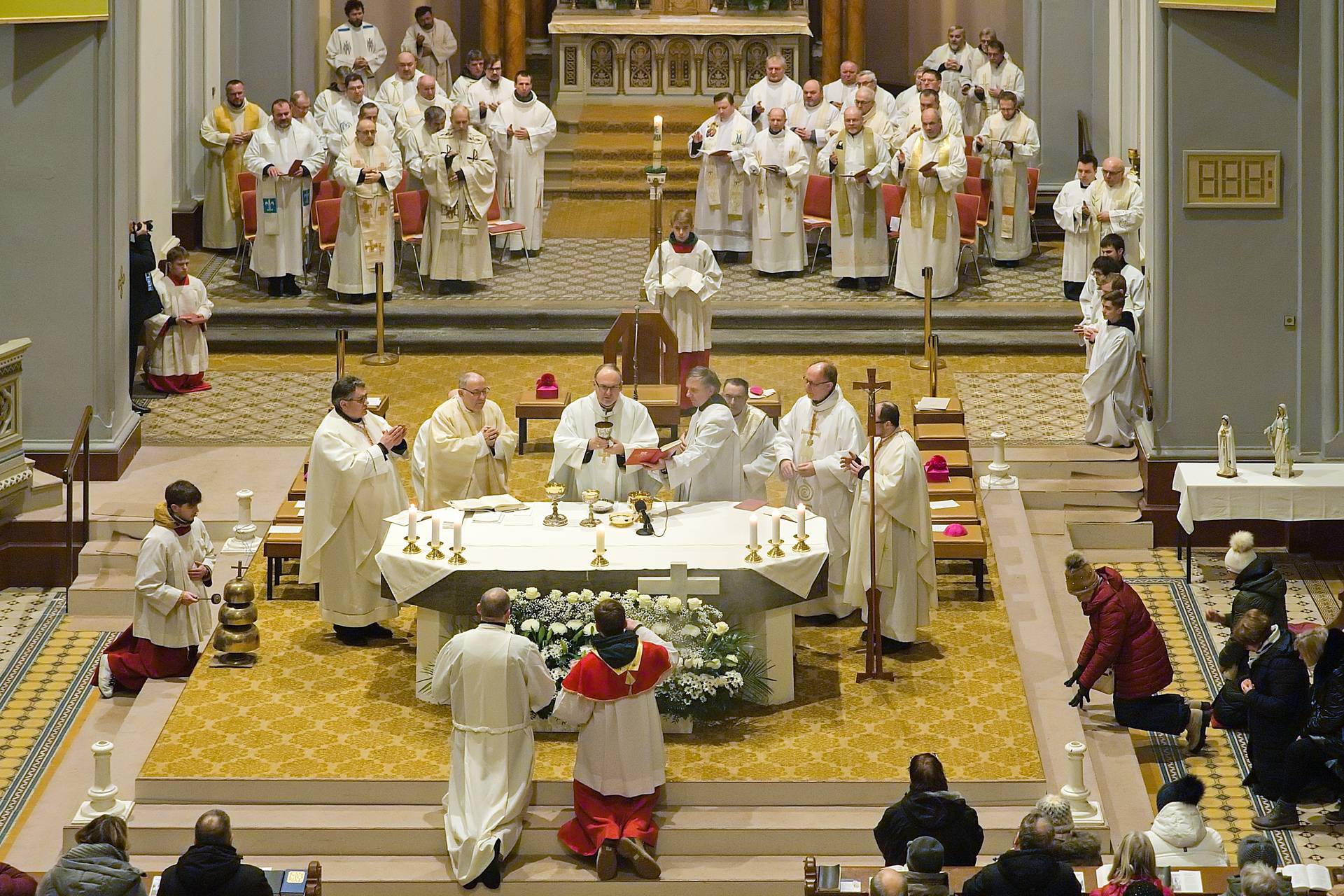
 Bishop Stanislav Pribyl of Litomerice celebrates Mass with Bishop Wolfgang Ipolt of Görlitz, Germany, and other clergy at the Basilica of Mary, Help of Christians in Filipov, Czech Republic, on Jan. 13, 2025, during the annual pilgrimage commemorating the 1866 healing of Magdalena Kade. | Credit: Lubomír Holý/Clovek a víra
Jan 13, 2026 / 12:11 pm (CNA).
Eighty years after the expulsion of ethnic Germans from Czechoslovakia, a Czech bishop has declared a local Year of Reconciliation to address wounds that remain from World War II and its aftermath.
Bishop Stanislav Pribyl of Litomerice announced the initiative in a pastoral letter dated Dec. 31, 2025, following the end of the Jubilee of Hope on Jan. 6. The year marks two anniversaries on Jan. 13: the 1866 healing of Magdalena Kade and the 1946 founding of Ackermann-Gemeinde, a Catholic reconciliation group established by expelled Germans.
"The end of World War II brought not just joy and relief but also reckoning with people and the past," Pribyl wrote in his letter. The war's aftermath caused displacement and resettlement of populations across Central Europe, leaving lasting scars on the region.
After Nazi Germany annexed the Sudetenland in 1938 and established the Protectorate of Bohemia and Moravia, the majority-German region became part of the Reich. Following Germany's defeat, Czechoslovakia expelled approximately 3 million ethnic Germans between 1945 and 1946, primarily from the Sudetenland region that now forms part of the Diocese of Litomerice.
The bishop acknowledged that the question of whether the expulsions were justified remains a matter for historical debate. However, the displacement remains visible in demolished houses without owners and in churches that are abandoned or slowly being rebuilt.
Confronting collective guilt
The bishop emphasized that collective guilt, anger, and desire for revenge accompanied the displacement, along with "the sudden acquisition of property without work and closer ties to the place." Some departing Germans were robbed, raped, or humiliated, a few committed suicide, and there were several massacres, Pribyl wrote.
Following a meeting of the diocese's priests' council in November, Pribyl declared the local jubilee of forgiveness and reconciliation. Monthly gatherings will take place in locations where the deportation was particularly cruel, including Terezín (Theresienstadt), which hosted a Nazi transit camp during World War II.
The events will include Christian-Jewish prayer services and Masses of reconciliation. The bishop hopes for "an ecumenical and interfaith spirit" at these gatherings, welcoming Christians, Jews, and Heimatsleute — Germans with deep historical ties to the region.
The press office of the Diocese of Litomerice told CNA that the jubilee is local and invitations were not sent out broadly. "This is not politics or a revision of history, although historians partake in the preparation," the press office said.
Heinrich Rüdiger, military attaché from the German embassy to the Czech Republic, joined the first event at Filipov on Jan. 13 marking the anniversary of the healing miracle.
Ackermann-Gemeinde's reconciliation work
The Ackermann-Gemeinde was founded in Munich on Jan. 13, 1946 — the feast day of the Marian apparition at Filipov — by expelled Sudeten German Catholics who sought reconciliation with the Czech people despite their own suffering. The organization took its name from "Der Ackermann aus Böhmen" ("The Plowman from Bohemia"), a medieval German literary work from Bohemia symbolizing the deep cultural roots of Germans in the region.
The organization has worked for decades on cross-border partnerships, supporting the restoration of damaged churches and cemeteries in the Czech Republic and advocating for human rights. Since 1991, Ackermann-Gemeinde has maintained an office in Prague.
Filipov shrine
Filipov, a Marian sanctuary in northern Bohemia near the German border, is sometimes called "the Czech Lourdes." On Jan. 13, 1866, Magdalena Kade, bedridden with severe illnesses, received a vision of the Blessed Virgin Mary, who told her: "My daughter, now you are healed."
Kade immediately recovered, and Bishop Augustin Pavel Wahala of Litomerice initiated a commission that recognized the healing and its supernatural character. Between 1870 and 1885, a neo-Romanesque church was built at the site, which Pope Leo XIII elevated to a minor basilica and dedicated to Mary, Help of Christians.
The Redemptorist order took custody of the shrine in 1884 and continues to care for pilgrims. Pribyl is himself a Redemptorist.
Opening old wounds to heal
"You might think that we should stop this reconciliation, as it has been 80 years, it is like taking corpses out of graves," the bishop wrote in his letter. However, he argued that old wounds must be opened to be healed.
The reconciliation effort "may not be definitive, but an important step towards the healing process that our region still needs so much," the bishop said. He noted that in some places, reconciliation is only beginning.
"Although we did not do wrong to our neighbors 80 years ago, we still live from the life-giving movement of forgiveness, as we pray in the prayer that Our Lord Jesus Christ himself taught us: 'Forgive us our trespasses, as we forgive those who trespass against us,'" Pribyl wrote.
The bishop concluded: "Prejudices survive and the reluctance to talk about them or to admit that we have all sinned is still here."
The reconciliation initiative follows recent Czech-Polish-German efforts to address the war's legacy. In November 2025, Polish and German bishops signed a new declaration in Wroclaw marking the 60th anniversary of historic 1965 reconciliation letters.