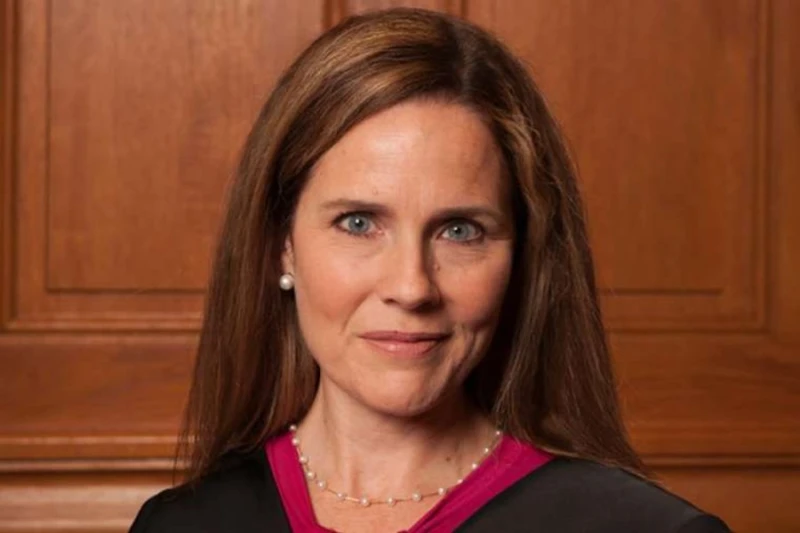
 U.S. Supreme Court Justice Amy Coney Barrett. / Credit: Rachel Malehorn/wikimedia CC BY SA 3.0
Washington, D.C. Newsroom, Dec 26, 2025 / 15:00 pm (CNA).
U.S. Supreme Court Justice Amy Coney Barrett says her Catholic faith "grounds her" and gives her "perspective."
During an interview with Bishop Robert Barron of Winona-Rochester, Minnesota, Barrett tackled a number of topics including free speech, the reversal of Roe v. Wade, and her law career. The U.S. Supreme Court justice also opened up about her Catholic faith, including how she prays and her relationship with the saints.
A 'love for the saints'
When asked which spiritual figures have influenced her, Barrett shared about her relationships with the saints, specifically her love for St. Catherine of Siena and St. Thérèse of Lisieux.
"My favorite was Thérèse of Lisieux. We have a daughter named Thérèse," Barrett said. "I was captivated when I was young by how young she was when she just completely gave her life over to the Lord."
"Her Little Way is so accessible to so many," she said. "I minored in French and I studied in France. It was actually Lisieux, where I was … that's where I decided to go that summer. So I spent a lot of time in the gardens of the Martin home. I think those examples of faith were important to me."
"One thing that we've tried to do with our children is really cultivate in them a love for the saints, because I do think they are great examples that can inspire our love of the faith."
Barrett said she has "prayed in different ways at different phases" of her life. As a law professor, she often prayed a "lectio divina." Now as a judge, she said she tends "to do more reading reflections" and will "read the daily 'Magnificat.'"
A "personal struggle in these last couple of years has been an ability to quiet my mind so that I can pray in a very deep and focused way," she said. Listening to reflections "helps me, if my mind is wandering, to be able to focus on reading something and the task at hand."
The Constitution and the common good
Despite her faith, Barrett also discussed how it is not what can influence her decisions as a judge. "The Constitution distributes authority in a particular way," she said. "The authority that I have is circumscribed."
"I believe in natural law, and I certainly believe in the common good," Barrett said. "I think legislators have the duty to pursue the common good within the confines of the Constitution and respect for religious freedom."
"You have to imagine, 'What if I didn't like the composition of the court I was in front of, the court that was making these decisions, and they view the common good quite differently than I do?' That's the reason why we have a document like the Constitution, because it's a point of consensus and common ground."
"And if we start veering away from that and reading into it our own individual ideas of the common good, it's going to go nowhere good fast."
Roe v. Wade
Barrett said both people who agreed with the Dobbs decision and those who did not "may well assume" she cast her vote based on her "faith" and "personal views about abortion."
"But especially given the framework with which I view the Constitution, there are plenty of people who support abortion rights but who recognize that Roe was ill-reasoned and inconsistent with the Constitution itself," she said.
Barrett further discussed "the trouble with Roe."
"There's nothing in the Constitution … that speaks to abortion, that speaks to medical procedures," she said. "The best defense of Roe, the commonly thought defense of Roe, was that it was grounded in the word 'liberty' and the due process clause, that we protect life, liberty, and property and it can't be taken away without due process of law."
The "word 'liberty' can't be an open vessel or an empty vessel in which judges can just read into it whatever rights they want, because otherwise, we lose the democracy in our democratic society," Barrett said.
The problem with Roe "is that it was a free-floating, free-wheeling decision that read into the Constitution."
The reason why it's difficult to amend the Constitution is because "it reflects a super-majority consensus," she said. "The rights that are protected in the Constitution, as well as the structural guarantees that are made in that Constitution, are not of my making. They are ones that Americans have agreed to."
"Roe told Americans what they should agree to rather than what they have already agreed to in the Constitution."
Free speech and freedom of religion
"I think the First Amendment protects, guarantees, forces us to respect one another and to respect disagreement," Barrett said. "There's a tolerance of different faiths, a tolerance of different ideas … we can see what would happen if you didn't have the guarantee to hold that in place."
"Think about what's happening with respect to free speech rights in the U.K.," Barrett said. "Contrary opinions or opinions that are not in the mainstream are not being tolerated, and they're even being criminalized. Because of the First Amendment, that can't happen here."
If the United States were to have "an established religion, then it would be very difficult to simultaneously guarantee freedom of religion because there would be one voice with which the government was speaking," Barrett explained.
An established religion would "sacrifice the religious liberty," she said. "But by the same token, the religious liberty, it would become self-defeating if the logical end to it was to force everyone to see things your way."
Discernment
At the end of the conversation, Barron asked Barrett what advice she would give young Catholics who want to be involved in public life, law, or the government.
"Discern first," Barrett said. Ask: "What are you called to do?"
"If you do feel like this is a vocation and something you're called to do, I think it can never be the most important thing," Barrett said. "I think being grounded in your faith and who you are and being right in the Lord, so that you're not tossed like a ship everywhere because there are enormous pressures."
Faith "grounds me as a person," Barrett said. "Not because my faith informs the substance of the decisions that I make, it emphatically does not, but I think it grounds me as a person. It's who I am as a person."
"So it's what enables me to keep my job in public life in perspective and remain the person who I am and continue to try to be the person I hope to be despite the pressures of public life," she said.