On June 13 the Church celebrates St. Anthony of Padua, whose widespread popularity can be traced to his efforts at reaching out as a neighbor to all.
The widespread popularity of St. Anthony of Padua, whose feast is celebrated in the Catholic Church on June 13, can be traced to his efforts of reaching out as a neighbor to all peoples, according to the rector of the basilica where the saint's body rests.
"The devotion to the 'Saint of the Peoples' is truly universal perhaps because he himself desired to consider all the world his as his home," Father Oliviero Svanera, rector of the Basilica of St. Anthony of Padua, Italy, told EWTN News.
"He was Portuguese by birth, he went to Morocco to spread the faith, he landed in Sicily by shipwreck, then he went back up the Italian peninsula all the way to Assisi and joined the friars of St. Francis, who sent him all the way to France."
Once St. Anthony returned to Italy he was appointed provincial superior and served in Padua, where he died in 1231.
"It is told that he would speak one language made of a thousand accents but which was understandable to all," Svanera said. "As such, he was a neighbor to all: to the poor, to people in difficulty, to the sick. In this, his being 'brother of all' is perhaps his universality, something that renders him a friend of all the peoples of the world, beyond nationality, culture, and even religions, given that St. Anthony is respected even by those who do not profess the Catholic faith."
St. Anthony was born as Fernando Martins in Lisbon around 1195, and when he was 15 he entered the Abbey of St. Vincent with the Canons Regular of St. Augustine and was ordained a priest.
In 1220 he was deeply moved when he encountered the relics of five Franciscan missionaries who had been martyred in Morocco. He was allowed to leave the Augustinians to join the Order of Friars Minor, where he took the name Anthony. He worked as a preacher and laid the foundations of Franciscan theology.
He was canonized in 1232, only a year after his death, by Gregory IX, who had heard him preach and called him the "Ark of the Testament."
It was also in 1232 that construction of the basilica that houses St. Anthony's body was begun. It was finished at the beginning of the 14th century.
Svanera explained the famous "Tredicina" that takes place before St. Anthony's feast day.
"The word 'Tredicina' [refers to] the 13 days of meditation and spiritual preparation for the solemnity of the saint — that is, from May 31 to June 13. Every day those devoted to St. Anthony invoke the intercession of the saint through a particular prayer ... to entrust themselves to the mercy of God the Father. These are the days in which the basilica becomes the goal of pilgrims, both individuals and those organized in groups, and our sanctuary becomes truly universal, as in these days of veneration and prayer there are tens of thousands of pilgrims who come here from every country of the world."
The priest also explained the story behind another popular tradition related to the famous saint called the "Bread of St. Anthony."
"The birth of this tradition of charity has its roots in one of the 'miracles' of the saint, that of Tommasino, a baby of 20 months who drowned in a washtub," Svanera said. "The desperate mother invoked the help of the saint and vowed that if she would obtain this grace, she would give to the poor the child's weight in bread. And the little one returned miraculously to life."
This gave rise, he said, to two Antonian works faithful to the spirit of St. Anthony: the Bread Work of the Poor ("l'Opera Pane dei Poveri") — an organization in Padua that works to bring bread and other necessities to people in difficulty; and also Caritas Sant'Antonio, which supports many development projects in dozens of countries around the world.
Svanera also highlighted the key lessons of St. Anthony's life.
"St. Anthony's preaching was always capable of provoking the hearts of everyone," he said. "And this too is thanks to his exemplary life and his humility, which he learned from Most Holy Mary, to whom he was profoundly devoted."
He continued: "St. Anthony proclaimed the Gospel which conquers the temptation of power, the temptation of pride, the temptation ... of worldliness ... Through his love, St. Anthony knew to stoop for the other (refugee, migrant, unemployed, alone, sick, imprisoned, marginalized, poor) and to take care of him. We will thus be effective Christians of a Church which goes forth if, like St. Anthony, we manage to go forth from ourselves to preach Christ crucified, following him with a style of humility, of true humility, a humility full of love."
This story was first published on June 13, 2017, and has been updated.
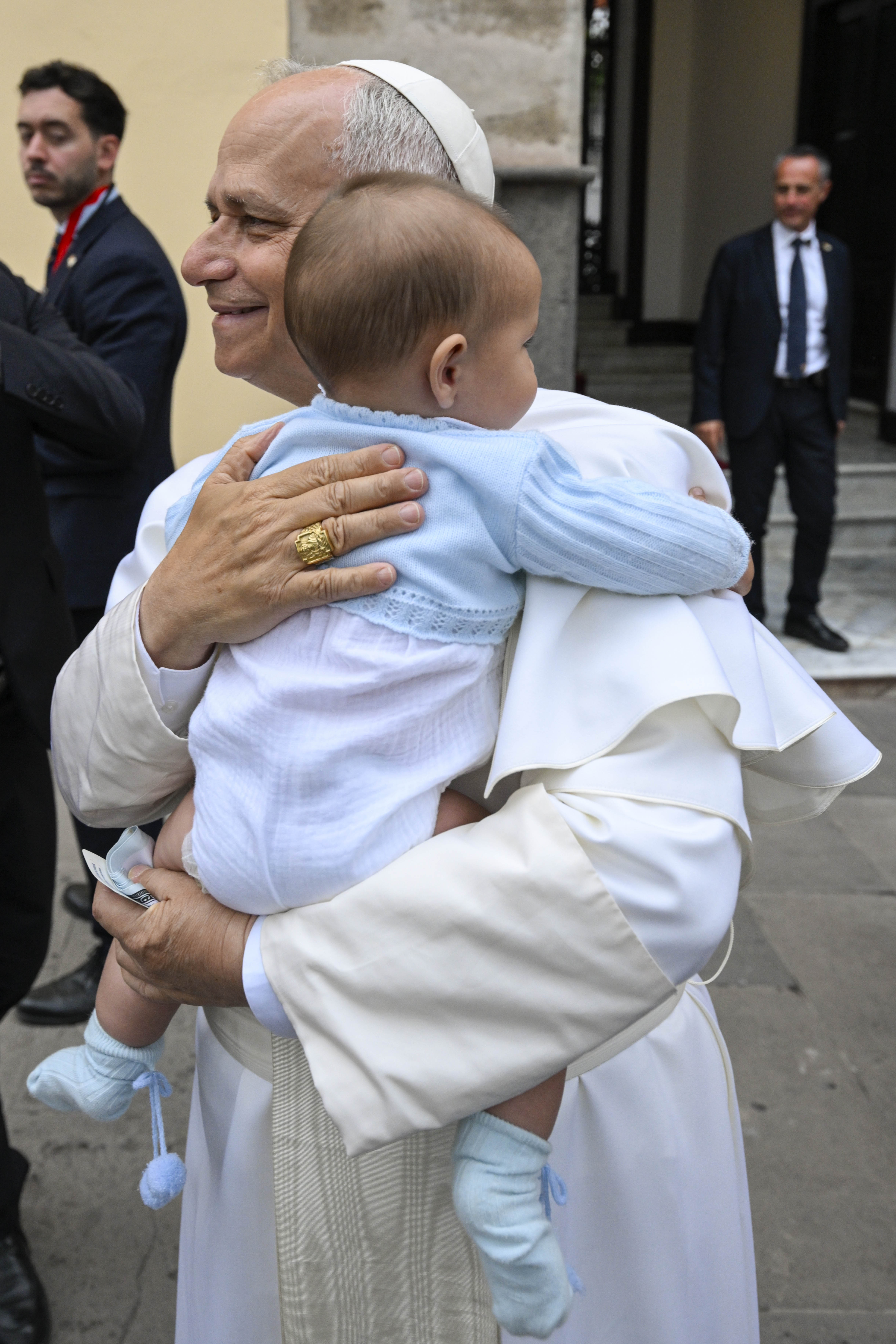
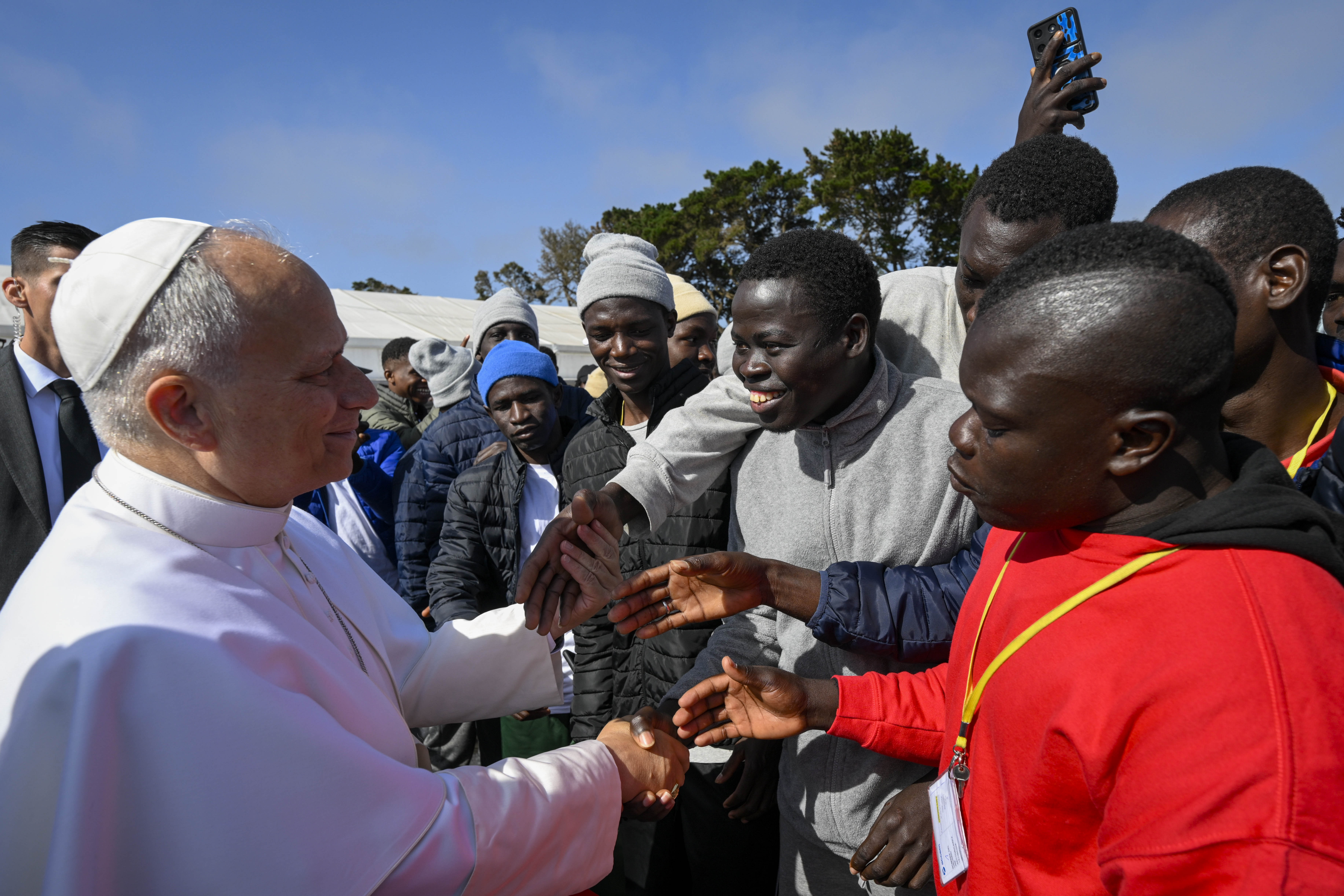
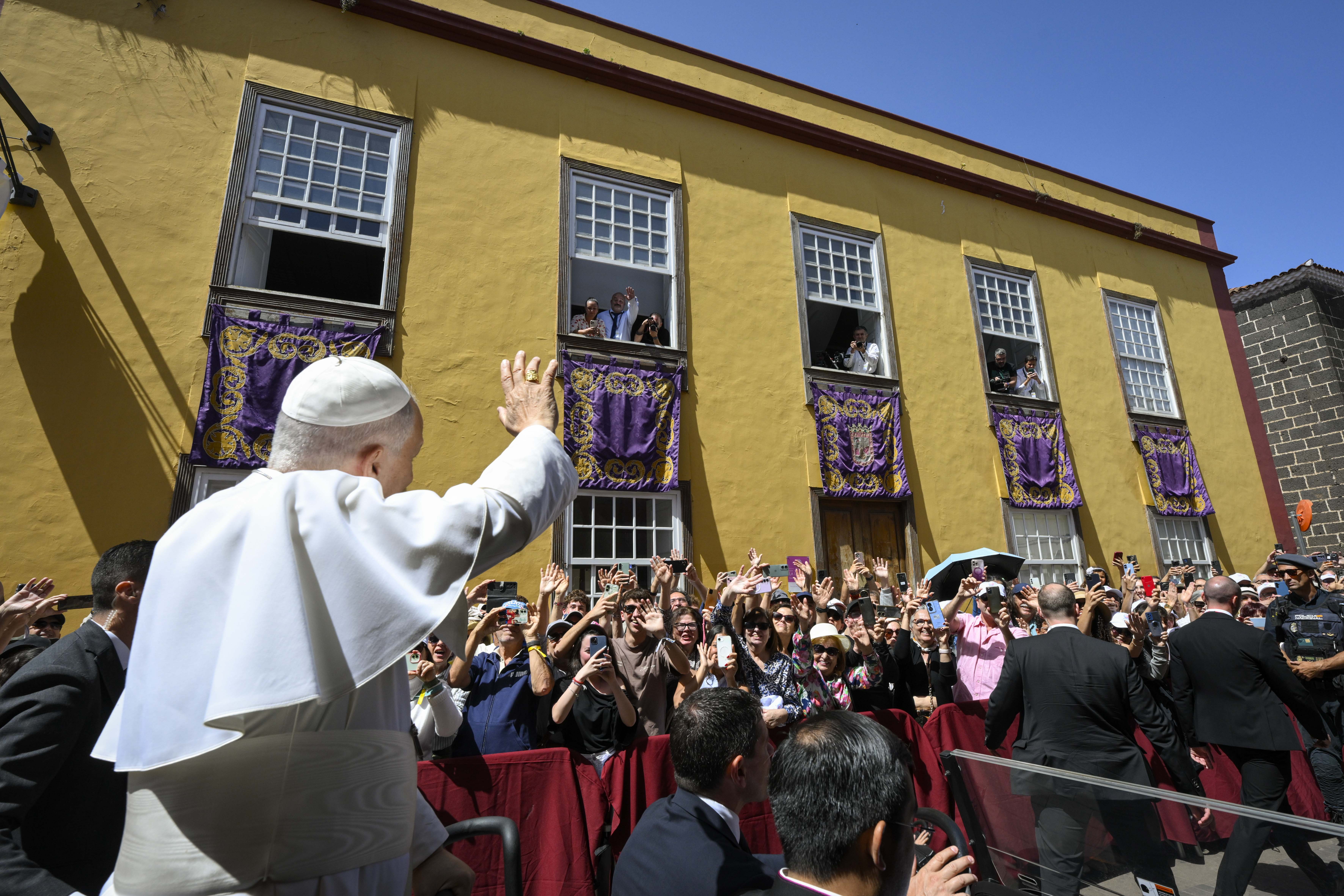
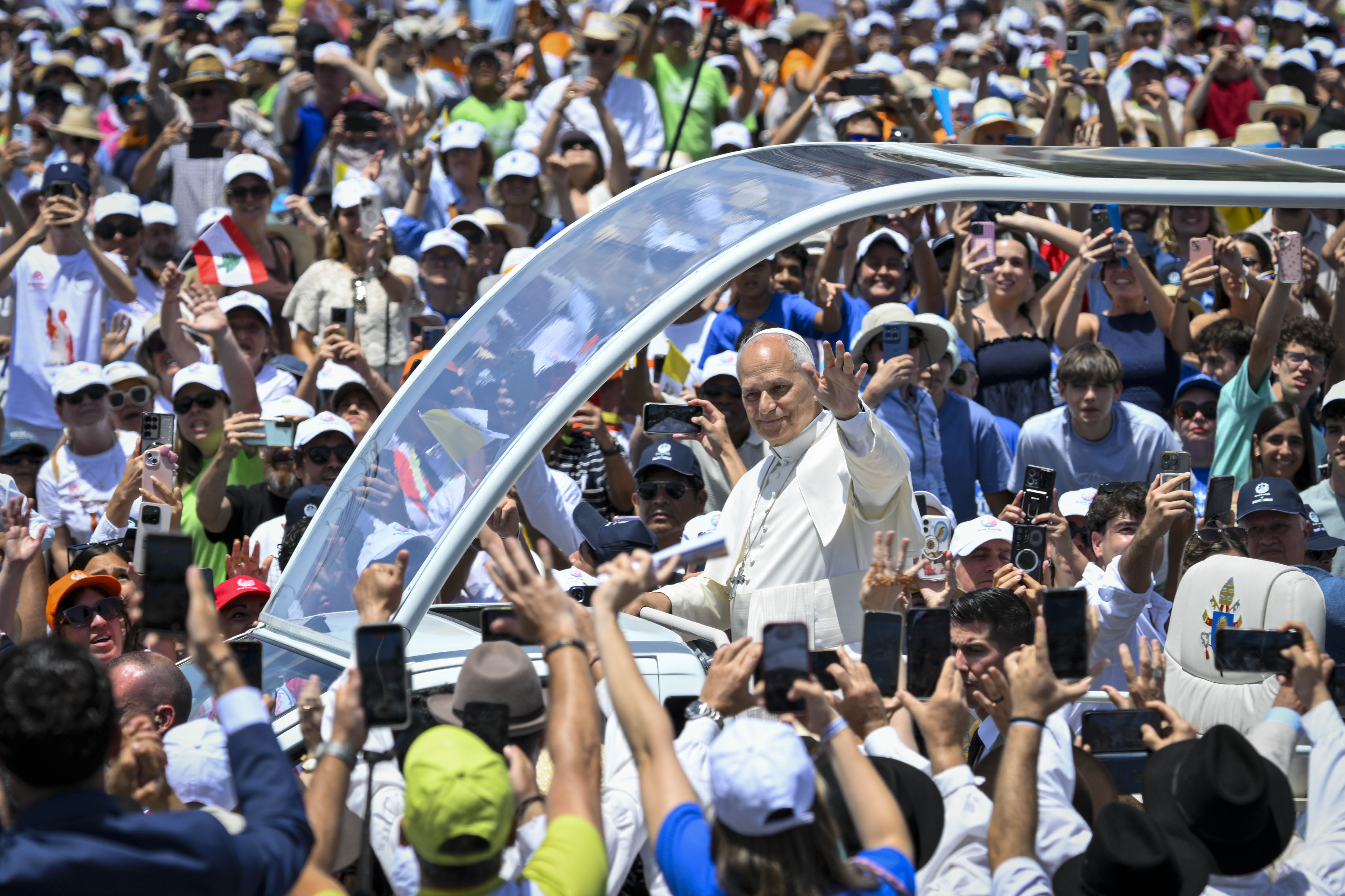
The Holy Father's visit from June 6–12 took him to Madrid, Barcelona, the Canary Islands, and Tenerife.
From packed squares and emotional encounters with the faithful to emphatic calls for peace, unity, and evangelization, Pope Leo XIV's recent visit to Spain offered no shortage of memorable moments. The Holy Father visited Madrid, Barcelona, the Canary Islands, and Tenerife from June 6–12.
Throughout his journey, the pope connected with Catholics across the country while highlighting Spain's rich spiritual heritage and encouraging believers to renew their faith in an increasingly secular world.
Here is a look at 10 of the most powerful moments from Pope Leo's visit to Spain:
1. Over a million Catholics join Pope Leo for Corpus Christi procession in Madrid
One of the most stunning moments came during the Eucharistic procession on the solemnity of Corpus Christi when 1.6 million people gathered in the famous Plaza de Cibeles in Madrid to be a part of the pope's celebration of Mass, procession, and Eucharistic blessing.
In Madrid, Pope Leo said Corpus Christi is "more than just another celebration on the liturgical calendar ... It is a way of returning to the heart of the faith to renew our love and fidelity to God."
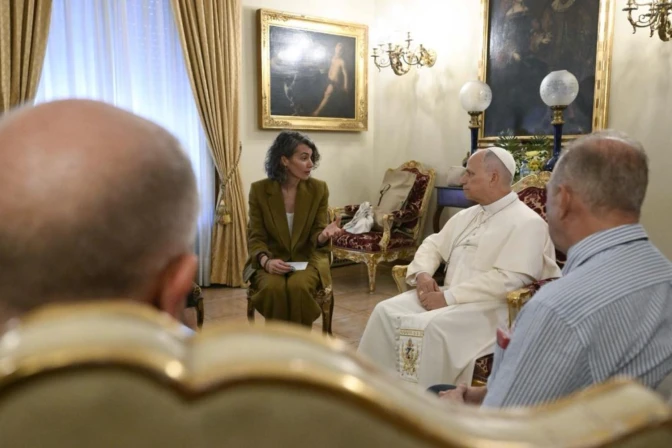
On the third day of his apostolic journey to Spain, Pope Leo met with six victims of abuse committed "by members of the clergy and the Church" in the country.
The victims, the Vatican stated, were "accompanied by Church personnel engaged in supporting and accompanying victims."
During the hourlong meeting, the victims shared their "painful personal experiences" with the Holy Father, and each person presented him with "proposals to make the Church's response to such tragic cases more effective."
Shortly before meeting with victims, the Holy Father urged the Spanish bishops to respond to the "scourge" of abuse in the Church "with listening, truth, justice, reparation, and an ever-more-determined commitment to prevention and a culture of care."
"Every wounded person must be able to find sincere listening, welcome, protection, and real paths to healing," the Holy Father said.
Pope Leo XIV meets with abuse victims in Madrid. | Credit: Vatican Media
3. Pope Leo becomes first pope to address Spanish Parliament
Pope Leo XIV became the first pope in history to address the Spanish Parliament when he spoke to lawmakers on Monday, June 8, the third day of his apostolic journey.
Although he is the third pope to visit Spain, after St. John Paul II and Pope Benedict XVI, none of Leo's predecessors addressed the legislative body representing the Spanish people.
The pope received nearly seven minutes of applause at the end of his speech, which urged lawmakers to protect human life from conception until natural death.
4. Pope honors Our Lady of Almudena with Golden Rose
One of the greatest devotions among Spanish Catholics is to Our Lady of Almudena — the patron saint of Madrid.
According to tradition, as Moorish forces invaded the region in A.D. 712, the citizens of Madrid secretly hid their beloved statue of the Virgin Mary inside the thick stone walls of the city's fortress, leaving two lit candles beside it. In 1085, after King Alfonso VI reconquered Madrid, the Christians searched for the statue. While processing around the city walls, a section of the wall miraculously crumbled, revealing the statue perfectly preserved with the candles still burning after centuries.
On June 8, that enduring devotion received one of the Church's highest marks of recognition when Pope Leo XIV bestowed a Golden Rose upon the historic statue.
"As a symbol of the pope's filial love for the Virgin Mary, I will place a Golden Rose at her feet," Leo said during a ceremony at Madrid's Cathedral of Santa María la Real de la Almudena.
The papal honor — one of the highest distinctions a pope can bestow upon a Marian image or shrine — recognizes the deep devotion generations of Spanish Catholics have shown to the Blessed Virgin under the title of Almudena.
The exact origin of the gifting of a Golden Rose is unknown, although it is considered one of the oldest papal traditions. The earliest reliable record dates to 1096, when Pope Urban II sent one to Fulcone d'Angers.
5. Pope Leo entrusts his pontificate to Our Lady of Montserrat
While in Montserrat, the Holy Father visited the Abbey of Montserrat, which is nestled among towering rock formations that resemble sculpted figures of animals or objects.
At the foot of Montserrat, after praying the rosary, the pope lifted up his prayer: "Let us ask her to help us clothe ourselves only with the armor of God."
He added: "Let us also consider how the Virgin holds the globe in her right hand, a sign of her maternal care, for the whole world finds a place in her heart. She invites us to recognize one another as brothers and sisters, so that no one is excluded and that communion is stronger than every division," he added.
The image of Mary currently venerated is a 12th-century Romanesque wooden sculpture, just over 3 feet tall, depicting the Blessed Virgin Mary with the Child Jesus. Except for the faces and hands, the statue is covered in gold, while the Virgin's dark complexion has earned her the popular nickname "La Moreneta."
"I am happy to come to the feet of La Moreneta to entrust to her, with full confidence in her maternal intercession, my Petrine ministry and the mission of the Church in a world that cries out for justice and peace," the pope said.
Pope Leo XIV venerates a 12th-century wooden sculpture of Mary with the Child Jesus in the Abbey of Montserrat, outside of Barcelona, Spain, on June 10, 2026. | Credit: Daniel Ibanez/EWTN News
6. Pope Leo prays with young man's rosary — then gives it back to him
While in Barcelona, an encounter between the pope and a young man named Sergi went viral.
During the pope's visit to the Shrine of Our Lady of Montserrat, Sergi handed Leo his rosary. The pontiff slipped it into his pocket before using it minutes later to pray during the event.
"I just wanted him to bless it, that's all, but he asked me, 'Is it for me?' And I'm not going to say no, so of course I said yes, and he kept it," the young man told EWTN News.
But the story didn't end there. Unexpectedly, after the event, Sergi managed to recover his prized sacramental, now prayed with by the pope.
7. Pope Leo visits the tomb of Venerable Antoni Gaudí
Before celebrating Mass at the Sagrada Familia Basilica in Barcelona, ??Pope Leo took time to visit the crypt, pray before the Blessed Sacrament, and light a candle at the tomb of Venerable Antoni Gaudí, who designed the iconic basilica more than a century ago.
Gaudí, known as the "architect of God," died in 1926 and is buried in the basilica crypt. He was known for his intense personal faith and devotion to the building of the Sagrada Família.
The Vatican announced April 14, 2025, that Pope Francis had formally recognized Gaudí's "heroic virtue," a key step in the canonization process. Two miracles attributed to Gaudí's intercession are now required for his canonization.
8. Pope Leo celebrates Mass in iconic Sagrada Familia Basilica
One of the historic milestones of Pope Leo's visit to Spain was the opportunity to realize Antoni Gaudí's dream: the inauguration and blessing of the Tower of Jesus Christ, coinciding exactly with the centenary of the great architect's death.
The spectacular central spire is crowned by a white cross that makes the basilica the tallest in the world and will be open to visitors starting in 2028.
After Mass, Leo XIV stepped outside to bless and inaugurate the Tower of Jesus Christ — beforea stunning celebration of lights and sacred music — in which the pope, rather than simply putting his stamp on a finished work, charted a course for Christians.
"The Sagrada Família is the tallest church in the world — not to stand out in worldly rankings but to guide the steps of God's people journeying through this land of Catalonia, with the cross illuminating the path like a lamp lit in anticipation of the Bridegroom's return," he affirmed.
"The entire city of Barcelona and all of Catalonia gather in this temple — itself a sign of unity and harmony for all of Spain — and lift their gaze to encounter the face of God the Father, resplendent in his Son-made-man, Jesus Christ," the pope added.
9. Pope Leo blesses a cross made of wood from the boats of migrants
At the Port of Arguineguín in Gran Canaria — a place that became a symbol of the migration crisis in the Canary Islands — Pope Leo offered a powerful witness to the dignity of every human person. Standing at a dock marked by the suffering and loss of those who arrived after dangerous journeys across the Atlantic, he prayed for migrants, denounced human trafficking, and called the world to a deeper examination of conscience.
The visit concluded beside the image of Our Lady of Mount Carmel, patroness of seafarers, where the Holy Father blessed a memorial cross made from the wood of migrant boats and erected in honor of those who lost their lives at sea. Entrusting migrants and all who undertake perilous journeys to her maternal care, he transformed a place once known for tragedy into a sign of hope and remembrance.
10. Pope Leo gives a powerful message to human traffickers
During the last day of his papal trip, Pope Leo raised his voice with unusual force.
In Tenerife, he spoke against human traffickers — those who charge staggering sums to allow migrants cross the ocean and those who enslave them mercilessly.
"For every life lost, every family deceived, every body subjugated, every woman threatened, every worker exploited, you will have to appear before divine justice," the pope said.
"Break those chains and free those you hold in bondage," he added. "Return what has been taken and make amends as much as you can."
Leo declared strongly: "Stop. Repent."
To those who profit from the suffering of others, the Holy Father left open the door of return to God.
"Repent while there is still time," he said, "for God's mercy can reach even the most hardened sinner, but it enters only through the narrow gate of truth, justice, and conversion."
Kenyan police have arrested a suspect in the May 2025 murder of Father Allois Cheruiyot Bett, who was shot while returning from a Eucharistic celebration in Kenya's troubled Kerio Valley region.
The arrest marks a significant breakthrough in investigations into the killing that shocked both the local community and the Catholic Church.
In a June 10 press briefing, the Officer Commanding Police Division (OCPD) for Marakwet East, Zablon Okoyo, identified the suspect as Meshack Kilimo and said he was apprehended through intelligence-led operations.
"Luckily enough, we managed to arrest one suspect by the name Meshack Kilimo. It is unfortunate that this one guy is also part of the reformed bandits that we have managed to tame. But of course, you know, human beings have different traits and characters. As for him, he has not changed," Okoyo said.
He explained: "We used our wits and managed to arrest the fellow yesterday. As we are talking today, he is supposed to be arraigned before the law courts by our Directorate of Criminal Investigations (DCI) department."
According to a June 10 report by The Star, a Kenyan publication, Kilimo was "arrested after he shot dead another man using an arrow during a quarrel over clan land in the same Kerio Valley area."
In the June 10 press briefing, Okoyo said investigations remain active and are being led by the DCI in Kenya.
"We shall prosecute the case accordingly, according to the witnesses and the evidence that we have gathered," he said, and added: "The case of the late Father Alois is within the DCI. The DCI opened a case and is still very active. Now that the suspect has been apprehended and presented before the magistrate, I believe all avenues will be opened."
The police commander cautioned that investigators are still examining whether the evidence collected directly links the suspect to the murder of the priest.
"If at all, the evidence that has been adduced and collected and placed in the active case of the late Father will connect to him, then I think it is a case that is going to come up very soon. But I can't preempt as of now because the officers handling the case are with the suspect right now before the court," Okoyo said in the press briefing.
Bett, a priest of Eldoret Diocese, died from gunshot wounds after being ambushed by armed assailants at Kabartile Village in Mokoro Location, Elgeyo Marakwet County. He was serving as pastor of St. Matthias Mulumba Tot Parish at the time of his death.
In a statement issued on the day of the attack, Kenya's National Police Service (NPS) said preliminary investigations indicated that the killing was not related to cattle rustling or banditry, despite the region's long history of armed criminal activity and intercommunal conflict.
Bett was laid to rest on June 3, 2025, at Holy Family Parish in Nandi County, the day after his funeral Mass at the Sacred Heart of Jesus Cathedral of Eldoret Diocese.
Since the priest's murder, security operations in the Kerio Valley have intensified as authorities continue efforts to restore stability in the region, The Star reported on June 10.
According to the report, government officials have confirmed recovering more than 500 firearms through the ongoing amnesty and disarmament program, and that hundreds of former bandits have undergone rehabilitation.
Speaking recently on the broader security situation in Kerio Valley, Cabinet Secretary for Interior and National Administration Kipchumba Murkomen attributed persistent insecurity in the region partly to environmental degradation.
Murkomen said shrinking grazing land, drying rivers, and declining natural resources have intensified competition among communities and contributed to cattle rustling, banditry, and violence.
He argued that lasting peace would require not only security operations but also environmental restoration and sustainable economic opportunities for young people through initiatives such as tree planting, rehabilitation of water sources, agroforestry, beekeeping, and ecotourism.
This story was first published by ACI Africa, the sister service of EWTN News in Africa, and has been adapted by EWTN News.
The move comes amid mounting evidence linking heavy social media use to increased rates of anxiety, depression, sleep disruption, and distorted body image among youth.
In a significant step to safeguard young people from the documented dangers of social media, the Canadian government has introduced legislation that would prohibit children under 16 from creating accounts on major social media platforms.
The proposed Safe Social Media Act, introduced in the House of Commons on Wednesday by Culture Minister Marc Miller, would ban children under the age of 16 from creating social media accounts on Instagram, TikTok, Snapchat, Facebook, and similar platforms.
The move comes amid mounting evidence linking heavy social media use to increased rates of anxiety, depression, sleep disruption, and distorted body image among youth.
Canadian officials cited studies showing that platforms designed to maximize engagement often exploit the vulnerabilities of adolescent brains still developing impulse control and judgment.
The legislation requires platforms to implement age-verification systems and to delete any existing accounts belonging to users under 16.
Under the bill, social media companies would be required to conduct risk assessments and take concrete steps to mitigate harms to young users. This includes limiting addictive design features such as infinite scrolling, autoplay videos, and personalized algorithmic feeds that target children.
Platforms must also provide robust tools for reporting harmful content, blocking users, and protecting against material that promotes self-harm, eating disorders, bullying, hate speech, violence, or the sexual exploitation of minors.
The legislation would create a new Digital Safety Commission of Canada to oversee enforcement. Companies that fail to comply could face significant penalties of up to $10 million or 3% of their global annual revenue, whichever is greater.
Adult-oriented websites, particularly pornography services, would face even stricter rules with very limited exemptions. The bill excludes gaming platforms such as Roblox and AI chatbots from the under-16 ban but still requires them to meet certain safety standards.
The Safe Social Media Act also mandates that platforms submit and publicly disclose detailed "Digital Safety Plans" outlining how they will protect young users.
The Canadian proposal aligns with a broader global trend of governments stepping in to protect children. Last year, Australia became the first country to ban social media for teens under 16, though the law's effects remain mixed.
Australia's online safety regulator, eSafety, reported in March that while social media platforms had taken "some steps" to comply with the country's ban on users under 16, a "substantial number of children" still retained accounts on the restricted platforms.
The compliance update revealed that approximately 4.7 million under-16 accounts were removed or restricted by mid-January, with another 310,000 blocked in the following weeks.
However, eSafety expressed concerns over ongoing gaps, including weak age verification, poor reporting systems, and practices that allowed children to repeatedly attempt age checks until they gained access. The regulator is now investigating major platforms — including Facebook, Instagram, Snapchat, TikTok, and YouTube — for potential noncompliance.
Meanwhile, earlier this year, both France's National Assembly and the Senate approved a bill that would prohibit children under 15 from using major social media platforms. The measure also includes a ban on mobile phones in high schools. If finalized, the restrictions are expected to take effect in September, making France the first European country to impose such limits.
France's president, Emmanuel Macron, said last year he would push for a ban on social media for children under age 15 after "a senseless wave of violence" he attributed to social media use that included the stabbing of a teacher by a 14-year-old boy.
"I am banning social media for children under 15," Macron wrote in a social media post on June 10, 2025. "Platforms have the ability to verify age. Do it."
Closer to home, Catholic leaders in the United States are voicing strong support for similar protections. The bishops of Minnesota recently praised state legislation limiting social media's addictive features for children under 16, including infinite scrolling, algorithmic feeds, and push notifications.
In a statement, the bishops highlighted how such measures promote healthier habits and allow young people to engage more fully with family, faith, and real-world relationships.
"These restrictions will mean happier kids who are less anxious, less worried, and more focused on the present moment," a spokesperson for the Minnesota Catholic Conference noted.
"We condemn in the strongest terms this action and affirm that hate has no place in our country, our city, and our hearts," the archbishop of Chicago said.
Cardinal Blase Cupich decried the burning of a large cross in Grant Park in Chicago after video of the incident surfaced online.
"Burning crosses, dramatic expressions of hatred designed to terrorize, were once sadly commonplace in our country," Cupich said in a June 10 statement. "Yesterday, we were reminded that the sickness of spirit they symbolize exists not only in the pages of history but in our present day. Seeing a burning cross in one of Chicago's most-visited public parks was shocking but not surprising."
Cupich's statement comes after video footage circulated online of a large cross being burned along a sidewalk in the Loop at Grant Park.
According to a June 11 community alert from the Chicago Police Department (CPD), the incident took place at 2:38 p.m. on June 9. CPD also released images of the suspect, a shirtless male with a black backpack, fleeing the scene.
CPD confirmed to EWTN the suspect has not yet been apprehended.
"We condemn in the strongest terms this action and affirm that hate has no place in our country, our city, and our hearts," Cupich said. "We pledge to work with our city's faith and community leaders to redouble our efforts to share the Gospel message that we are all children of God, made in his image."
The bishops' conferences of the G7 countries emphasized the dignity of the human person amid ongoing wars, technological innovation, environmental concern, and global economic inequity.
The heads of the Catholic bishops' conferences for every country in the Group of Seven (G7) are encouraging government leaders to prioritize the dignity of the human person, global peace initiatives, and environmental issues in the upcoming summit.
Leaders from the seven global powers — the United States, Canada, France, Germany, Great Britain, Italy, and Japan — will meet for the annual G7 summit in Evian-les-Bains, France, from June 15–17. G7 summits focus on issues of international cooperation among the powers.
On June 12, ahead of next week's meeting, the heads of the bishops' conferences from each power issued a joint statement outlining their priorities. It touches on ongoing conflicts, such as the Russia-Ukraine war and wars in the Middle East, and emerging technology such as artificial intelligence (AI).
"Amid armed conflict, geopolitical fragmentation, the crisis of multilateralism, growing inequalities, climate disruption, and accelerating technological change, we affirm that the dignity of the human person must remain the foundation of political and economic governance," the bishops wrote to the political leaders.
Peace efforts
The bishops encouraged the nations to cooperate with one another on peace efforts and adhere to international laws, warning that geopolitical tensions are causing international order to erode and stating that international institutions like the G7 are "indispensable for preventing conflicts."
Some concerns listed by the bishops are the protecting of civilians and promoting justice among people. The document urges G7 powers to "strengthen these institutions so that they might better serve the global common good." The bishops also emphasized safeguarding religious freedom and protecting religious minorities, families, prisoners of war, and the displaced.
"Churches and religious communities can help rebuild trust, accompany those wounded by war, and create the social and moral conditions for lasting peace," the bishops wrote. "Through its local presence, humanitarian commitment, and capacity to build bridges among peoples, the Catholic Church remains a credible partner for peace and dialogue."
Development and technology
The bishops encouraged G7 countries to work in solidarity with the Global South and took issue with reductions in development assistance for developing countries.
"As humanitarian needs grow across the world, millions of people are seeing their access to food, healthcare, education, and protection eroded," they wrote. "We call upon G7 states to renew their commitment to international solidarity and to an equitable partnership with countries of the Global South. Development policies must focus above all on poverty reduction, food security, access to education and healthcare, and the protection of the most vulnerable."
The bishops added that industrialized countries should ensure economic partnerships with other nations are grounded in equity, the rights of local populations, decent working conditions, and environmental protections.
With respect to AI, the bishops recommended global rules that ensure the innovation serves the human person and the common good, and referenced Pope Leo XIV's guidance on the subject in his encyclical Magnifica Humanitas, in which the Holy Father called to "disarm AI."
"To disarm means discrediting the assumption that technical power automatically confers the right to govern," Leo wrote, which was quoted in the bishops' letter to the G7 leaders.
"To disarm does not mean rejecting technology but preventing it from dominating humanity," the pope added. "It means freeing technology from monopolistic control and opening it to discussion and debate, therefore making it human-friendly and restoring it to the plurality of human cultures and ways of life. … Merely regulating it is insufficient; it must be disarmed, welcoming, and accessible."
The bishops wrote that AI "must remain under human control and be governed by clear ethical principles." They said it must be directed toward the common good, justice, transparency, and inclusion. They added that it "must never lead to the dehumanization of social relations or to the automation of decisions that affect human life."
Shared responsibilities
The bishops wrote that G7 powers should assume a shared responsibility toward creation and displaced people.
This includes environmental concerns, such as climate change. The bishops urged joint efforts to reduce greenhouse gas emission and expand renewable energy. Such protection, they said, "is not only an environmental necessity but also a requirement of justice."
"The most industrialized countries bear a special responsibility in view of their level of resource consumption and their historical contribution to global warming," they wrote.
Additionally, the bishops emphasized the shared responsibility for migrants and refugees, who "must always be received with dignity, while recognizing the legitimate responsibility of states to safeguard the common good."
"Those forced to flee war, persecution, poverty, or climate disasters cannot be regarded as a threat," they wrote. "They are our brothers and sisters in humanity."
The bishops noted that G7 countries bear "a particular responsibility for the global common good."
"The decisions taken by member states have direct consequences for peoples, for international stability, and for the future of younger generations," the bishops wrote.
The young girl described to Pope Leo, through her sense of touch, how she perceives the Tower of Jesus Christ, the tallest at the Sagrada Familia Basilica in Barcelona.
When Pope Leo XIV first arrived at the Sagrada Familia Basilica in Barcelona to celebrate Mass and dedicate the Tower of Jesus Christ, he was given an introduction to the tower by 13-year-old Valentina Sánchez, who is blind.
The young girl had the opportunity to describe to the Holy Father and the king and queen of Spain how she perceives the tower, which was completed earlier this year and is the tallest of the basilica's 14 completed towers, with the help of a tactile model of the basilica.
She offered details about its structure, shapes, and volumes based on the information she gathered through her sense of touch, a demonstration that particularly moved the pope.
The National Organization of the Blind of Spain (ONCE, by its Spanish acronym), said that moments before the encounter, Valentina said she was "excited and enthusiastic but not nervous to meet one of the most important people in the world."
Valentina suffers from a hereditary optic atrophy known as Leber's disease, which allows her to distinguish only light and shadow. Since being diagnosed at barely a year old, she has been a member of ONCE, which has helped her with her education.
Valentina lives a short distance from the basilica and is in her first year at a neighborhood high school. Like her, more than 7,000 students with disabilities are assisted by ONCE in attending classes alongside sighted students in traditional schools. She also attends the Barcelona Educational Resource Center to supplement her education.
The young girl studies the violin and aspires to become a concert performer. Her hobbies include traveling with her family and reading in Braille. In fact, her ONCE teacher, Ramon Coma, noted that she "devours books."
A family with ties to the Sagrada Família
The connection between Valentina's family and the Sagrada Família is not just a matter of living in the same neighborhood, where construction has been ongoing for over a century. Her father, Francisco, an engineer by profession, worked at the basilica for years.
According to ONCE, Francisco shared a wish with his daughter: "It would be wonderful to see the Sagrada Família together one day, once it is finished."
Although that moment is still some time away, this week they were able to realize part of that dream when they attended the pope's blessing of the tower together and Valentina gave the pope a drawing she made that shows how she sees the Tower of Jesus Christ "with her heart."
This story was first published by ACI Prensa, the Spanish-language sister service of EWTN News. It has been translated and adapted by EWTN News English.
The proposed legislation would fast-track euthanasia requests, effectively reducing the opportunities for appeals and extended legal challenges.
Just months after 25-year-old Noelia Castillo died by euthanasia following a protracted and highly publicized legal battle, Spain's Congress of Deputies began debating a bill on June 11 that would dramatically limit judicial review in future euthanasia cases.
The proposed legislation would fast-track euthanasia requests, allowing only a single hearing in a lower court before the decision could be appealed solely to the Constitutional Court, effectively reducing the opportunities for extended legal challenges.
The vote to consider the proposal, spearheaded by the Catalan regional parliament, took place just three days after members of both houses of Spain's legislature gave a seven-minute standing ovation to Pope Leo XIV, who in his historic address asked: "If life ceases to be recognized as a fundamental value, what future can our societies have?"
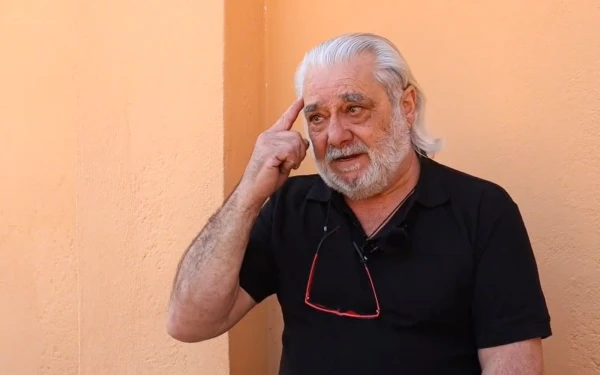
Coinciding with this legislative initiative, the Christian Lawyers Foundation has released a video featuring the father of Noelia Castillo, the young woman who was euthanized on March 23 following a two-year legal battle led by her father, Javier Castillo.
'An injustice has been done to Noelia'
Sources at the foundation told ACI Prensa, the Spanish-language sister service of EWTN News, that this marks the "first and only" time Castillo will make a public statement, since from the time his daughter's case became known and even after her death, he hasn't spoken out.
"An injustice has been done to Noelia," declared Castillo, who emphasized that "more resources could have been allocated" to address her psychological and psychiatric ailments. In contrast, he said the state was "very efficient" when it came to administering euthanasia, essentially "to get the problem off their hands."
In his opinion, Noelia managed to convince the doctors that her case met the criteria set out in the euthanasia law passed in 2022: "She deceived them very effectively, and they let themselves be deceived," said Castillo, who also argued that the assessment of euthanasia cases should include the parents' perspective.
Castillo decried the fact that, when he was in Noelia's room before her death and the members of the Guarantees Committee provided for in the euthanasia law arrived, "they kicked me out of the room" and didn't give him information when he asked for it.
No one in the family wanted euthanasia for her
Recalling his daughter's death, Castillo burst into tears, and overcome with emotion, said: "I was able to see her in the box, I said goodbye to her and here I have her" he said, pointing to his head, indicating he will remember her forever.
"I would be the happiest man alive if she had wanted to keep living with me and if I could have continued looking after her until the day I died," he said, lamenting that as soon as he decided to turn over the case to the Christian Lawyers Foundation, his daughter decided to shut him out.
The image of his daughter in her coffin after being euthanized is etched in the memory of Javier Castillo, Noelia's father. | Credit: Christian Lawyers Foundation
"The moment she saw that her father was opposed, that I was trying to stop the euthanasia, she completely cut me off, even though up until then, I had been with her every day of the week," he recounted.
"Right up to the last moment, none of us in the family lost hope … not one of us," he said. "Neither mother, nor father, nor sisters wanted euthanasia; each of us, in our own way and with our own lives, tried to prevent this from happening."
Following Noelia's death, which came after a long legal battle, Castillo admitted to having mixed feelings: "Powerless, like a failure. We lost, yet we won. I have to say that Christian Lawyers has prevailed over all those people who did nothing for her. Yes, they certainly did their homework," he said.
Castillo expressed his conviction that "my daughter is now in heaven," while also acknowledging that the legal battle "gave to me two years of my daughter's life. Two years. Do you know what two years of life means? A lot. A whole lifetime."
'Fast track' procedure
The legislative proposal taken under consideration June 11 aims to mandate a "fast track" procedure for appeals in euthanasia cases.
Furthermore, under the proposed legislation, such appeals would only be filed with the Administrative Disputes Chamber of the High Court of Justice of an autonomous community, thereby bypassing trial courts and the provincial courts.
Spain has 17 autonomous communities, the rough equivalent of states in a federal system.
The appeals process would be conducted in only one court without any right of appeal, save for an "amparo" appeal before the Constitutional Court, which is a type of appeal that is rejected in 98% of cases, as detailed in the explanatory memorandum of the bill.
This story was first published by ACI Prensa, the Spanish-language sister service of EWTN News. It has been translated and adapted by EWTN News English.
The Holy Father spent a week in Spain meeting with Catholic and civic leaders, visiting historic sites, and holding major papal Masses.
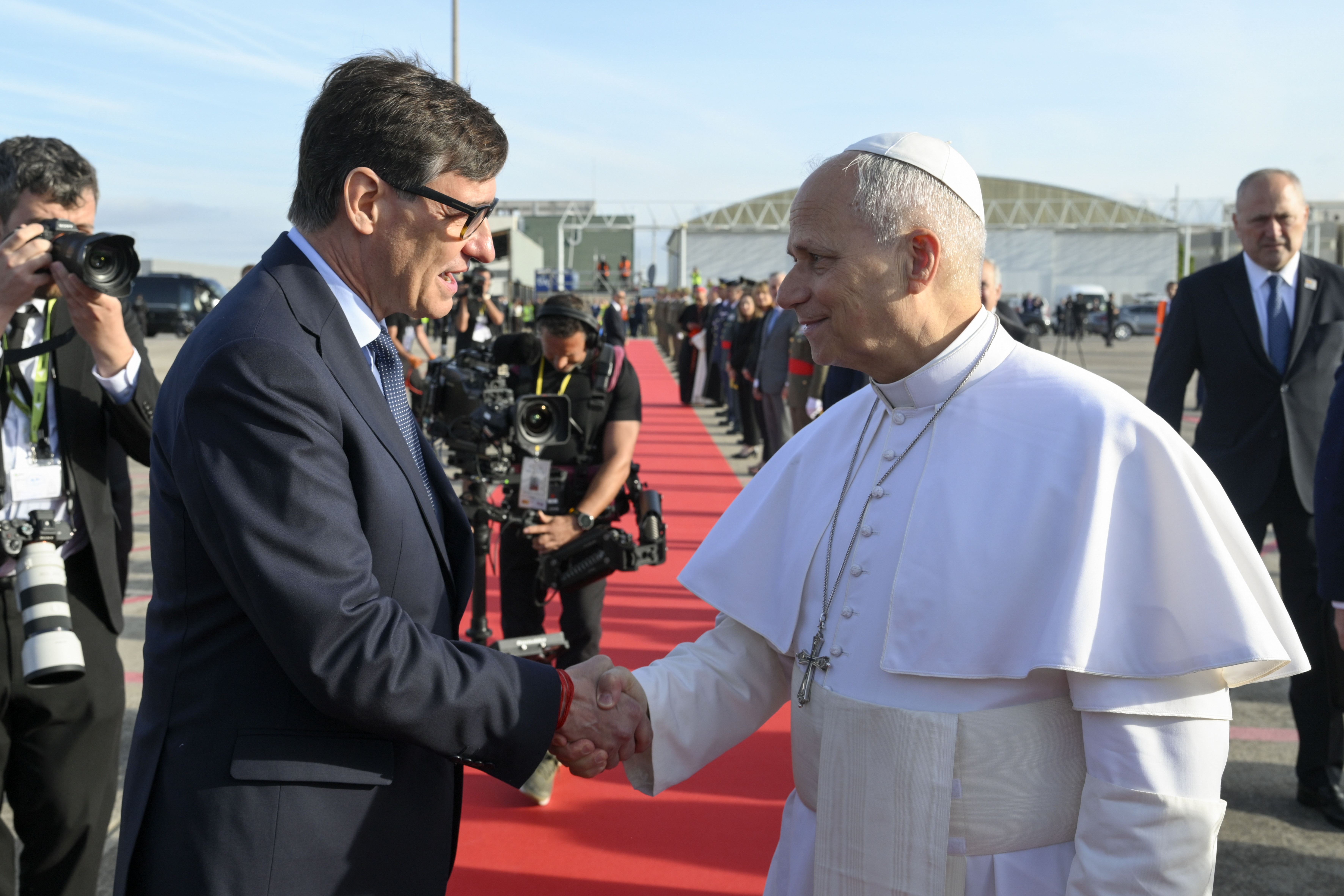
Pope Leo XIV departed Spain for Rome on June 12, finishing a weeklong trip to the European country marked by meetings with national leaders and bishops and a historic Mass at the Basilica of the Sagrada Familia.
The Holy Father spent time in Madrid and Barcelona before finishing his visit in the Canary Islands off the coast of Europe. Throughout his week's trip he also met with civic groups, including those that minister to migrants, and visited a prison in Barcelona.
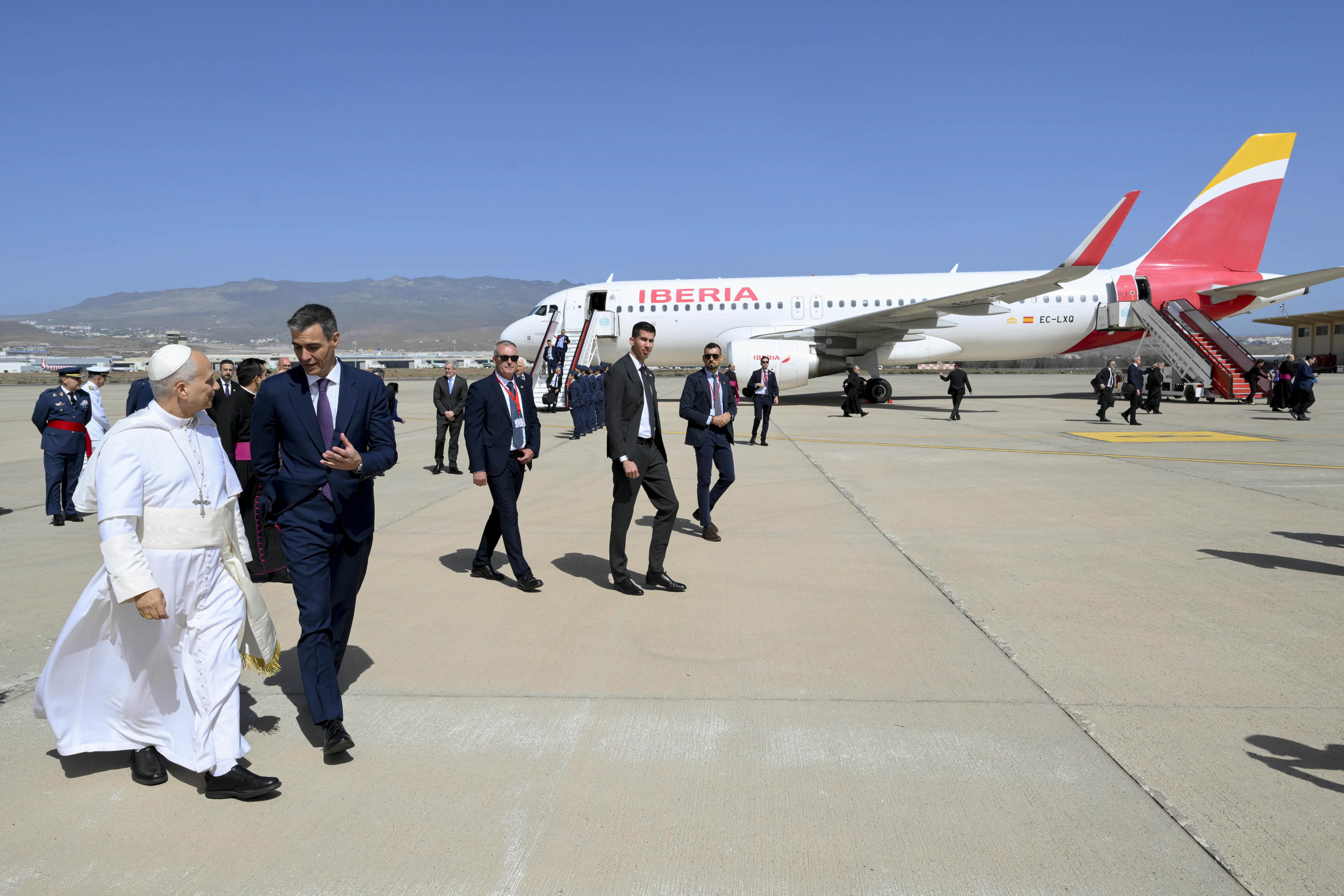
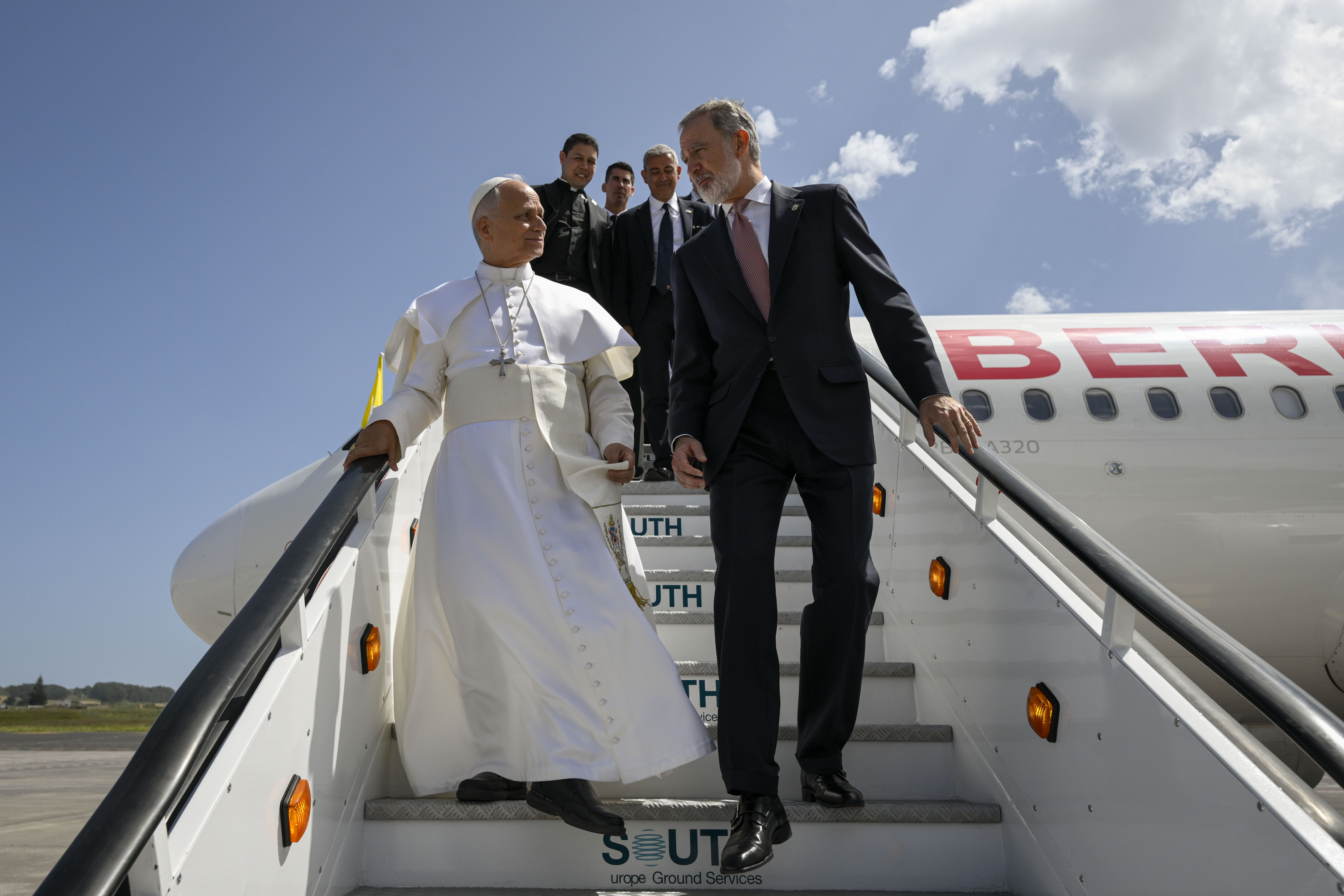
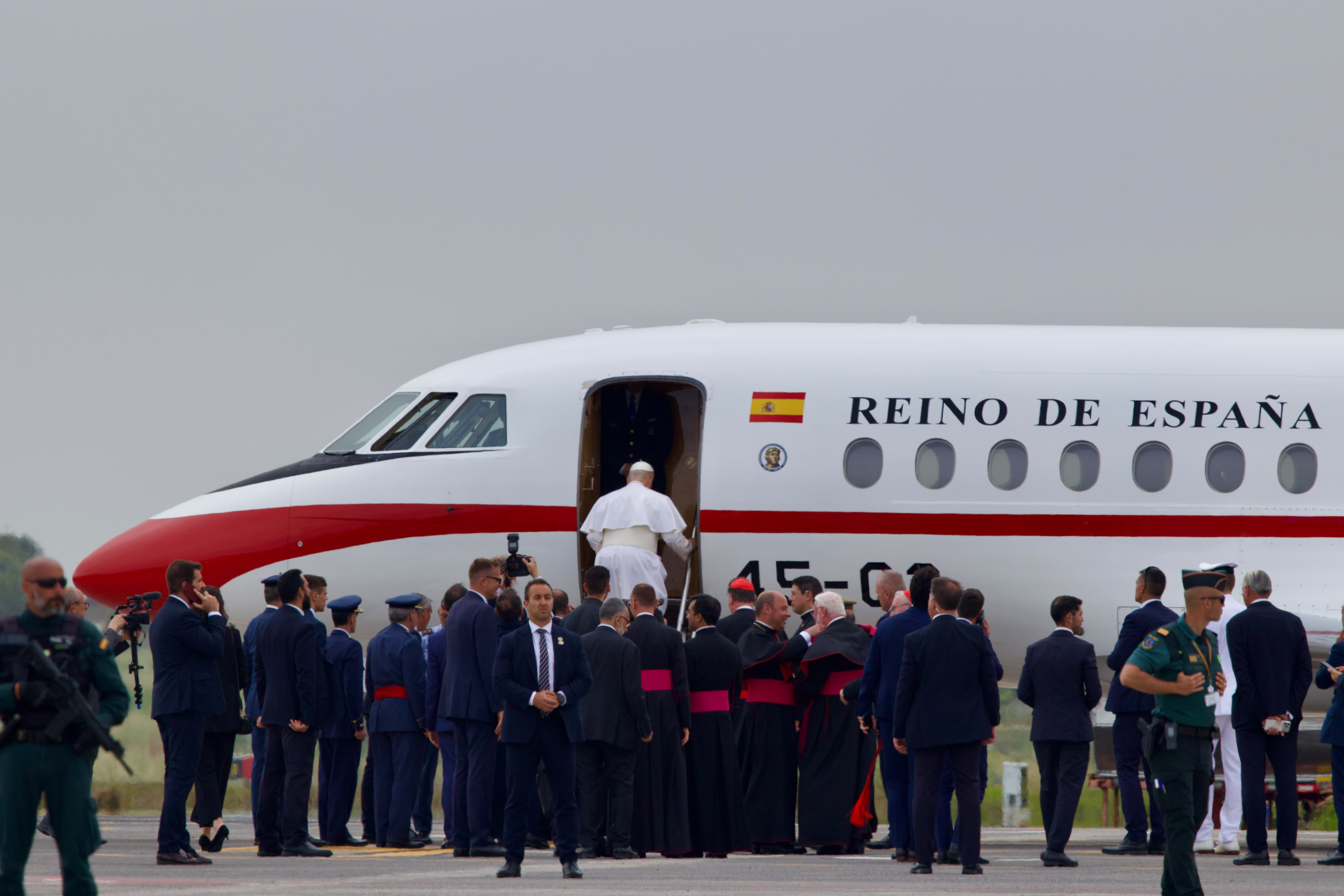
The visit finished with the papal plane suffering a malfunction forcing the pope to deboard before takeoff. He ultimately left for Rome on the king of Spain's personal airplane after the king personally offered him the use of the aircraft.
Here's a look at the pope's final days in Spain before his return to the Holy See:
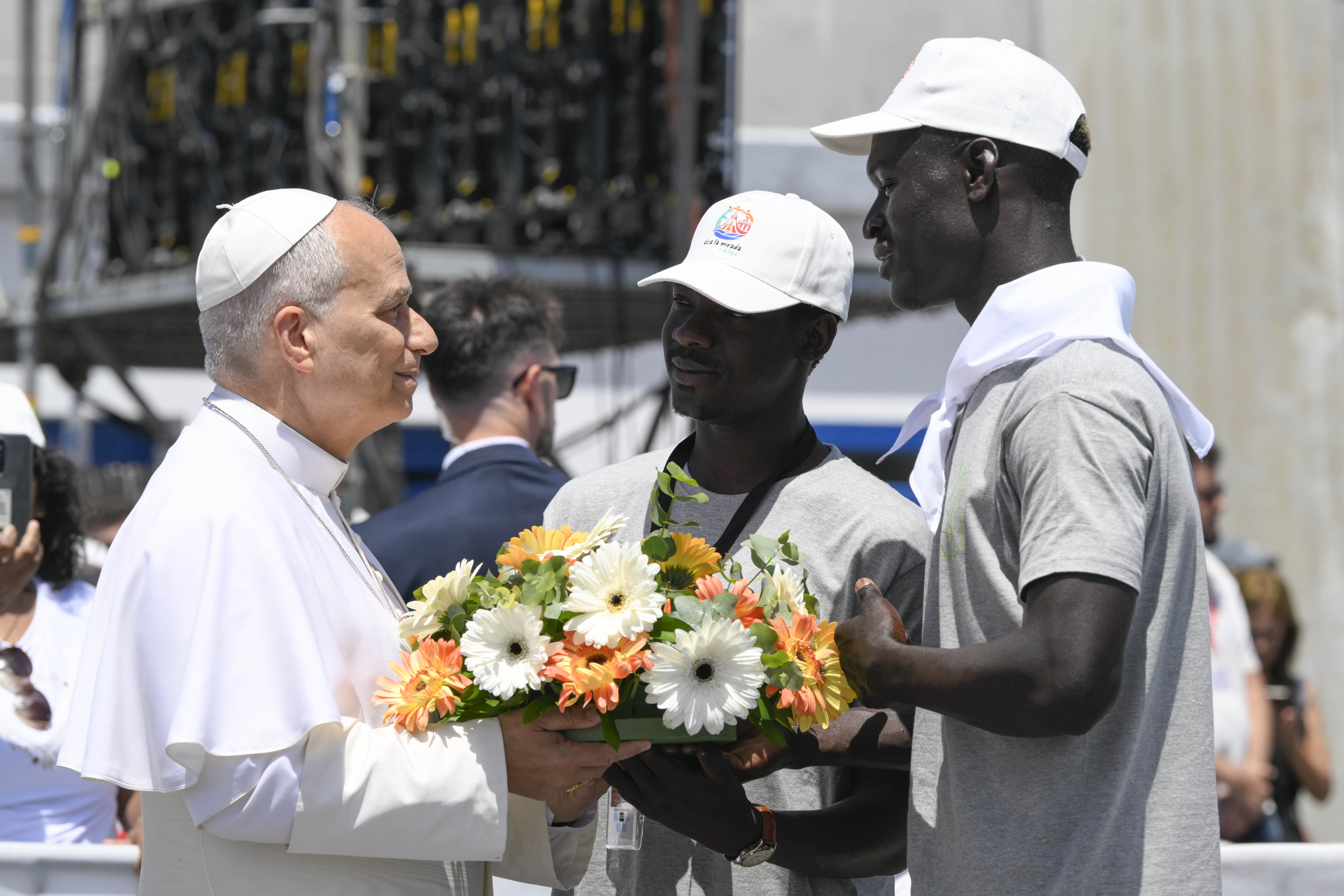
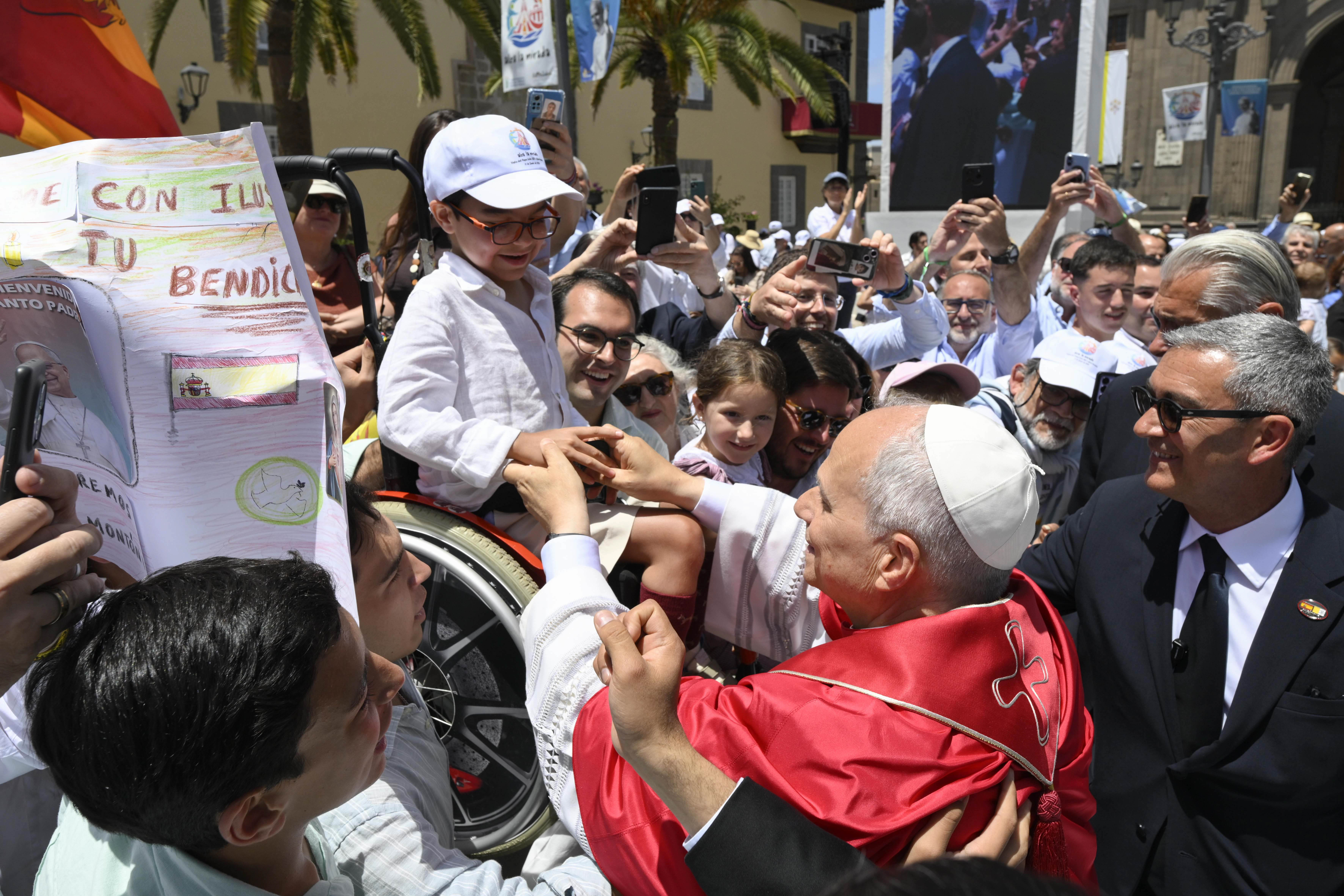
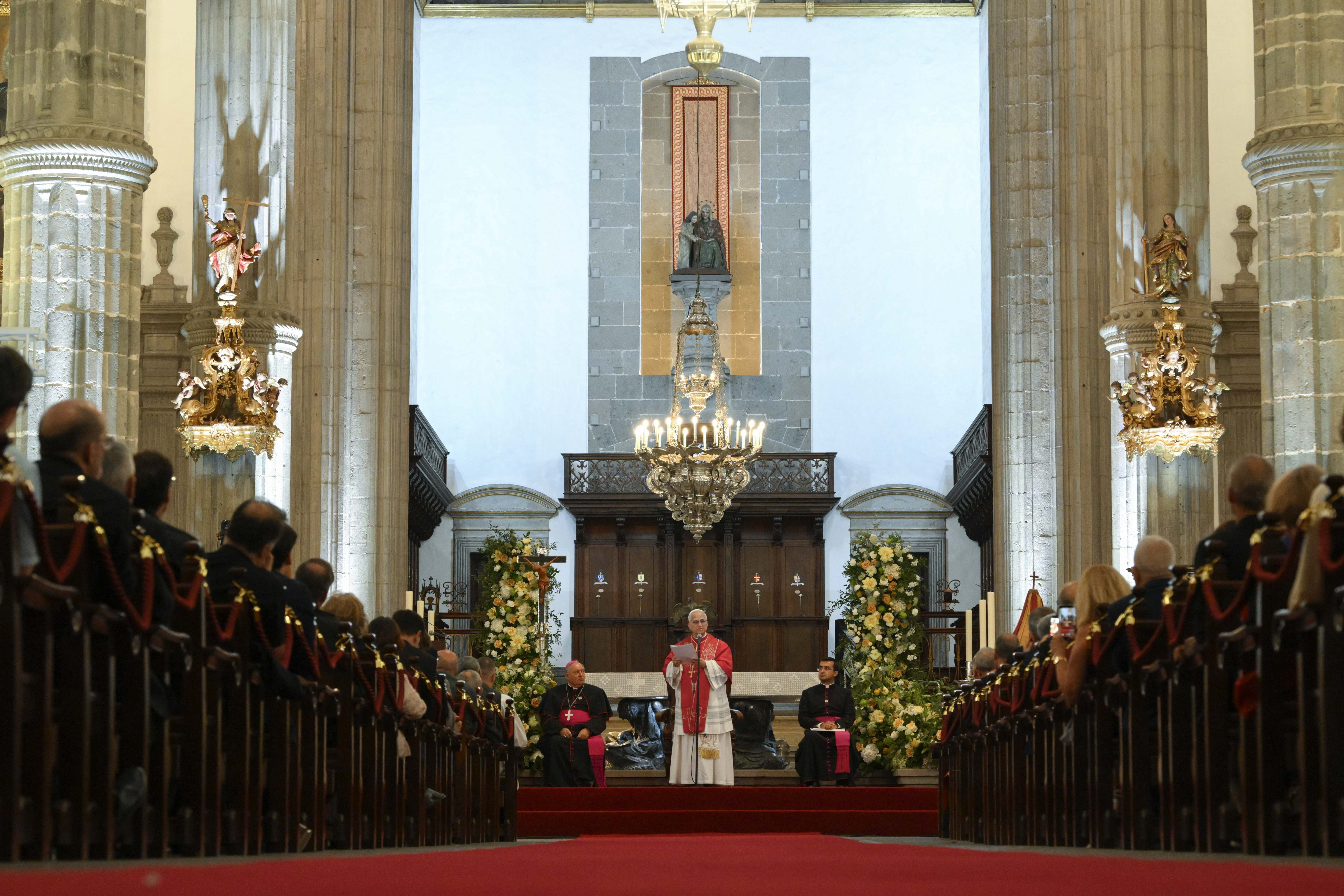
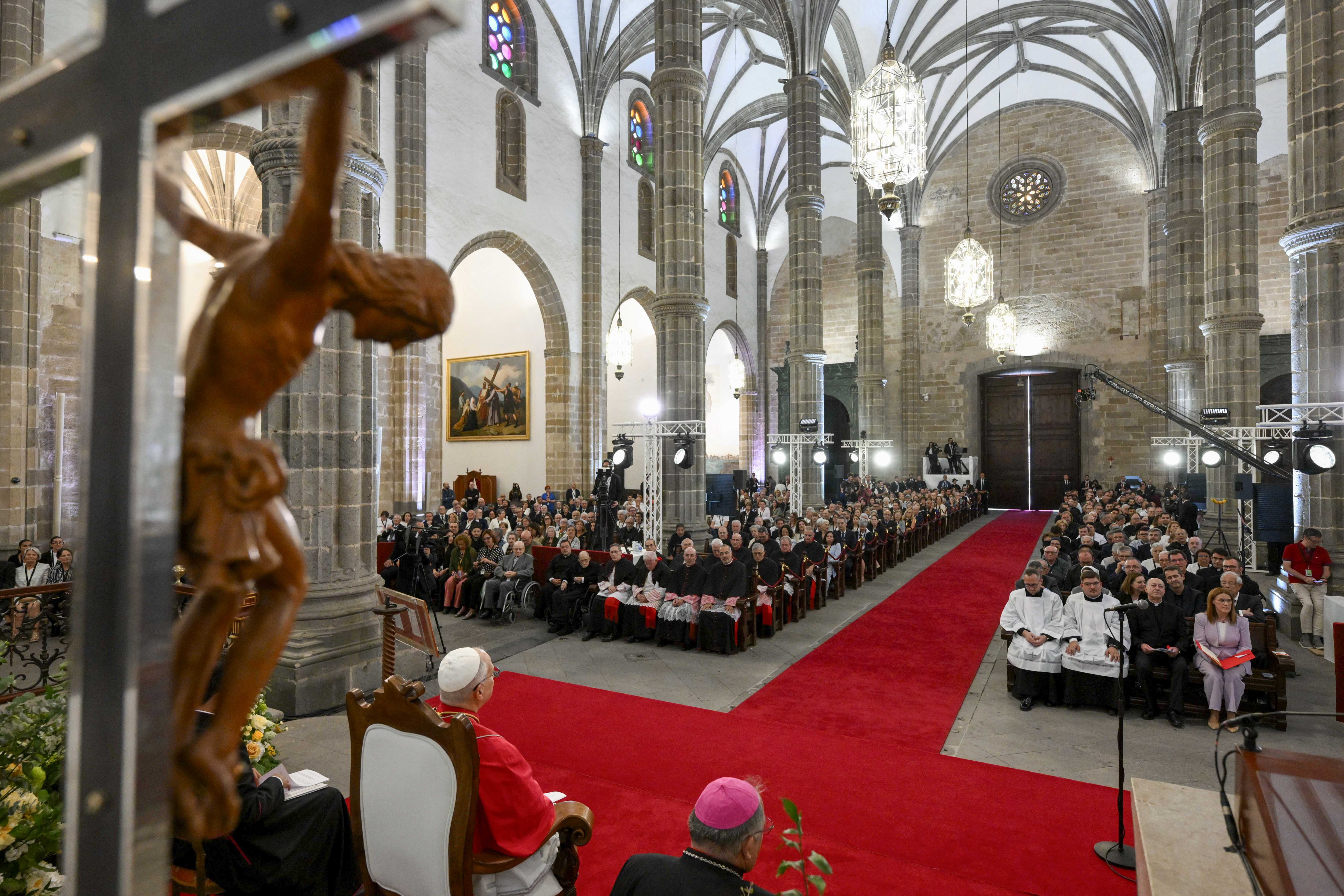
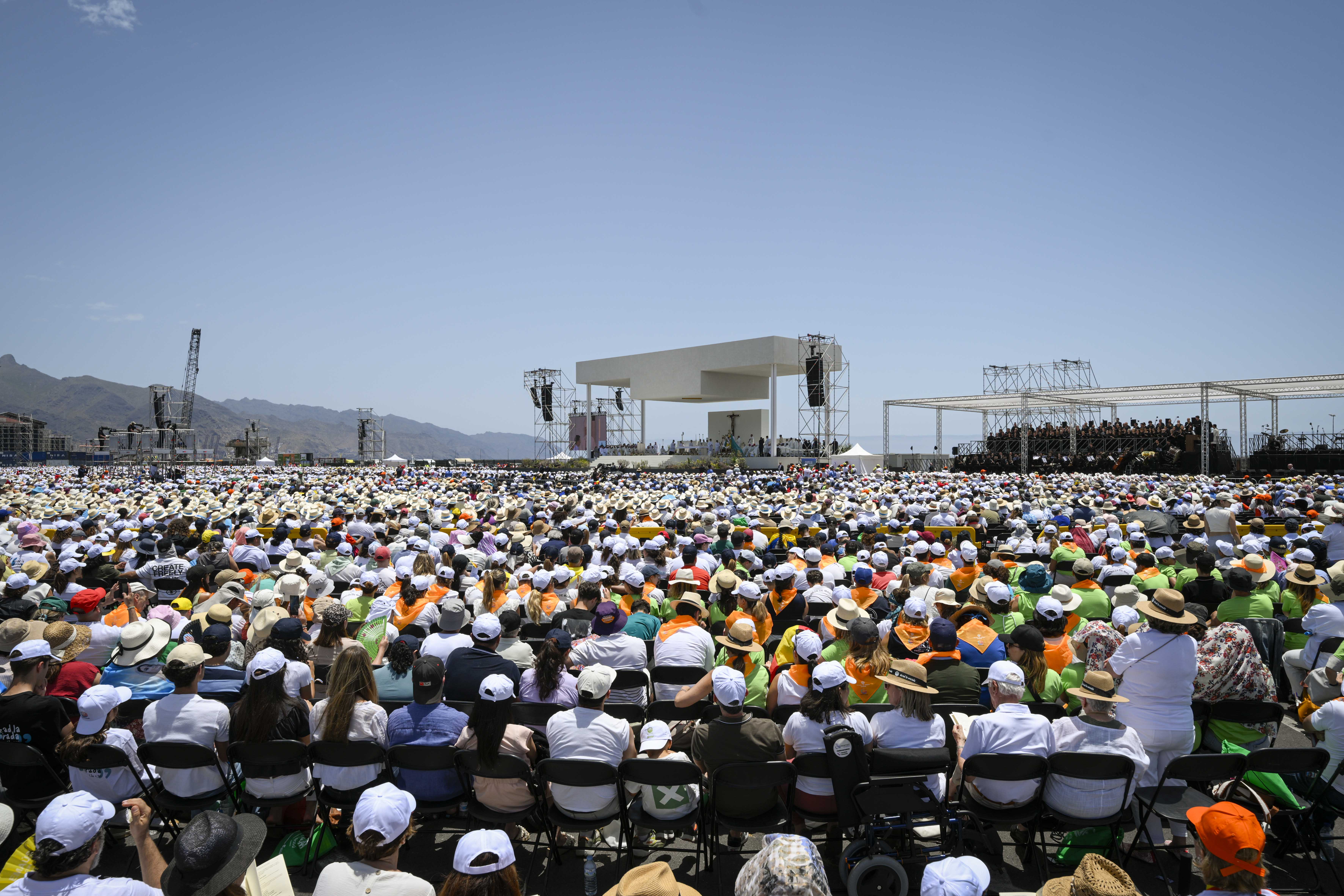
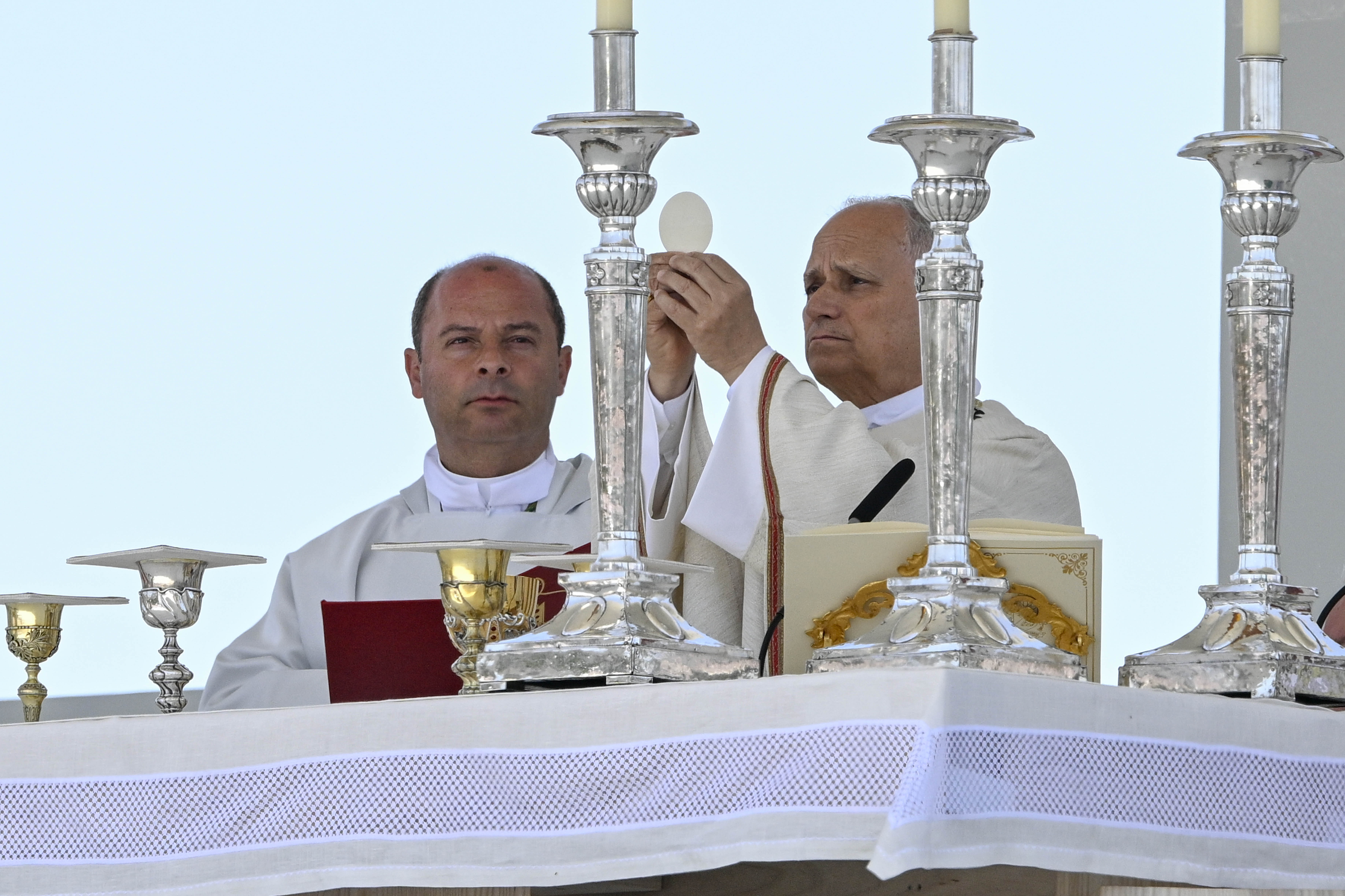
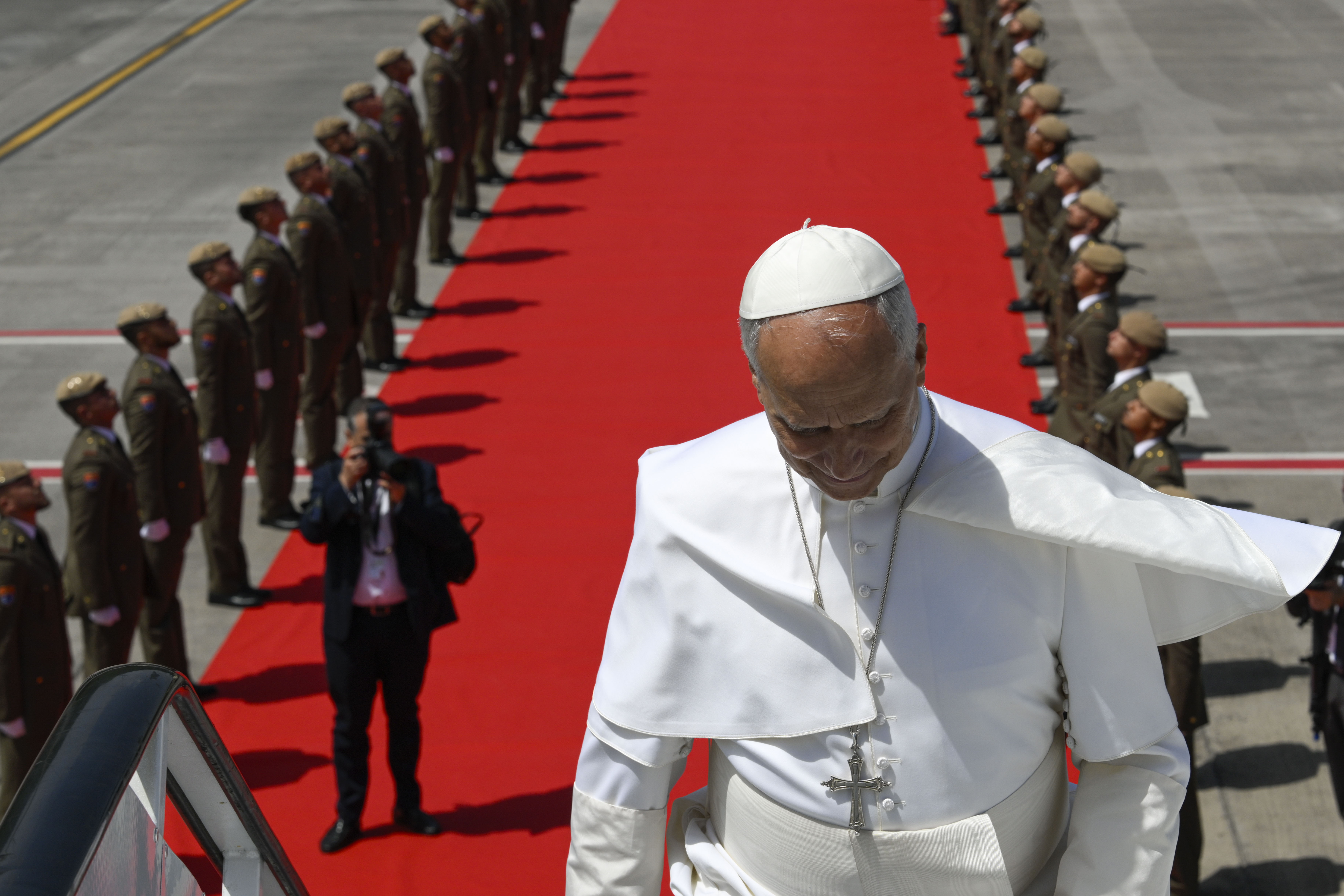
Pope Leo XIV departs Barcelona for the Grand Canary Islands at Josep Tarradellas Barcelona/El Prat International Airport, June 11, 2026. | Credit: Vatican MediaPope Leo XIV arrives in the Grand Canary Islands, June 11, 2026. | Credit: Vatican MediaPope Leo XIV meets with members of humanitarian groups working with migrants in Spain's Grand Canary Islands, June 11, 2026. | Credit: Vatican MediaPope Leo XIV greets a boy in a wheelchair in Las Palmas, Gran Canaria, Spain, June 11, 2026. | Credit: Vatican MediaPope Leo XIV meets with Catholics and religious leaders at the Cathedral of St. Anne in Las Palmas, Gran Canaria, Spain, June 11, 2026. | Credit: Vatican MediaPope Leo XIV meets with Catholics and religious leaders at the Cathedral of St. Anne in Las Palmas, Gran Canaria, Spain, June 11, 2026. | Credit: Vatican MediaPope Leo XIV holds a baby in Gran Canaria, June 12, 2026. | Credit: Vatican MediaPope Leo XIV meets with migrants in the Plaza del Cristo de La Laguna, Tenerife, June 12, 2026. | Credit: Vatican MediaPope Leo XIV waves at crowds during a meeting with organizations that assist with migrant integration, at the Plaza del Cristo de La Laguna, Tenerife, June 12, 2026. | Credit: Vatican MediaPope Leo XIV waves to crowds before Mass at the Port of Santa Cruz in Tenerife, June 12, 2026. | Credit: Vatican MediaThousands of Catholics gather for a papal Mass with Pope Leo XIV at the Port of Santa Cruz in Tenerife, June 12, 2026. | Credit: Vatican MediaPope Leo XIV elevates the Eucharist during Mass at the Port of Santa Cruz in Tenerife, June 12, 2026. | Credit: Vatican MediaPope Leo XIV boards the papal airplane at Tenerife International Airport, June 12, 2026. | Credit: Vatican MediaPope Leo XIV leaves the plane he was to take back to Rome on June 12, 2026, from Tenerife, Spain. A malfunction on the plane forced the Holy Father to depart the aircraft unexpectedly. | Credit: Vatican MediaPope Leo XIV boards the king of Spain's airplane on June 12, 2026, in Tenerife, Spain. | Credit: Daniel Ibañez/EWTN News
The Holy Father's remarks were read at the 2026 Canterbury Medal Gala, an annual event held by the nonprofit law firm that represents clients who are defending their religious liberty in court.
PHILADELPHIA — Affirming that the right to religious freedom is "the cornerstone of any just society," Pope Leo XIV praised the Becket Fund for Religious Liberty for more than 30 years of "great efforts to defend this right" in a message to the organization delivered on June 11.
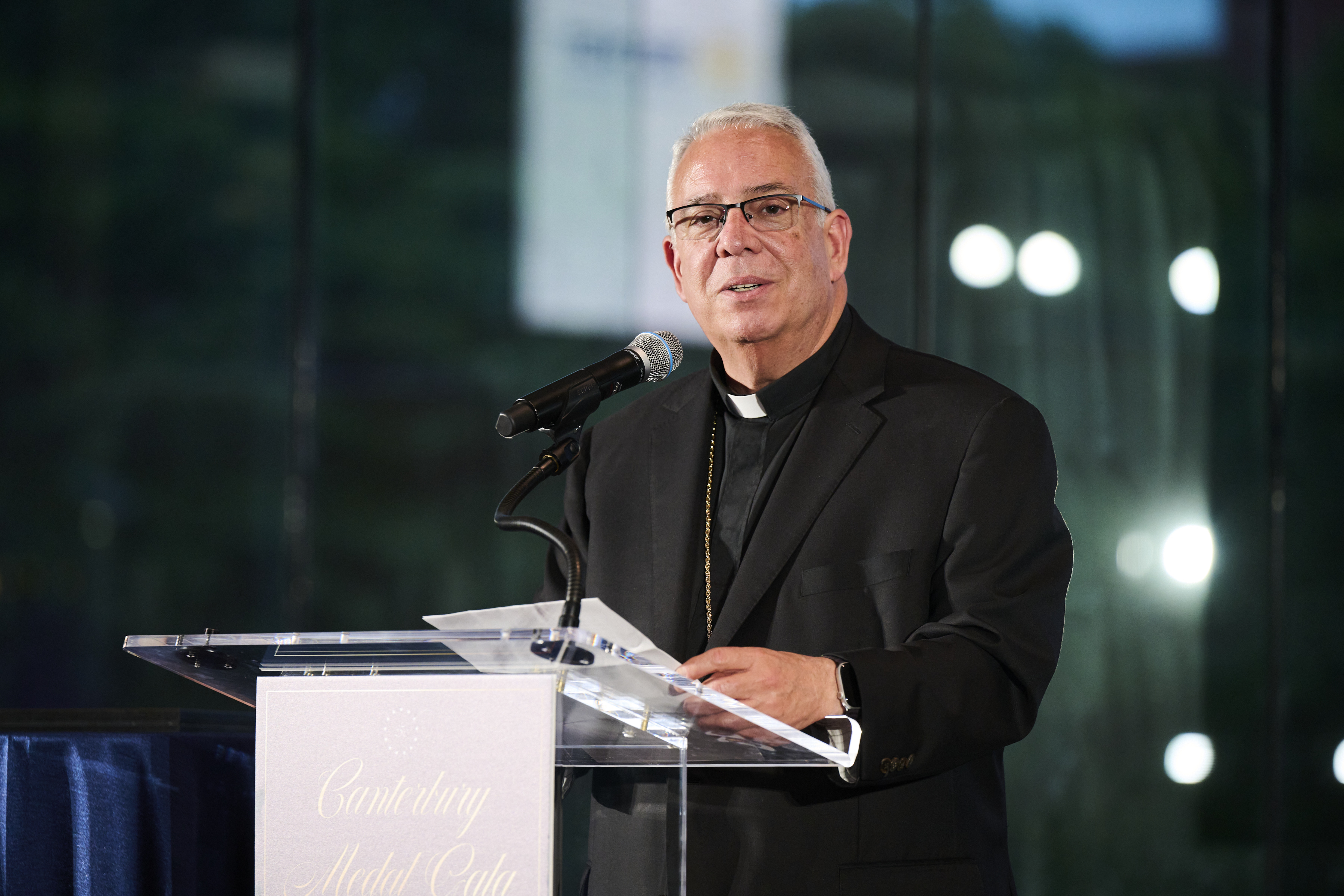
The Holy Father offered the commendation to participants at the 2026 Canterbury Medal Gala, an annual event held by the nonprofit law firm that represents clients defending their religious liberty in court. The message, dated June 4, was read by Philadelphia Archbishop Nelson Pérez.
"By ensuring that all men and women are free to act in conformity with the dictates of their conscience and to practice their faith openly, without coercion or fear, you work to safeguard the inviolable dignity of the human person," Pope Leo XIV said in his message to the group, which was read by Philadelphia Archbishop Nelson Pérez on June 11, 2026. | Credit: Courtesy of Becket Fund
Leo noted that the defense of "religious liberty as an integral part of upholding dignity" acquires "particular significance as the United States of America prepares to celebrate the 250th anniversary of its foundation."
Reflecting on the history of his American homeland, Leo said: "Indeed, we can recognize in the Preamble to the Declaration of Independence an expression of the truth regarding the human person. Namely, the innate dignity of every man and woman, created by God in his own image and likeness, and the rights that stem therefrom."
Speaking directly on the efforts of the Becket Fund, the pope said the organization works "to safeguard the dignity of the human person" by "ensuring that all men and women are free to act in conformity with the dictates or their conscience and to practice their faith openly, without coercion or fear."
"As you continue this noble task, it is my hope that every individual will embark upon the pursuit of truth sincerely and without fear," the Holy Father said, adding that "the Scriptures tell us that truth itself has a name, Jesus Christ (cf. Jn 14:6), and that God will undoubtedly aid those who search for him with all their heart (cf. Jer 29:13)."
2026 Canterbury medalist
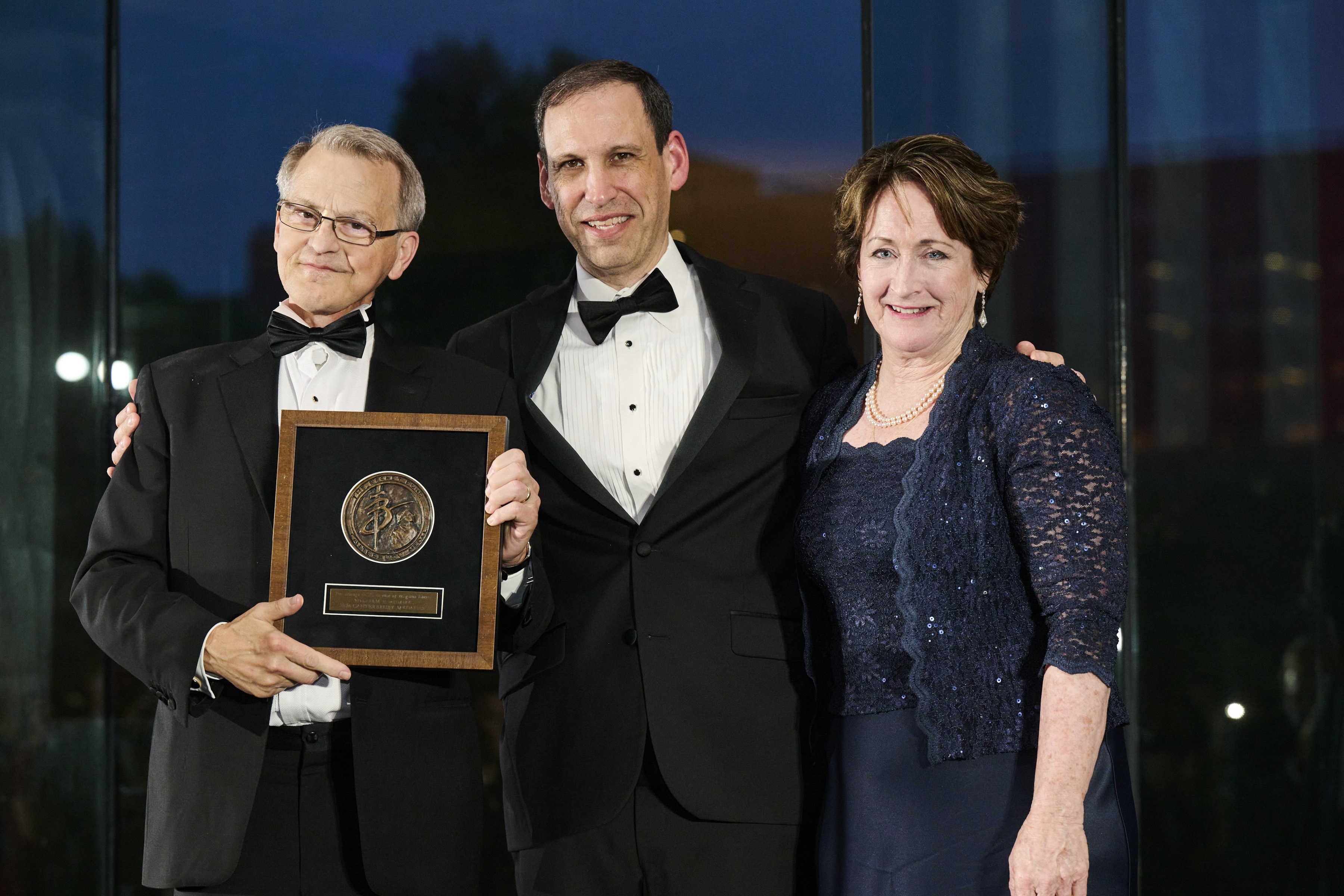
At the event, William P. "Bill" Mumma — the longtime board chairman of the Becket Fund and former CEO of Mitsubishi UFJ Securities, Japan's largest financial services company — was awarded Becket's highest honor, the Canterbury Medal.
The medal draws its name from one of history's most dramatic religious liberty standoffs, that which occurred between Archbishop of Canterbury Thomas à Becket, the law firm's namesake, and King Henry II of England.
William P. "Bill" Mumma, left, receives the 2026 Canterbury Medal, accompanied by Becket Fund President and CEO Mark Rienzi and Mary Rice Hasson, wife of Becket Fund founder Kevin J. "Seamus" Hasson and a distinguished scholar in her own right at the Ethics and Public Policy Center. | Credit: Courtesy of Becket Fund
Mumma served as the Becket Fund's full-time volunteer CEO from 2011 to 2021 and continues to serve as the organization's board chairman. In his remarks accepting the award, Mumma said that religious liberty "has to be defended."
"The last 50 years have taught us not to take it for granted," Mumma continued. "I urge all of you to redouble your commitment to this noble cause."
Past Canterbury medalists include the late Nobel Peace laureate and Holocaust survivor Elie Wiesel; Cuban poet and former political prisoner Armando Valladares; Orthodox rabbi of the oldest Jewish congregation in the U.S., Rabbi Dr. Meir Soloveichik; First Counselor in the First Presidency of The Church of Jesus Christ of Latter-day Saints President Dallin H. Oaks; and 62nd Chaplain of the U.S. Senate Barry C. Black.
With Philadelphia's Independence Hall forming a backdrop as he spoke to the gathering at the National Constitution Center, current Becket President and CEO Mark Rienzi noted that "religious freedom is at the heart of the American story."
For 250 years, Rienzi said, U.S. religious freedom "has enabled people of differing and conflicting beliefs to live together in peace."
"Becket exists to ensure that each new generation of Americans can write its own chapter of that story. We look forward to carrying our mission into America's next 250 years," he said.