An expert witness had briefly addressed the topic of mortal sin and suicide before objections from Clancy's defense team.
Remarks about Catholic doctrine were at the center of a charged dispute on Aug. 24 in the ongoing high-profile murder trial of Lindsay Clancy, who stands accused of strangling her three children before she attempted to take her own life.
The trial in Plymouth Superior Court has ignited a national debate around mental health and postpartum psychosis. Supporters have argued that Clancy — who strangled her three small children on Jan. 24, 2023, at her Duxbury, Massachusetts, home — was suffering from postpartum mental conditions that mitigated her alleged responsibility in the killings.
Her legal team has conceded that she killed the children but has argued that she was not responsible for her actions. Clancy tried to take her own life just after she allegedly carried out the murders.
On Aug. 24 Kirk Heilbrun, a professor of psychology at Drexel University, appeared as a witness for the prosecution at the trial. During his testimony he said Clancy claimed to have told her children "Go to God, baby" as she was strangling them.
"That was part of her expectation that she and the children would be together in heaven with God," Heilbrun said. "She was raised as a Catholic, and this, as I understand Catholic considerations — that's not necessarily what happens."
"But when I asked her about that, when I said, 'Isn't suicide a mortal sin?'" he continued, at which point Judge William Sullivan halted the proceedings and held a discussion with attorneys.
After a 20-minute recess, Clancy's attorney Kevin Reddington asked for a mistrial, claiming that the prosecution was guilty of "intentional misconduct" for "injecting" religion into the proceedings. He cited another instance earlier in the trial in which the Catholic faith was discussed.
Prosecutors argued against the request. Sullivan ultimately denied the request for the mistrial, though he said he would tell the jury to "disregard" Heilbrun's remarks about Catholicism.
"I'm going to tell them it's an inappropriate area of inquiry, and that this witness' understanding of Catholic dogma or Catholic teaching is irrelevant," Sullivan said.
The trial continued on Aug. 25 with several more witnesses. Heilbrun himself returned to the stand, stating that he felt Clancy was "criminally responsible" for the alleged murders of her children.
"She retained an awareness of the illegality of killing others, including her children," he told the court. "Her moral awareness of this killing was influenced by her strong desire to die and, if she was dead, not to leave her children behind."
Shepherding Future Shepherds, an initiative through the International Institute for Culture, will partner with the Avila Institute's High Calling program.
A Catholic vocations initiative that has reached over 100,000 people on social media will expand its efforts to boost priestly vocations with the launch of a discernment program.
Shepherding Future Shepherds, an initiative through the International Institute for Culture, announced Aug. 18 that it will partner with the Avila Institute's High Calling Program to support men discerning the priesthood. Shepherding Future Shepherds' social media has generated more than 7.8 million views on its videos highlighting inspirational stories of modern-day priests.
The initiative's program director, Matthew Haas, told EWTN News that Shepherding Future Shepherds' partnership with High Calling will center on accompaniment, reaching out to men who feel they might have a call to the priesthood and offering "not only resources but an entire program that will take you through a formal process of discernment to make sure that this is truly your call."
"We're encouraging not only that reflection on that discernment but helping to provide them with the tools and resources to work through that to help uncover where it is that God's calling them," he said.
Haas said that since 2025, the initiative has not only reached people through social media and its newsletter but has also attracted more than 6,000 people to its weekly prayer group for vocations.
"We're very hopeful despite all the negativity that's out there," Haas said. "Just the fact that we've seen the growth that we have is really encouraging, and it shows that a lot of people do care about the priesthood and … seeing it replenished, and understand that this is something that needs attention."
Haas said a national poll the group conducted on people's views of the priesthood revealed that those ages 18 to 25 held "the most negative view of priesthood," with concerns over "predatory behavior" in the wake of the Church's sex-abuse scandal cited by 1 in 4 adults in the demographic.
"We're definitely up against the challenge," Haas said. "And I think that's so much of it is just that the sense of, you know, a cultural association with the priesthood."
Ultimately, he said, "that's where we're trying to show stories of these role models of priests who are alive today."
"We don't want people to say, 'Oh, that was a thousand years ago and that's not relevant to me today,'" Haas said. "We want to say, 'No, these priests are doing wonderful things today and serving the Church, serving our people … in all sorts of different capacities.'"
The archdiocese said the parish had no participation in a demonstration that moved into the church, nor did it give permission for its filming.
A video that went viral on social media of a man being forcibly removed from Precious Blood Catholic Church in Los Angeles involved people with no ties to the archdiocese or church, according to the Archdiocese of Los Angeles.
Eoin Richard Connolly had organized an anti-Islam demonstration near the church just west of downtown on Aug. 23. An Instagram video captures him being chased from the church and doused in blue paint before he flees into a Starbucks.
The Archdiocese of Los Angeles said in a statement: "Several individuals participating in a rally at a nearby location moved their demonstration to the sidewalk directly outside of Precious Blood Church. Then, when the demonstrators made their way into the church they were asked to leave by a surprised group of women volunteers who were cleaning and locking up the church following the 12:30 p.m. Mass."
The archdiocese said the parish had no participation in the demonstration, nor did it give permission for its filming.
"The individuals shown in the filming removing another person from the church are not staff nor are they affiliated with the parish in any way. In addition, the man wearing a clerical shirt seen in some of the videos is not part of the parish nor Archdiocese and is believed to be clergy member of another Christian denomination," the statement said.
"The Archdiocese respects the right to peaceful expression while also recognizing the importance of maintaining a safe and orderly environment for those gathering for religious worship," the statement said.
Jeff Lee, spokesman for the Los Angeles Police Department, said officers responded around 2:25 p.m. on Aug. 23 to a report that 20 to 30 protestors were inside the church. No charges have been filed, Lee said.
Connolly said on Instagram that he planned the "march to the Southern California Islamic Center to stand against the war on AMERICANS by Jihadist sympathizers and Antifa Terrorists." He could not immediately be reached for comment.
Cardinal Pierbattista Pizzaballa assured Christians in the Holy Land they "will not be abandoned," said Michael LaCivita, communications director at Catholic Near East Welfare Association.
Cardinal Pierbattista Pizzaballa visited Christian communities in the West Bank, where he celebrated Mass on the solemnity of the Assumption of the Blessed Virgin Mary and assured local Christians that the Church will not abandon them.
His visit to Taybeh and Jenin followed an Israeli order issued in July declaring "the area of Taybeh and Rimon" a closed military zone, prohibiting Israelis and foreign nationals from entering or remaining there. The designated area includes part of Taybeh's built-up area, agricultural land, and religious and historical sites.
Taybeh "represents a place which has been inhabited by followers of Jesus, by Christians, for 2,000 years," said Monsignor Peter Vaccari, president of the Catholic Near East Welfare Association (CNEWA), a papal agency that provides humanitarian and pastoral support to Christians across the Middle East.
Taybeh "highlights the indigenous Christian population and remains to this day the only really Christian village that is left throughout the West Bank," Vaccari said in interview Aug. 24, an excerpt of which was broadcast on "EWTN News Nightly."
The persecution of the Christian population has "increased" as "radical settlers will take it upon themselves to either deface religious symbols, to interfere with the business enterprises of the people of Taybeh," or "insert themselves in whatever way they feel they have the right to — which is a violation of international law," Vaccari said.
Amid the conflict, on Aug. 15, Pizzaballa celebrated Mass at the Latin Church of Christ the Redeemer.
In his homily, Pizzaballa referred to the people of Taybeh as the "Christian voice, speaking out for justice, speaking out for the desire for dialogue with all people," Vaccari said.
"He urged the people of Taybeh to guard their hearts ... against any kind of despair. Guard their hearts against any kind of contamination. Guard their hearts in a way that they would be those who would fight for justice and fight for the principles of justice," Vaccari said.
"I may not have answers at the human and worldly level, but I believe in God," Pizzaballa said. "And I am certain that, in him, we can continue to give birth to life, even here in Taybeh."
"We will continue to do everything within our power to preserve the ecclesial presence here, at every level throughout the Holy Land," he said.
Christian persecution continues to rise
In a separate interview with "EWTN News Nightly" on Aug. 21, Michael J. L. LaCivita, communications director at CNEWA, detailed the importance of Pizzaballa's visit.
As Christians in the Holy Land "feel that they're in danger of losing their homes and their livelihoods," Pizzaballa was able "to assure them that they will not be abandoned" and "that we have not forgotten them," he said.
Taybeh is "historically an agricultural village," LaCivita said. "It's surrounded by agricultural lands, olive groves, and oranges, and things of that nature. It's quite a bustling place."
Now, though, "they are under siege" and there is "violence," LaCivita said.
"Their fields are being torched," he said. "Even an ancient church dedicated to St. George, who was a very popular saint in the Palestinian community among Muslims as well as Christians ... was vandalized last year [and] set afire."
"So they're very much concerned about their livelihoods, especially now that the IDF has basically surrounded the village and said that it's militarily closed off and will not permit either people in or out," he said.
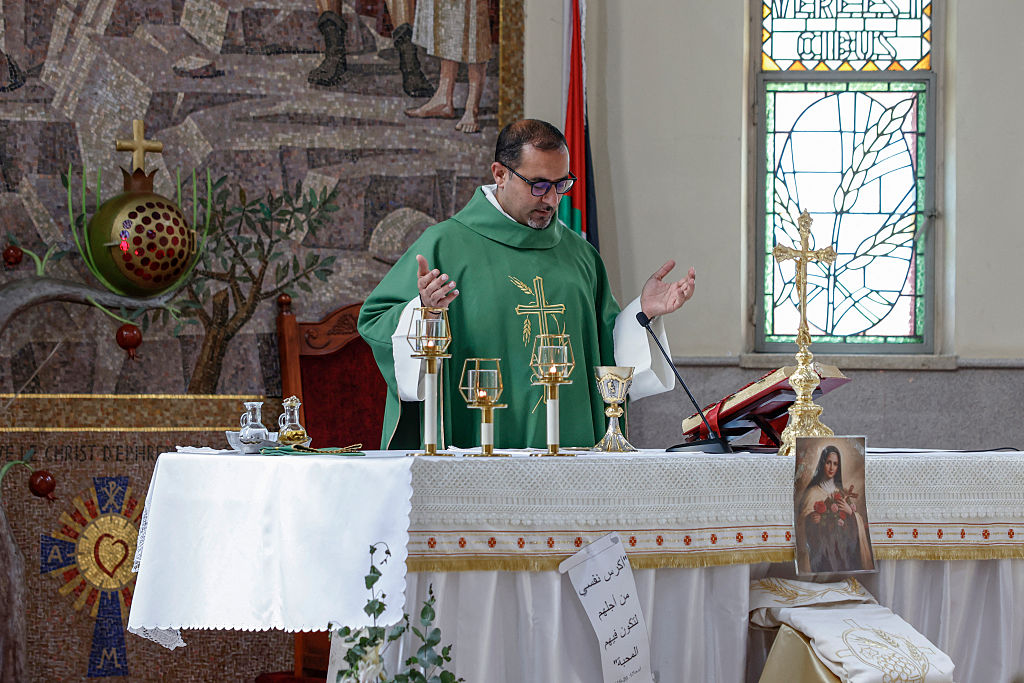
Father Bashar Fawadleh, a Palestinian Catholic priest of the Latin Patriarchate of Jerusalem who serves as the parish priest of the Christ the Redeemer Church, says Mass on June 22, 2026, in the Palestinian Christian town of Taybeh, northeast of the city of Ramallah in the Israeli-occupied West Bank. | Credit: Zain Jaafar/AFP via Getty Images
While the conflict continues, Catholics can "pray, because as we know, prayer moves mountains, and so we need to pray and pray for all people of goodwill," LaCivita said.
"We need to work for justice so that there can be peace and unity. Because without justice we cannot have peace," he said.
The faithful can also support the efforts of organizations like CNEWA, which work to "get the supplies and the food and the water that is needed" in the area, he said.
The pontiff appointed Patrick Kelly as a member of the Dicastery for the Laity, the Family, and Life on Aug. 25.
Pope Leo XIV has appointed Knights of Columbus Supreme Knight Patrick Kelly as a member of the Dicastery for the Laity, the Family, and Life. The Vatican announced Kelly's appointment on Aug. 25.
The dicastery was created by Pope Francis in 2016 to promote, as stated in its statutes, "the apostolate of the lay faithful, the pastoral care of the family and its mission according to God's plan and for the safeguard and support of human life." The dicastery is also the Vatican office responsible for organizing the international World Youth Day (WYD).
Its members are not full-time staff and do not need to relocate to Rome. Rather, they attend plenary sessions in Rome and vote on decrees.
Cardinal Kevin Farrell has served as its prefect since 2016, the year it was founded.
Kelly first joined the Knights of Columbus in 1983 while a student at Marquette University in Wisconsin. After studying law at Marquette University Law School and theology at The Catholic University of America, where he earned a master's degree in theology from the Pontifical John Paul II Institute for Studies on Marriage and Family, he served 24 years in the United States Navy, earning several military honors.
Before joining the leadership of the Knights of Columbus, Kelly served as an adviser to several U.S. federal agencies, including the U.S. House of Representatives and the U.S. Department of State. As senior adviser to the ambassador-at-large for international religious freedom at the U.S. Department of State, he served as a liaison between the U.S. government and other countries, including the Holy See, on religious freedom issues.
In 2006, Kelly was named vice president for public policy of the Knights of Columbus. He became deputy Supreme Knight in 2017 before being elected Supreme Knight in 2021.
Paralleling trends elsewhere, at Harvard University more young people than ever are joining the Catholic Church.
This past spring, a record 85 people became Catholic at St. Paul's Catholic Church across the street from Harvard University, and 45 of those were Harvard students or faculty.
This year, 65 have registered so far, which is keeping apace with last year's "dramatic increase" in conversions, Father Nathaniel Sanders, the undergraduate chaplain at Harvard, told EWTN News.
Last year's group, which came from both the Harvard Catholic Center and St. Paul's, was the "largest class of people becoming Catholic in our history … So, there is something really exciting happening here," Sanders also noted in a recent episode of "The Great American Road Trip," a cultural and tourism initiative created to celebrate the country's 250th anniversary.
In the episode, the family of U.S. Transportation Secretary Sean Duffy travels to Boston while their daughter, Paloma, is considering various college options, including Harvard. The young woman's parents arrived with reservations about the possibility of their daughter studying there, as they fear it threatens to undermine the Christian upbringing she received at home.
However, a meeting with Sanders ultimately gives them a different perspective.
A growing Catholic community
In the video, the chaplain speaks not only about those preparing to join the Church but he also highlights the increase in student participation in Catholic life at Harvard.
"Student attendance at Mass is very good right now. It has definitely increased by 10% to 20% in recent years," he notes.
According to a report published in December 2025 by The Wall Street Journal, Sunday Mass at St. Paul's currently draws an average of about 300 students, up from around 200 a few years ago.
Sanders says one of the characteristics of this community is the profile of the participants.
"We have very intelligent, high-achieving students. We can give talks on a range of issues, and the students ask great questions," he explains in the video. "I am really grateful for what God is doing here."
The Holy Spirit is behind the increase in conversions
Regarding the growth, Sanders told EWTN News that "there's nothing particular about Harvard" that explains it. "There's a wider trend going on among young people, and I attribute that to the Holy Spirit. I think there are real cultural factors at play leading students to want to discover more about the faith."
He said a lot of the conversions on campus are driven through Bible study groups on campus. "We run about 30 different Bible studies, with the help of the FOCUS missionaries," who "do a lot of outreach, get people involved."
He credited many conversions to a study being led by "a dynamic student on a sports team who will run a Bible study with the help of the missionaries. A lot of converts have come through that."
The two main groups of students he sees becoming Catholic at Harvard are unchurched youth who grew up in culturally Catholic homes but never received the sacraments and former evangelical Protestants.
"Fewer children are being baptized these days, so those who were never churched, who were raised culturally Catholic, in some sense, are coming in showing interest in the faith," he told EWTN News.
The second group, former "megachurch Protestants, begin to read" about the Catholic faith, he said, "and then that's sort of the end of it" — they convert.
Students speak out
John Phillips, a former president of the Harvard Catholic Center, told The Wall Street Journal last year that he had nearly turned down his admission to Harvard because he had previously attended only Catholic schools and feared he would not be able to grow in his faith within such a secular environment.
However, upon arriving on campus in 2022, he found students who, while taking their academic studies seriously, were equally committed to Catholicism.
"I saw a community I could be a part of," Phillips explained.
Adaolisa Mba, now a senior and the Harvard Catholic Center's formation chair, shared a similar experience with The Wall Street Journal: "It's really impressive to be in a Catholic community with a lot of people my age. We motivate each other to be closer to God."
After visiting Boston College and heading on to Harvard, Paloma's mother, Rachel Campos Duffy, remarked in the episode: "We have a saying in our house, and I say it all the time to the kids: My job isn't to get you into Harvard, it's to get you into heaven. So it's kind of ironic that we're now going to tour Harvard."
The family had a chance to meet with Sanders during their visit, and Paloma's father expressed to him his fear that the school might undermine the faith he had taught his children and weaken their convictions.
Addressing this concern, Sanders said: "I think it depends on the kids, whether or not they're sort of coming with the virtues necessary to live out that life well. But I don't think there is anything nefarious going on."
"You come here because it's the best opportunity. And if someone has a sense of themselves and a sense of God before coming, I think that will only flower," he added.
The issue is not about preventing a young Catholic from having their beliefs challenged, Sanders said, but rather ensuring they have a sufficiently deep-rooted faith.
"If they are confident enough in their faith that they won't have an existential crisis the first time it's challenged in class, and they have the social skills," he said, young Catholics can "thrive at Harvard."
"Visiting Harvard seems to ease my parents' concerns and the assumptions they had about the school, and I think they were pleasantly surprised to see how strong the Catholic community there is," Paloma observed.
This story was first published by ACI Prensa, the Spanish-language sister service of EWTN News. It has been translated and adapted by EWTN News English.
Archbishop Paul Gallagher met with Russian Foreign Minister Sergey Lavrov on Aug. 25.
Archbishop Paul Gallagher, the Vatican's secretary for relations with states and international organizations, met with Russian Foreign Minister Sergey Lavrov in Russia on Aug. 25 to discuss Russia's ongoing war with Ukraine.
The Vatican Secretariat of State announced the meeting on its X account the same day, describing it as a meeting where "topics of common interest and current international issues" were discussed between the two parties.
"During the course of the meeting, topics of common interest and current international issues were addressed, with particular attention to the war in Ukraine and the prospects for peace," the statement on X said.
The meeting took place on the first day of Gallagher's trip to Russia, Aug. 25–27. Vatican News, the official news outlet of the Holy See, described Gallagher's trip as "a mission of dialogue and peace." It is his first trip to Russia since 2021.
According to the schedule published on X by the Vatican Secretariat of State, Gallagher's meeting with Lavrov on Aug. 25 will be followed by a meeting with Metropolitan Anthony of Volokolamsk, chairman of the Department for External Church Relations of the Moscow Patriarchate.
On Aug. 26, Gallagher will meet with Yuri Ushakov, the foreign policy adviser to Russian President Vladimir Putin, and on Aug. 27, Gallagher will meet with Catholic clergy, religious, and bishops. He will also celebrate Mass at the Cathedral of the Immaculate Conception of the Blessed Virgin Mary in Moscow.
Vatican News noted that Gallagher's schedule "confirms the Holy See's determination to continue along the path of dialogue, even at one of the most difficult moments in international relations at the global level."
The Vatican has been reviewing the bylaws for Germany's planned Synodal Conference since late March, with the panel's first meeting in doubt for November.
The president of the German Bishops' Conference has announced the bylaws for the German Synodal Conference are still under review in Rome.
The Synodal Conference is intended to serve as a permanent body implementing the controversial German Synodal Way. The Vatican continues to review the bylaws of this new national-level body, which is to consist of bishops and non-bishops.
"The statutes are currently being reviewed in Rome," Bishop Heiner Wilmer of Münster said in an interview Sunday with the Kirche+Leben website.
"I know from those responsible there that it will still take some time. I am confident that we will make progress on this."
Wilmer confirmed what he had already hinted at in May: "Personally, I do not expect us to meet as early as November, given the dynamics involved, because the matter is being passed from one dicastery to the next."
The first meeting of the new German body was scheduled for Nov. 6–7 in Stuttgart. The next session was then scheduled to take place in Würzburg on April 16–17, 2027.
The Synodal Conference's bylaws have been under review in Rome since the end of March. Nearly half a year has now passed. That leaves just over two months until the originally planned date in November.
The issue regarding the bylaws that remains contentious is that of joint deliberation and decision-making by diocesan bishops and non-bishops, which has met with resistance in the Vatican, at least in recent years.
Specifically, the bylaws state that the Synodal Conference "deliberates and makes decisions in the spirit of 'synodal decision-making processes'" on important issues of Church life of supra-diocesan significance.
Despite all the criticism of the Synodal Way, the Vatican under Pope Francis — and now under Pope Leo XIV — has never formally demanded that the process, with its sometimes radical attempts to change traditional Church teaching, be terminated, nor has it demanded that bodies be established only in ways that are unproblematic under canon law and that already exist at all levels in Germany.
Meanwhile, in his interview with Kirche+Leben, Wilmer emphasized: "For me, the Church is synodal. I associate synodality with deep respect and great appreciation. We can only move forward if we journey together."
In the Diocese of Münster, synodality is "deeply rooted," according to the bishops' conference chairman. As the new bishop of the diocese, he is looking forward "to walking this path together with so many baptized people here, but also internationally, ecumenically, and with our Jewish and Muslim brothers and sisters."
Bishops who opted out
Three sitting diocesan bishops — Cardinal Rainer Maria Woelki of Cologne; Bishop Stefan Oster, SDB, of Passau; and Bishop Rudolf Voderholzer of Regensburg — have already withdrawn from the Synodal Way some time ago, after the relevant Vatican authorities had issued several clear warnings. The now-resigned bishop of Eichstätt, Gregor Maria Hanke, OSB, had also withdrawn from the Synodal Way.
As a result, the Synodal Committee for the Preparation of the Synodal Conference was not supported by the German Bishops' Conference but rather by an association established specifically by the 23 other dioceses.
Should the Vatican approve the bylaws, it is possible that these three diocesan bishops could also join the committee.
Oster stated in March: "I have always said that I will follow the universal Church. I am waiting with some anticipation to see how Rome will respond. But fundamentally, my position is this: If we do this in agreement with the universal Church, then I will participate."
The bishop of Passau emphasized that the "German side" had "tried to make it clear" in discussions with the Vatican that "passing resolutions" is different from "deciding."
"I'm curious to see how the Romans will respond to this," he said.
Nevertheless, he expressed confidence, because "the process has been going on for over two years now. A sense of reciprocity has developed in the meantime. They're not going to run this thing into the ground. The Romans, too, have an interest in ensuring that no one walks away having lost face. That's why I believe the Synodal Conference will take place."
This story was first published by CNA Deutsch, the German-language sister service of EWTN News, and has been translated and adapted by EWTN News English.
Catholic Charities of the Archdiocese of Chicago and Catholic Charities of the Archdiocese of Gary will each receive $100,000 to aid in their efforts for Midwest storm relief.
The Chicago Bears announced Aug. 22 a donation of $200,000 to Catholic Charities' work to support those impacted by severe storms and flooding across the southern suburbs of Chicago and northwest Indiana.
Catholic Charities of the Archdiocese of Chicago and Catholic Charities of the Diocese of Gary, Indiana, will each receive $100,000 to aid in their efforts to help address immediate and ongoing needs in the affected communities including food, clothing, housing assistance, and other resources to help in recovery while many families are still without power, displaced from their homes, and begin to consider rebuilding plans.
On Aug. 11, high winds, heavy rain, and tornado activity swept through northwest Indiana and east Chicago causing severe damage to homes and other buildings. Gary, Indiana, was reported as being the hardest-hit city.
NIPSCO, one of Indiana's largest natural gas and electric companies, reported nearly 400,000 outages after the storm. The company described the storm as the most destructive ever to strike its service area, causing historic damage to the electric system and producing its largest power outage ever.
As of Aug. 24, roughly 10,000 individuals remain without power in Gary.
"We are very grateful for this generous gift from the Bears, which will immediately benefit many people in need who have been impacted by recent storms and provide for ongoing recovery efforts," Bishop Robert J. McClory of the Diocese of Gary said in a statement.
"Catholic Charities of the Diocese of Gary has been responding to local needs from day one. The support from the Bears and many other partners will help elevate efforts to reach the most vulnerable in our communities," he added. "I encourage everyone to continue to pray, reach out to our neighbors who are suffering, and support efforts by Catholic Charities and others to assist those in need."
Catholic Charities of the Diocese of Gary Executive Director Terry Seljan said: "The devastating impact of the storms across northwest Indiana has turned lives upside down for thousands of families, leaving them to face unexpected challenges and uncertainty."
He explained that currently their focus "is on helping our neighbors access the support and resources they need to stabilize so they can begin to recover and move forward."
He added: "We are incredibly grateful to the Chicago Bears organization for their generous support and for the care and concern they have shown for our Northwest Indiana community. Their commitment is a powerful reminder of what can happen when people come together to help their neighbors in times of need. We hope others who are able will join them in supporting the Storm Relief Fund and helping bring relief, hope, and healing to families across our region."
Sally Blount, CEO of Catholic Charities of the Archdiocese of Chicago, also expressed her gratitude.
"We deeply value and respect the long-standing philanthropic leadership of the Chicago Bears organization. As one of our region's largest human services providers, we are honored to be entrusted with distributing this critical funding," she said.
"An unexpected expense of even a few hundred dollars can amount to a crisis for an individual or family already living on a very limited budget. This funding will make a big difference to families affected by the storm," she said.
France's highest constitutional authority has carved out conscience protections for Catholic institutions and pharmacists, which was welcomed by Archbishop Laurent Ulrich of Paris.
The official promulgation of France's end-of-life law in the Journal Officiel on Aug. 19 came with a significant victory for religious and conscience freedom.
Catholic hospitals, hospices, and nursing homes will not be forced to allow euthanasia or assisted suicide on their premises, and pharmacists cannot be compelled to prepare or dispense the lethal substance.
This conscience-clause win, secured by interpretive reservations by the Constitutional Council on Aug. 14, has received less attention than the law itself, adopted by the Parliament in July, and which the progressive government of President Emmanuel Macron had vigorously defended since 2023.
In a press release on its ruling, the council — France's highest constitutional authority — specified that the exemption applies when hosting assisted dying would be "manifestly contrary" to an institution's statutory mission or project, and only if that opposition is formally written into its governing statutes or an ethical charter, and only if other establishments are able to meet local needs.
For pharmacists, the council issued a separate reservation grounded in Article 10 of the 1789 Declaration of the Rights of Man, ruling that preparing or dispensing the lethal substance "is liable to offend" personal convictions.
As originally adopted, the text required that when a person is hospitalized or living in certain covered facilities, "the head of the establishment must allow the intervention of the professionals participating in the procedure" as well as access for anyone accompanying the person requesting to die — with no exception for an institution's own objections.
Archbishop Laurent Ulrich of Paris welcomed the reservations in his Aug. 19 message to the faithful marking the law's promulgation, calling them "an opportunity." He expressed his hope that institutions built around care for the gravely ill and expertise in palliative care would "find in these reservations an encouragement to maintain their particular character, and to remain places where no one will be killed."
The Aug. 14 exemption followed formal submissions to the council from several Catholic and pro-life organizations, including the Fondation Jérôme Lejeune and the European Centre for Law and Justice (ECLJ), a Strasbourg-based advocacy group, which argued that forcing institutions to accommodate mobile euthanasia teams "constitutes a clear violation of their freedom."
While the bill was still moving through the French Parliament, Sister Agnès, a physician with the Little Sisters of the Poor, on March 3 spoke on behalf of French Catholic congregations that run hospitals and nursing homes during an interactive dialogue with the U.N. Human Rights Council's special rapporteur on freedom of religion or belief in Geneva. She told the rapporteur the draft law would force those congregations to accept euthanasia on their premises or risk up to two years in prison and a 30,000-euro fine, warning they could be forced to "renege on God's commandments" to keep operating.
Legal scholars have noted the unusual character of this reversal and highlighted the weight of the advocacy of Catholic organizations.
Roseline Letteron, a professor of public law who publishes the blog "Libertés, Libertés chéries," wrote that the council built the institutions' exemption on different legal ground than the pharmacists' clause: not the individual right to conscience but the right to form an association and the right to run a business as one sees fit, combined with an older idea, borrowed from a 1959 law on religious schools, that an institution can have a distinct "character" worth protecting.
French courts had rejected comparable institutional opt-outs before, for civil-status registrars who refused to perform same-sex marriages in 2013 and hospital department heads who objected to abortion in 2001. Letteron asked directly whether the council "wanted to give symbolic satisfaction to the Catholic lobby," concluding that "the answer is yes."
Meanwhile, ECLJ Director Grégor Puppinck called the Aug. 14 decision "a great victory," saying in a statement that the group would now "continue this fight in other countries that have already legalized euthanasia, in order to guarantee the freedom of faith-based institutions there as well."
A French constitutional ruling does not bind courts abroad, but the ECLJ — which has published its own comparative-law study of the question — intends to press the same argument through European Court of Human Rights jurisprudence on institutional autonomy, contending that freedom of religion protects "communities and institutions," not only individuals, and that "the right to refuse to kill must be accepted completely" for both.
The Fondation Jérôme Lejeune, whose own submission had focused especially on the law's lack of protection for people with intellectual disabilities — a concern it says it had also raised repeatedly with the U.N. — called the council's ruling "scandalously minimal" in an Aug. 14 statement.
"The Fondation Jérôme Lejeune will never resign itself," said its president, Jean-Marie Le Méné. "The fight is far from over."
The foundation said it would watch closely as the government drafts implementing decrees, continuing to press its demand for protections for people with intellectual disabilities.