The Archdiocese of Colombo welcomed the ruling but said those convicted are only part of the case, as a separate probe into alleged state links continues.
Sri Lanka's High Court has sentenced 15 men to prison terms of 200 to 260 years for their roles in the 2019 Easter Sunday bombings. The convictions are the first directly tied to the attacks on three churches and three hotels that killed 279 people.
A three-judge bench in Colombo delivered the verdict Sept. 22 after a nearly five-year trial involving 23,270 charges, LiCAS.news reported. Fourteen defendants were convicted on all counts, including murder, conspiracy to commit terrorism, and possession of firearms and explosives under the Prevention of Terrorism Act. Nine were acquitted, while a 15th was convicted on some counts. The court also ordered the confiscation of the convicts' property.
According to the sentencing list published by Sri Lanka Mirror, one defendant received 260 years, four received 240 years, five received 220 years, and five received 200 years. Prosecutors identified Mohamed Naufar, an Islamist preacher, as the ringleader who supported the suicide bombers, and he received 220 years.
The dead included 45 foreign nationals, among them five U.S. citizens, according to the U.S. Justice Department.
Father Jude Krishantha Fernando, director of mass communications for the Archdiocese of Colombo, welcomed the ruling but said those convicted "represented only one part of the case," Newswire reported. He also called for scrutiny of whether intelligence and security officials had enough information to prevent the attacks.
"Finally, we have justice," Fernando told Agence France-Presse. "It has taken a long time to get to this point."
In July, former police chief Pujith Jayasundara and former defense secretary Hemasiri Fernando were sentenced to death for failing to act on intelligence warnings. In August, Ranjith said the Church "cannot support capital punishment because it violates human dignity," Radio Veritas Asia reported.
Padre Pio is known for his deep wisdom, his stigmata, miraculous reports of his bilocation, being physically attacked by the devil, and mastering the spiritual life.
One of the most popular Catholic saints of the 20th century, St. Pio of Pietrelcina, commonly known as Padre Pio, was a Capuchin Franciscan friar, priest, and mystic. His tomb can be found in the Sanctuary of St. Mary Our Lady of Grace in San Giovanni Rotondo, Italy.
Padre Pio is known for his deep wisdom about prayer and peace, his stigmata, miraculous reports of his bilocation, being physically attacked by the devil, and mastering the spiritual life.
As the Church celebrates his feast day on Sept. 23, here's a look at 13 facts about St. Pio's life and faith.
1. Padre Pio was only 5 years old when he expressed a strong desire to serve God.
Born Francesco Forgione on May 25, 1887, in Pietrelcina, Italy, he served as an altar boy at his local parish. At the early age of 5, he consecrated himself to Jesus. By the age of 10, his family looked to see how he could become a Capuchin friar.
2. Padre Pio was only 15 when he entered the Capuchin Friars Minor as a novice.
Being a young teenager, Francesco was given the name Pio or Pius when he entered as a novice. He professed his solemn vows three years later. No stranger to suffering amid frail health throughout much of his studies, he was ordained a priest in 1910. He ascended the Gargano mountains to the rural friary outside of San Giovanni Rotondo in 1916. He remained there for more than 50 years, until his death on Sept. 23, 1968.
3. St. Pio received the visible wounds of Christ known as the stigmata, just like St. Francis of Assisi.
On Sept. 20, 1918, Padre Pio received the stigmata while praying in a church. The wounds remained visible on his body for the rest of his life. The wounds were on his hands, feet, and side, corresponding to the wounds suffered by Jesus during his crucifixion.
4. The blood from his stigmata smelled of floral perfume.
Referred to as the "odor of sanctity," the blood that came from Padre Pio's wounds is said to have smelled like perfume or as having a floral aroma. The trait has also been exhibited by other saints who manifested stigmata markings.
5. Padre Pio heard confessions 12 to 15 hours a day.
While listening to confessions, the saint would smell flowers as sins were confessed. Some penitents waited two weeks just to visit him in the confessional. Padre Pio could also read the hearts of penitents, reminding them of sins that were forgotten or omitted.
The saint once said: "Confession is the soul's bath. You must go at least once a week. I do not want souls to stay away from confession more than a week. Even a clean and unoccupied room gathers dust; return after a week, and you will see that it needs dusting again!"
6. Padre Pio suffered attacks from the devil on a consistent basis.
From a young age, Padre Pio was blessed with heavenly visions, but he also experienced spiritual warfare, including attacks of the devil.
In a book written by Father Gabriele Amorth on Padre Pio, the famous exorcist of Rome said: "The great and constant struggle in the life of the saint was against the enemies of God and souls, those demons who sought to capture his soul."
Amorth continued: "The devil appeared to him under many different forms: as a big black cat, wild and threatening, or as a repulsive animal, in the clear intention to frighten him; under the appearance of naked and provocative young girls who danced obscene dances, obviously to test the chastity of the young priest. However, the worst was when the devil took on the appearance of his spiritual director, or posed as Jesus, the Virgin Mary, or St. Francis."
7. He had the gift of bilocation, meaning that he could be in more than one place at a time.
Multiple eyewitness accounts attest to the ability of Padre Pio to be in multiple places at once. Fellow friars remember seeing him in prayer outside when they knew he was still in his room. Some accounts come from others who claim to have seen him on different continents all over the world.
As to how Padre Pio experienced such feats, the closest he ever came to an explanation of bilocation was to say that it occurred "by an extension of his personality."
8. A sighting of a "flying friar" kept war planes from bombing Padre Pio's town during World War II.
Among the most remarkable of the documented cases of bilocation was Padre Pio's appearance in the air over San Giovanni Rotondo during World War II. While southern Italy remained in Nazi hands, American bombers were given the job of attacking the city of San Giovanni Rotondo. However, when they appeared over the city and prepared to unload their munitions, a brown-robed friar appeared before their aircraft. All attempts to release the bombs failed. In this way, Padre Pio kept his promise to the citizens that their town would be spared. Later on, when an American airbase was established at Foggia a few miles away, one of the pilots of the incident visited the friary and found, to his surprise, the friar he had seen in the air that day over San Giovanni.
9. Before dying at the age of 81, all his wounds healed without scars, just as he had foretold they would 50 years prior.
A doctor examining the saint's body who was present when he was dying observed that the wounds of the stigmata were completely healed, without any trace or scar. Padre Pio's body was placed in a coffin in the church of the monastery to allow pilgrims to visit and pray.
10. Pilgrims can visit the rooms in which Padre Pio lived.
All the cells where Padre Pio lived in Italy have been outfitted with vintage furnishings to make them look exactly like they were in the early 20th century. Each site also boasts a small museum with relics and artifacts from his life.
11. Many miracles have been attributed to Padre Pio.
Several miracles have been attributed to the saint's intercession, including the story of Gemma di Giorgio, a little girl who visited Padre Pio. Born blind without pupils in either eye, she miraculously regained her sight after visiting him. One truly miraculous factor about her healing was that, although she could see, she still lacked pupils. Another miracle was chronicled on EWTN.
12. He established a hospital.
Living a life of suffering, made difficult by physical pain and sickness, Padre Pio was able to build a hospital with the help of generous sponsors. Casa Sollievo della Sofferenza, which means "Home for the Relief of the Suffering," was inaugurated on May 5, 1956. The hospital sits atop a hill overlooking San Giovanni Rotondo. Starting with only about 250 beds and just enough equipment, the hospital is now known for its state-of-the-art facilities and services.
13. Even before his death on Sept. 23, 1968, Padre Pio reportedly spent his last moments in prayer.
Beatified in 1999, St. Padre Pio was canonized on June 16, 2002, by the late St. John Paul II. He is known among Catholics as St. Pio of Pietrelcina. More than 500,000 attended his canonization. He celebrated Mass the day before his death.
This story was first published by the National Catholic Register, the sister partner of EWTN News, and has been adapted and updated by EWTN News.
At the shrine famous for its healing waters, Pope Leo XIV will meet with sex-abuse victims and address an assembly of French bishops, who continue to deal with fallout from the country's abuse crisis.
Pope Leo XIV's visit to Lourdes this week will be key to his message of respect for human life in all stages and conditions, which is the theme of his Sept. 25–28 pastoral visit to France. Images of the pontiff meeting ailing pilgrims will complement the trip's official motto: "That the World May Have Life."
But the visit to the world-famous shrine will also be the moment where he will most directly address clerical sexual abuse, a crisis that has cast a shadow over the Church in France since a landmark abuse report in 2021.
Lourdes will be the setting Sept. 27 for the pope's private meeting with sex abuse victims and a speech to the French Catholic bishops, who continue to deal with fallout from the abuse crisis. The shrine itself has been touched by controversy in recent years due to the prominent display there of artwork by a priest accused of sexual and spiritual abuse.
In a survey conducted in France ahead of the Sept. 25–28 visit, the topic of clerical sexual abuse loomed large.
For 15% of respondents, the fight against abuse and its prevention within the Church was the topic they most wanted the pope to address while in France. It was the second-most popular answer after "peace and conflict in the world."
The Church in France has been grappling with the repercussions of abuse in the wake of the findings of an independent commission that found that likely hundreds of thousands of children had been abused over the past 70 years.
The Independent Commission on Sexual Abuse in the Church (CIASE) published a nearly 2,500-page final report in October 2021, estimating that 216,000 children were abused by priests, deacons, monks, or nuns in France from 1950 to 2020.
It added that when abuse by lay Church workers was also taken into account, "the estimated number of child victims rises to 330,000 for the whole of the period."
Some of these victims will take part in a private meeting with Pope Leo at the Sanctuary of Our Lady of Lourdes on Sept. 27.
According to the French bishops' conference, the seven victims represent people abused as minors or adults in different contexts, including churches or Catholic schools.
The seven people issued a joint declaration, published in AFP on Sept. 16, stating: "To engage in dialogue [with Pope Leo] does not mean to endorse. To be received does not mean to renounce our demands."
Five of the seven revealed their identities. Among them is Bertrand Virieux, a victim of ex-priest Bernard Preynat, who died in 2024 but in 2020 was sentenced to five years in prison for assaults on young scouts in the Archdiocese of Lyon.
According to the victims' declaration, they met on Sept. 14 to prepare for the papal audience and to "share the fundamental questions" they wish to pose to the pope.
The encounter during the papal trip, which will also include stops in the cities of Paris and Metz, ignited controversy among several abuse support groups in France who criticized the format of the meeting and the choice of whom to include — especially the exclusion of victims' groups. A spokesman for the Bétharram victims' collective, which represents former student victims from the Notre-Dame de Bétharram school near Lourdes, called the decision to include only individuals in the meeting with Leo an instance of "institutional contempt," according to InfoVaticana.
Responding to the frustration, the bishops of France have promised to hold other gatherings for victims and to accept their letters after the papal trip.
Earlier on the same day that he meets the victims, Leo will take part in a closed-door meeting with France's bishops. Given the importance of the abuse issue to the bishops in recent years, it is likely that the pope will address it in his remarks, Cyprien Viet, a Vatican journalist for I.Media, said.
Lourdes and Rupnik mosaics
The Lourdes shrine, one of the most visited Catholic sites in the world, is an evocative backdrop for the meeting with abuse victims, since it is among the first shrines to take definitive action to cover artwork by the accused sexual abuser Father Marko Rupnik, currently on trial at the Vatican.
Bishop Jean-Marc Micas of Tarbes and Lourdes announced in August that mosaics by Rupnik on the façade of the Basilica of the Rosary would be covered ahead of the pope's visit. In 2025, the mosaics had been partially covered.
"My role is to ensure that the shrine welcomes everyone, especially those who are suffering," Micas told La Dépêche du Midi. "Among them are victims of sexual abuse and assault, both children and adults."
Rupnik's mosaics also grace the chapel of the apostolic nunciature in Paris, where Pope Leo will stay the night of Sept. 25–26, though no public events will take place there.
Elena Lorenzo has been taken to court several times, charged with violating the Madrid regional government's Comprehensive Law against LGBTI-phobia. She must now defend herself for the fifth time.
Ten years ago, Elena Lorenzo, a life coach in Spain specializing in personal identity, received the first legal complaint lodged against her by the LGBT lobby there. Now fully a decade later and after several administrative proceedings were dismissed, she is once again facing criminal charges for "discriminatory messages" and awaiting trial.
Following an extensive professional career in teaching, training, and personal and spiritual development across various countries, in 2013 Lorenzo began working "with men and women who have chosen and decided to delve deeper into their personal identity whether due to doubts about their identity or because they experience same-sex attraction and wish to live out their heterosexuality," as stated on her website.
Throughout this time, she has never been reported by any of her clients.
"I accompany people in their personal development journeys, regardless of sexual orientation. My work is carried out freely in an atmosphere of freedom and with absolute confidentiality," she explained to ACI Prensa, the Spanish-language sister service of EWTN News.
"Those who come to me do so, it goes without saying, of their own free will, seeking a space to explore issues related to their identity and emotional life. I never make clinical diagnoses, as I am neither a psychologist nor a psychiatrist," she pointed out.
Past complaints
In August 2016, the group Arcópoli filed a complaint against Lorenzo, alleging that she had violated the Madrid regional government's Comprehensive Law against LGBTI-phobia. Lorenzo said the complaint was based on "a covert recording made by someone posing as a client." Despite the media attention the case attracted, it was ultimately dismissed.
In 2019, the same association filed another complaint, claiming that her website contained offensive language. She was fined over $22,000 and had to launch a fundraising campaign to cover the penalty.
"Many clients, grateful for the service provided over the years, helped me out," the life coach said. Ultimately, the fine was overturned, and the amount was refunded three years later.
In February 2020, Arcópoli alleged that Lorenzo had engaged in the "promotion of therapies to cure or induce aversion to homosexuality" through her online course "Path to Heterosexuality." This complaint was also dismissed in May 2023.
A fourth proceeding, similar to the previous ones, was initiated in July 2022, this time led by the Spanish Association Against Conversion Therapies (AECTC, by its Spanish acronym). Three months later, Lorenzo was once again fined over $22,000. However, the penalty was rescinded after it was determined that there had been a "procedural defect resulting in a denial of the right of defense for the party under investigation."
That same year, the AECTC filed another complaint against Lorenzo, alleging four offenses: incitement to hatred, illicit association, practicing a profession without a license, and consumer fraud.
The prosecutor's office did not find a basis for most of the accusations, although it considered the possibility that a crime was committed due to "discriminatory messages" contained in a section of her website dedicated to so-called homosexual obsessive compulsive disorder (homosexual OCD). Lorenzo has been forced to take down that section from her website because of a preliminary injunction ordered by the court, pending the trial.
Homosexual OCD is defined as an anxiety disorder of heterosexual persons that is characterized by the fear of experiencing same-sex attraction.
"The prosecution is seeking a sentence of several years in prison, a financial penalty, and being barred from practicing my profession," stated Lorenzo, who charged she has been subjected to a "smear campaign over the last 10 years."
This story was first published by ACI Prensa, the Spanish-language sister service of EWTN News. It has been translated and adapted by EWTN News English.
Although church attendance is low and the society is quite s quite secularized, the president of Uruguay's bishops' conference believes Pope Leo's visit will give a boost to the country's spiritual renewal.
The president of the Uruguayan Bishops' Conference, Bishop Milton Tróccoli, said the apostolic visit of Pope Leo XIV scheduled for Nov. 6–8 will awaken a "spiritual springtime" in the country. Located in the Southern Hemisphere, the season of spring is also just beginning in Uruguay.
"The pope's visit will be a renewal of faith; many people may sometimes have a faith that is a bit dormant, or they are very practicing Catholics who will come and listen attentively to the message the pope will bring to us," the bishop stated in an interview with "EWTN Noticias," the Spanish-language broadcast edition of EWTN News, following his Sept. 18 meeting with the pontiff at the Vatican.
"I believe it will bring about a renewal, a kind of spiritual springtime, for all of Uruguay," Tróccoli emphasized.
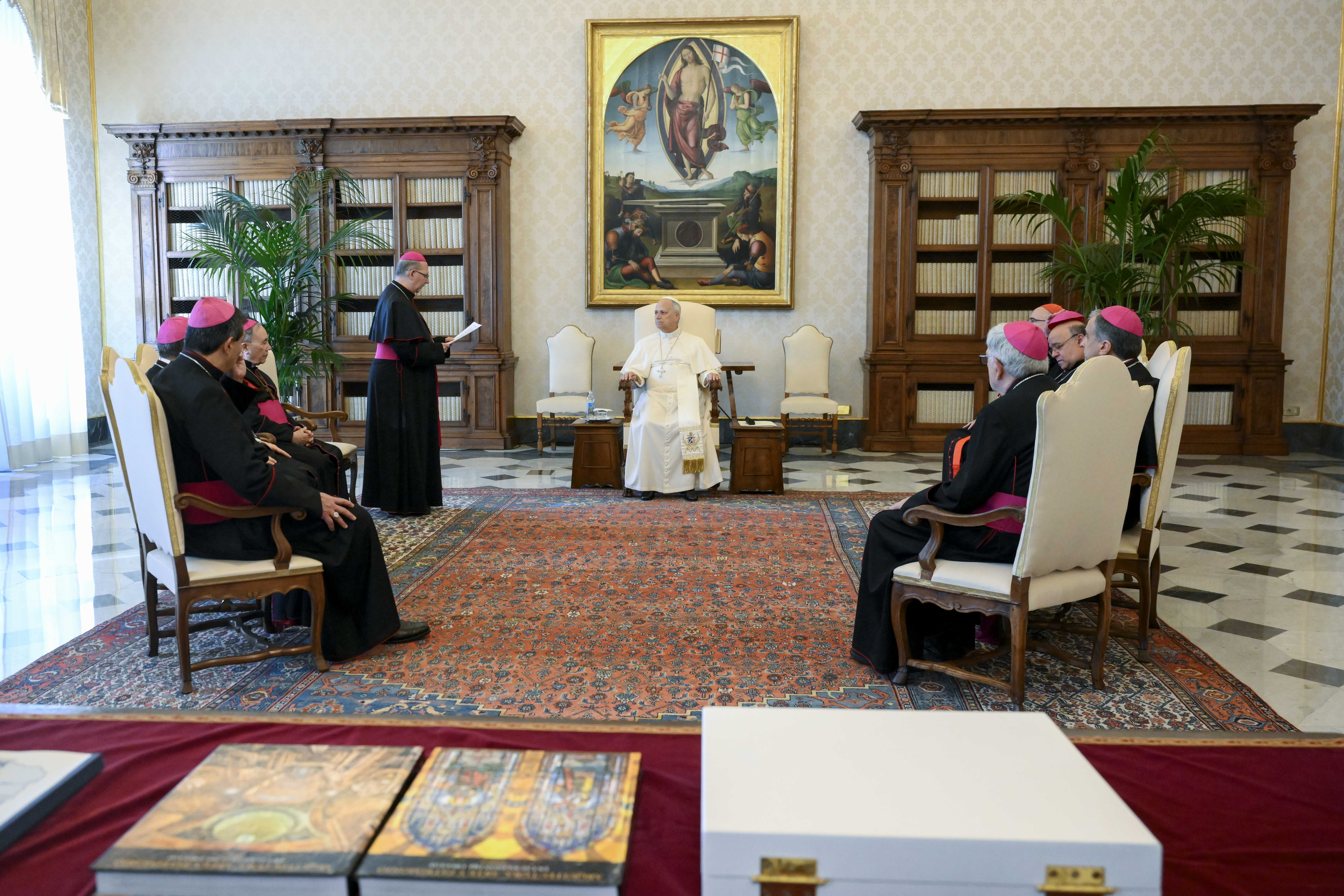
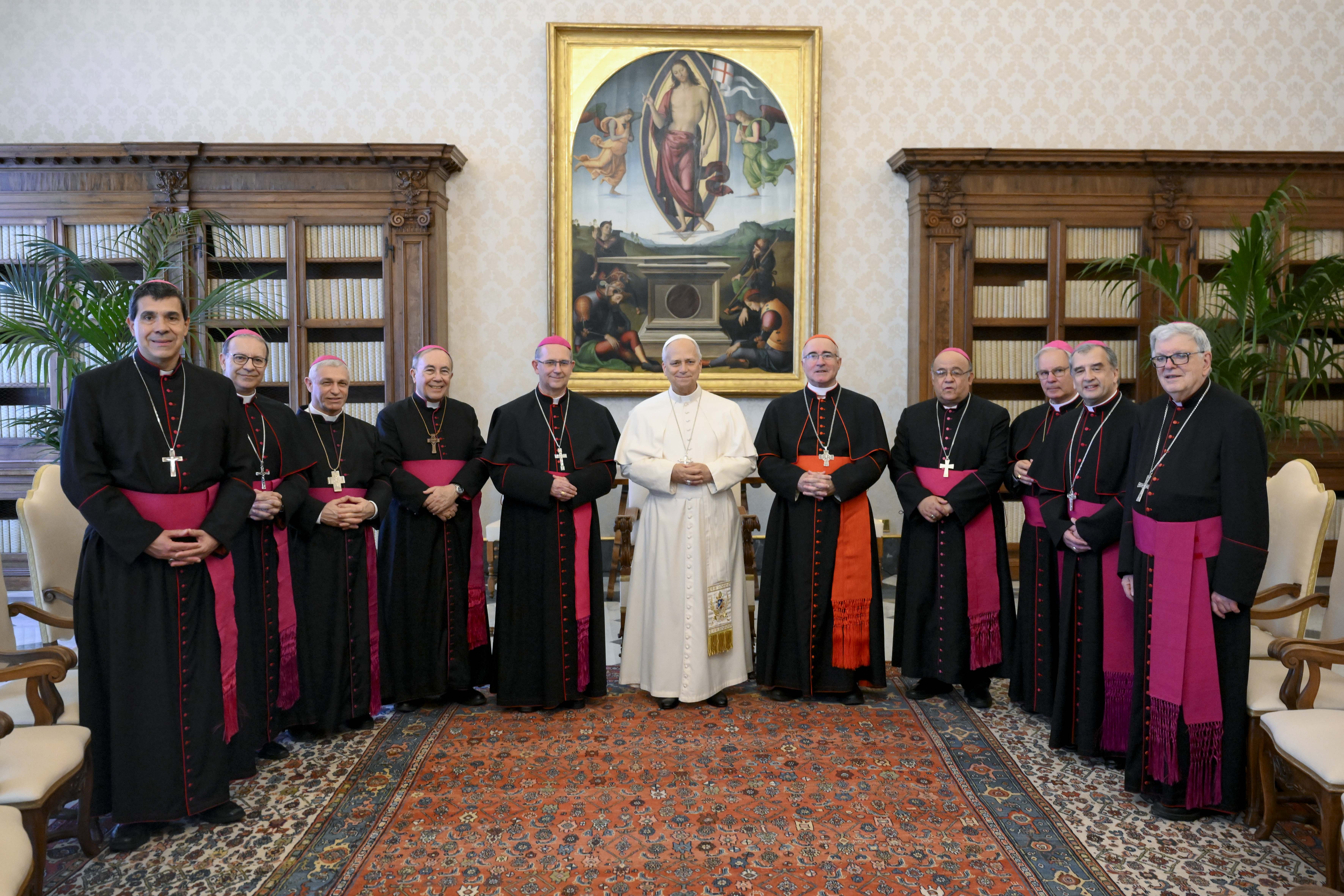
Uruguay's bishops were in Rome last week for their ad limina visit to the Vatican, a trip that included various meetings at the dicasteries of the Roman Curia.
The bishops of Uruguay conclude their ad limina visit to the Vatican on Sept. 18, 2026, with a meeting with the pope. The visit included various meetings at the dicasteries of the Roman Curia. | Credit: Vatican Media
The pope received them for an hour and shared one of his primary concerns: how to transmit the Gospel.
"Today, we see a sort of breakdown in the transmission of the Gospel, especially within the family. We can no longer take for granted that families are the ones encouraging their children or teenagers to attend church or receive the sacraments; indeed, the number of child baptisms in Uruguay has dropped significantly," the Uruguayan prelate noted.
However, he noted that much like in other secularized countries such as France, Uruguay is also experiencing an unprecedented phenomenon: a rise in young adults seeking Christian initiation.
"Baptisms for adults are on the rise, specifically young adults requesting the sacrament of baptism and the full process of Christian initiation: baptism, confirmation, and the Eucharist. For us, this is very encouraging," he commented.
An increasingly secularized country
Uruguay is often described as one of the most secularized countries in Latin America. For instance, it is the only country in the region where Holy Week is not recognized by the government; instead, it was renamed "Tourism Week" by law in 1919.
According to data from the Uruguayan Bishops' Conference, in a country of barely 3 million inhabitants, approximately 35% of the population identifies as Catholic. Within that group, according to Tróccoli, "we can say that approximately 10% attend Mass every Sunday or frequently receive the sacraments."
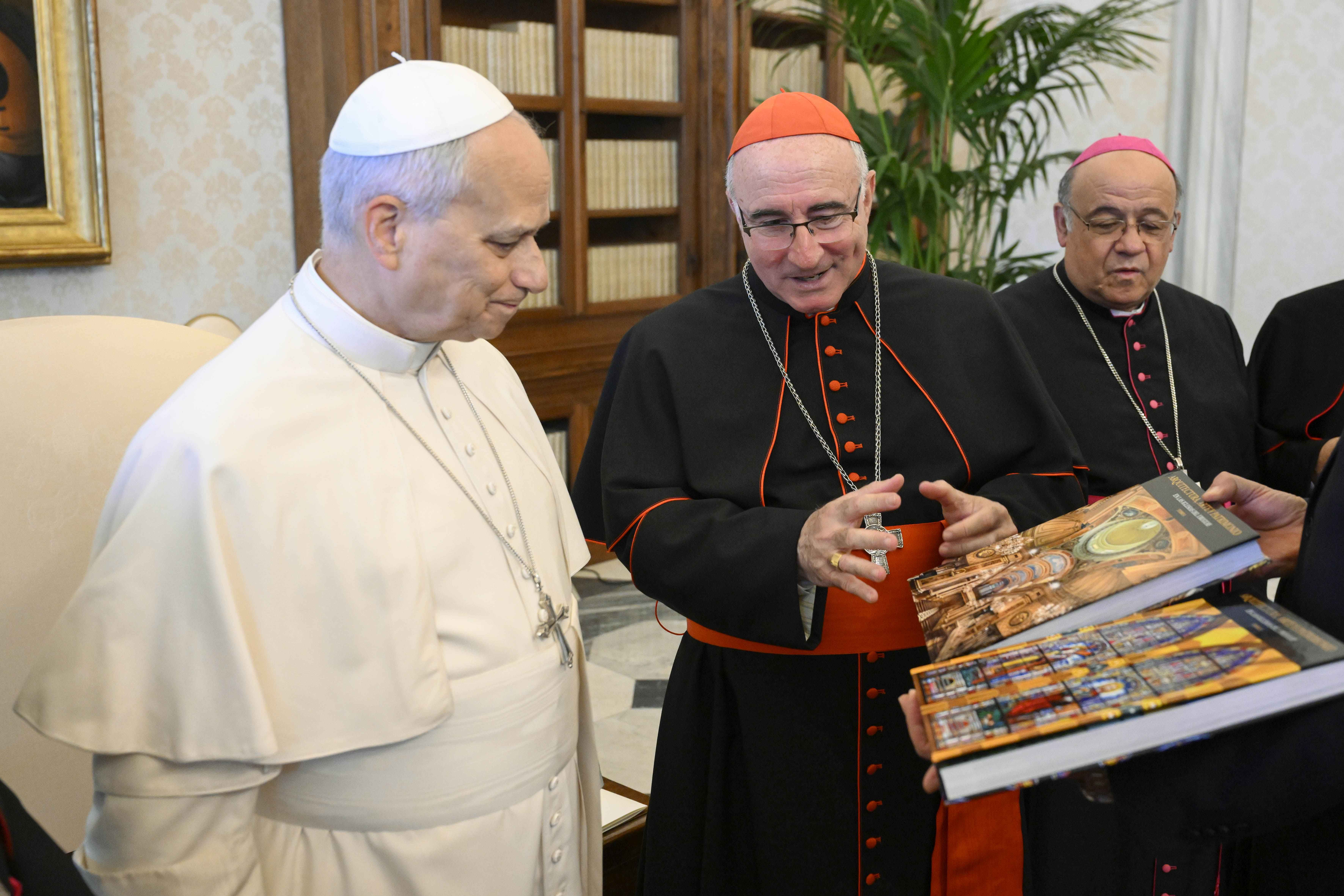
The Uruguayan bishops present the pope with a book featuring 80 Catholic churches across the country with images by Julio Testoni and stories compiled by Miguel Ángel Álvarez Montero, titled "Architecture, Art, and Heritage in the Churches of Uruguay," during their visit to the Vatican on Sept. 18, 2026. | Credit: Vatican Media
There are also "many who call themselves believers without a religion, that is, without institutional affiliation, who believe in God but do not belong to any specific religion; this is a group that has been growing in recent years."
He also noted that approximately "40% of the population currently falls into this category, while others declare themselves agnostic or nonbelievers."
In this context, evangelization constitutes, according to the bishop, "a very great challenge." The local Church considers Uruguay "a mission country where we must proclaim the Gospel extensively."
"We must place strong emphasis on the initial proclamation of the Gospel, while the Church also works extensively through various social and human development initiatives, naturally bringing the Gospel and acting out of faith in Jesus Christ, and working for the common good, though these efforts often go unnoticed," Tróccoli explained.
Drug trafficking, childhood poverty, and suicides
During his meeting with the Uruguayan bishops, Leo XIV showed interest in learning firsthand about the country's social situation.
Tróccoli lamented the extent of "social fragmentation" and the fact that Uruguay is "a society tending toward polarization, just as our world is polarized."
He also noted the issue of "rising violence stemming from drug trafficking, something we were not accustomed to experiencing. Well, perhaps the rate is very low compared to other countries, but for our society, it is something new and something that deeply affects families."
The bishop also highlighted concerns regarding children living in poverty and the rise in youth suicides, issues he linked to "a lack of a more transcendent perspective."
"The number of suicides, especially among young people, represents a high percentage, the highest in Latin America. This deeply questions and challenges us as a Church," he stated.
For the Uruguayan Church, this reality presents the challenge of proclaiming a message of hope. "We must do a better job of proclaiming the Gospel so that it can offer hope, give meaning to life, and provide reasons, truth, for living, growing, and developing as a person."
A visit marked by devotion to the Virgin of the 33
The visit of the Uruguayan bishops to the Vatican took place less than two months before the apostolic journey with which Pope Leo XIV will begin his Latin American tour.
A meeting between Pope Leo XIV and Uruguayan bishops on Sept. 18, 2026, provided an opportunity to present the Holy Father with a document containing messages from citizens across Uruguay, sent in anticipation of his arrival in the country on Nov. 6, 2026. | Credit: Vatican Media
The pontiff will arrive in Latin America on Nov. 6, lead an event in Montevideo, and meet with President Yamandú Orsi. The following day, he will travel to Paysandú and subsequently return to Montevideo to visit various charitable works of the Church and celebrate a Mass at Centenario Stadium.
On Sunday, Nov. 8, before departing for Argentina, he will celebrate the Mass of the Virgin of the 33, Uruguay's national patroness, in the city of Florida.
The National Shrine of the Virgin of the 33 is located there, situated about 60 miles from Montevideo. Indeed, the coincidence of dates with the country's principal Marian celebration was one of the factors influencing Leo XIV's decision to begin his tour of Latin America there.
The feast of the Virgin of the 33 is celebrated every Nov. 8, although the national pilgrimage traditionally takes place on the second Sunday of the month. In 2026, the two dates coincide, and the pope did not want to miss the occasion.
"For us, it is truly a tremendous gift that the pope could come at this time, especially since it coincides with the feast of the Virgin of the 33, who is the patroness of Uruguay, and the national pilgrimage. The feast day of the Virgin falls on Nov. 8, which is a Sunday this year, and the pope himself will celebrate the Eucharist," Tróccoli explained.
Memories of St. John Paul II
The Uruguayan bishops presented the pope with two books featuring images of various churches from across the country. They also gave him a collection of letters and drawings prepared by both the faithful and nonbelievers.
Leo XIV has never visited Uruguay. However, some Uruguayans knew him when he was still Father Robert Prevost. During his time as superior general of the Order of St. Augustine, he traveled to Argentina on several occasions, where he met Uruguayan Augustinians.
However, memories of St. John Paul II's visits remain very much alive among Uruguayan Catholics. The Polish pontiff visited the country twice — in 1987 and 1988 — at a particularly significant time of democratic consolidation following the military dictatorship.
Tróccoli said he believes the visit of Leo XIV could have a similar impact. "It created a sense of unity not only within the country but also a resurgence of faith and personal devotion. We saw an immediate increase, for instance, in the number of people attending Mass or drawing closer to the faith," the prelate noted.
In this regard, he said he believes Pope Leo XIV's visit will awaken "the most genuine aspects of the search for faith and of religious sentiment, and from there, more people will want to draw closer."
The president of the bishops' conference also stated that the trip will mark a turning point for Uruguayan society: "It will be a visit filled with hope. The pope isn't going to come just for some people; he comes for everyone, and everyone is also invited to feel part of this celebration of encountering him."
This story was first published by ACI Prensa, the Spanish-language sister service of EWTN News. It has been translated and adapted by EWTN News English.
The Sept. 15 murder of Father Román de la Cruz Hernández was likely perpetrated by organized crime and is not an isolated incident but forms part of a pattern of fear and intimidation.
The recent murder of Father Román de la Cruz Hernández in the Mexican state of Hidalgo has once again drawn attention to the violence plaguing the country and has renewed concerns over how organized crime acts with impunity.
De la Cruz, 48, the parish priest of Santa Cruz in Huejutla, Hidalgo, was found dead on a road in the Lolotla district on Sept. 15.
On Sept. 17, Francisco Ángel Fernández Hasbun, chief of staff for the Hidalgo state attorney general's office, stated in a video that the agency is "conducting the appropriate investigations."
According to local media, the priest's body was found with gunshot wounds near a pickup truck, accompanied by a placard bearing a message whose content has not been disclosed by the authorities.
The Mexican Bishops' Conference (CEM) has demanded a "thorough investigation" of the case, while Bishop José Hiraís Acosta Beltrán of the Diocese of Huejutla lamented "the alarming situation of violence being experienced in our country."
Around 600 people marched for peace in Huejutla on Sunday, Sept. 20, and attended a Mass for De la Cruz. During the homily, Acosta called for "a culture of peace and reconciliation," asking for the crime to be solved and urging that "neither this event nor the other crimes that have wounded our Mexican nation be allowed to go unpunished."
On the afternoon of Sept. 21, Acosta and Fernández met and delivered a brief joint statement.
Fernández said important information regarding the case was provided during the meeting and said the two believe the case will resolve quickly, noting the Church's collaboration with the authorities during the inquiries.
'The telltale signs of organized crime'
According to the Catholic Multimedia Center, a group that documents violence against Church members in Mexico, four priests have been murdered so far during President Claudia Sheinbaum's term in office. The total number of priests murdered since 1990 exceeds 60.
The center's director, priest and journalist Father Omar Sotelo, told ACI Prensa, the Spanish-language sister service of EWTN News, that the murder "bears the telltale signs of organized crime."
Sotelo noted that "extortion and threats against priests in the country are an ongoing reality."
He noted that, among those recorded and analyzed by the group, "more than 80% of cases remain unsolved," including the 1993 murder of Cardinal Juan Jesús Posadas Ocampo, archbishop of Guadalajara, a case that stands as "a monument to impunity."
In a 2016 Facebook video, Cardinal Juan Sandoval Íñiguez, then-archbishop emeritus of Guadalajara and Posadas' successor, declared the murder "a crime by the state, perpetrated by the Federal Judicial Police." He even named Rodolfo León Aragón, then-director of the police, as the one behind the murder, who Sandoval said probably got his orders from then-Attorney General Jorge Carpizo, whose death in 2012 ended the investigation.
'This could happen to us, too'
Julieta Appendini, director of the pontifical foundation Aid to the Church in Need (ACN) in Mexico, told ACI Prensa "it is important not to view these murders merely as isolated criminal acts."
The impact of a crime against a priest "goes far beyond the loss of an individual," she said, noting that "the priest often has a very close presence in the life of the community: He knows the families, ministers to the sick, listens to people's problems, celebrates the sacraments, and can also serve as a figure of trust and mediation."
"When he is murdered, the community loses someone who fulfilled many of those roles, and an even greater sense of fear and helplessness can take hold."
She warned that the murder could serve as a warning to other priests: 'This could happen to us, too.'"
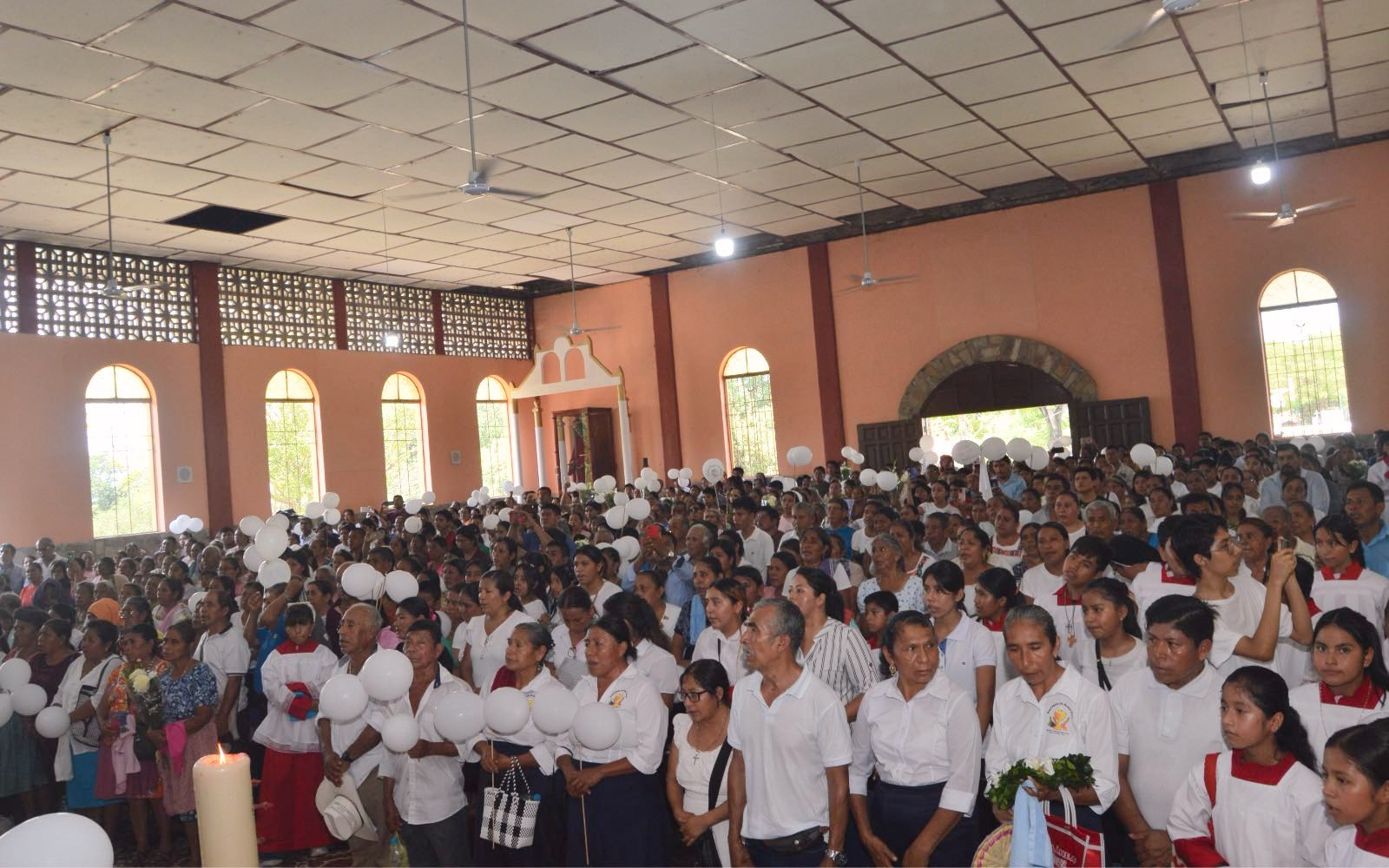
The faithful attend the Mass celebrated on Sept. 20, 2026, in Santa Cruz, Huejutla, in memory of Father Román de la Cruz Hernández. | Credit: Father Domingo Porfirio Cruz/Diocese of Huejutla
'The goal is to sow fear'
"The goal is to sow fear," Sotelo said. The community of Huejutla "is afraid; they have already told us so."
Despite this, he affirmed that, "the clergy of Huejutla will continue working and carrying out their pastoral mission just as they are doing now."
According to Sotelo, this type of murder demonstrates "the ruthless power" of organized crime in the country, "where, regrettably, the authorities have been ineffective in managing the situation and ensuring the safety of the Mexican people."
Appendini pointed out that "a priest working in a community affected by violence does not merely celebrate the sacraments. Often, he is one of the individuals who remains when others have had to leave; he ministers to the families, listens to the victims, defends the vulnerable, and can become a voice denouncing these acts of violence."
"That can place him in a vulnerable position vis-à-vis those seeking to control territory or impose silence," she said.
Appendini noted that ACN's 2025 Religious Freedom Report "points to threats, extortion, murders, assaults, and pressure to remain silent directed at priests and other religious leaders in Mexico."
However, she clarified that "not every attack on a priest is necessarily motivated by an intent to attack religion. In Mexico, violence can be linked to territorial control, drug trafficking, extortion, or land disputes."
Religious freedom "comes into play when a person is put at risk precisely for carrying out their mission and ministering to their community," she said.
'We must not normalize these situations'
"Fear also has consequences for religious freedom," Appendini warned, noting that "a person may legally have the right to practice their faith, but if doing so publicly, serving their community, or speaking out against violence puts him in danger, then that right is not being fully exercised."
"That is why, at ACN, we believe we must not normalize these situations or reduce them merely to statistics. When a priest who serves his community is threatened or murdered, we must also ask ourselves what is happening to that community and to the freedom of the people living there," she noted.
Sotelo acknowledged that, in both his priestly ministry and his work as a journalist, "we sometimes feel fear; we know that at any moment we could even lose our lives for speaking about these kinds of circumstances."
However, he affirmed that "God is with us, the Master Jesus is with us, and in the face of that, we have no choice but to continue carrying out our pastoral work as a priest, a journalist, as a reporter."
This story was first published by ACI Prensa, the Spanish-language sister service of EWTN News. It has been translated and adapted by EWTN News English.
Bishop Garcia asked for prayers for the man who was shot and "all who have been involved," asking for government authorities to be "transparent and honest about what occurred."
Bishop Daniel E. Garcia of the Diocese of Austin, Texas, said he was "deeply saddened and disturbed" by an ICE officer's shooting of a Venezuelan man in Austin, as federal officials described the encounter as an officer responding to the man's attempt to flee arrest.
In a letter dated Sept. 20, the day of the shooting, Garcia wrote that people in the city are "living in terror and fear because of the increased activity of ICE agents on our streets."
He asked for prayers for the man who was shot, his family, "all who have been involved and for our entire community," and for federal, state, and city authorities to be "transparent and honest about what occurred."
The New York Times reported that ICE agents were checking license plates in north Austin Sunday afternoon when they found a deportation order for Wilber Rafael Garces Perez, pulled him over and told him that he would be arrested. Garces Perez then drove away, according to the Times, and a short chase followed.
The Texas Department of Public Safety said ICE requested help about 12:50 p.m. with a vehicle pursuit of a blue Toyota Corolla. Austin Police Chief Lisa Davis said city police were not part of the ICE operation and that the shooting came before troopers arrived.
The U.S. Department of Homeland Security said it is investigating, with FBI assistance, "the officer involved shooting of an illegal alien from Venezuela" who it said entered the country illegally and had a final order of removal.
DHS said the man's condition is stable and that he is in federal custody pending removal.
Video showed the Corolla and an unmarked Ford SUV stopped under a highway overpass when an officer approached the Toyota, which was moving slowly. Witnesses reported multiple shots. Garces Perez, who his family said was making a DoorDash delivery, was shot in the upper torso, treated at Dell Seton Medical Center, then transferred to ICE custody.
His lawyer, Kate Lincoln-Goldfinch, said at a news conference Monday that he is at the South Texas ICE Processing Center in Pearsall. Garces Perez called his attorney during the conference, saying over speakerphone that a bullet remains near his spine, he is not receiving adequate medical care, and he slept on the floor at the facility.
"I'm not doing well because of the gunshot I received," he said in ?Spanish.
Lincoln-Goldfinch disputed that her client knowingly fled identified agents. She alleged that an unmarked vehicle sideswiped him, he did not know it was ICE, and officers shot him after another collision.
Lincoln-Goldfinch also said her client entered the country legally and had a work permit.
"Many people are often being detained only due to the color of their skin or the language they speak," Garcia wrote.
In a Sept. 22 statement to EWTN News , García said that in his diocese, he is hearing from clergy and parishioners of "specific instances" where people "have been detained as they are going about the ordinary responsibilities of daily life. When good, hardworking people become fearful that they may be targeted because of their ethnicity or appearance, we all have a responsibility to listen and to speak to the human reality that exists within our communities."
He told EWTN News he has dispensed those who are afraid from the obligation to attend Sunday Mass, calling it an "extraordinary step."
"Regardless of a person's immigration status, every person is created in the image and likeness of God and possesses an inherent dignity that must always be respected and protected," Garcia said on Sept. 20. "We cannot allow differences of citizenship to diminish our recognition of the dignity that belongs to every human being."
During National Migration Week, he added, "we are all brothers and sisters. When one person is harmed, all of us are affected." He repeated the call for "comprehensive immigration reform" and "a viable immigration policy that respects the rule of law while recognizing the dignity of every person."
Neither ICE nor DHS responded to a request for comment from EWTN News in time for publication.
Sister Miriam James Heidland, SOLT, a well-known speaker, podcast host, and author, said she is discerning the establishment of a new religious community called Friends of the Bridegroom.
Popular Catholic speaker, podcast host, and author Sister Miriam James Heidland, SOLT, announced on Sept. 21 that she is publicly discerning the establishment of a new religious community called Friends of the Bridegroom.
"After several years of private discernment, I would like to announce to you with great reverence and care that, with the blessing of my religious community the Sisters of the Society of Our Lady of the Most Holy Trinity (SOLT) and the Archbishop of Milwaukee, Wisconsin, his Excellency Jeffrey S. Grob, I am officially entering into a time of public discernment of the foundation of a new religious community, Friends of the Bridegroom," Heidland wrote in a post on X.
The religious sister explained that her many years working in healing ministry and working with other religious sisters, priests, and bishops has allowed her "to see and experience the need and ache for the ongoing healing and renewal of our clergy and religious sisters."
Heidland has served as the executive director of Friends of the Bridegroom alongside Father John Burns of the Archdiocese of Milwaukee. According to its website, it is an apostolate that seeks to renew the Church through the healing, renewal, and expansion of consecrated life and the priesthood.
She called her time working with the apostolate "a profoundly blessed time" and added that "the Lord has continually stirred a desire in all of us in the apostolate to discern the foundation of a new community of priests, religious sisters, and laity who would work toward this important renewal."
"During this time of public discernment, the Friends of the Bridegroom ministry and my public activities connected with this discernment will remain under the pastoral care and oversight of Archbishop Jeffrey Grob, Archbishop of Milwaukee," she explained. "I am deeply grateful for his willingness to accompany and guide this discernment during this important time."
Heidland will remain a sister in good standing with SOLT and will continue to wear the order's habit.
"I am truly grateful for the support of so many people over the years and I continue to count on your prayers and support as we discern this very important step … Once again, I extend my tremendous gratitude to Sister Mary Aloysius of Jesus, SOLT General Sister Servant, her General Council, and Archbishop Jeffrey Grob," she wrote.
Heidland was placed for adoption by her 17-year-old unmarried biological parents. After spending some time in foster care, she was adopted by a Catholic couple and raised in Woodland, Washington.
It was her adoptive parents who gave her a foundation in the faith. However, at age 11 she was sexually assaulted and at 13 she was raped. She has never publicly named her abuser.
During her teenage years, Heidland focused her time on sports. When she was a senior in high school she was offered a full scholarship to play volleyball at the University of Nevada, Reno. While she remained an important part of the team, she was an alcoholic by the age of 21 and embraced the partying lifestyle.
Completely estranged from her faith and feeling broken, a priest entered into her life and made a lasting impact. Heidland's mother also began to pray and fast for her daughter, asking the Lord to guider her becoming a nun.
In 1998, Heidland entered the Society of Our Lady of the Most Holy Trinity after she felt Jesus calling her to become his bride. Today, she speaks openly about the healing and restoration Jesus has done in her life and shares her powerful testimony with others around the world.
Despite there being no federal law regulating home schooling, the parents have been fined and ordered by a court to enroll four of their children in a traditional school, a ruling they are appealing.
The Vieira family from Blumenau, Brazil, has been home-schooling their seven children for over a decade, an approach that the parents, Diego and Patricia, view as an educational mission focused on human, spiritual, and academic formation.
"We have a well-structured routine. We value sound pedagogical planning. Each child has a plan tailored to their age, and we prioritize personalized education for each of them," the family explained to "EWTN Noticias," the Spanish-language nightly newscast of EWTN News.
For the Vieiras, home schooling is not merely an academic alternative but a mission directly linked to Christ's call to become holy.
"That is the goal of Catholic education: heaven, the pursuit of virtue, the pursuit of holiness, and the acquisition of wisdom to truly contemplate the truth," they stated.
Personalized family-based education
The children's daily schedule is organized according to their needs. In the mornings, they study the subjects in their educational plan, while in the afternoons, they engage in musical, athletic, and cultural activities, as well as practice chess.
However, this form of home schooling ended up in court.
In late July, a trial court judge ordered that four of Diego and Patricia's children be enrolled in and attend a traditional school. Additionally, the couple was ordered to pay a fine of nearly $13,000.
The parents said they believe the decision is linked to their public role in advocating for home schooling.
"Because we are public figures and are actively pushing for regulation, we firmly believe this is a case of persecution against leaders of the movement, as the persecution has escalated with each passing year," they stated.
They also noted that their Catholic identity has influenced how their stance is perceived.
"Because, whether we want to or not, we always uphold the banner of canon law, parental authority, and the family's authority in the education of children. And when we demonstrate this, we encounter a great deal of prejudice in various situations," they explained.
'Home schooling is unstoppable'
Diego Vieira is the president of the Santa Catarina Association of Homeschooling Families and serves on the board of the National Association for Homeschooling. For years, he has supported other families facing legal challenges for educating their children at home.
Together with Patricia, he also spearheads the "Educating for Heaven" project, which offers guidance and materials to families interested in home schooling.
The couple has been promoting this educational approach for over a decade. Their eldest son, Igor, 19, was home-schooled and is currently studying literature and history at a university; he also teaches classes and is a national chess master.
The young man noted that being home-schooled allowed him to develop his abilities at his own pace.
"I was taught to read and write at home, and from a very young age, my parents encouraged me to study. Being able to study at home gave me the freedom to develop at my own pace and have a flexible routine; I could devote more or less effort to tasks I found difficult and truly focus on studying what I enjoyed most," he stated.
A family active in their community
Despite criticisms leveled at home schooling, members of the Blumenau community highlighted the Vieira family's social engagement.
City councilman Flavio José Linhares stated that the family maintains an active presence in the city, particularly through sports and culture.
"In chess, the family has already won over 300 medals representing the municipality in the game. So, they lead an active life in the community," he noted.
The official also expressed his opposition to the court ruling against the family.
"When we saw the decision ordering the family to pay a fine equivalent to 40 minimum wages, we were outraged. We appreciate the quality, care, and love they show for their children's education," he stated.
The debate on home schooling in Brazil
There are no official statistics in Brazil regarding the number of families who home-school. The National Association for Homeschooling estimates there are more than 75,000 families and 150,000 students, although these figures come from the organization itself rather than government records.
Currently, home schooling is not regulated by federal law.
In 2018, Brazil's Supreme Federal Court ruled that, for the time being, families do not have a recognized legal right to educate their children exclusively at home. However, the court also noted that the constitution does not prohibit home schooling and that it is up to the congress to establish regulations.
A bill to regulate home schooling was approved by the Chamber of Deputies (lower house) and is proceeding through the Senate.
For Diego and Patricia, their defense is grounded in religious and legal principles as well as a matter of conscience.
"We base our position on our faith, our beliefs, Church law, natural law, and human rights. All treaties guarantee this freedom, as well as the primacy of parents," they stated.
"We're not doing anything wrong. Therefore, we have a clear conscience regarding this matter and will continue to fight. Home schooling is unstoppable," they added.
The family has already filed an appeal against the ruling and stated that, if the decision stands, they will take the case to higher courts.
This story was first published by ACI Prensa, the Spanish-language sister service of EWTN News. It has been translated and adapted by EWTN News English.
Counterdemonstrators threw paint at a pro-life information stall as Germany's March for Life filled the streets of two cities for the fourth year running.
Thousands of pro-life demonstrators took to the streets of Berlin and Cologne on Saturday, Sept. 19, for Germany's annual March for Life, which for the fourth time was held in both cities at once. Organizers put the combined turnout at about 6,000.
At the start of the Cologne rally on the Neumarkt square, counterdemonstrators threw paint at an information stand.
The Cologne rally, organized by Mona Schwaderlapp, a 27-year-old occupational therapist and mother of three, opened at 1 p.m. under the motto "The Right to Life Is a Human Right." The route passed the Basilica of the Holy Apostles and ran along Zeughausstrasse through the city center before returning to the Neumarkt, where the march ended around 4 p.m.
Paint, smoke, and blockades in Cologne
The paint was thrown by two counterdemonstrators who had obtained the green vests worn by the pro-life marchers and moved unnoticed to the stand of the pro-life foundation Stiftung Ja zum Leben, according to the Catholic weekly Die Tagespost. CNA Deutsch, the German-language sister service of EWTN News, observed on the scene in Cologne that the attackers also set off purple smoke bombs.
During the stage program, several counterdemonstrators pushed to the front of the stage with a banner. One counterdemonstrator, who sprayed the banner with paint during the march, faces a criminal complaint for property damage.
Cologne police said the march had been registered for 3,000 people and that the "pro-choice" counter-event was likewise expected to draw 3,000. Police gave no figures for actual turnout.
CNA Deutsch observed officers using drones to monitor the march. Apart from two sit-in blockades, the procession through the city center passed without major disruption.
"We are here today because there are people who need our help," said Ludwig Brühl of the federal board of the pro-life group Aktion Lebensrecht für Alle at the rally. He warned: "Surrogacy arrangements are being sold in the middle of Cologne."
Brühl said he and fellow campaigners had gone undercover to track down people taking in large sums from the business. "They know how to get around our laws," he said. "We have to stop these people."
Surrogacy and Down syndrome in Berlin
The group's federal chairwoman, Cornelia Kaminski, also spoke against surrogacy, in Berlin.
The 22nd March for Life took place in Berlin at the same time, drawing 4,200 people according to the German pro-life group Bundesverband Lebensrecht. Berlin police put the figure at about 2,200.
Five Bavarian bishops took part in the Berlin march, reported the Diocese of Regensburg. They were Bishop Rudolf Voderholzer of Regensburg, Bishop Stefan Oster of Passau, Auxiliary Bishop Josef Graf of Regensburg, Auxiliary Bishop Florian Wörner of Augsburg, and Bishop Emeritus Gregor Maria Hanke of Eichstätt.
Cologne Auxiliary Bishop Dominikus Schwaderlapp took part in the march there. Several other bishops had sent written greetings to the organizers ahead of the marches.
"In all, well over 6,000 people (4,200 Berlin, 2,100 Cologne) of all generations set out today to take to the streets for the right to life of every human being from conception to natural death," the Bundesverband Lebensrecht said.
The group's chairwoman, Alexandra Linder, said: "Democracy means universal human dignity, the right to life from conception to natural death, and a prohibition on the killing of the innocent."
This story was first published by CNA Deutsch, the German-language sister service of EWTN News, and has been translated and adapted by EWTN News English.