The Diocese of Otukpo gave thanks for the return of the seminarian and those who have provided him care, and called for prayers for other captives.
OTUKPO, Nigeria — A seminarian who was abducted from the bishop's residence in Nigeria's Diocese of Otukpo on July 29 has escaped from his captors and returned home unharmed.
In a statement shared with ACI Africa, the sister service of EWTN News in Africa, on Aug. 16, the chancellor of the diocese, Father Joseph Aboyi Itodo, said Kelvin Ochai "managed to escape from his abductors and made his way to Aliade in Gwer East Local Government Area, where he was found and later safely taken home."
According to the chancellor, Bishop Michael Ekwoyi Apochi, who leads the diocese, expressed gratitude to the people of God "for their show of solidarity and earnest prayers which led to the speedy and safe return of our brother."
Apochi also thanked the priest and parishioners of Sts. Peter and Paul Aliade Parish, who received Ochai as a seminarian following his escape and provided him with accommodation for the night.
Itodo also expressed the diocese's appreciation to the Nigeria police for attending to the seminarian after he escaped.
While giving thanks for Ochai's safe return, the chancellor appealed for continued prayers for the many people being held by criminal groups in different parts of Nigeria, asking God to bring them safely out of captivity.
He also called for prayers for an end to insecurity and the restoration of peace and stability in the West African nation.
"May the good Lord reward you all beyond measure," Itodo said, appealing for continued prayers that God would protect the people from violence and "restore sanity to our country Nigeria."
The West African nation has continued to experience attacks by armed groups involved in killings and kidnappings for ransom.
The Boko Haram insurgency has posed a major security challenge in the country since 2009. The group reportedly seeks to turn Africa's most populous nation into an Islamic state.
Insecurity in other parts of Nigeria has also been linked to attacks involving predominantly Muslim Fulani herders, sometimes referred to as the Fulani militia.
This story was first published by ACI Africa, the sister service of EWTN News in Africa, and has been adapted by EWTN News.
"American Martyr" can be seen in theaters Aug. 25-26 in English and in Spanish on Aug. 27.
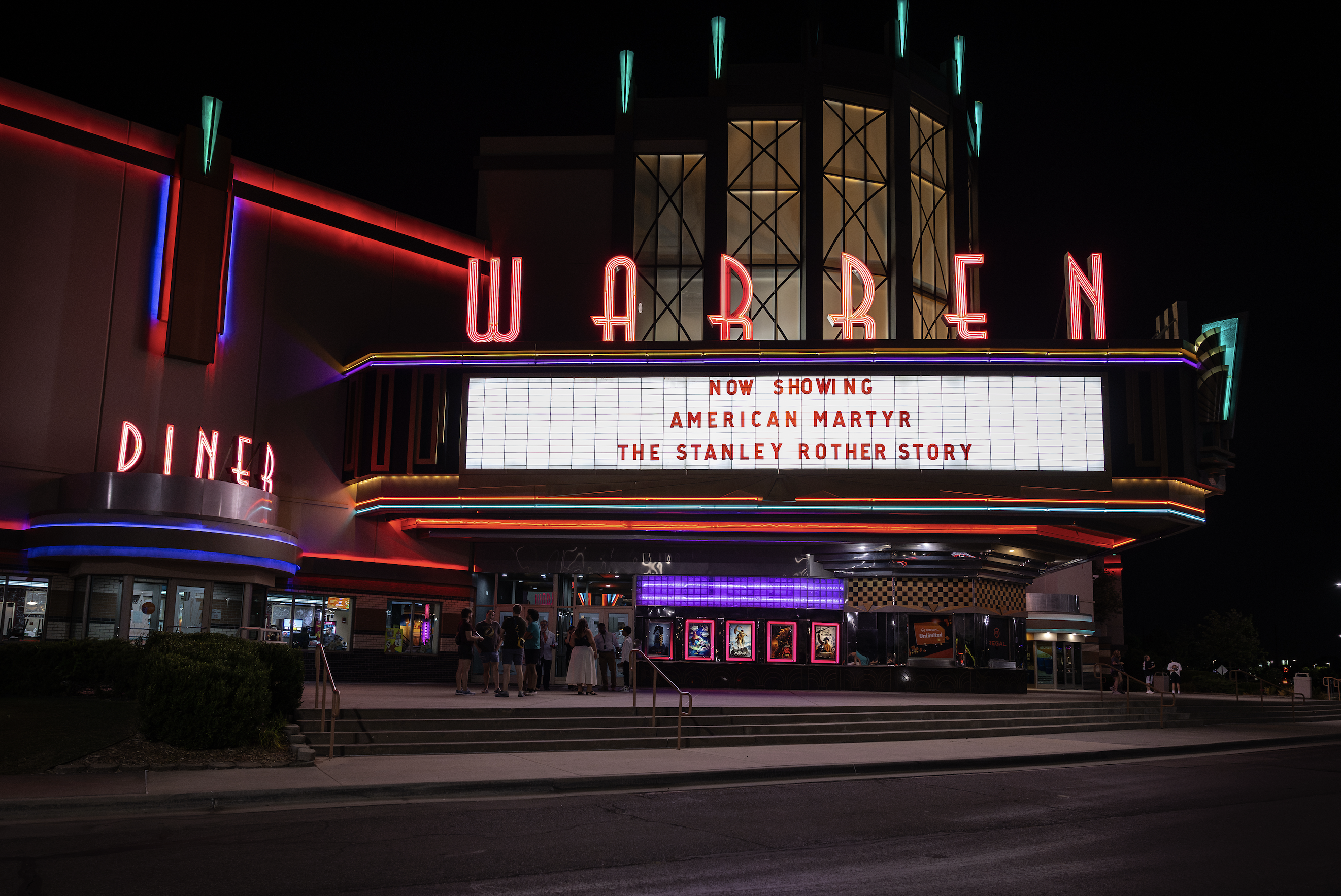
Hundreds gathered late last month in Oklahoma City for the premiere of the new film "American Martyr: The Stanley Rother Story," a feature-length documentary depicting the inspiring life of Blessed Stanley Rother.
"This has been a long time coming," Archbishop Paul Coakley of Oklahoma City told EWTN News on the red carpet July 28.
Born in Okarche, Oklahoma, Rother was a farmer before he attended Mount St. Mary's Seminary in Emmitsburg, Maryland, and was ordained a priest in 1963. After serving as an associate pastor at a parish in Oklahoma for five years, Rother received permission to join the staff at the Oklahoma diocese's mission in Santiago Atitlán, Guatemala.
He served the Tz'utujil people, who are descendants of the Mayans, in Guatemala, learning their native Tz'utujil language as well as Spanish. As their pastor, Rother celebrated Mass and helped translate the New Testament into the Tz'utujil language. He quickly gained the trust and love of the local people, ministering to them in their homes, sharing meals, helping them in the fields, and visiting the sick.
While Rother was in Guatemala, a civil war broke out and the Catholic Church was caught in its crosshairs. The priest's name was placed on a death list. On July 28, 1981, three men entered the rectory at night and killed the beloved priest.
Rother's cause for canonization opened in 2007 by the Archdiocese of Oklahoma City, and in 2016 Pope Francis recognized Rother as a martyr for the faith. He became the first American-born priest to be recognized as a martyr by the Catholic Church.
The Warren Theater in Oklahoma City hosted the premiere of "American Martyr: The Stanley Rother Story" on July 28, 2026. | Credit: Photo courtesy of Chris Porter
"We've been very intentionally promoting the cause of Blessed Stanley Rother for many years," Coakley said. "He's been beatified and now we're working toward his canonization, and in order for that ever to happen we need more and more people seeking the intercession of Blessed Stanley Rother and seeking his divine favor so that miracles may be performed through his intercession. So that's why we undertook this production, to introduce him to more and more people."
The archbishop added that the film is "a beautiful depiction of the life of an ordinary Catholic who responded generously and faithfully to God's grace and mercy and allowed the Lord to transform him and form him into the saint ultimately that we hope he will finally be named."
Michael Scaperlanda, chancellor at the Archdiocese of Oklahoma City, said: "This is an exciting moment for the archdiocese to have a nationwide release … of this wonderful documentary narrated by Martin Sheen."
He highlighted the importance of sharing Rother's story to a wider audience because it serves as a reminder that "even ordinary people can become saints."
For Felipe Coche Pablo, the documentary is particularly personal. Pablo is a native of Santiago Atitlan and was baptized by Rother when he was 6 months old. He was 2 years old when Rother was killed.
When Rother's cause was opened, Pablo was appointed to serve as the official church notary for Rother's parish in Santiago Atitlán. It was then that he learned about the potential saint's life and legacy.
Pablo said learning about Rother deeply impacted his life and taught him "to keep fighting in life. There are always stumbles, but you have to pick yourself back up, like he [Rother] did."
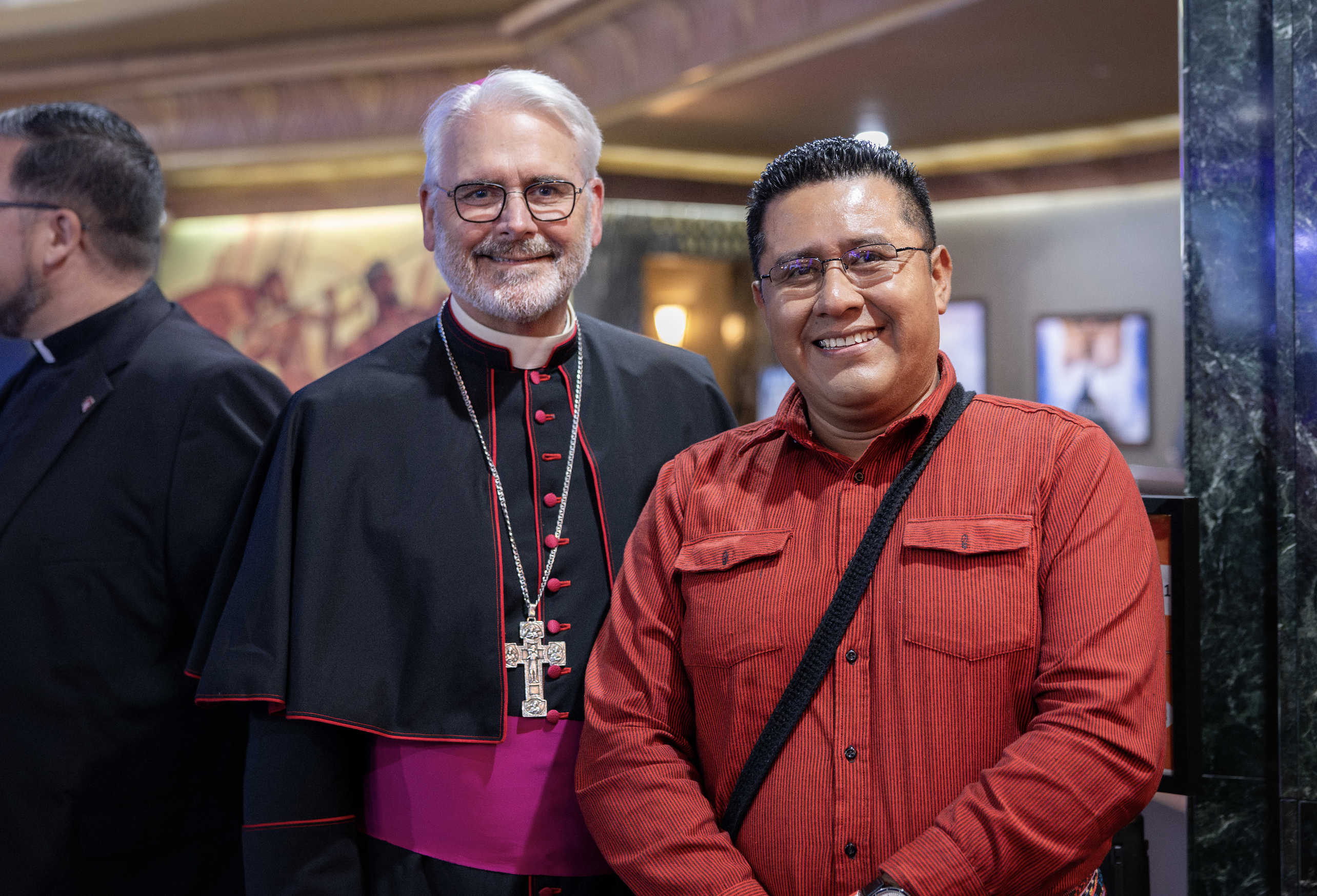
Archbishop Paul Coakley of Oklahoma City, left, and Felipe Coche Pablo, right, at the premiere of "American Martyr: The Stanley Rother Story" on July 28, 2026. | Credit: Photo courtesy of Chris Porter
Today, Pablo is the administrator at Colegio Católico Padre Apla's — also known as the Blessed Stanley Rother Catholic School — in Santiago Atitlán. This school is part of the parish in which Rother served, Santiago Apóstol, or St. James the Apostle Church.
"We have 435 students and the education is trilingual — Tz'utujil, Spanish, and English," he explained. "Our first language is the Mayan language, Tz'utujil. And he [Rother] was a priest that was very loved by the people because he learned the Mayan language Tz'utujil, like us, like what I speak."
Pablo said he hopes viewers of the film will be inspired by Rother's "service to others" and to "carry peace, love, evangelize, and what is most needed in life — look for God."
Coakley added that he hopes viewers will leave the theater reminded that "all of us are called to holiness."
"Stanley Rother would not have been the one in high school in the yearbook that said most likely to become a saint … And yet all of us are called, it's our vocation if you're baptized, you're called to be a saint. All of us are called to be saints. And Stanley Rother gives us a hope that for each one of us that is a possibility that is real."
"American Martyr" can be seen in theaters across the U.S. on Aug. 25 and 26 in English and in Spanish on Aug. 27.
A dispute between Florida's Catholic bishops and the state attorney general over vaccine exemptions in Catholic schools is testing the boundaries between state law and Church authority.
A dispute between Florida's Catholic bishops and state Attorney General James Uthmeier over vaccine exemptions in Catholic schools is testing the boundaries between state law and Church authority, with both sides arguing religious freedom is at stake.
The dispute began with what Wenski described as Uthmeier's "veiled threat" in a July 31 letter to the Florida Conference of Catholic Bishops. In it, the attorney general urged the bishops to bring Catholic schools into compliance with Florida law requiring religious exemptions for school vaccine mandates, on pain of the loss of state funding through its school choice scholarship program.
Florida has one of the most expansive school choice programs in the United States, whereby families can use state-funded scholarship money for a variety of education-related expenses, including private school tuition.
Uthmeier argued in his letter that "at least one diocese" in Florida appears to have adopted a policy based on what he characterized as the bishops' erroneous interpretation of guidance given to Wenski in 2011 by the National Catholic Bioethics Center.
The bioethics center's then-president, John Haas, said Catholic institutions could not grant exemptions to vaccines on religious grounds because the Church has determined that utilizing vaccines derived from aborted fetal cell lines was "not intrinsically evil" because of the remoteness of the original, evil act of abortion.
At the same time, Haas made a distinction between religious and conscience objections, stating Catholic institutions should grant the latter "as liberally as possible for the sake of the delicate consciences" of Catholic parents. He also noted that the consciences of those making school policies must be respected.
Wenski told "EWTN News in Depth" host Catherine Hadro in an Aug. 14 interview: "If a Catholic has conscience objections to the vaccines you can't say that your objections come from your understanding of the Catholic faith because the vaccinations available and developed are not contrary to Church teachings."
Religious exemptions or conscience exemptions?
The distinction between the two types of exemptions is important, making the Florida case complicated, Andrea Picciotti-Bayer, an attorney and the founder of The Conscience Project, told EWTN News.
While most states offer some combination of medical, religious, and conscience exemptions to vaccine mandates, Florida law does not explicitly protect conscience objections, only medical and religious ones.
Uthmeier argues that conscience objections fall under the protection of religious liberty, particularly for Catholics, for whom the formation of conscience is a central aspect of the faith.
"The teachings of the Catholic Church do not require Catholic schools to compel students to take vaccines derived from the tissue of aborted children against the sincerely held religious objections of their parents," Uthmeier wrote.
The attorney general also noted that some Catholic families object to certain vaccines not only because of their connection to aborted fetal cell lines, but also because of concerns about the safety of vaccine ingredients and methods of production, including the use of mRNA technology, which he said brings a "heightened risk of health defects, including miscarriages."
The National Catholic Bioethics Center declined to comment to EWTN News. However, the organization maintains resources on its website stating the Church's position that although vaccines developed through morally problematic means may be used for grave reasons, vaccination is not a moral obligation for Catholics and, in order to protect human dignity and the free exercise of conscience, should be voluntary.
The organization also states that "public health measures and policies should be built upon sound science and ethical principles."
Uthmeier: Parents' rights are being violated
Uthmeier told EWTN News he is concerned about the "religious freedoms and rights of parents." He pointed out that many Catholic families have come to him noting the irony that their conscience rights are protected in public schools in Florida but not in Catholic ones.
Uthmeier also said families are confused because Catholic schools in several dioceses across the country do grant vaccine conscience and religious exemptions.
Because Catholic schools receive state scholarship funds, he argued, the state has an interest in ensuring that religious freedoms are protected.
"Where First Amendment rights [and] the religious beliefs of parents are being violated, we as a state have a duty to investigate and see what legal tools we may have to protect our parents in Florida," he said.
While acknowledging that the state cannot dictate religious beliefs, he said he remains unconvinced that the bishops have identified an authentically religious reason for denying exemptions.
A Catholic himself, Uthmeier further pointed to what he said were long-standing Catholic teachings regarding parental authority and conscience rights.
"Respecting the right of conscience is deeply embedded in our catechism," he said. "How these rights can be violated, and how Catholic Church officials can disagree on citing religious teaching across the country, perplexes me."
Wenski: Catholic schools must protect the common good
Wenski likewise framed the controversy as a religious freedom issue, from the perspective of the Church's right to determine and apply its own teachings.
He described Uthmeier's position as "an unfair and ill-advised interpretation of separation of Church and state" and argued that lawmakers never intended school-choice scholarships to impose a religious test on participating schools.
"The Church has a right to determine our own teachings," he said.
Wenski told EWTN News that the bishops "certainly respect the rights of conscience of every person." At the same time, he said Catholic social teaching also obligates schools to promote the common good and protect children through immunization.
"We've witnessed in recent months an upsurge of cases of measles, and we know that that presents certain dangers for pregnant women," Wenski said.
The archbishop noted that Catholic schools already grant medical exemptions when a physician certifies that a child should not be vaccinated.
But he maintained that parents who object to vaccination are free to choose another school.
"Nobody is forced to go to a Catholic school," he said.
The bishops sent Uthmeier a formal response, Wenski said, outlining what they view as the religious freedom issues implicated by the attorney general's intervention.
Wenski said the bishops are "prepared to protect our students, to defend our rights, and to preserve religious freedom" while remaining open to continued dialogue with the state.
Critics of Florida bishops' policy disagree
While Wenski suggested the issue is largely settled within Catholic teaching, critics of the Florida bishops' policy disagree.
Yvonne Bontkowski, director of Children of God for Life, said the controversy reflects a deeper disagreement over how Catholics should respond to vaccines connected to abortion-derived cell lines.
"This is the first time I have ever seen where the state isn't asking the Church to violate its teaching, it's asking the Church to honor it," she told EWTN News.
The organization argues that although the Church has determined it can be morally permissible to receive such vaccines under certain circumstances, Church teaching says Catholics still have a moral duty to advocate for ethical alternatives and resist what it sees as the continued exploitation of aborted fetal tissue in biomedical research.
Bontkowski cited a 2005 document from the Pontifical Academy for Life, which established the moral permissibility of the use of vaccines developed from aborted fetal cell lines in order to protect health but also affirmed that Catholics may exercise conscientious objection regarding such vaccines.
"Our conscience is directed to what is morally good," she said. "The Vatican never said these vaccines are morally good. It said we're not sinning if we take them for grave reasons and on a temporary basis while we demand ethical alternatives."
She argued that families exercising that duty should not be excluded from Catholic education, which, unlike immunization, is a moral obligation.
Canon law states that parents have both a right and a "most grave obligation" to provide a Catholic education for their children, while Canon 217 affirms that the faithful have the right to a Christian education "by which they are to be instructed properly to strive for the maturity of the human person and at the same time to know and live the mystery of salvation."
Other critics contend that the debate ultimately turns on differing understandings of public health and the common good.
Barbara Loe Fisher, co-founder and director of the National Vaccine Information Center, told EWTN News that Catholic school officials generally formulate vaccine and other public health policies based on the judgments of public health authorities.
But, she argued, the COVID-19 pandemic exposed public distrust in scientific and governmental institutions, especially regarding data about who is at greatest biological risk for vaccines "that could hurt or even kill people."
"Unfortunately the entire notion of the common good rests upon the science," Fisher said. "If the scientists and the government haven't done due diligence in doing the best science, or haven't told the full truth, that is a moral dilemma the Church is going to have to eventually grapple with."
The pontiff offered prayers for the Indonesian people in a message on Aug. 17.
Pope Leo XIV has sent a message expressing his closeness to the Indonesian people following a 7.7-magnitude earthquake that struck the country on Aug. 15.
In a telegram dated Aug. 17 and signed by Secretary of State Cardinal Pietro Parolin, the pope expressed his sadness on learning of the earthquake, which, according to an Aug. 17 BBC news report, has killed at least 53 people and left over 5,000 displaced.
According to the same report, the earthquake has also caused severe structural damage to hundreds of buildings, particularly on Indonesia's Flores Island and in North Sumatra. Authorities continue to assess the number of injuries.
"His Holiness Pope Leo XIV was deeply saddened to learn of the devastation caused by the earthquake in the region of East Nusa Tenggara, and he offers the assurance of his spiritual solidarity and closeness to those suffering the continuing effects of this disaster, particularly for the many displaced and injured," the telegram said.
In the message, addressed to the archbishop of Ende, Archbishop Paulus Budi Kleden, SVD, the pope also encouraged authorities to continue their humanitarian efforts and commended "the dead to the loving mercy of Almighty God."
Leo's recent telegram follows that of Aug. 11, in which he expressed closeness to the victims of a 7.4-magnitude earthquake that struck western Colombia on Aug. 10, which killed at least 281 people and injured 3,971, according to Colombia's President Abelardo de la Espriella on Aug. 13.
The men, held since May on charges of conversion and attempted murder, walked out of jail after the Rajasthan High Court granted bail.
Ten Catholics who were arrested after they chased a group of Hindu activists out of a village church during Mass in India's desert state of Rajasthan returned home on the night of Aug. 13, more than 100 days after they were jailed.
"We are happy and relieved as our people have been released after being imprisoned for over 100 days on false charges," Bishop Devprasad John Ganawa of Udaipur, a Divine Word missionary, told EWTN News on Aug. 17.
Hindu activists barged into the church and disrupted the Mass at Communion time on the evening of May 1 in the remote village of Kalinjara, in Banswara district in southern Rajasthan, shouting accusations of "conversion." Catholics confronted the intruders and chased them out.
Instead of registering a criminal case against the intruders, police in the state, which is governed by the Hindu nationalist Bharatiya Janata Party (BJP), charged the Catholics with "conversion and attempt to murder" and arrested members of Bandaria Parish on the nights of May 1 and May 3. Ten were held in judicial custody.
Father Arvind Amliyar, the parish priest, told EWTN News in May that the group entered during Communion and began filming and that one of the men drew a knife before parishioners took it from him and forced the group out.
Members of a Hindu Sena group said they had acted on information about alleged cow slaughter and conversion activity, according to Catholic Connect, a news platform of the Conference of Catholic Bishops of India. The Banswara district superintendent of police said days after the incident that the situation was under control and that an investigation was underway, with evidence collected from the scene, the outlet reported. Police did not confirm the parish's allegation that officers had refused to register its complaint.
"Our people are victims of the anti-conversion law. Our legal team pursued the case after bail was denied by the district court. We thank God that they are now out of jail," Ganawa said.
Under the Rajasthan Prohibition of Unlawful Conversion of Religion Act, which took effect in 2025, the burden of proof rests on those accused of causing a conversion, who must show that it was not unlawful. As in several other BJP-ruled states, that reversal has made bail difficult to obtain in the lower courts.
The act is under challenge in India's Supreme Court, which in November 2025 issued notice to the Rajasthan government on petitions contesting its constitutionality, including one brought by the Jaipur Catholic Welfare Society.
'A day of great joy'
"It was certainly a day of great joy for us," said Amliyar, who was celebrating Mass when the May 1 incident occurred. He was at the Kushalgarh jail to receive the men after the Aug. 12 bail order from the Rajasthan High Court reached the jail the following day.
"Our people were thrilled to receive them at the church," said Amliyar, who had been traveling back and forth to the legal team on behalf of his distant parishioners.
"We thank the Lord for our bail after 104 days," one of the released Catholics told EWTN News on Aug. 17. His identity is being withheld because of legal restrictions.
"All of us spent days in jail praying. But since we were kept in different cells, we could not pray together. But the Lord took care of us. None of us had any sickness in the jail," he said.
"The days we spent in jail did not frustrate us. It has only strengthened us in faith," he added, while thanking all those who prayed for their release and those who worked for it.
A pattern of arrests
Human rights defenders point out that anti-conversion laws are misused against Christian and Muslim minorities, with hundreds arrested under the laws but hardly any convictions.
In a similar case, Father Babu Francis, director of the Diocesan Development and Welfare Society of Allahabad Diocese in Uttar Pradesh state, was detained by police on Oct. 1, 2023, when he went to find out why his driver had been taken from his house by police.
Police were looking for the driver's brother, a pastor, against whom a Hindu activist had filed a case of "conversion" for conducting prayers in a house. Unable to find the pastor, they took the driver from a nearby house to the police station. The eldest of the three brothers rushed to the station and was also detained, and the driver's son-in-law was arrested when he went to question the detentions.
The driver's wife slipped away from the police station during the argument and called Father Francis, who rushed there. Three hours later, the priest was also arrested, and all of them were charged with conversion and even "attempt to murder."
The Allahabad High Court released the priest on bail 82 days later, just before Christmas 2023.
Pilgrims have climbed the Calvary hill in Nitra since 1766; this year three bishops met them at the top.
Three bishops took part in a traditional pilgrimage in Nitra, Slovakia, over the weekend to mark the solemnity of the Assumption of the Blessed Virgin Mary. The largest event of its kind in the area, the pilgrimage dates back to the 18th century, with pilgrims first marching up the local hill of Calvary in 1766, according to the website of the Diocese of Nitra.
This year marked the 260th annual thanksgiving pilgrimage to the shrine, according to the diocese. Participation was restricted and at times banned under the communist regime, and the pilgrimages have been held freely again since 1990.
The ceremony in Nitra — the oldest Slavic diocese — drew several thousand faithful. Those taking part included Bishop František Rábek, the retired military ordinary of Slovakia; Bishop Jozef Halko, auxiliary bishop of Bratislava; and Bishop Viliam Judák of Nitra. Each celebrated a Mass and heard confessions during the two days, which featured several Masses and confessions in Slovak but also in Hungarian, as well as adoration and an organ concert.
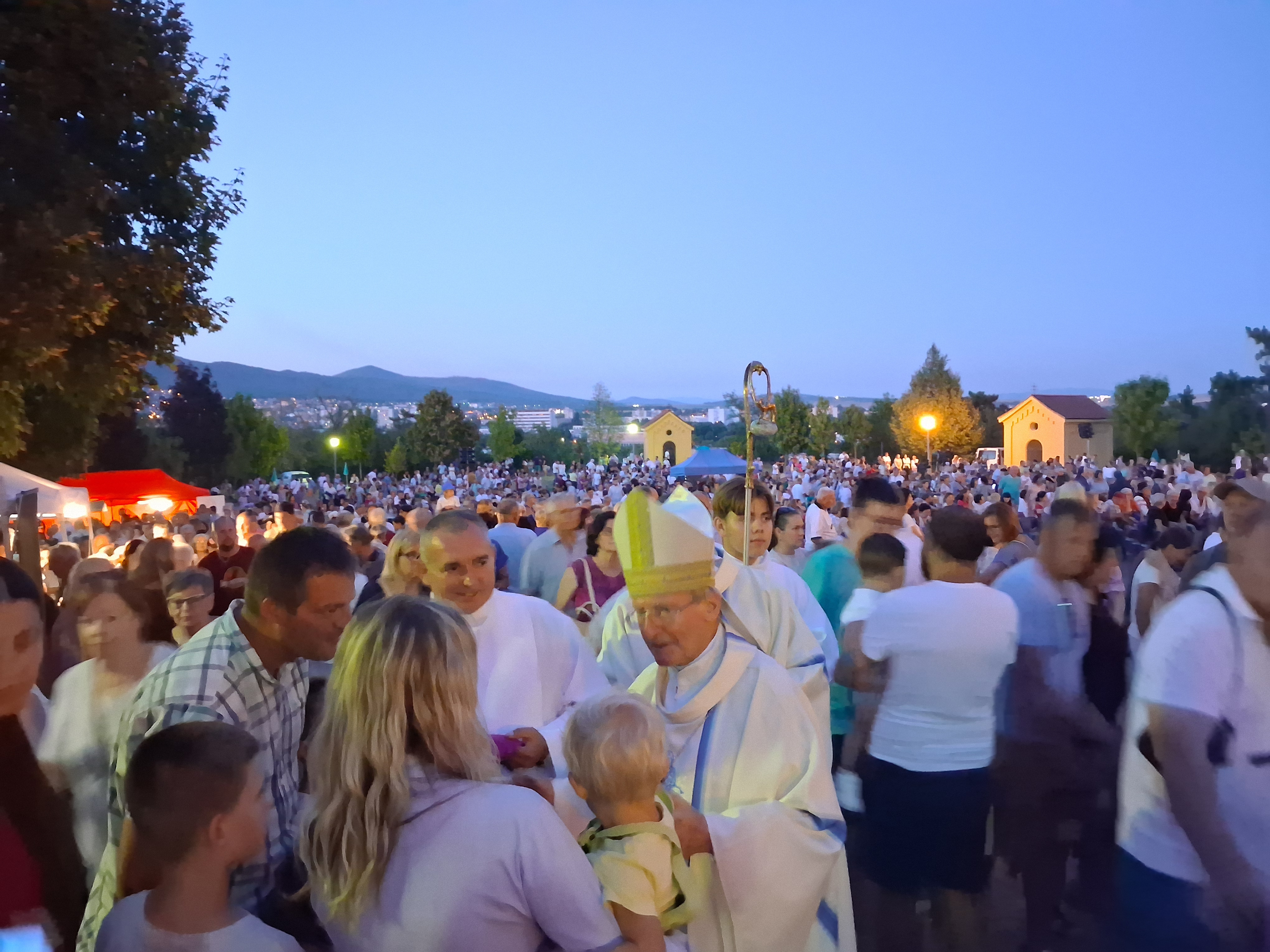
Bishop František Rábek blesses a child at the close of the evening liturgy on the Calvary hill in Nitra, Slovakia, on Aug. 15, 2026. | Credit: Bohumil Petrík
Halko, who celebrated a Mass in Hungarian, told EWTN News that during the pilgrimage he reflected "on how we are very Marian in the Eucharist as we say yes to God, amen, which is our small preaching as we give ourselves to him and vice versa."
Bishops preach on Mary's example
For his part, Rábek, who was a priest in the local parish of Nitra-Calvary and now lives on the site of the pilgrimage, invited parents "to search for a healthy balance in your kids to develop their talents, but also the word of God."
Mary was a simple, ordinary woman, yet she was ready to embrace God's word and became a role model, he said. "Show me a woman who is as famous, glorified, and respected as Mary," he emphasized.
The pilgrimage culminated in a Mass on Sunday, which the mayor of Nitra and other local politicians attended. In his homily, Judák cited Carl Jung, the psychologist and son of a Protestant pastor, who called the Catholic Church's 1950 dogma of the Assumption of the Virgin Mary "the most important religious event since the Reformation."
The bishop of Nitra asked the Virgin Mary to help all present proceed on the path to the goal of life, which is self-giving love.
"If we strive to live according to our conscience, that is, to fulfill God's will just like she did, our life and the events of our life, everything we do well, will not perish even upon death," he stressed.
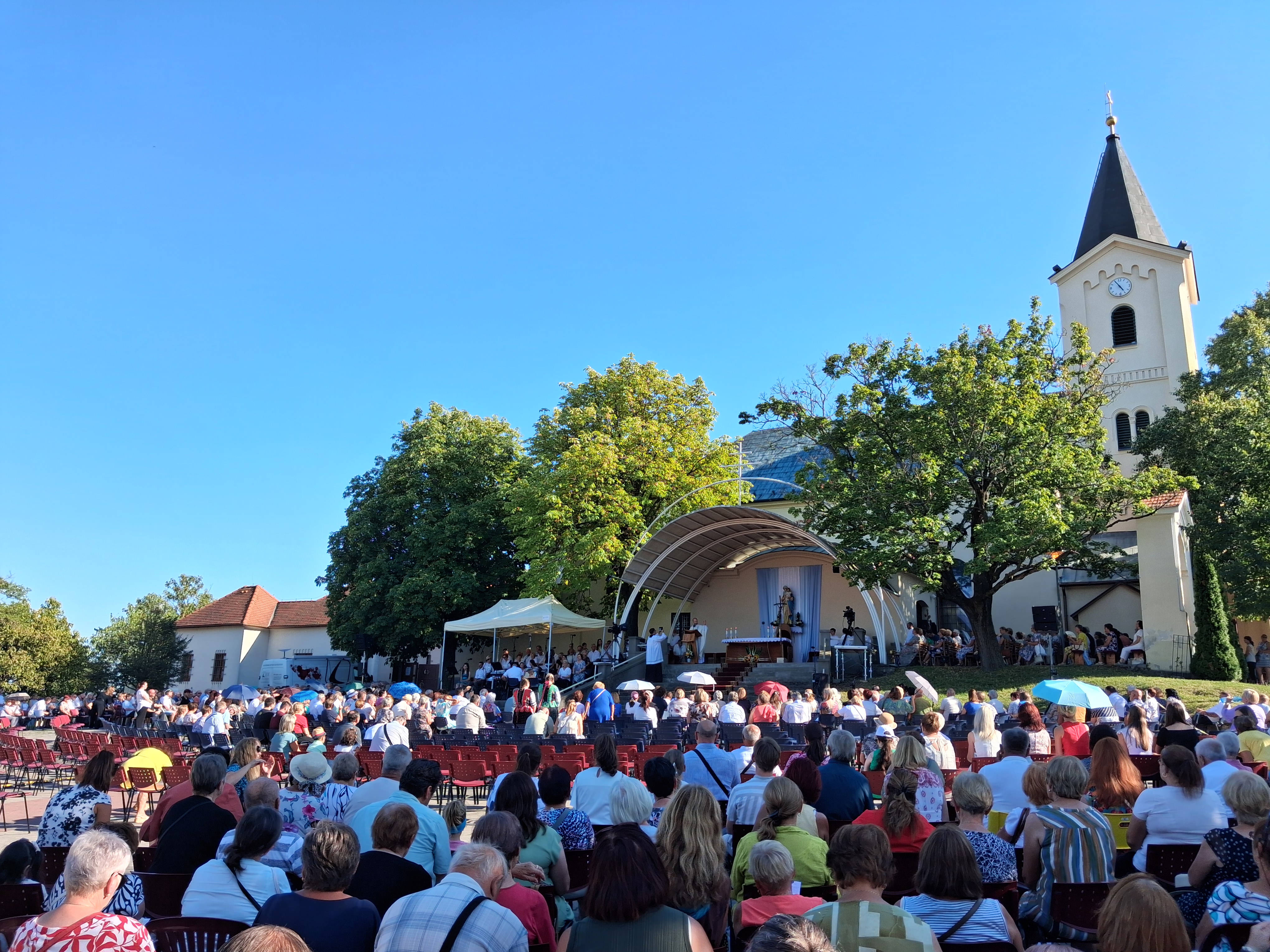
Pilgrims attend Mass at the open-air sanctuary on the Calvary hill in Nitra, Slovakia, on Aug. 15, 2026. | Credit: Bohumil Petrík
The prelate encouraged everyone to look, "just as we and many millions of people looked up" on Aug. 12 "to see the cosmic phenomenon of the solar eclipse," but now "with a spiritual sight to where the Virgin Mary leads us."
May this moment at the feet of the Virgin Mary of the Assumption help us, Judák continued, "so that tomorrow, in a week, in a month, in a year, at least until the end of our lives, we will never lose sight of the noble goal of our life, and that we strive for it with God's help."
He likewise encouraged the faithful to fulfill their Christian duty and to act and profess Christian values in the local elections coming this autumn.
50 pilgrims on foot in the heat
The pilgrimage was organized by the parish of Nitra-Calvary, run by the Divine Word Missionaries (the Society of the Divine Word), whose Slovak province has its seat on the Calvary hill.
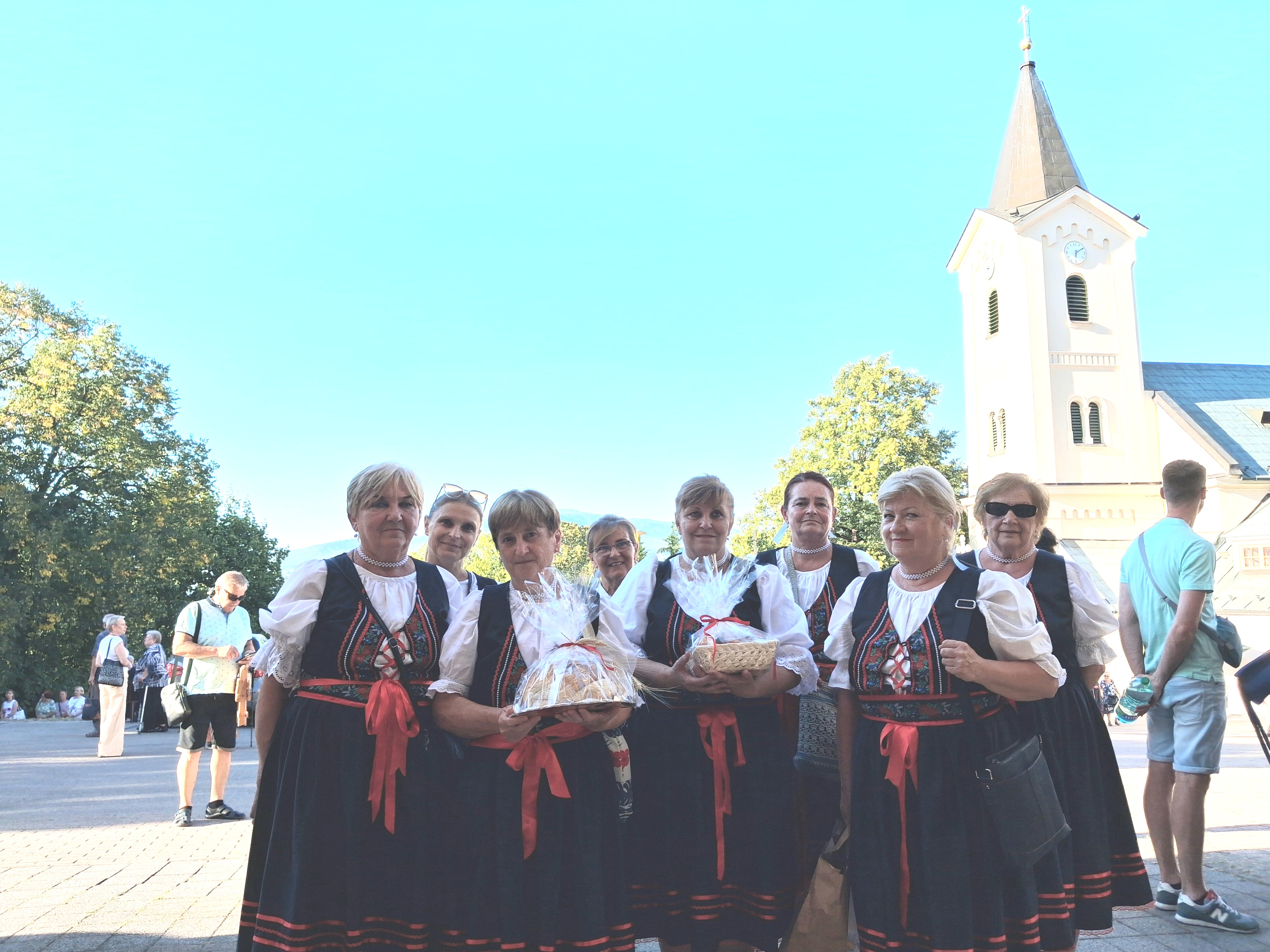
Women in traditional Slovak dress carry baskets of bread at the Assumption pilgrimage in Nitra, Slovakia, on Aug. 15, 2026. | Credit: Bohumil Petrík
The parish priest, Father Ján Štefanec, SVD, told EWTN News that he "is happy this place is alive for the feast, though I would like to see so many people show up more often" in the parish.
He said he finds it interesting that every year many pilgrims come from the region to pray to the Mother of God, that former parishioners return for the feast, and that cyclists at times make part of their pilgrimage on two wheels. Although people nowadays come by car or bus, this time a group of 50 pilgrims walked 20 kilometers (12 miles) in temperatures of 36 degrees Celsius (97 degrees Fahrenheit), the Divine Word missionary said.
Father Ricardo Bello Mato offers his reflections on heaven and his many years as a priest.
Upon turning 100, Father Ricardo Bello Mato, a priest from Santiago de Compostela, Spain, talked about what heaven means to him.
"It's like a dwelling place around the Father, the Son, and the Holy Spirit. A space filled with the immensity of God, God's children living together, seeing God's wonderful, creative power in the cosmos," the centenarian priest shared in an interview with the Archdiocese of Santiago de Compostela, where he has served for more than seven decades.
Is it worth being a priest?
Reflecting on the most memorable moments of his long life, Bello highlighted "the day of my ordination as a deacon and the day of my first Mass. My diaconal ordination was conferred by the cardinal, Don Fernando Quiroga. There were about 33 of us, and at one point someone had to speak and offer thanks; that role fell to me, as I was the oldest."
"At my first Mass, I felt unworthy and inadequate. It was a deeply moving experience. It took place in 1955 at the parish in Cances, a time of great celebration and high hopes," he continued.
Regarding the crosses he has borne in his life, the priest remarked that there have been "many, which I strove to carry well."
When asked whether he felt it was worth being ordained a priest, he replied: "For me, yes, and I believe also for some of the faithful whom I supported and who later thanked me for it."
On Wednesday, Aug. 12, the archbishop of Santiago de Compostela, Francisco José Prieto Fernández, visited the priest, who now devotes himself to prayer, spiritual accompaniment, and writing.
Bello's life
Bello was born on Aug. 1, 1926, in the village of Cances into a large Catholic family. His childhood was marked by the aftermath of the 1936–1939 Spanish Civil War, the loss of his older brother, and the need to assume adult responsibilities, according to the archdiocese.
After the war, he was sent to the Salesian school in Madrid. He entered the seminary in 1943 and celebrated his first Mass in 1955. Shortly thereafter he was assigned to a parish where a group of university students assisted him in his ministry.
"I tried to go to the Americas, but Father Benito Espiño wouldn't let me; instead, he sent me to Ozón, near Muxía. The Holy Spirit took hold of me there and never let me go," the priest recalled, noting that he had also once hoped to reach what is known as the Continent of Hope (Latin America).
He served in various parishes, where he ministered to many people and helped restore a monastery. He also led short courses, spiritual exercises, and gave talks.
In 1999, he was appointed chaplain of the Padre Rubinos Residence and also of the Sisters of Charity, where he ministered to the elderly, the poor, and many other members of the faithful.
This story was first published by ACI Prensa, the Spanish-language sister service of EWTN News. It has been translated and adapted by EWTN News English.
The pontiff will visit one of the world's smallest countries on Aug. 22. Here's what to know about San Marino's deep Catholic roots.
Pope Leo XIV will make a pastoral visit to the Republic of San Marino on Aug. 22, becoming only the third pontiff to visit the country after Pope Benedict XVI and St. John Paul II.
During his visit, the pope will meet with authorities, lead Eucharistic adoration, and meet the faithful gathered before traveling to the nearby city of Rimini, Italy, for the "Meeting for Friendship Among Peoples."
Here are 10 things to know about San Marino's ancient history and deep Catholic heritage.
1. San Marino was founded at a time of Christian persecution.
San Marino is said to have been founded in A.D. 301, roughly 270 years after the death and resurrection of Christ. It was also founded at a time when early Christians in Rome still faced widespread persecution, producing martyrs such as St. Agnes, St. Pancras, and St. Lucy. The Great Persecution under Emperor Diocletian occurred soon after the country's founding and lasted nearly a decade (A.D. 303-311).
2. San Marino is among the world's oldest and smallest republics.
The country's founding in A.D. 301 also makes it the world's oldest continuing republic. Like Vatican City, it is completely surrounded by Italy and is one of the world's smallest states by both land area and population.
The land area measures 23.63 square miles, which is 20 times smaller than New York City by land area. Its population is approximately 34,000, about the same as Ithaca, New York.
3. The name San Marino comes from a hermit saint.
St. Marinus, after whom the country is named, was a third-century deacon who fled the Great Persecution under Diocletian. According to tradition, he settled on Monte Titano, where San Marino now stands, and founded a monastery there.
His reputation for holiness began to spread in his old age, leading many to join his monastery. The owner of Monte Titano also offered him the mountain as a gift. It has remained the highest point of the sovereign state ever since.
4. San Marino has been protected by popes and has never been annexed.
Though landlocked by Italy today and occupied several times throughout its more than 1,000-year history, San Marino has never been annexed by another nation.
By the 17th century, it was even surrounded by the Papal States, the region of Italy ruled by the popes until the Kingdom of Italy permanently absorbed it in 1870. Pope Urban VIII placed San Marino under papal protection through the 1631 treaty while recognizing its full sovereignty.
5. San Marino is governed by two captains who serve for only six months.
San Marino has two heads of state, the captains regent, who are currently Alice Mina and Vladimiro Selva. For nearly 800 years, they have been elected by the country's 60-member parliament, the Grand and General Council.
The captains regent serve only six-month terms, among the shortest constitutional terms for any political office in the world. They cannot serve a second consecutive term but can return to office after three years.
6. Pope John Paul II and Pope Benedict XVI have been there.
Despite being in Italy, San Marino has only been visited by two popes.
St. John Paul II visited the country on Aug. 29, 1982. During his visit, he met with the only communist head of state in Western Europe, Captain Regent Giuseppe Maiani.
Benedict XVI visited on June 19, 2011, as part of his pastoral visit to the nearby Diocese of San Marino-Montefeltro.
During their visits, both popes venerated the relics of St. Marinus, the country's patron, at the Basilica of San Marino.
7. The official language of San Marino is Italian.
Italian has remained San Marino's only official language since the Middle Ages, reflecting its shared history with the Italian peninsula.
The country also has a regional dialect called Sammarinese, a local variant of Romagnol spoken in the nearby Romagna region of Italy.
8. San Marino's most famous cake represents its three towers.
The country's cuisine has been heavily influenced by Italy. But one can visit there to try its most famous dessert: the Torta Tre Monti ("the cake of the three mountains").
The cake is made up of three layers of wafer and chocolate-hazelnut cream, representing the three towers that make up San Marino: the Guaita, the Cesta, and the Montale.
9. Abraham Lincoln was made an honorary citizen of San Marino.
Shortly after becoming U.S. president in 1861, Abraham Lincoln received a letter from the captains regent of San Marino granting him honorary citizenship as the U.S. prepared for the Civil War. Lincoln replied later that year, accepting the honor.
The original letter from the captains regent can still be viewed at the U.S. National Archives in Washington, D.C.
10. San Marino hosts an annual event, which Leo XIV will attend.
On Aug. 22, Pope Leo XIV will become only the third pope in history to visit San Marino. He is scheduled to meet with civil and religious leaders during his visit and to greet the faithful who will gather in the country's main squares.
At 12:45 p.m. that day, he will travel to the nearby city of Rimini for the "Meeting for Friendship Among Peoples," an annual international Catholic cultural festival organized by the lay movement Communion and Liberation.
He will then meet the sick and elderly at Rimini Cathedral and celebrate Mass before returning to Rome at 8 p.m.
The federal high court described the actions taken against the woman as a "flagrant violation" of her fundamental rights to human dignity and freedom of religion.
KANO, Nigeria — A federal high court in Nigeria has restrained authorities in the country's Kano state and the Islamic religious police, known as Hisbah, from arresting a 22-year-old woman because she converted from Islam to Christianity and rejected a forced marriage.
In its May 26 ruling, the court described the actions taken against the woman, identified by the pseudonym "Sarah," as a "flagrant violation" of her fundamental rights to human dignity and freedom of religion, according to Alliance Defending Freedom (ADF) International.
The court also ordered that she receive financial compensation, ADF said in an Aug. 11 report announcing the ruling.
Sarah, a resident of Kano state, reportedly fled her family home in 2025 after suffering abuse from her elder siblings, who were allegedly attempting to force her into marriage.
Her parents had died years earlier, and her siblings subsequently enlisted local Hisbah officials to have her arrested, according to ADF.
Sarah was reportedly detained for four days. She alleged that she was beaten and pressured to accept the marriage from which she had fled.
She later found refuge with a Christian family, the Abaras, and voluntarily converted to Christianity while staying with them, ADF reported.
Amid fears of further threats, the family helped her relocate to Jos in January. Her siblings subsequently accused the Abaras of kidnapping her.
On Feb. 24, Sarah filed a fundamental-rights enforcement action challenging the measures taken against her. Two days later, the Abaras were arraigned in Kano without legal representation.
The Federal High Court of Nigeria subsequently prohibited Kano state authorities and Hisbah officials from pursuing Sarah's arrest because of her conversion or her refusal to enter the proposed marriage.
"The court's ruling in Sarah's case affirms that the Hisbah police have no jurisdiction over Christians or other non-Muslims," ADF Senior Counsel for Global Religious Freedom Sean Nelson said.
He added: "Sarah's choice to convert and reject a forced marriage is her right under law."
Sarah welcomed the judgment and expressed gratitude to the Christian family that had sheltered her.
"The Abara family kept me safe in a time when I had nowhere else to go. I am grateful to them especially for introducing me to the Gospel. It is not against the law for me to choose my faith in Jesus," she said.
She also expressed gratitude that the court had recognized her freedom to become a Christian and protected her from the religious police.
The criminal proceedings against the Abaras remain pending in Kano, with ADF providing legal assistance.
Previous cases involving Christian converts
Sarah's case follows other reported incidents involving people who converted, or were suspected of converting, from Islam to Christianity in northern Nigeria.
In January 2018, the reported conversion of Nabila Umar Sanda, then a 19-year-old student at Bingham University in Abuja, attracted national attention after security officials intervened.
Media reports indicated that Nigeria's Department of State Services arrested Sanda and some of her Christian associates after Islamic leaders learned of her conversion. Christian leaders Jeremiah Datim and Simput Dafup were also reportedly drawn into the case, which unfolded in Jos, Plateau state.
Hisbah organizations operate in several northern Nigerian states to enforce Islamic moral codes. They have faced allegations of interfering with Christians and other people who are not subject to Islamic religious obligations.
In November 2023, International Christian Concern reported that Hisbah officials in Kano stopped five Christian girls who were traveling to church. The girls were allegedly instructed to dress according to Islamic standards and prevented from attending church until the service had ended.
In another case, Pastor Yohanna Shuaibu was killed by a mob in Kano state in 2021 following allegations that he had helped convert a Muslim man to Christianity.
Christian Solidarity Worldwide (CSW) reported that the man had left Islam but was attending neither a church nor a mosque. Members of the local Muslim community nevertheless reportedly assumed that he had become a Christian and blamed Shuaibu.
According to the organization, Shuaibu had returned to Massu village in Kano state's Sumaila Local Government Area to evacuate children from a Christian school when the mob attacked him. He later died from injuries sustained in the attack.
This story was first published by ACI Africa, the sister service of EWTN News in Africa. It has been adapted by EWTN News.
The rules governing the production of bread for Communion hosts date back to the Last Supper and the custom of unleavened bread.
The Second Vatican Council referred to the Eucharist as "the source and summit of the Christian life," St. Augustine referred to it as "a Divine storehouse filled with every virtue," and St. Thérèse of Lisieux described it simply as "the sole remedy, if you want to be cured."
Yet though Christ in the Eucharist occupies a place of centrality in the Church, many Catholics may not ever stop to reflect on the bread that in the Mass becomes Christ — namely, how is this unique substance produced before it is brought to the altar?
The question is not merely academic; in rare instances the local Church can run out of Communion hosts, as occurred in Cuba in June. All of Cuba's hosts are produced by Discalced Carmelites at the Monastery of Santa Teresa and San José, but the lack of a reliable power supply there hindered production over the summer.
Sister Ruth Starman, the head of altar bread production for the Benedictine Sisters of Perpetual Adoration in Clyde, Missouri, told EWTN News that the requirements for Catholic altar bread are dictated by the Code of Canon Law of the Church, specifically canon 924.
The sisters' abbey in Missouri has been producing altar bread for years and was the first U.S. producer of altar breads approved by the Vatican to make low-gluten hosts.
Standard hosts, she said, "can be made of wheat and water only."
"Yeast is not allowed because that would make it leavened bread and Jesus used unleavened bread at the Last Supper," she said. "Any other additives such as salt, honey, etc. would be forbidden."
In addition to the strict water-and-wheat requirements, Church law dictates that the bread must be "recently made so that there is no danger of spoiling."
Manufacturers, meanwhile, use special machines on which to bake the bread to ensure it is produced in the familiar uniform and thin style.
"The baking machines have plates that may have designs on them or not," Starman said. "The plates will produce a thin wafer sheet that will then need to be moistened in a dampener before being cut into the round hosts." Breads that are not moistened "will shatter when cut," she said.
Special cutters, meanwhile, allow bakers to divide the bread into differently sized hosts including the smaller rounds intended for lay communicants and the larger portions for priests and bishops.
As to why the bread is so thin and flat, Starman told EWTN News: "I don't have the answer for that but just conjecture. Because it is unleavened, the bread will be 'flat' anyway. However, I suppose with the invention of specialized baking equipment, where two baker plates close upon the batter, that probably started the more wafer-thin hosts."
Starman said there have been "no major changes" to the process in recent years.
"The Vatican does periodically have to remind priests and the Church at large that anything other than a wheat bread cannot be used," she said. "Hosts made from rice, corn, or potato starch, for example, are considered invalid matter."
The low-gluten hosts at the abbey, she said, are made from two different wheat starches that have had most of the gluten removed. "The Church does not say how much wheat percentage a host must have, but only that it needs to have some amount to make it valid matter," she said.
Elsewhere the Church has stressed the need for hosts to be treated with reverence at every stage of the process. The instruction Redemptionis Sacramentum, promulgated in March 2004 by what was then the Congregation for Divine Worship and the Discipline of the Sacraments, states that the bread "should obviously be made by those who are not only distinguished by their integrity, but also skilled in making them and furnished with suitable tools."
In response to the shortage of Communion hosts in Cuba earlier this year, Church leaders in Panama sent 35,000 hosts to the island nation, while another 300,000 were sent from Puerto Rico.
Archbishop José Domingo Ulloa Mendieta of Panama said at the time that the emergency shipment arose "in response to the difficulties several Cuban dioceses are facing in ensuring a supply of hosts."
The prelate called the hosts "an essential element for the celebration of the sacrament that constitutes the source and summit of the Christian life."