• Home
  • About Us
  • Support
  • Concerts & Events
  • Music & Media
  • Faith
  • Listen Live
  • Give Now

Catholic News

Washington, D.C., Auxiliary Bishop Evelio Menjivar-Ayala talks immigration and dialogue with high-ranking Catholics in the Trump administration.

Catholics must educate themselves on "the facts" regarding the U.S. immigration system and the Church's teachings on the matter, according to Washington, D.C., Auxiliary Bishop Evelio Menjivar-Ayala.

Following his participation in a panel at the New York Encounter titled "Seeking a Home: A Catholic View on the Status of Immigration to the U.S.," Menjivar-Ayala told EWTN News that he is "very hopeful" about the future of immigration in the U.S. "When people show up for a talk like this, and you see standing room only, that tells you of the great desire of people to get informed, to get educated."

The D.C. auxiliary bishop emphasized the need to "get the facts," not only about the immigration system in the U.S. but also where the Church stands on the issue. "For the Church, the first and the most important thing is human dignity," he said. "It is the dignity of every person, undocumented or citizen."

While the government must enforce its laws and protect its sovereignty, Menjivar-Ayala said, it is necessary for the government to "look at the eyes of the person, the dignity of every human being," and to ensure that enforcement is "done in a humane way that respects the dignity of the human person."

"Let us educate ourselves," he said, adding: "As they say, the social doctrine of the Church is the best-kept secret. And the Church teaches, has beautiful teachings, about the social dimension of our faith."

Dialogue with Catholics in the Trump administration

Menjivar-Ayala noted that previous administrations in the past had participated in dialogue with the Catholic Church, consulting with organizations such as the Catholic Legal Immigration Network Inc. (CLINIC) on the issue of immigration. However, he said, the current administration has not.

Menjivar-Ayala noted the disparity between the Church's emphasis on human dignity and the Trump administration's position that every unauthorized border crossing is a criminal act.

He said we should be careful about narratives surrounding the issue and refrain from categorizing those who cross the border without authorization the same way as perpetrators of crimes such as murder, rape, or theft.

Menjivar-Ayala said criminals should be prosecuted as criminals and not categorized in the same way as immigrants, noting that "immigration laws are a different set of laws than criminal laws" but that the current administration is now "pulling them together."

Responding to high-ranking officials who are Catholic, such as "border czar" Tom Homan, who has described the Catholic Church as being "wrong" about immigration, Menjivar-Ayala said he believes "it's a question for them" about "how are you living the Gospel?"

"I would say that the question is not for me, because for me and for the bishops it is very clear. Every person has dignity, and in every migrant, no matter if they are documented or undocumented, we should see the face of Christ," he said. "So the question is for them, for those who claim to be Catholic but are not seeing the face of Christ in the migrants."

Menjivar-Ayala stressed the need for one's politics to be informed by the Gospels and faith, rather than one's faith being informed by politics or one's personal views. "It is the Gospel that needs to tell me how I should see the world and not politics," he said.

Life for the immigrant community in Washington, D.C.

Immigration enforcement among Catholic migrant communities in D.C. is "dying down a bit," according to Menjivar-Ayala.

Sacred Heart Shrine in the Columbia Heights neighborhood reported that six of its parishioners were detained by Immigrations and Customs Enforcement (ICE) agents in August 2025, including an usher who was on his way to evening Mass.

Menjivar-Ayala said the immigrant community at Sacred Heart Shrine "has been affected the most" in the city but has also become the most tight-knit. During the panel, Menjivar-Ayala described parishioners in immigrant communities banding together to bring food and provide other support for one another. "I was thinking about that parish," he said.

"I believe right now it's dying down a bit, but nobody knows when you are going to have ICE in the streets," he concluded.

Panel highlights broken system, need for congressional action

For the panel, Menjivar-Ayala was joined by Mario Russell, executive director of the Center for Migration Studies, and Ashley Feasley, a legal expert in residence at The Catholic University of America's Immigration Law and Policy Initiative.

During her remarks, Feasley described the U.S. immigration system as "old," having not been reformed since the late 1990s.

"What has happened here is people may have many perspectives about the failures of one president or another on immigration reform," she said. "But the one place where I think we can really circle in on is the failure of Congress to act regardless of who is in the White House or who controls Congress."

Feasley noted the presence of a number of comprehensive bills seeking to address border security and asylum but have had a difficult time garnering bipartisan support. This, she said, has ultimately been "one of the biggest problems."

During his remarks Russell, similarly to Menjivar-Ayala, encouraged Catholics to inform themselves about the immigration system by reading reports such as those from the Center for Migration Studies or from diocesan sources.

"What is happening is basically what is happening," he said. "Robert Reich, the old labor secretary, recently said, 'Why would the Immigration Customs Enforcement go to Home Depot to find criminals? Why would they go to a posada or a corner to find criminals? Those are workers,' so the evidence doesn't support the narrative."

Full Article

"The pope encouraged us to use AI responsibly, to use it in a way that helps us grow, not to let it work against us, " said Davide Bolchini, the moderator of an AI panel at the weekend conference.

NEW YORK — How can Catholic social teaching guide us in weighing the benefits of artificial intelligence against the dangers it poses to human dignity? That question animated a wide-ranging discussion among Catholic thinkers and technology experts at the New York Encounter on Saturday.

Citing Pope Leo XIV's call to use AI responsibly as well as the Church's historic defense of human dignity in the face of modern technology, Davide Bolchini, moderator and dean of the Luddy School of Informatics at Indiana University, opened the discussion before an audience of several hundred people gathered for the three-day cultural conference in New York City.

"The pope encouraged us to use AI responsibly, to use it in a way that helps us grow, not to let it work against us, but to let it work with us, not to substitute human intelligence, not to replace our judgment of what's right ... our ability of authentic wonder," Bolchini said.

With technology rapidly advancing, Bolchini asked, how can the Church stay ahead of these challenges?

Chuck Rossi, an engineer at Meta who is developing AI-driven content moderation technology at the technology conglomerate, which includes Facebook and Instagram, argued that in his work, developments in AI have been instrumental in safeguarding human beings from harm. 

AI systems, he said, can examine 2.5 billion pieces of of shared online content per hour, filtering harmful material including nudity and sexual activity, bullying and harassment, child endanger, dangerous organizations, fake accounts, hateful conduct, restricted goods and services, spam, suicide and self-injury, violence and incitement, and violent and graphic content.

"That's my world," he said. "It's a very, very hard problem. If we miss 0.1% of 2. 5 billion, that's millions of things that we didn't want to be seeing. But we do an excellent job, and we have for years — we're one of the best at it," Rossi said.

Using AI also protects human content moderators from being exposed to disturbing material, as they were in the past.

"The good thing that we are giving back to humans is you never have to do this horrible work," he said.

Paul Scherz, professor of theology at the University of Notre Dame, acknowledged the benefits of AI, which he said included advances in medicine and efficiency for tasks like billing ("Nobody wants to do billing," he said).

But Scherz warned of the dangers of relying on technology to do what is intrinsically human.

"We are really starting to turn to AI as people more broadly for these relational aspects, which would be tragic because there is something in that human-to-human connection, the 'I/thou connection,' as Martin Buber called it, that is irreplaceable by a machine," Scherz said. He noted that AI has even moved into ministry, with the rise of Catholic apps relying on bots to offer catechesis.

Scherz also cautioned that substituting AI for human interaction and intelligence risks eroding our skills, whether in relationships or in professional life.

"My fear is as we use these chatbots more and more we will lose those person-to-person skills. We'll no longer be able to engage one another as well, or have the patience and virtue to deeply love and encounter one another," Scherz said.

In addition, relying on AI in our work, for example, when a doctor consults AI to make a diagnosis, will result in our "de-skilling," he said. 

"We know that people, when they're using automated systems, they tend to just become biased and complacent and just approve the automated system. They lose their skills," he said, adding that airline pilots who rely too much on autopilot are more prone to making errors.

Louis Kim, former vice president of personal systems and AI at Hewlett-Packard who is currently pursuing graduate studies in theology and health care, pointed out that it's not possible to know today what skills will be required in the future.

"My personal view is I often find that predictions of impacted technology are largely unconsciously based on what we know of the current paradigm and structure and technologies," Kim said.

"There are going to be skills needed to control AI that are going to be different," he said.

Kim also called for "humility" in discussions about AI's potential to affect human relationships.

"Let's ask ourselves about the quality of our current human relationships, whether it's in the workplace, in toxic cultures, sometimes at home — even at conferences, at your next break, as you go around talking to this person [or] that person, how many times that person is looking over your shoulder for the more important person to talk to?" he said.

Our moral formation, he said, will continue to shape the quality of our encounters with others.

Full Article

The pontiff urged "coherence between faith and life" and persistent prayer for peace.

Pope Leo XIV on Sunday made his first visit to a parish in the Diocese of Rome, celebrating Mass at Santa Maria Regina Pacis in Ostia Lido and urging Catholics to cultivate "coherence between faith and life" while opposing violence and injustice with "the disarming strength of meekness" and renewed prayer for peace.

Santa Maria Regina Pacis, located on Rome's coast and part of the diocese's southern sector, is the first Roman parish the pope has visited during his pontificate. The pope is expected to visit four additional parishes over the next four Sundays in the diocese's remaining sectors.

Upon his arrival, Leo was welcomed by Cardinal Vicar Baldassare Reina and Bishop Tarantelli Baccari, vicegerent and auxiliary bishop for the southern sector. Before Mass, the pope greeted children in catechism and young people in a field behind the church, then met with the elderly, the sick, the poor, and Caritas volunteers in the parish gym.

"It is for me a source of great joy," the pope said in his homily, "to be here and to live with your community the gesture from which Sunday takes its name. It is the Lord's Day because the risen Jesus comes among us, listens to us and speaks to us, nourishes us and sends us out."

Reflecting on the day's readings, Leo said the law God gave his people is not opposed to freedom but is "the condition for making it flourish." The Lord's commandments, he added, "are not an oppressive law, but his pedagogy for humanity, which seeks the fullness of life and freedom."

Jesus' preaching, he continued, reveals "the authentic and full meaning of God's law," pointing to a fidelity to God grounded in respect and care for others "in their inviolable sacredness" — something to be cultivated first "in the heart." The pope warned that it is in the heart that both "the noblest sentiments" and "the most painful profanations" take root: "closures, envies, jealousies," by which someone who harbors evil thoughts against a brother is "as if, within, he were already killing him."

"We must remember," Leo added, "that the evil we see in the world has its roots precisely there, where the heart becomes cold, hard, and poor in mercy."

The pope said such realities are felt "also here, in Ostia," where violence can wound, sometimes taking hold among young people and adolescents, "perhaps fueled by the use of substances," or through criminal organizations that exploit people and draw them into wrongdoing.

In response, he urged the parish community to continue working "with generosity and courage" to sow "the good seed of the Gospel" in the neighborhood.

"Do not resign yourselves to the culture of abuse and injustice," the pope said. "On the contrary, spread respect and harmony, beginning by disarming language and then investing energy and resources in education, especially for children and youth."

Addressing the young in particular, Leo expressed the hope that they would learn in the parish "honesty, welcome, and love that overcomes boundaries," as well as the ability to help those who do not repay them and to greet those who do not greet them — learning to go toward everyone "freely and gratuitously."

"Learn coherence between faith and life, as Jesus teaches us," he said.

In concluding remarks, the pope recalled that Pope Benedict XV gave the church its title, "St. Mary, Queen of Peace," during World War I, envisioning the community as "a ray of light in the leaden sky of war." Today, Leo said, "many clouds still darken the world," including the spread of ways of thinking contrary to the Gospel that exalt "the supremacy of the strongest," encourage arrogance, and prize "victory at any cost," deaf to the cry of those who suffer.

"Let us oppose this drift with the disarming strength of meekness," the pope said, "continuing to ask for peace, and to welcome it and cultivate its gift with tenacity and humility."

This story was first published by ACI Stampa, the Italian-language sister service of EWTN News, and has been translated and adapted by EWTN News English.

Full Article

David Ryan, a 61-year-old Irishman who suffered sexual abuse as a teenager, shared his story face-to-face with Pope Leo XIV, the first time the pope met with a victim individually.

Feb. 2 marked a turning point in the life of David Ryan, a 61-year-old Irishman who suffered sexual abuse as a teenager. More than 40 years later, he was able to share his story face-to-face with Pope Leo XIV in the first private meeting the pontiff has held alone with a victim of abuse.

While the Holy Father had already met with other victims of abuse, those meetings were in groups. The meeting with Ryan was different: For almost an hour, he was able to share everything he thought and still thinks about what happened to him and about the reaction of the Catholic Church in Ireland, which he felt did not listen to him.

"He's a lovely man, and a lovely experience… Wow. I'm so glad I've done it today, I'm really so glad I've done it. I didn't hold back, I told him about the abuse and asked him, 'Why are these priests still doing this?'" Ryan told reporters in Rome who were waiting for him outside the Apostolic Palace in the Vatican.

"His sympathy, his empathy toward the survivors, myself and my family, toward my close friends… He felt this, he was sorry, and it was genuine. I knew it was genuine," he emphasized.

Ryan suffered sexual abuse when he was roughly between the ages of 11 and 17 while attending Blackrock and Willow Park School in Dublin. His brother, Mark, who died at age 62, was also a victim of abuse but never revealed what had happened to him. "It ruined my life. It ruined Mark's life, and my brother is now gone," Ryan, who brought a photo of Mark to Rome, told EWTN News.

When Ryan's story came to light in a documentary titled "Blackrock Boys" on RTÉ radio, it shocked the nation. Following the broadcast, the Irish government commissioned a report that revealed widespread allegations of sexual abuse at hundreds of schools over several decades — a total of 2,400 cases. This was made possible by the courage of Ryan and others like him who shared their stories.

Ryan, who felt he was not being heard by the Church, wrote to Pope Leo XIV and received a reply to meet with him, an appointment he attended with Deirdre Kenny, CEO of One in Four, an Irish charity that advises and supports adults who have suffered sexual abuse.

'I'm so sorry for you'

EWTN Vatican correspondent Colm Flynn spoke with Ryan after his meeting with the pope. He recounted that he told Leo XIV "that I wanted an apology, and the first thing he said to me was, 'David, all I can say is that I'm so sorry for your pain and hurt, what your family went through, what Mark and the other survivors went through. I can feel your pain, but I don't know your pain.' And he looked me straight in the eyes and just said, 'I'm so sorry for you.'"

"But I could feel a kind of energy coming down when he told me, because I knew he meant it, and it's like a whole new experience for me. It's still going down; I still can't believe I've been there. I thought this day would never come," he emphasized.

'I just wanted him to hear my voice, my story'

After explaining that he wanted to express his anger to the pope and get a response from him, Ryan clarified that with the Holy Father, "I wasn't going to shout and scream; there was no point in doing that. I just wanted him to hear my voice, I wanted him to hear my story, and he heard. He apologized in a way I wasn't expecting, and his empathy toward me… it was just quiet and surreal."

"And I didn't hold back, I told him I had been raped three times. It's not pleasant, but many men are afraid to talk about it, and a lot of men don't cry," he said. However, he shared that in his case, he managed "to talk about it, I have cried."

Ryan also said the pope "was shocked to hear how many people had been abused and that the Church had hidden it for so long. I asked him why they did that, and he replied, 'David, I don't have an answer yet for you, but I will have an answer when I can.'"

'It wasn't your fault'

Ryan also told Flynn that he shared his story so that others "would want to come forward and speak out about clerical abuse, because a lot of men don't talk and keep it quiet."

"And as I told the pope: It wasn't my fault. And that took me a long time to admit: It wasn't my fault. He shook his head and said to me, 'Yes, it wasn't your fault, David.' And that really did hit me. We shook hands afterwards, and I know he understands. It was the best thing I've ever done," he concluded.

This story was first published by ACI Prensa, the Spanish-language sister service of EWTN News. It has been translated and adapted by EWTN News English.

Full Article

In his catechesis before the Angelus, Leo said Jesus fulfills the Law by calling Christians beyond minimal righteousness to great love.

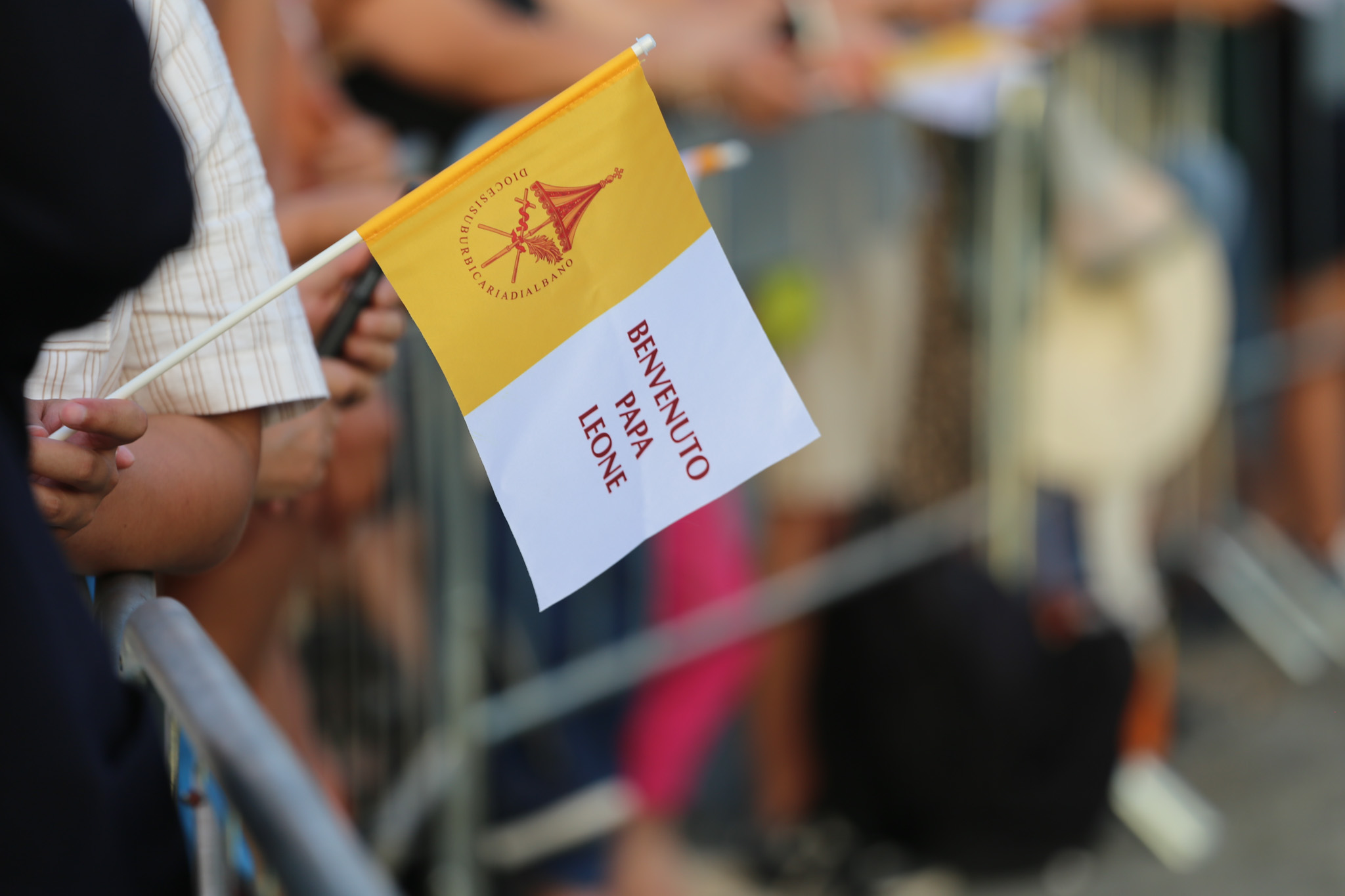
Pope Leo XIV on Sunday expressed his closeness to the people of Madagascar after two cyclones caused flooding and landslides.

"I pray for the victims, their families, and for all who have suffered serious damage," the pope said after praying the Angelus in St. Peter's Square on Feb. 15.

Looking ahead to upcoming Lunar New Year celebrations in East Asia, Leo said: "May this joyful celebration strengthen family ties and friendships, bring peace to homes and society, and provide an opportunity to look to the future together and to build peace and prosperity for all."

In his reflection before the Marian prayer, the pope focused on the day's Gospel from the Sermon on the Mount (Mt 5:17-37), saying Jesus "reveals the true meaning of the precepts of the Law of Moses."

"They are not meant to satisfy an external religious need of feeling 'righteous' before God but to bring us into a relationship of love with God and with our brothers and sisters," he said, adding: "The Law is fulfilled precisely by love, which brings its profound meaning and ultimate purpose to completion."

Leo emphasized that "true righteousness consists in love," and he warned against reducing faith to the bare minimum: "The Gospel offers us this valuable teaching: Minimal righteousness is not enough; great love is needed."

This story was first published by ACI Stampa, the Italian-language sister service of EWTN News. It has been translated and adapted by EWTN News English.
Full Article

During World War II, the unexpected intervention of the Maharaja of Nawanagar, known as "the Good Maharaja," provided hundreds of Polish children a home at his personal estate in India.

The 1941 Sikorski-Mayski agreement between the Soviet Union and Poland resulted in the release of tens of thousands of Polish prisoners of war held in the Gulag and other Soviet camps. Their number included thousands of displaced children, many of whom were orphans. No one wanted these children; they couldn't return to Nazi-occupied Poland, and the Soviet Union didn't want them. Thanks to one man from a small princely state in India, their future became secured.

The unexpected intervention of Jam Sahib Digvijaysinhji, the maharaja of Nawanagar, known as "the Good Maharaja," provided these children a home in his personal estate at Balachadi.

Digvijaysinhji had been educated at Malvern College in England and was part of Winston Churchill's Imperial War Cabinet. 

"He was an extraordinary man, and to the Polish people, he became a national hero ... an Indian Oskar Schindler," former Malvern College teacher and housemaster Andrew Murtagh wrote of Digvijaysinhji.

Father Piotr Wisniowski, chaplain of EWTN Poland, told EWTN News: "The Good Maharaja, Jam Sahib Digvijaysinhji, wrote himself into history through extraordinary humanity. When he welcomed Polish orphans to Balachadi, he said: 'You are no longer refugees. From today, you are the children of Nawanagar, and I am your Bapu — your father.' These words were not a public-relations gesture but a pledge to take responsibility for the most vulnerable."

During World War II, the unexpected intervention of the maharaja of Nawanagar, Jamsaheb Digvijaysinghji, known as
During World War II, the unexpected intervention of the maharaja of Nawanagar, Jamsaheb Digvijaysinghji, known as "the Good Maharaja," provided hundreds of Polish children a home at his personal estate in India. | Credit: Public domain

The Poles amnestied by Stalin following the Sikorski-Mayski agreement formed the 40,000-strong Anders Army, which played a vital role in Allied war efforts. But the Polish children — Catholic and Jewish, many of whom were orphaned or had lost a parent — were the unwanted detritus of war. They had been detained in camps and temporary orphanages, often left to die of illness or starvation. Many were sons and daughters of the estimated 22,000 Polish soldiers and civilians murdered by Soviet forces in the Katyn Woods massacre.

Responsibility for this humanitarian catastrophe shifted to the Polish government in exile and to British government officials. Many nations were unwilling to offer shelter to the children. The agreed-upon solution was to relocate the refugees to India.

Digvijaysinhji moved quickly to alleviate the humanitarian crisis. His state was the first to host 500 Polish children. Other Indian states followed his kindness.

"After 1941, when Polish refugees were freed from Soviet captivity, Poland was a nation devastated by war, unable to care even for its own children," Wisniowski told EWTN News. "The maharaja understood that tragedy and said, 'If God has sent me these children, it is my duty to care for them.' That is why Poland remains grateful to him — for lives saved, dignity restored, and for the witness that mercy knows no borders of nations or cultures."

At first, foster homes were suggested, but the Polish government was opposed to separating the already traumatized children. Other options, such as schools and convents, proved unworkable. The viceroy of India set up The Polish Children's Fund, supported by the archbishop of Delhi and the mother superior of the Convent of Jesus and Mary. The group raised funds among private donors including the Tata family.

Children from Polish orphanages, USSR, 1941-1942. | Credit: Photo from the collection of Wieslaw Stypula

Anuradha Bhattacharjee in "The Second Homeland: Polish Refugees in India" explains how India — though not sovereign at the time and not at all prosperous — became the first country in the world to accept and offer sanctuary at its own cost to the hapless Polish population rendered homeless and subsequently stateless.

"The first Polish children were hosted in Balachadi in Nawanagar state and were maintained by charitable funds raised in India, subscribed to by several Indian princes and wealthy individuals. They were settled at a camp near Balachadi when no place for the children could be found in the whole of British India. The state of Nawanagar took the bold step of adopting the children to prevent their forcible repatriation to Soviet-occupied Poland at the end of the second world war."

By December 1942, around 640 children had made the 1,500-kilometer (932-mile) arduous journey in trucks from Ashgabat in Turkmenistan to Balachadi. According to accounts, they were extremely thin and miserable, their clothes hanging about their frames, and this was after having already been fed for a few months.

Digvijaysinhji converted the guesthouse of his Balachadi palace into a school with a special library shelved with Polish books. The children often put on plays with Digvijaysinhji in attendance. Among their Polish caregivers were Father Franciszek Pluta, who was later denounced by the communists as an international kidnapper after relocating some of the children to the United States, as well as scoutmaster Zdzislaw Peszkowski, a survivor of the Katyn Woods massacre who was ordained a priest after World War II.

Peszkowski campaigned for the truth about Katyn for the rest of his life and was a contemporary and close associate of St. John Paul II.

In the camp the children enjoyed the outdoor life, the beach, and the climate. They camped and played soccer, hockey, and volleyball.

Father Franciszek Pluta celebrates a field Mass during the land evacuation from the Soviet Union to India. | Credit: Photo courtesy of Kolo Polaków z Niechcial z Niechcial

At the end of the war, many children feared living under communist rule, having suffered deportation to Siberia from the Soviet regime. Only those children who wanted to return to Poland were required to go back. Eighty-one children were relocated to the United States to build new lives there with the help of Catholic missionaries. Twelve Jewish children were relocated to Haifa in 1943.

In 1989, following the fall of communism in Poland, the kindness and generosity of Digvijaysinhji was formally recognized by the Polish government. In 2012, a park in Warsaw was named the "Square of the Good Maharaja" and a monument was erected. He was also posthumously given the Commander's Cross of the Order of Merit of the Republic of Poland.

Full Article

Restoration work is progressing rapidly on two 13th-century historic mural reliefs at the ancient Mar Behnam and Sarah Monastery.

Restoration work is progressing rapidly on two 13th-century historic mural reliefs at the ancient Mar Behnam and Sarah Monastery in Iraq. The effort is being led by the monastery's administration in collaboration with the French organization Mesopotamia after the artworks suffered extensive destruction at the hands of ISIS.

The monastery was featured in an EWTN News special on Iraq marking 10 years since the rise of ISIS and examining Christianity in Iraq a decade after the extremist group's occupation. The report highlighted both the destruction inflicted on Christian heritage and the steady efforts toward restoration, with Mar Behnam Monastery standing as a visible sign of endurance and renewal.

The murals, depicting the "Martyrdom of Mar Behnam" and "Saint Sarah," face one another inside the monastery church and are considered unique in both scale and artistic detail.

No other monastery today contains comparable works in terms of size, age, and creative intricacy. They have long been objects of popular devotion in addition to their historical value, as Chorbishop Mazen Mattoka, the monastery's superior, explained to ACI MENA, the Arabic-language sister service of EWTN News.

Father Mazen Mattoka, superior of the ancient Mar Behnam and Sarah Monastery in Iraq. | Credit: Photo courtesy of Father Mazen Mattoka

ISIS militants devastated the two plaster murals in an attempt to erase Christian heritage and obliterate artworks that had withstood centuries of challenges. Despite the severity of the damage and the high cost of restoration, multiple coordinated efforts, which Mattoka describes as guided by divine providence, have worked to lift the dust and darkness of ISIS from the sacred images.

Mattoka believes providence led French journalist Pascal Makosian to visit the monastery and recognize the profound pain caused by the vandalism.

Through his organization, Mesopotamia, Makosian undertook the restoration project under the sponsorship of the Syriac Catholic Archdiocese of Mosul, in consultation with the Nineveh Antiquities Inspectorate and with the work of local artists.

The murals are distinguished by rich symbolic colors: royal blue framing the inscriptions as a symbol of heaven; red signifying martyrdom; and green representing continuity and eternal life. Their uniqueness is further deepened by encoded theological meaning. At the center, Mar Behnam is depicted mounted on his horse; below him appears a scene symbolizing the defeat of evil; and above, two angels carry the martyred saint into the kingdom, representing resurrection.

The mural of St. Sarah measures approximately 2 meters (6.6 feet) in height and nearly 1 meter (3.3 feet) in width, appearing modest beside the larger Mar Behnam mural, which extends nearly 4 meters (13.1 feet) in length and 2 meters (6.6 feet) in width. Both are framed by inscriptions in Arabic and Syriac, according to Mattoka.

Extensive damage

The two plaster murals suffered destruction estimated at nearly 80%, according to sculptor Thabet Michael, head of the restoration team. He explained that ISIS left little more than the outer frame intact, from which the restoration process began.

Michael had participated in the previous restoration of the murals in 2011, gaining experience that proved essential in confronting current challenges — particularly the complete disfigurement of sculptural features and the erasure of facial details.

He praised the French team's study of the murals and their history, as well as the preparation of a comprehensive photographic archive. By consulting the oldest available images — including photographs taken by foreign travelers in 1904, despite their lack of color and facial detail — restorers were able to approximate the original appearance as closely as possible.

Approaching the original

The restoration was carried out using the same original raw materials — gypsum mixed with lime — with additional elements to enhance cohesion and durability. The murals' original colors, which had faded over centuries, were restored using comparable pigments. Surviving fragments of colored sections were analyzed to achieve shades closest to the original work, created by Syriac artists of Tikriti origin known for their mastery of sculpture, calligraphy, and ornamental design.

Michael emphasized the necessity of returning to historical sources and studying them carefully in order to reach satisfactory results in restoring any historic artwork. He added that the completed work reflects the Atabeg artistic style prevalent at the time of the murals' creation, blended with local Iraqi elements and inspired by Assyrian civilization.

This story was first published by ACI MENA, the Arabic-language sister service of EWTN News. It has been translated and adapted by EWTN News.

Full Article

According to Pew data, the share of U.S. adults identifying as Christian is down from 2007 levels but has held steady since 2020.

Recent claims of an emerging religious revival in the West may overstate the case, but there are clear signs that belief in God is rising, experts said Saturday at the New York Encounter, the annual conference hosted by members of Communion and Liberation.

Speaking at the gathering, Chip Rotolo, a research associate at the Pew Research Center, cited data showing that religious affiliation in the United States has declined steadily for decades. Yet recent findings from Pew's Religious Landscape Study have offered reasons for cautious optimism among those concerned about the nation's secularization.

According to Pew's data, the share of U.S. adults identifying as Christian (63%) is down from 2007 levels (78%), but has held steady since 2020.

Panelists Brandon Vaidyanathan, Chip Rotolo, Lauren Jackson and Justin Brierley speak on the panel
Panelists Brandon Vaidyanathan, Chip Rotolo, Lauren Jackson and Justin Brierley speak on the panel "Hungry for Belonging" at New York Encounter, Saturday, Feb. 14, 2026 | Credit: Jeff Bruno

"The fact that the religious decline we're so used to seeing is leveled off is a huge shift," Rotolo said, noting that recent data shows that the number of Americans who are religiously affiliated, attend church and pray daily have "been very stable."

He noted that this stabilization began during the COVID-19 pandemic, when many might have expected religious participation to drop as churches closed and communities were forced to rethink worship and parish life.

"If you already had one foot out the door at your church, it would have been easy to step away," Rotolo said. "But we've seen this remarkable stability. That has drawn a lot of attention, curiosity and hope."

A second key finding has further fueled interest. According to Pew's research, 92% of Americans express some form of spiritual outlook — meaning they believe in at least one of the following: that people have souls, that God exists, that there is something spiritual beyond the natural world, or that there is an afterlife.

Attendees listen to the panel
Attendees listen to the panel "Hungry for Belonging" at New York Encounter, Saturday, Feb. 14, 2026 | Credit: Jeff Bruno

"Something is definitely shifting in American religious life," Rotolo said. "We can disagree and continue figuring out exactly what that is, but it's certainly an interesting time to study."

Also speaking at the panel was Justin Brierley, author of "The Surprising Rebirth of Belief in God." Brierley said that although there have been questions raised about the methodology of surveys showing an increase in religiosity in the West, there has been a noticeable cultural shift away from the "New Atheism" popularized in the early 2000s by figures such as Richard Dawkins, author of "The God Delusion."

By the 2010s, Brierley said, he began to see public intellectuals acknowledging Christianity's formative role in shaping Western civilization. Some, he added, have gone further — openly professing religious belief.

He pointed to the conversion of the Somali-born Dutch and American writer Ayaan Hirsi Ali, who in late 2023 published a viral essay titled "Why I'm Now a Christian."

"When she came out with that article, it made a lot of people say, 'If Ayaan Hirsi Ali — arguably one of the most prominent former atheists in the world — has changed her mind, it could happen to anyone,'" Brierley said.

Lauren Jackson, a religion columnist at The New York Times, said her outlet recently launched a series titled "Believing," inspired in part by Pew's findings on religious life in America.

"We took all this data together and made the claim that Americans haven't found a satisfying alternative to religion," Jackson said. Through interviews and surveys, she added, many in the U.S. have expressed "an intense desire for belonging, for meaning, for community, for connection to the transcendent."

That desire, however, is not always expressed within the walls of a church. The series has explored other avenues through which Americans seek spiritual meaning and communal identity, including the growing popularity of saunas and the sense of belonging fostered by soccer communities.

While the speakers stopped short of declaring a religious revival at work, they agreed that the current moment reflects a significant shift — one marked by a renewed openness to faith and the enduring human search for transcendence.

Brierley noted that to most people the once-popular atheists' arguments in favor of science and technology as an alternative to religion, haven't been convincing.

"I think as we've lost the Christian story in the modern West, it has led to people looking for other stories to make sense of their life. I think some people did for a while reach for the atheist materialist story," he explained.

"When you look at where culture has actually gone and the science and technology we put in, it turns out we have made ourselves unhappier," he said.

Full Article

"We can say that, thanks to God, thanks to our Faith, we have a strong foundation," said Bishop Pavlo Honcharuk.

Amid the ongoing Russia-Ukraine war, survival means remaining in relationship with Christ and in community with one another, according to a delegation of Ukrainian Catholic Church leaders who gave their testimony at the New York Encounter on Feb. 14.

Bishop Pavlo Honcharuk of Kharkiv and Father Wojciech Stasiewicz, director of Caritas-Spes of the Kharkiv-Zaporizhia Diocese, shared how they have approached survival throughout the four-year conflict that has ravaged their communities.

The bishop and priest spoke during a panel moderated by Bishop Earl Fernandes of Columbus, Ohio.

Bishop Pavlo Honcharuk of Kharkiv, Father Wojciech Stasiewicz, and Bishop Earl Fernandes of Columbus, Ohio speak at the New York Encounter, Saturday, Feb. 14, 2026 | Credit: Jeff Bruno

This year's New York Encounter is centered on the theme "Where Everything Is Waiting for You," focusing on "the reemerging human desire for authentic belonging amid global isolation, emphasizing how freedom, truth, forgiveness, and dignity foster certainty and openness in true community." The event will continue through Feb. 15.

"We can say that, thanks to God, thanks to our Faith, we have a strong foundation," said Honcharuk, who compared the current situation in Ukraine to the Titanic. The bishop described the struggles faced by Ukrainians today, including the obliteration of power grids across the country, below-freezing temperatures, and ongoing drone and missile strikes.

"We are in the middle of a tempest of suffering and pain," he said. "In this sense, we're always expecting or waiting for death, but in the midst of all that, we are trying to be able to love, and to help others."

The bishop reflected during his remarks that survival for him has been in keeping busy with the demands of his role, which extend far beyond pastoral care due to the humanitarian aid role the Church in Ukraine has assumed.

From traveling to precarious locations to preside over funeral services, to thawing frozen generators, the bishop remains occupied.

"If you were to stop and sit and look at it, and try to deepen what is happening, you wouldn't be able to stand it. There are many instances where people lose their minds, they close in on themselves." This, he said, "is the most terrible thing."

Honcharuk said Christ's love is what compels him to remain with his people, and that ultimately, having faith in God is what brings peace.

"The beginning of war is in the hearts of men," the bishop said. "When there is no God, a person does not feel like someone. He has to prove all the time to himself and to others that he is someone. He exploits everything to show that he is someone."

In the end, he said, a person's encounter with God is where peace begins.

Father Stasiewicz also shared how his work with Caritas has acted as both a humanitarian hub for Ukrainians, and as a ministry of faithful presence and community throughout the war.

The priest emphasized the need to be in community, especially during conflict, otherwise "you're carrying all this burden by yourself, and you have nobody to help you, or to sustain you."

Papal Nuncio to the U.S. Cardinal Christophe Pierre attended the panel, which took place in the main auditorium of the Metropolitan Pavilion. The event was at maximum capacity, and attendees gave a warm standing ovation to the Ukrainian bishop and priest for several minutes. 

Full Article

The Holy Father accepted the resignation of Amarillo Bishop Patrick Zurek, who has reached retirement age.

Pope Leo XIV on Feb. 14 accepted the resignation of Amarillo Bishop Patrick Zurek, appointing Cardinal Daniel DiNardo to serve as apostolic administrator of the Texas diocese until a permanent replacement can be found.

Zurek has served as the Amarillo bishop for nearly 20 years, having been appointed to the post by Pope Benedict XVI in 2008. He had previously served as an auxiliary bishop of the Archdiocese of San Antonio.

The diocese on its website identifies him as "the longest serving Bishop in the history of the Diocese of Amarillo." At 77 he was two years past the customary retirement age for bishops.

DiNardo previously served as the archbishop of Galveston-Houston from 2006 to 2025. He was created a cardinal by Pope Benedict XVI in 2007. He has served as both the president and vice president of the U.S. Conference of Catholic Bishops.

Religious sister named deputy director of Vatican press office

On Feb. 13, meanwhile, Pope Leo XIV appointed Sister Nina Benedikta Krapic, MVZ as deputy director of the Holy See Press Office.

The first religious sister to serve in the role, Krapic previously served in the Dicastery for Communications. Vatican News reported that she has also worked "as a journalist and as a legal advisor for women victims of domestic violence and other marginalized individuals."

She is currently studying for a doctorate in social sciences at the Collegium Maximum of the Pontifical Gregorian University in Rome. She will take up the post in the Vatican press office in March 1.

Krapic replaces Cristiane Murray in the press role. Murray was appointed to the position by Pope Francis in 2019 after having worked for Vatican Radio for more than 25 years.

Full Article

Facebook Twitter Instagram YouTube Soundcloud

Public Inspection File | EEO

© 2015 - 2021 Spirit FM 90.5 - All Rights Reserved.