"I am asking every parish of the diocese to include a prayer for immigrant families and for all those affected by these events at every Mass in the days ahead," Bishop Frank Caggiano said.
Bishop Frank Caggiano of Bridgeport, Connecticut, called for support as he said recent immigration enforcement in the state has left some Catholic families afraid to attend church or school.
Families in Fairfield County, including those in Danbury and Stamford, "have lived through moments of real fear as immigration enforcement activity has intensified in our area," Caggiano said in a statement.
Caggiano urged federal officials to respect human dignity no matter one's country of birth. Regardless of immigration status, each person "is made in the image and likeness of God and possesses a dignity that no earthly power may set aside," he said.
The bishop's Aug. 30 statement followed local reports of heightened immigration enforcement throughout local communities.
Gov. Ned Lamont of Connecticut released a statement in July about the actions of U.S. Immigration and Customs Enforcement (ICE) in the state. It reported that there would be coordination with community organizations and advocates regarding increased ICE activity.
"Connecticut has some of the lowest crime rates in the country, thanks to the excellent work our state and local police do to keep violent criminals off our streets. Rounding up people at random to fill a quota does not lower crime. It traumatizes families and communities," Lamont said.
Caggiano detailed some of the specific instances in the diocese.
"I have heard of husbands and fathers taken from their cars on the way to work, of spouses unable to find where a loved one has been brought, and of neighbors who no longer feel at ease walking to the store, dropping off a child at school, or simply going about the ordinary business of the day," he said.
"Whatever one believes about the just enforcement of our nation's laws, no person of faith can look upon this kind of suffering with indifference," he said.
"I do not write to make a political statement, nor is it the place of a Bishop to dictate the particulars of civil policy that belong properly to lawmakers and to citizens acting according to their conscience," he said.
"But I write as a pastor who cannot remain silent while members of our human family are suffering, while families are separated, and while fear has entered our schools, our workplaces, and our streets," Caggiano said.
Local parishes are 'places of welcome and refuge'
Caggiano called on parishes in the diocese to support immigrant families and anyone affected by enforcement actions.
"To our immigrant brothers and sisters throughout Fairfield County, whether or not you are Catholic, whether or not you have ever set foot in one of our parishes, please know that the Church stands with you," he said.
"Our parishes, our Catholic Charities, and our Office of Hispanic Ministry remain, as they have always been, places of welcome and refuge, and no one need fear that the doors of our churches will ever be closed to them," he said.
The bishop asked parishes to include a prayer for immigrant families and those affected "at every Mass in the days ahead." He also urged the community to remember the words the Lord spoke in Scripture: "Do not be afraid, for I am with you."
"Fear is real, but it does not have the final word," he said. "Christ walks with every suffering family in Fairfield County each day, and He asks each of us, as His Church, to walk with them as well."
Caggiano called on Our Lady of Guadalupe, mother of the migrant and consolation of the afflicted, to "wrap her mantle around every family who suffers in this hour."
The bishops discussed the pastoral challenges facing the Church in North America as a whole and concelebrated a Mass on Aug. 30 in the Cuernavaca, Mexico, cathedral.
"It is increasingly urgent that the Catholic Church in the Americas speak with one voice," stated Bishop Daniel Flores of Brownsville, Texas, vice president of the United States Conference of Catholic Bishops (USCCB), following the Mass celebrated Aug. 30 at the cathedral in Cuernavaca, Mexico, which marked the beginning of a meeting among Mexican, U.S., and Canadian bishops.
Bishop Ramón Castro Castro of Cuernavaca, president of the Mexican Bishops' Conference (CEM, by its Spanish acronym) was the main celebrant of the Mass. Concelebrating alongside various priests, along with Flores, were Bishop Oscar Cantú of San José, California, chairman of the USCCB Subcommittee on Hispanic/Latino Affairs; and Bishop Pierre Goudreault of Sainte-Anne-de-la-Pocatière, president of the Canadian Conference of Catholic Bishops.
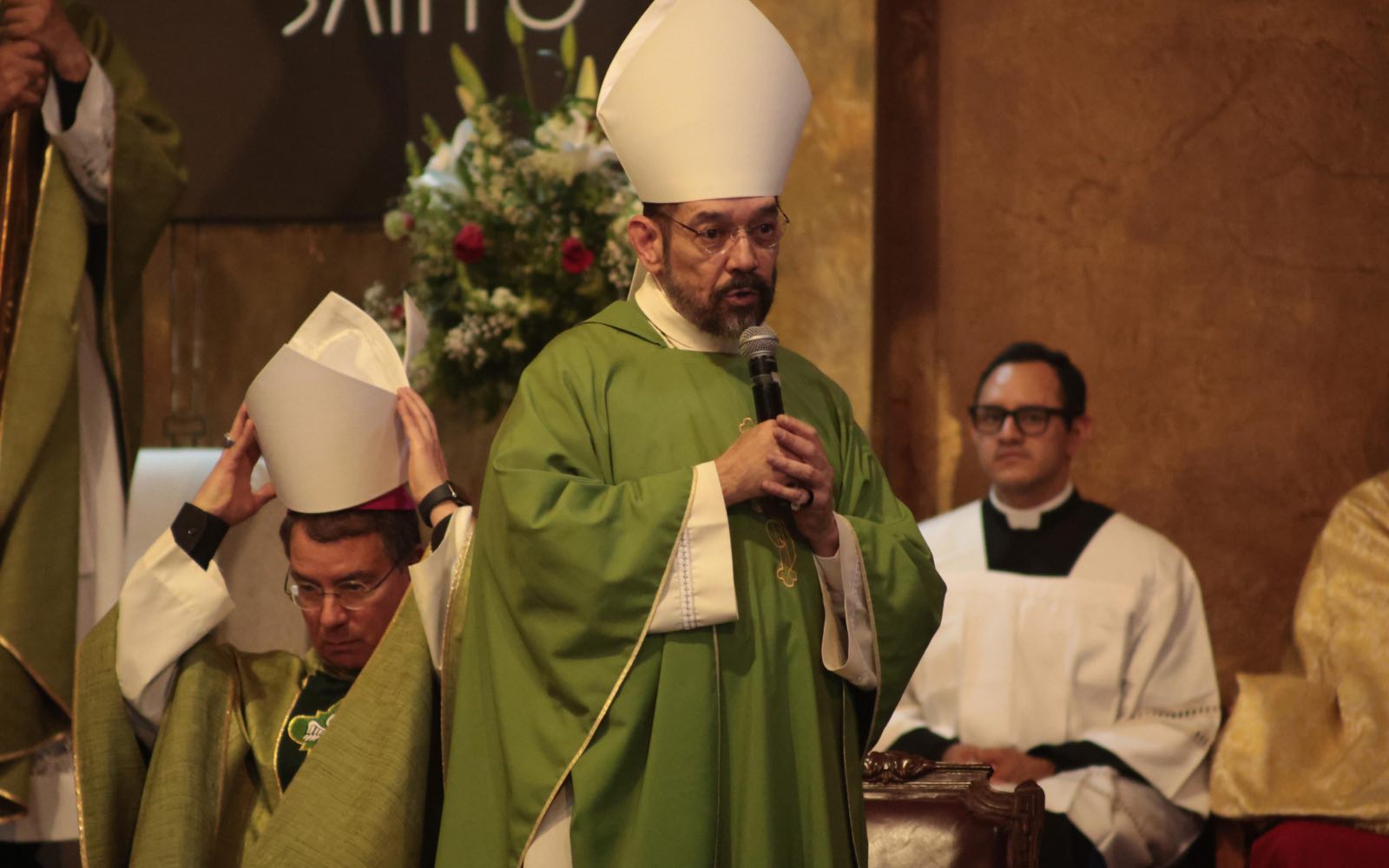
Bishop Daniel Flores of Brownsville, Texas, addresses the congregation at the conclusion of the Mass at Cuernavaca Cathedral on Aug. 30, 2026. | Credit: Photo courtesy of the Diocese of Cuernavaca
In a brief message, Flores expressed gratitude for "Bishop Ramón's inspiration in inviting us to this gathering to strengthen this ecclesial communion."
"In the times we are living through, it will become increasingly important — indeed, urgent — for the Catholic Church in the Americas to speak with one voice, defending the honor of Our Lord and the dignity of the human person — especially the poor and immigrants, who often have nowhere to lay their heads, just like the Lord Jesus himself," he said.
"We need to preach together and united as one Church, under the guidance of our Holy Father, Pope Leo, and in communion with all the bishops of the world," he added.
3 distinct countries 'but one and the same faith'
In his homily, Castro highlighted that this meeting of leaders from North American episcopal conferences is "the first of its kind in our history."
"We are three distinct countries. We are three Churches with different histories and realities, yet we share one and the same faith, one baptism, one Eucharist, and one mission," the Mexican prelate affirmed.
Regarding the role of bishops, Castro emphasized that "before being leaders, we are disciples," and "before having responsibilities, we are men called by the Lord."
"Perhaps this can be the profound spirit of this gathering of the Church in North America: for all of us to place ourselves once again behind Jesus."
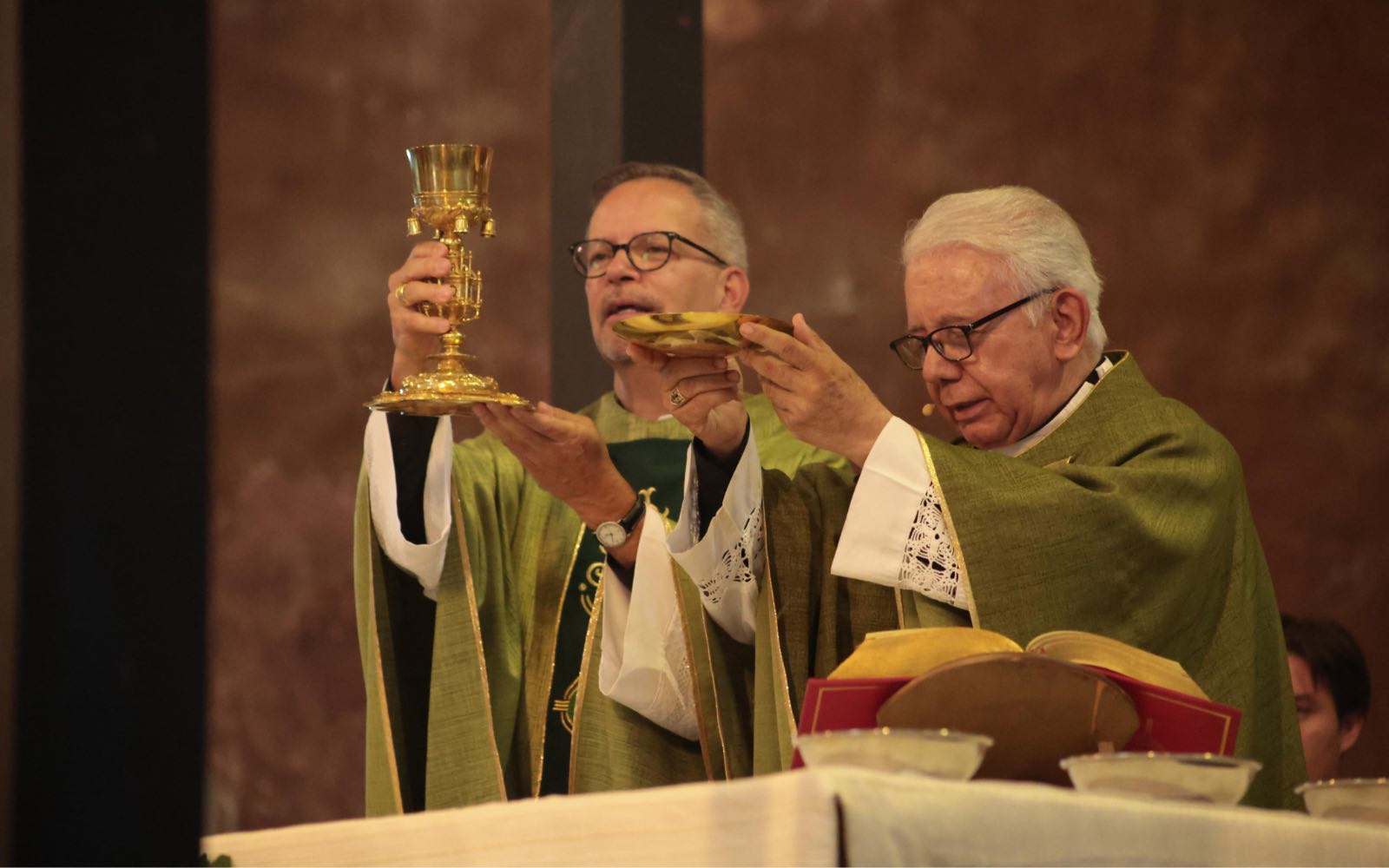
Bishop Ramón Castro Castro of Cuernavaca, Mexico, right, and Bishop Pierre Goudreault of Sainte-Anne-de-la-Pocatière, Canada, pray during the consecration at the Cuernavaca Cathedral on Aug. 30, 2026. | Credit: Photo courtesy of the Diocese of Cuernavaca
'Enormous challenges'
The president of the CEM emphasized that "our peoples face enormous challenges, particularly Mexico," and pointed to issues such as "violence, demagoguery, corruption, loneliness, secularization, individualism, materialism, polarization, wounded families, and young people seeking reasons for hope."
He further noted that "perhaps one of the most common themes among the three of us as countries and conferences is migration."
"Over the coming days, we will have the opportunity to share our perspectives on these realities, not in a spirit of judgment or confrontation but rather out of the pastoral responsibility that falls to us as shepherds," the bishop of Cuernavaca said.
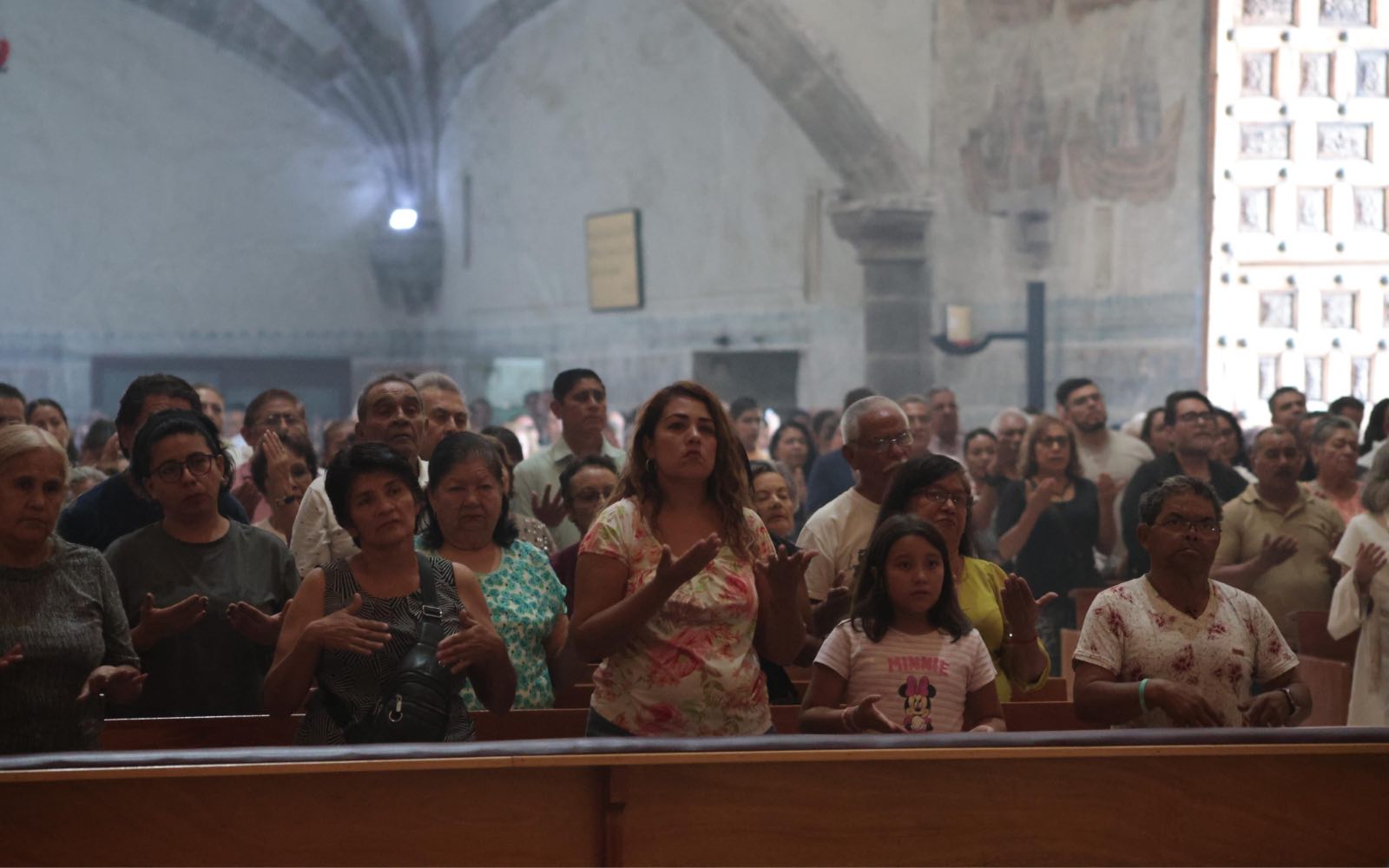
The faithful attend Mass at the Cuernavaca Cathedral on Aug. 30, 2026. | Credit: Photo courtesy of the Diocese of Cuernavaca
"We want to better understand the lives of our people. To what end? To be able to serve them better," he stated.
Castro emphasized that "migration must not be reduced to statistics, public policies, or economic obligations," because "behind every migrant there is a face, a story, a family, a hope, and, unfortunately, often many wounds."
"The Church must view these people as brothers and sisters whose dignity must be recognized and protected," he said.
The Mexican bishop also expressed his wish "that from Cuernavaca we might send a simple yet powerful sign to our churches, churches on pilgrimage in Canada, the United States, and Mexico."
This story was first published by ACI Prensa, the Spanish-language sister service of EWTN News. It has been translated and adapted by EWTN News English.
Bishop Paolo Liu Honggang is the third bishop ordained in China in two months and the sixth episcopal consecration during Leo's pontificate amid implementation of the Vatican-Beijing agreement.
Father Paolo Liu Honggang was ordained bishop of the Diocese of Datong in China's Shanxi province on Monday.
The Holy See said Pope Leo XIV appointed Liu bishop of Datong on Aug. 10 after approving his candidacy under the mechanisms established by the Vatican's agreement with Beijing on the appointment of bishops.
The ordination is the third episcopal consecration in China in just two months and the sixth to take place during Leo's pontificate, although not all six episcopal appointments originated under the current pope.
One of the six prelates had already been ordained a bishop in 2017, while two others were initially selected unilaterally by Chinese authorities during the sede vacante between the death of Pope Francis and the election of Leo. The new pope subsequently approved their appointments.
A life of pastoral service
Liu was born Nov. 2, 1970, in Wufuying village near Taiyuan, the capital of Shanxi province.
He began his priestly formation at the Fenyang seminary, where he studied from 1988 to 1992. He later attended the National Seminary in Beijing from 1992 to 1996, earning a bachelor's degree in theology.
He was ordained a priest for the Diocese of Datong on Nov. 24, 1996.
Following his ordination, Liu served as pastor of Zhangguantun from December 1996 to 1999, Xubao from 2000 to 2003, and Xihehe from 2003 to 2005.
He had served as diocesan administrator of Datong since March 15, 2005.
Appointments under Leo XIV
The process leading to Liu's appointment and episcopal ordination took place entirely during Leo's pontificate, providing another sign that the pope intends to continue dialogue between Rome and Beijing.
Several episcopal appointments and recognitions have taken place in China since Leo's election.
On June 11, 2025, the Vatican announced the Chinese government's civil recognition and installation of Bishop Giuseppe Lin Yuntuan as auxiliary bishop of Fuzhou in Fujian province.
Lin, however, was not ordained a bishop during Leo's pontificate, having received episcopal ordination in 2017. Pope Leo XIV appointed him auxiliary bishop of Fuzhou on June 5, 2025, before Chinese authorities granted him civil recognition.
On July 8, 2025, Leo suppressed the Dioceses of Xuanhua and Xiwanzi, which had been established by Pope Pius XII in 1946, and erected the new Diocese of Zhangjiakou as a suffragan see of Beijing.
Two months later, on Sept. 10, Father Giuseppe Wang Zhengui, whom the pope had appointed to lead the new diocese, was ordained a bishop.
In 2026, Father Francesco Saverio Duan Yongkun was ordained coadjutor bishop of Bameng in the Inner Mongolia Autonomous Region after Leo appointed him on June 15 under the Provisional Agreement between the Holy See and the People's Republic of China.
The pope also appointed Father Giuseppe Chang Yanfeng on June 15. Chang was subsequently ordained bishop of Chifeng, another diocese in Inner Mongolia.
Tensions during the sede vacante
Chinese authorities unilaterally selected two bishops during the sede vacante following Pope Francis' death, including one for a diocese already headed by a bishop recognized by the Holy See.
Father Ignatius Wu Jianlin was ordained auxiliary bishop of Shanghai on Oct. 15, 2025, after Pope Leo XIV formally appointed him to the post on Aug. 11.
Chinese authorities had previously announced Wu's election by an assembly of priests and laypeople on April 28, during the sede vacante.
The Holy See's later announcement revealed that Leo had approved the nomination Aug. 11. Although the appointment was not immediately made public, the Vatican announcement indicated that the case was ultimately brought within the framework of the Holy See-China agreement.
Francis Li Jianlin was likewise ordained bishop of the Apostolic Prefecture of Xinxiang in Henan province on Dec. 5, 2025, after Leo formally appointed him Aug. 11.
Li was the second bishop whose candidacy had been advanced by Chinese authorities during the sede vacante.
17 bishops ordained under Vatican-China agreement
With Liu's ordination, 17 Catholic bishops have now been ordained in China under the Provisional Agreement first signed between the Holy See and China during Pope Francis' pontificate.
The bilateral agreement, first signed in 2018, regulates the process for selecting and recognizing Catholic bishops in China.
The Holy See and China have not maintained formal diplomatic relations since 1951, following the communist takeover under Mao Zedong. Chinese Catholics subsequently became divided between the state-controlled Chinese Catholic Patriotic Association and an underground Catholic community that remained loyal to Rome.
The full text of the agreement has never been made public.
It was renewed every two years until 2024, when the two sides extended it for four years, through 2028.
According to publicly known elements of the agreement, the pope retains the final authority over episcopal appointments in China, including the ability to reject candidates proposed by Beijing. The Holy See, meanwhile, has agreed not to make episcopal appointments without prior consultation with the Chinese government.
This story was first published by ACI Prensa, the Spanish-language sister service of EWTN News. It has been translated and adapted by EWTN News English.
As Caritas Nepal is running community kitchens and sourcing body bags, a second emergency, winter, is approaching.
Five days after Nepal's worst glacial flood, Caritas continued a full-scale relief operation for thousands of families in the affected area. The work has also taken on the grim task of corpse management, helping deal with the many dead bodies resulting from the catastrophe.
The official death toll of the deluge, provided by authorities, has climbed to 919, and 4,793 people are still missing. More than 930 hydropower workers remain unaccounted for, LiCAS News reported. Many are feared to be trapped in hydro tunnels along the Bhote Koshi-Trishuli river system.
In a situation report shared with EWTN News on Aug. 30, the president of Caritas Nepal, Father Silas Krishna Bogati, confirmed that the Catholic Church's response is fully operational. Emergency shelters and hygiene kits have reached over 1,000 households. A cash assistance payment of 15,000 Nepali rupees (roughly $110) is being distributed to 750 of the worst-affected families.
The priest, who also serves as apostolic administrator of the Apostolic Vicariate of Nepal, added that more than 50 community kitchens run daily to feed 300 families.
Operations supported by China and India
The full scale of destruction is yet to be accounted for. Reuters reported that the flood destroyed 19 bridges, roadways, and other crucial infrastructure, hampering emergency aid and the search for survivors.
As rescue operations, supported by China and India, continue amid the risk of landslides and more flooding, aid workers are already flagging a second looming emergency: winter. Displaced families sheltering in high-altitude areas will require thermal gear and winter-proof shelter within weeks, Bogati shared with EWTN News.
Nepal Red Cross has formally asked Caritas Nepal to source more than 1,000 body bags, with decomposition already becoming a public health concern, the president of Caritas Nepal wrote.
To avoid future catastrophes, Nepal and China are expected to improve communication on real-time glacier data, avalanche risks, and water levels.
International pledges for help and support exceed $200 million, with commitments from the United States, Europe, Canada, and the World Bank.
Pope Leo XIV again prayed on Sunday for the flood victims. "Let us pray for those who have lost their lives, for the injured, those missing, for the families and rescue workers," he said. "May the concern of everyone help to alleviate the suffering and provide the necessary aid to the people affected."
In the immediate aftermath of the disaster, U.S. bishops called for international mobilization and "long-term efforts to help affected communities rebuild their homes, livelihoods, and critical infrastructure."
Archbishop Josafá Menezes da Silva directed that the use of AI must always conform to reality and the truth regarding a person's appearance, voice, and statements.
The archbishop of Aracaju in Sergipe state, Brazil, Josafá Menezes da Silva, has established rules for the use of artificial intelligence (AI) in archdiocesan communications. The guidelines, addressed to priests, deacons, lay ministers, and the entire people of God of the Archdiocese of Aracaju, are based on documents of the Church's magisterium regarding human dignity, communications, and the use of technology.
The principal resources used by Menezes are the message for the 60th World Communications Day and the encyclical Magnifica Humanitas, both by Pope Leo XIV, regarding the safeguarding of the human person in the age of artificial intelligence; the document Antiqua et Nova, a joint note from the Holy See's Dicastery for the Doctrine of the Faith and Dicastery for Culture and Education, signed by Pope Francis concerning the relationship between artificial intelligence and human intelligence; and a reflection by Father Doriano Vincenzo De Luca, head of the social communications service for the Archdiocese of Naples, Italy.
"The starting point for all the Church's reflection on artificial intelligence is the unconditional defense of the dignity of the human person," the archbishop of Aracaju explained. The prelate highlighted that the note Antiqua et Nova "places human dignity at the center of discernment regarding artificial intelligence and reminds us that technology must be guided by the good of the person and of society" and that "human intelligence must guide the use of technology for the sake of the 'authentic good of the person.'"
Therefore, "in light of the guidelines of the Church's magisterium and with the aim of guiding discernment regarding the proper use of artificial intelligence tools, ensuring respect for the principle of human dignity by 'preserving faces and voices,' and ensuring these tools serve as an aid rather than replacing the responsible work that only a human being can perform, we hereby establish" certain guidelines within the territory of our Archdiocese of Aracaju, the bishop said.
Review and transparency
Menezes mandated that "all art produced with the aid of artificial intelligence" within the archdiocese must "undergo a mandatory human review before publication" and that "any and all content generated or manipulated by artificial intelligence" must also "be labeled and clearly distinguished from content created by humans, especially when the use of AI could affect the perception of the reality being presented."
Prohibited uses for clergy
Regarding the clergy, Menezes directed that "generative artificial intelligence must not be used to reconstruct or simulate the appearance of a bishop, priest, or deacon when the result replaces their actual photograph or could be interpreted as an authentic representation of their appearance or of a situation they experienced."
He also established that "generative artificial intelligence must not be used to reconstruct or simulate the voice of a bishop, priest, or deacon in a message or speech not originally delivered by them" and that "one must not attribute to a real person an appearance, speech, action, or situation that does not correspond to reality."
In addition, the archbishop prohibited the use of artificial intelligence to "reconstruct a real person's face, replacing their photograph"; to "significantly modify a real person's features"; to "create an artificial appearance presented as their actual appearance"; to "produce images placing a member of the clergy in situations that did not occur"; to "produce a synthetic representation that could be mistaken for a real photograph"; and to "create audio files attempting to simulate a person's voice in a message or speech not actually delivered by that person."
AI as an auxiliary tool
According to the archbishop of Aracaju, "artificial intelligence can be used as an auxiliary tool" in nine situations: creating backgrounds, creating textures, generating abstract elements, creating illustrations, suggesting layouts, working with colors, assisting with composition, assisting with editing, and helping to create visual concepts.
"These guidelines are based particularly on the message from Pope Leo XIV for the 60th World Communications Day, in which the Holy Father warns that the simulation capabilities of artificial intelligence can fabricate 'parallel realities,' usurp faces and voices, and make it increasingly difficult to distinguish between reality and fiction," Menezes explained.
According to the archbishop, "the same document" also "draws attention to the need to protect people's images, photographs, audio recordings, faces, and voices, preventing harmful uses such as digital fraud, cyberbullying, and deepfakes that can violate privacy and personal intimacy without consent."
At the end of the decree, Menezes exhorted "all pastoral workers, communicators, and the faithful to act with prudence, always consulting their respective ordinaries and respecting current regulations, so that technology may serve the mission and never distort it." He further emphasized that "everything the Church communicates must be truthful in content and responsible in its manner of representation."
The archbishop ended his directive with the prayer "May Our Lady of the Immaculate Conception, patroness of our archdiocese, intercede for us and help us preserve, in every communication, the dignity and beauty of human faces and voices called to reflect Christ."
This story was first published by ACI Digital, the Portuguese-language sister service of EWTN News. It has been translated and adapted by EWTN News English.
The Coalition of Catholics Against Antisemitism has been tapped by the Government of Israel as part of its latest outreach to American Catholics.
JERUSALEM — The Coalition of Catholics Against Antisemitism (CCAA), a lay-led U.S. organization established in late 2023 that "affirms the right of the Jewish people to live safely and securely in their ancestral homeland" as well as recognizes that "modern Israel is essential to that security," has emerged as a leading resource in the Government of Israel's outreach to American Catholics, who constitute the country's largest single religious constituency.
Tammy Ben-Haim, head of religious and interfaith affairs at Israel's Ministry of Foreign Affairs, told EWTN news that a May meeting in Washington, D.C., with CCAA Director Simone Rizkallah, a first-generation American of Egyptian-Armenian descent, convinced her of the importance of engaging the organization and its supporters.
"I was so impressed by Simone and the vision she had for the organization to combat antisemitism," including CCAA's network of key influencers throughout the American Catholic world, Ben-Haim said.
Signatories to the CCAA's "Statement of Solidarity and Action," a statement developed in the wake of the Oct. 7, 2023, Hamas attack against Israel that also affirms the above-referenced right of the Jewish people "should not jeopardize the right of Palestinians to also live in safety and security," include dozens of the country's top Catholic thought leaders and personalities.
"When Israel's Ministry of Foreign Affairs (MFA) decided to begin engaging Catholics more proactively and wanted to design a trip specifically for Catholic leaders, it made sense that they would reach out to us," Rizkallah said.
As a result, in August Rizkallah coordinated with the MFA a weeklong itinerary for 13 American Catholic influencers that addressed firsthand both concerns for the security of Israelis in the country's Gaza and Lebanon border regions as well as honest discussions with Israeli Arab and Palestinian Catholics about the conditions and challenges they face.
Signaling the importance of the initiative, the government of Israel highlighted the group's visit on social media, noting that the journey of the American Catholic community leaders was one of "friendship and solidarity" that served to both "deepen their commitment to standing against antisemitism and strengthening the bonds between Christians and Jews."
During the visit, the group, which included representatives from various U.S. Catholic educational institutions, media, think tanks, and lay apostolates, came face-to-face with the existential threats Israel has faced in recent years. The group visited sites of the Oct. 7, 2023, invasions into Israel by thousands of Hamas militants from Gaza, meeting with survivors of the attacks that killed over 1,000 Israelis.
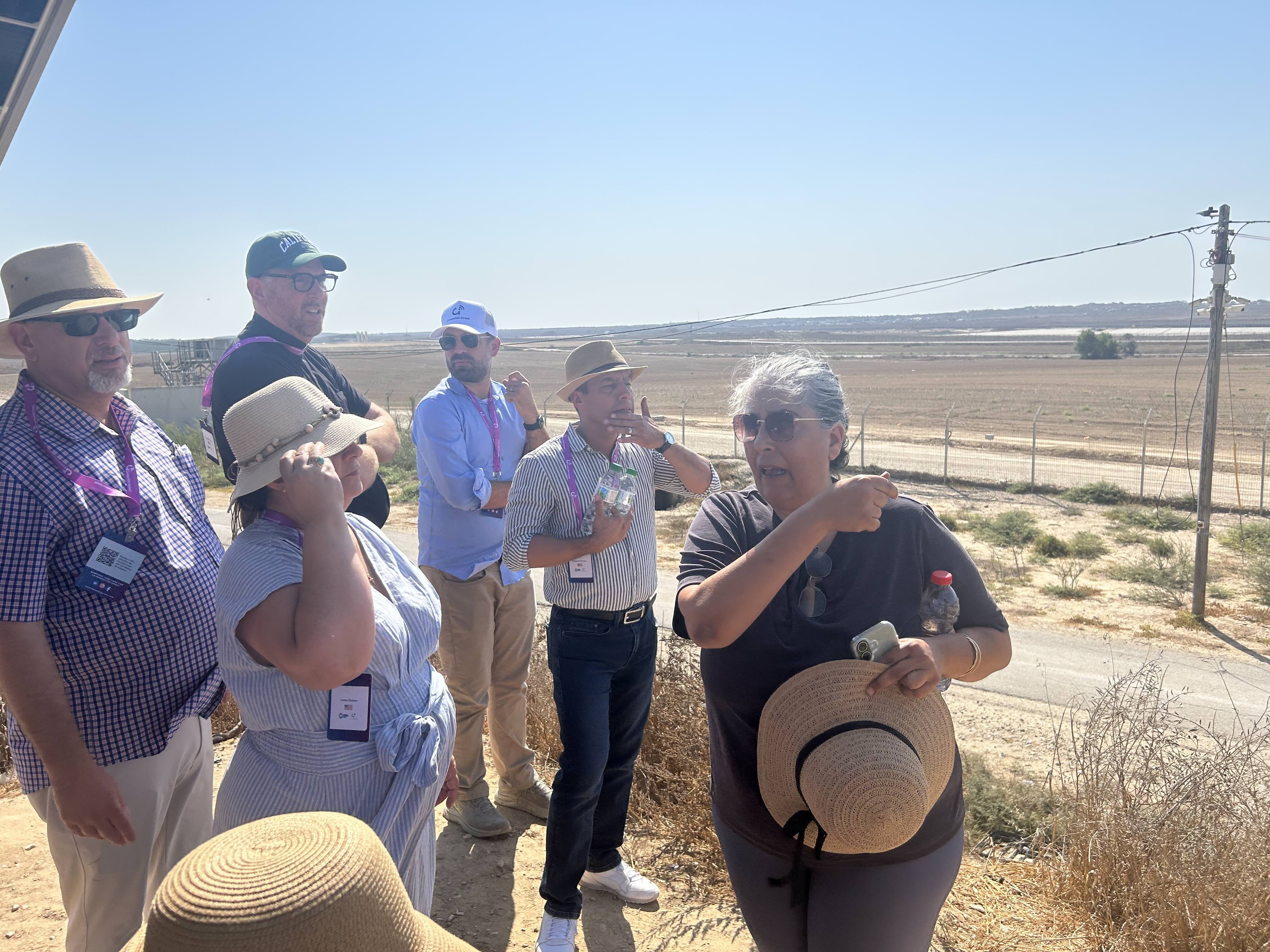
Members of the delegation survey the Gaza Strip, accompanied by Oct. 7, 2023, survivor Oshrit Sabag (pointing over her shoulder) of the neighboring Nahal Oz kibbutz. | Credit: Ken Oliver-Méndez/EWTN News
From a mountaintop overlooking Israel's border with southern Lebanon and as multiple explosions could be heard in the distance, the group received a sobering briefing on Israel Defense Forces (IDF) operations to neutralize the threat from Hezbollah in the neighboring country.
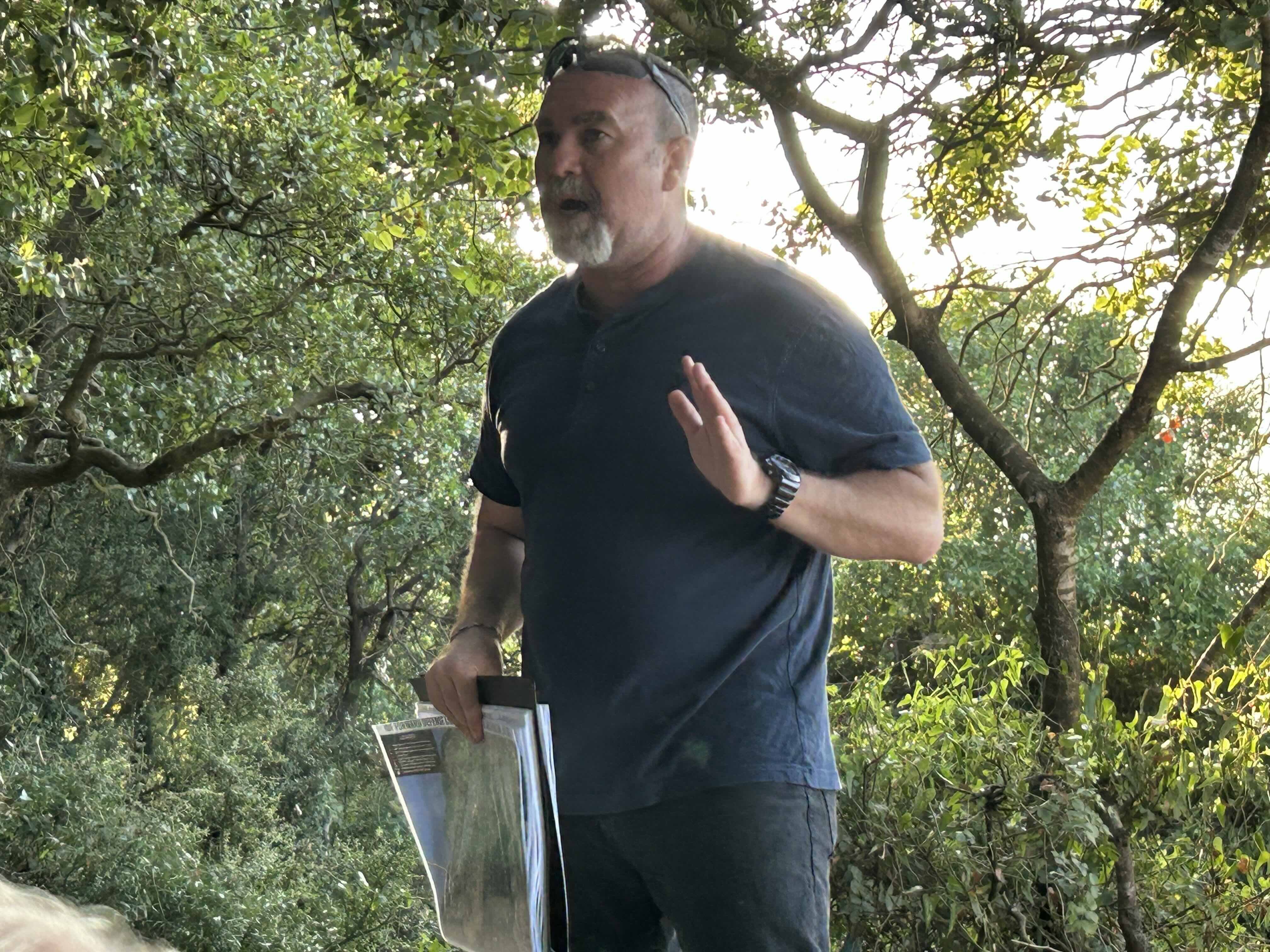
Along the border with Lebanon and as multiple explosions could be heard in the distance, Avrahim Levine briefed the delegation on Israel Defense Forces operations to neutralize the threat from Hezbollah in the neighboring country. | Credit: Ken Oliver-Méndez/EWTN News
In addition, the Government of Israel facilitated the group's direct interaction with various Christians in the disputed lands internationally known as the West Bank (known in Israel by their biblical names of Judea and Samaria) as well as in Haifa, in northern Israel. To varying degrees, these Christians also see themselves as facing existential threats.
The group's guide in Bethlehem, the Palestinian-controlled West Bank town of Jesus' birth, lamented that just in recent weeks the town has lost several leading Christian families, who have emigrated to Greece.
Bethlehem continues to experience a devastating loss of its Christian population. From once having constituted a robust majority, the percentage of Christians there is now estimated in the single digits, with conditions for those remaining further exacerbated by the dearth of pilgrims and severe limitations, since the atrocities of Oct. 7, on permissions for Palestinians to enter Israel for work.
In Haifa, the group met with Archbishop Youssef Matta of the Melkite Greek Catholic Church, Israel's largest Christian community. Melkite Greek Catholics represent nearly 40% of Israel's total Christian population of 185,000. Nazareth, Haifa, and Jerusalem, respectively, are the country's largest Christian population centers.
In a meeting also attended by Ben-Haim and Cesare Marijeh, senior director of the Christian Department of Israel's Ministry of Interior Affairs, Matta addressed several challenges facing his community, including alleged extortion rackets by Muslim and Jewish organized crime families as well as discrimination in government subsidies for the Church's schools, of which there are five under his jurisdiction.
At a luncheon with the delegation, Monsignor Simon Khoury, a Melkite Greek Catholic priest who serves a parish in Cana, asserted that the government has deliberately turned a blind eye to the criminal extortion rackets faced by Christians, as he believes such crimes align with the agenda of certain sectors of Israeli society that favor the displacement of the country's non-Jewish population.
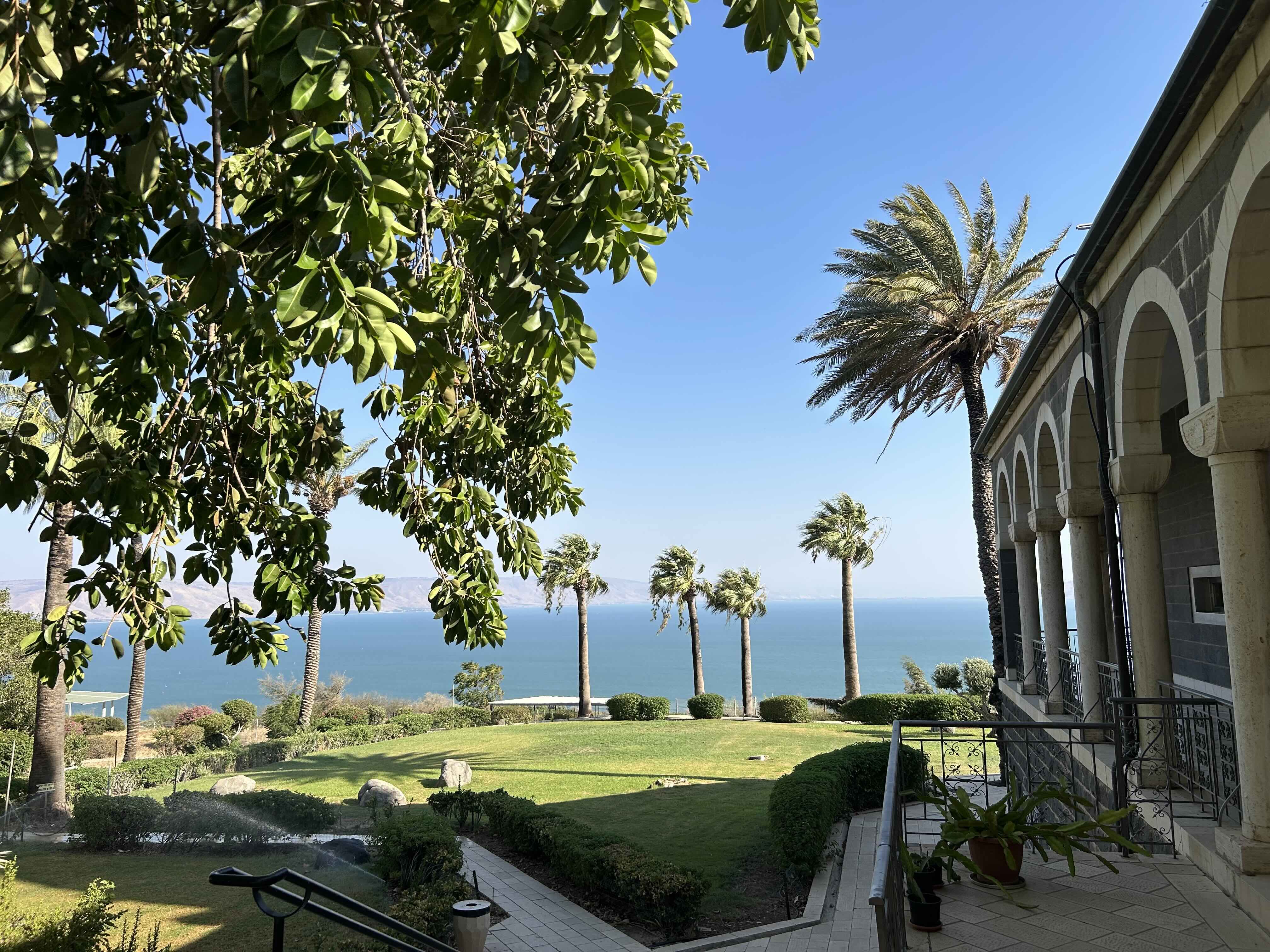
View of the Sea of Galilee from the Mount of Beatitudes, the site of Jesus' Sermon on the Mount. | Credit: Ken Oliver-Méndez/EWTN News
From the beginning to the end of the trip, members of the delegation pressed Israeli authorities to provide necessary assistance to and security for the country's Christian population, contending that such actions will go a long way toward bolstering goodwill toward Israel among hundreds of millions of Catholics worldwide.
At a meeting of the group with the Ministry of Foreign Affairs' director of the Department for Combating Antisemitism, Arezoo Hersel-Rohila, and the Anti-Defamation League's Israel director, Carole Nuriel, EWTN News asked them to identify and address the principal antisemitic narrative that the country is currently facing at the international level.
Both women agreed in answering that it is equating Israel's policy in Gaza to that of the Nazis, i.e., the charge that Israel is committing genocide in Gaza. The officials vigorously contested this widespread allegation, citing that by definition genocide requires intent and that in contravention of such intent, Israel's military has repeatedly sought to relocate Palestinian civilians within Gaza to get them out of harm's way as it targets Hamas' terrorist infrastructure.
Other organizations that also address this question, such as the American Jewish Committee (AJC), assert that the IDF "still endeavors to warn Gazans prior to attacks and has allowed humanitarian aid for civilians to be delivered under arrangements intended to prevent Hamas from diverting aid or controlling its distribution to reinforce its authority."
Israel's government also answers the charge by pointing to evidence that Hamas has repeatedly called on Palestinian civilians to ignore Israel's warnings about impending strikes, in effect using them as human shields. Defenders of Israel's actions in Gaza, like the AJC, also note that "international law does not prohibit Israel from undertaking legitimate actions that will likely result in civilian harm unless the expected civilian harm will clearly exceed the anticipated military advantage from the attack."
As the ADL and much of the Jewish community worldwide see it, the propagation of antisemitic narratives around Israel's operations in Gaza have particularly proliferated among social media influencers, including some Catholics.
This also explains in part the why a wide range of U.S. Catholic influencers who personally stand in support of the CCAA's statement of solidarity, including participants affiliated with EWTN News, the Ethics and Public Policy Center, the Institute on Religion and Democracy, the National Catholic Prayer Breakfast, the Family Research Council, the GIVEN Institute, Tepeyac Leadership, Benedictine College, and the Franciscan University of Steubenville, among others, were invited to engage firsthand with these ongoing issues.
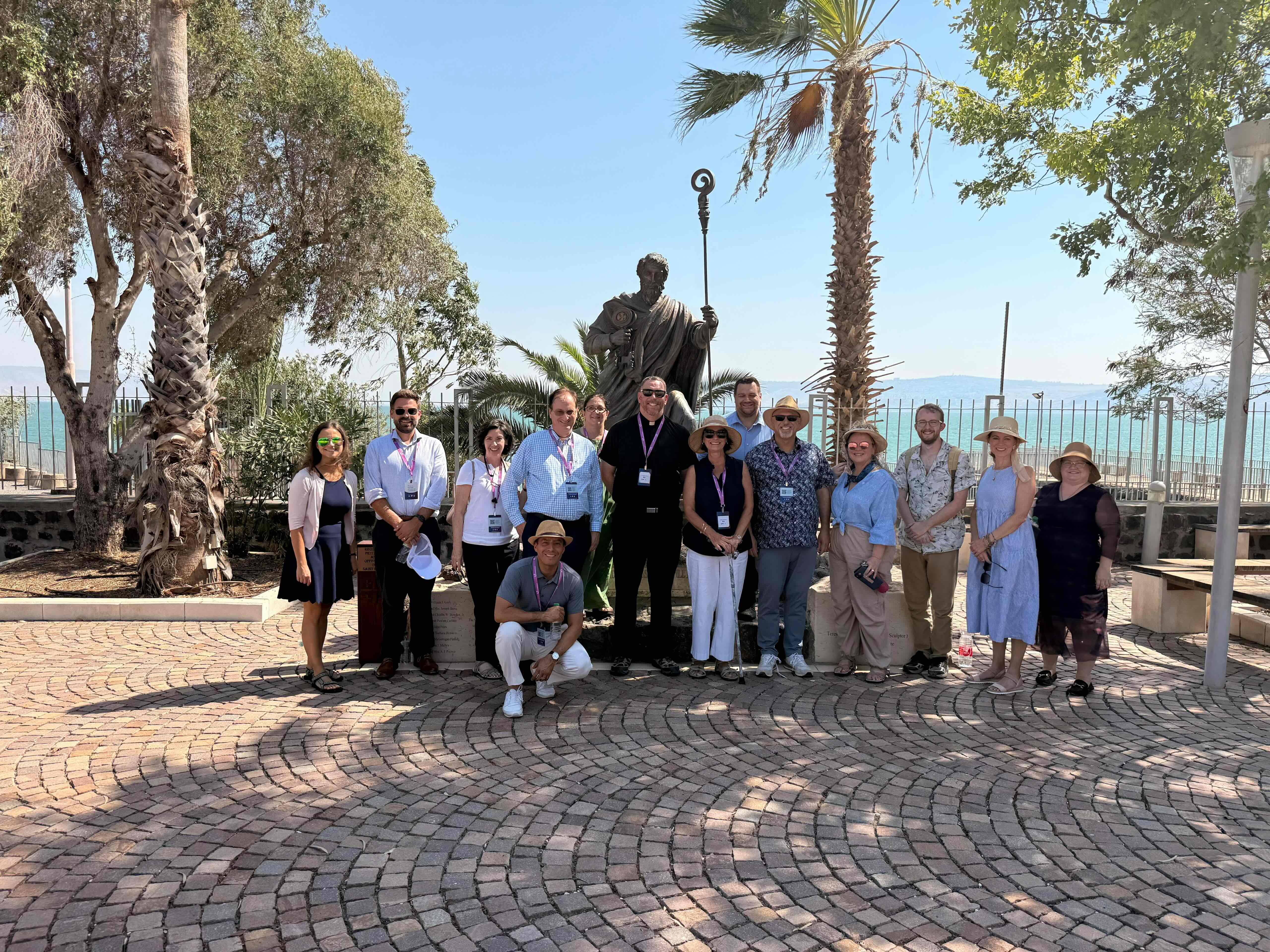
With St. Peter's statue towering above them, members of the delegation are seen here in Capernaum, the fishing village that was the primary base of operations of Jesus' ministry in Galilee and home of the Chief of the Apostles. | Credit: Photo courtesy of Yosi Shoshani
Ben-Haim, who accompanied the delegation on the Stations of the Cross route in Jerusalem's Old City, told EWTN News that going forward, she would like to see more such delegations, especially "young up-and-coming Catholic leaders and influencers" have similar experiences.
"No amount of explaining or telling our story equals one visit to Israel," Ben-Haim explained. Noting that terrorist organizations like Hamas and Hezbollah are right at the country's borders, she insisted that "all that I believe Israel and Israelis want is for people around the world to understand this; we want to live in a county and in a region that is peaceful and quiet. We cannot afford to have the Oct. 7, 2023, massacre happen again; we cannot allow our borders to be crossed and our children and families to be murdered for being Jews and Israelis."
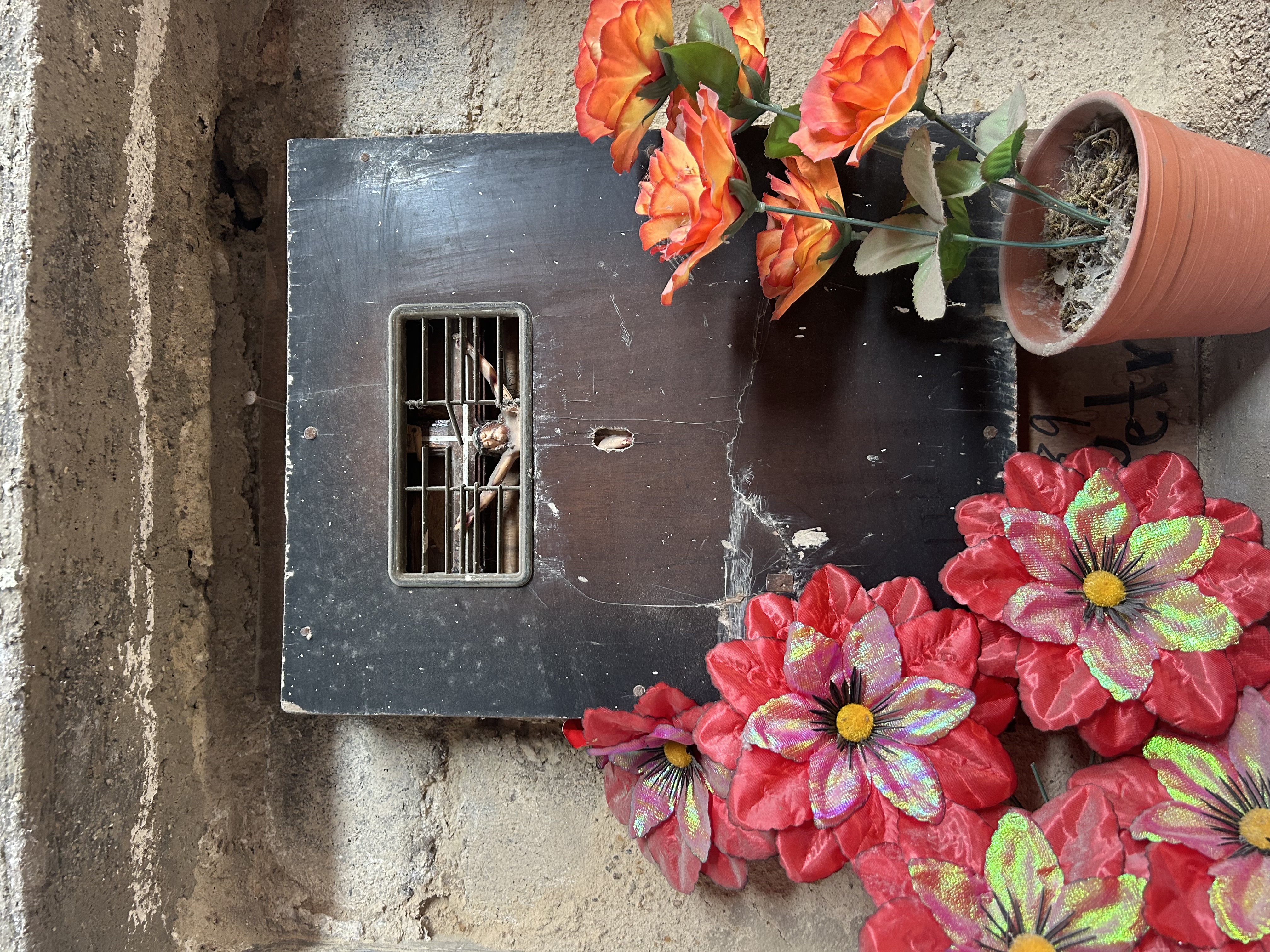
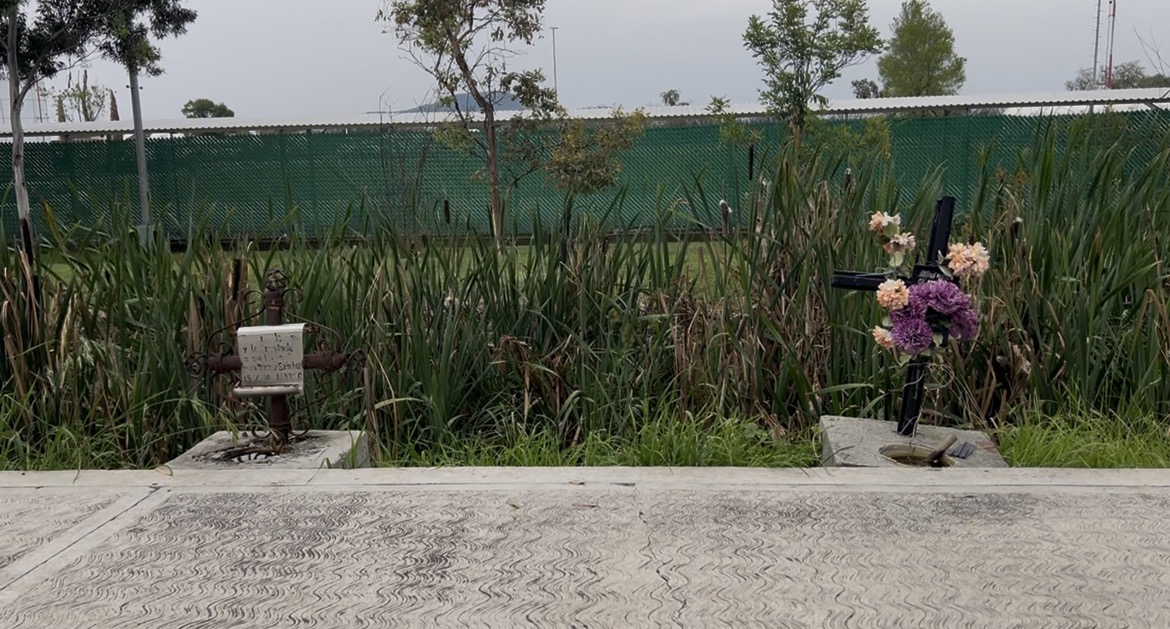
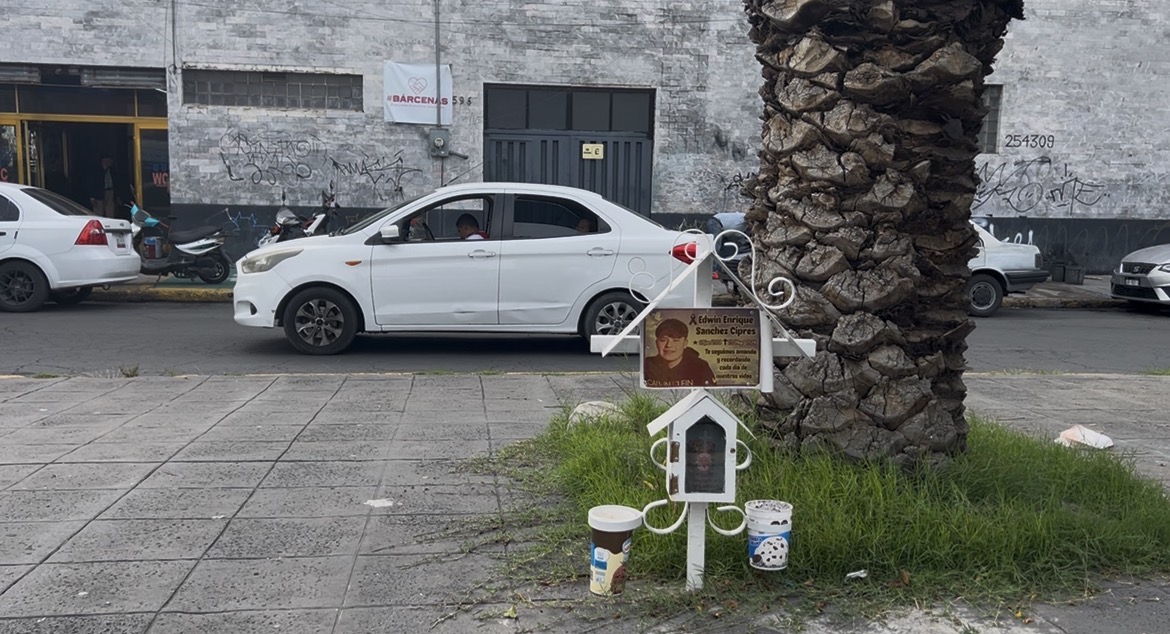
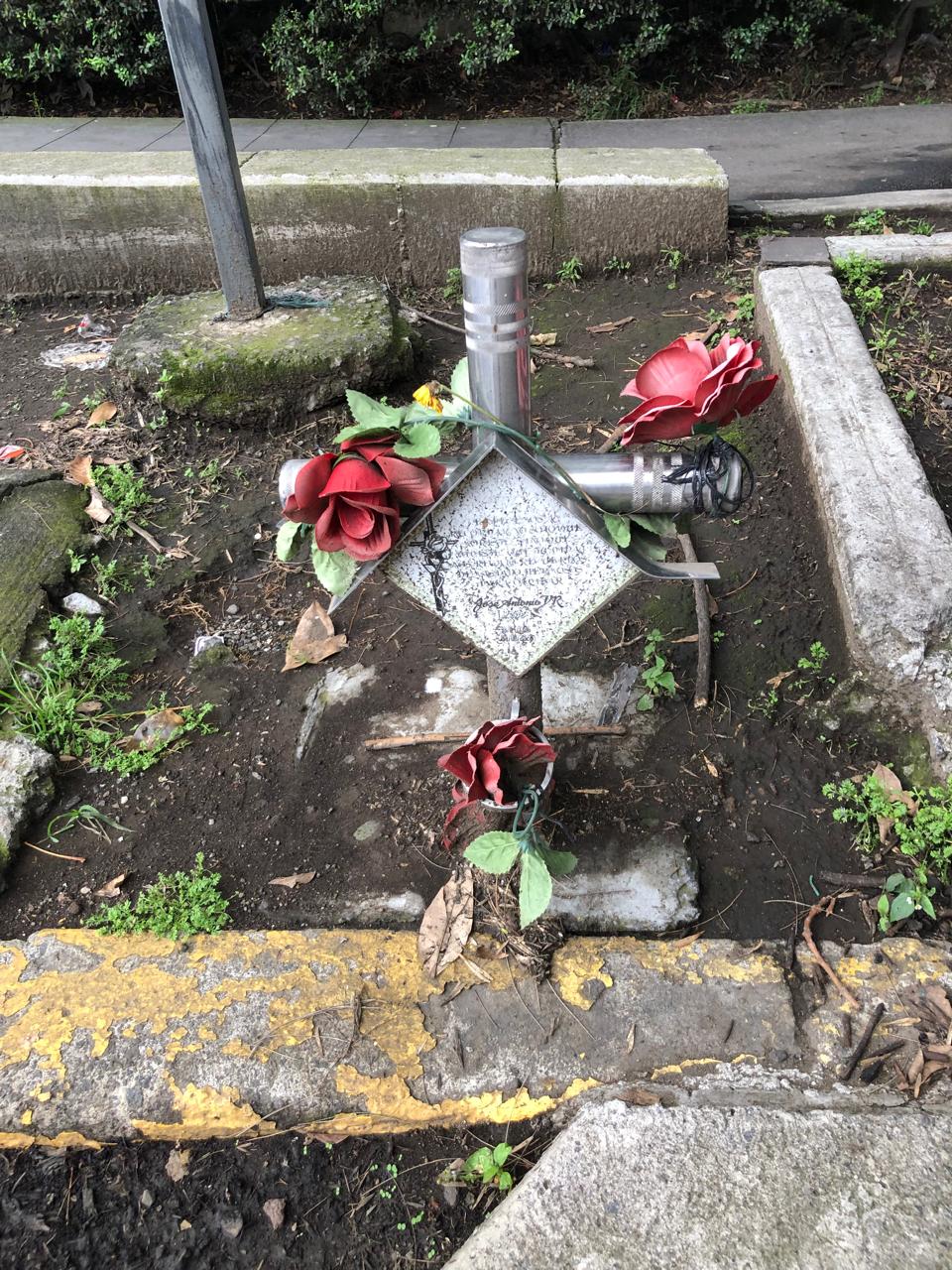
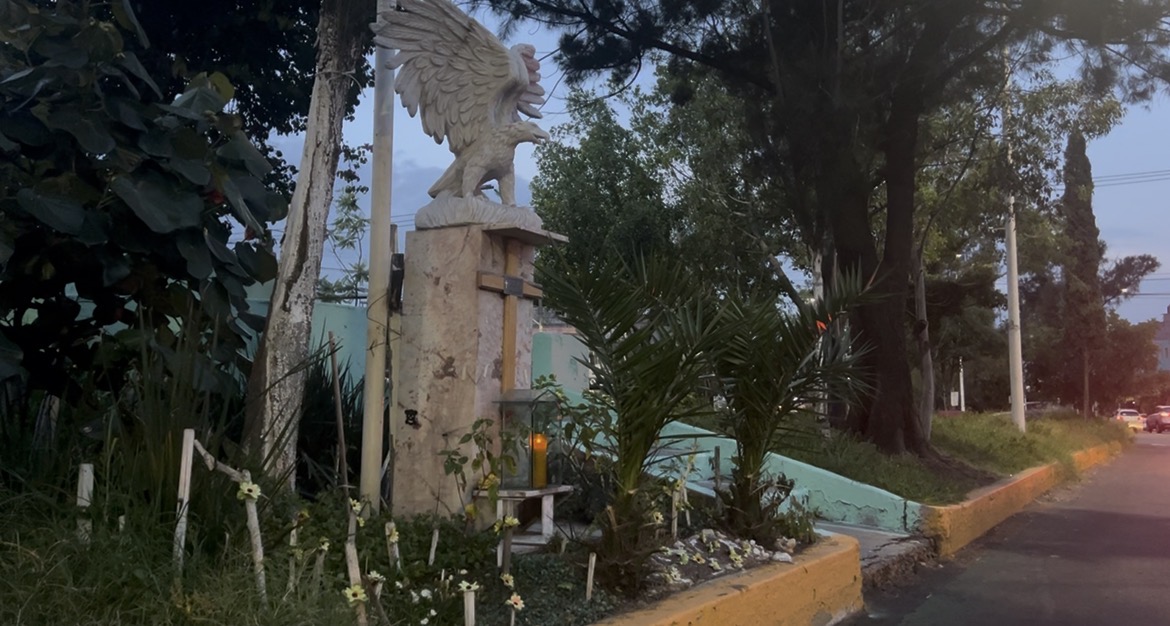
Makeshift public memorials are a way for friends and family to commemorate a loved one who died at that location, often a street or road, and in the case of murder, can serve as a call for justice.
Small memorials adorned with crosses, candles, flowers, images of the Virgin Mary, and plaques with a deceased person's name are part of the urban landscape in some Latin American cities. These memorials are known as cenotaphs, erected to keep alive the memory of those who perished, usually in a violent way.
The term "cenotaph" comes from a Greek expression meaning "empty tomb" and traditionally refers to a monument built to honor a person whose remains are buried elsewhere.
An altar on the streets of Jalisco, Mexico, in August 2026. | Credit: Diego López Colín/ACI Prensa
It is common to find these small structures on streets, sidewalks, medians, and highways in countries such as Peru, Colombia, or Mexico, usually placed to mark the location where a person lost his or her life.
In an interview with ACI Prensa, the Spanish-language sister service of EWTN News, Father Roberto Delgado Suárez, a priest of the Diocese of Nezahualcóyotl in Mexico specializing in grief ministry and palliative care, explained that through Christ's sacrifice, the cross was transformed from "a sign of condemnation into a sign of salvation."
Cenotaph on the streets of Teoloyucan, Mexico, in August 2026. | Credit: Diego López Colín/ACI Prensa
He noted that such memorials can help people reinterpret the site where their loved one died, turning a space associated with sorrow into "a sacred place." He pointed out that, especially for families, the cenotaph serves as a way to express "This is where I last saw my son; this is where my son was — here in this world."
On the other hand, Delgado noted that for some people, a cenotaph can represent a "call for justice," as is the case with "mothers or families searching for their children." In this way, the memorials can take on a dual meaning: an expression of faith, but also "a sign [calling for] justice."
Cenotaph on the streets of Nezahualcóyotl, Mexico, August 2026. | Credit: Diego López Colín/ACI Prensa
Although the cenotaphs are neither cemetery monuments nor crypts, the priest urged people to show them due respect, as they are "signs that point us toward God."
The memorials are built in a variety of ways. Some consist solely of a cross and a plaque bearing the deceased person's name; others include photographs, flowers, candles, or religious images. In some cases, families erect larger structures resembling a cemetery monument along the roadside.
Cenotaph on the streets of Mexico City, August 2026. | Credit: Diego López Colín/ACI Prensa
Guillermina Hernández Martínez, a psychologist and specialist in thanatology (the study of death, dying, loss, and grief), said the significance of these memorials varies.
In an interview with ACI Prensa, she noted that "sometimes, out on the streets, the crosses are now forgotten," while others remain tended for years.
Cenotaph on the streets of Nezahualcóyotl, Mexico, in August 2026. | Credit: Diego López Colín/ACI Prensa
Hernández warned that in some cases, too much of a bond to the location of the memorial could hinder emotional healing, as "people often continue to idealize [the deceased] and do not allow themselves to process their grief." She emphasized the importance of psychological and thanatological support, particularly in the wake of a violent death.
Grief, she explained, is a process requiring time and support, yet one must always remember that "it is part of life," and for Catholics it is "another step toward being with God."
This story was first published by ACI Prensa, the Spanish-language sister service of EWTN News. It has been translated and adapted by EWTN News English.
Archbishop Fernando Chomali of Santiago, Chile, took the opportunity to reference a trend among Latin American youth to redirect their ambitions in life from looking cool to serving Christ with joy.
In recent weeks, a new trend has gained significant momentum among young people across Latin America: "aura farming."
In the world of video games, "farming" means collecting points toward a goal. Under the Merriam-Webster Dictionary's "Slang and Trending" category, aura farming means "the act of doing something to look cool, impressive, stylish, etc." To "farm aura," the dictionary further explains, means to "do something in order to enhance one's coolness."
The expression spread rapidly on social media platforms like TikTok, sparking curiosity and a following, primarily among Gen Z youth. However, the phenomenon's viral nature quickly moved from screens to the streets.
Through specific gestures that have become hallmarks of the trend, young people gather to "farm aura" and even hold competitions featuring distinctive poses, facial expressions, or ways of walking, with the surrounding crowd deciding who performed best.
Cardinal Fernando Chomali, archbishop of Santiago, Chile, recently reflected on this new trend: "'Aura farming' is a desperate cry from young people to be seen, heard, valued, loved, and acknowledged. It's a different version of the 'therian' trend [a person who psychologically identifies with an animal], reflecting the same worrying phenomenon: Many young people feel lonely! And, regrettably, little is said about that," he commented on X.
In another post, the cardinal advised young people: "The best way to aura farm is to approach life with hope and joy. I invite you to study assiduously and to prepare your body and soul well to serve others. What better way to aura farm than by thinking big and building a more just country! Aura for and by Chile!" he commented.
On Aug. 27, the cardinal highlighted a relevant social service in Santiago: "The Franciscans of Recoleta, day after day, provide lunch for 150 people. The soup kitchen is very orderly and has a wholesome atmosphere." The stories the guests "tell of so many people without a home, without family, with nothing, except a lunch served with love by the friars and their collaborators. I love the Church and am happy to have given my life to it! Purely aura farming with Christ," he stated.
This story was first published by ACI Prensa, the Spanish-language sister service of EWTN News. It has been translated and adapted by EWTN News English.
The pontiff said believers should speak honestly to God in moments of confusion while humbly accepting his ways.
CASTEL GANDOLFO, Italy — Pope Leo XIV on Sunday called for the immediate release of hostages taken in a deadly massacre in Haiti, appealed to authorities to protect the population from violence and prayed for victims of severe flooding in Nepal and Tibet.
Speaking after the Angelus in Castel Gandolfo on Aug. 30, the pope said he had received "tragic reports" from Haiti about a massacre in Kenscoff.
"Tragic reports are emerging from Haiti of the horrific massacre carried out in Kenscoff, in which numerous people have lost their lives and others taken hostage," Pope Leo said. "I express my spiritual closeness to the victims and their families, and call for the immediate release of all hostages."
"I make a heartfelt appeal to all those in positions of authority to take concrete steps in order to ensure the safety of the population and put an end to all forms of violence," he added.
The pope also renewed his prayers for those affected by flooding in Nepal and Tibet.
"Let us pray for those who have lost their lives, for the injured, those missing, for the families and rescue workers," he said. "May the concern of everyone help to alleviate the suffering and provide the necessary aid to the people affected."
Pope Leo then broadened his appeal, urging Christians to continue praying for peace and recalling the words of St. Augustine, whose feast the Church celebrated Aug. 28.
"Let us continue to pray for peace," he said. "Saint Augustine, whose feast we celebrated a few days ago, said that peace 'is like the miraculous bread multiplied in the hands of the disciples as they broke it and distributed it.'"
"May there be an increase in the world of those who courageously break and share the bread of peace, overcoming divisions, promoting justice and practicing forgiveness for the good of all," the pope said.
Leo also noted that the World Day of Prayer for the Care of Creation will be celebrated Tuesday, marking the beginning of the ecumenical Season of Creation, whose 2026 theme is "Living Water."
"I invite everyone to join in prayer and action, that we may become channels of the living water of God's peace, refreshing our wounded world," he said.
Understanding and accepting God's ways
Before the Angelus, Pope Leo reflected on the Gospel account in which Jesus tells his disciples of his coming Passion, prompting Peter to reject what he hears.
The pope noted that Peter had only shortly before recognized Jesus as "the Messiah, the Son of the living God," but was shocked when Christ explained that he would go to Jerusalem, suffer, be killed and rise on the third day.
Peter's reaction, Leo said, was "an outburst of zeal, certainly motivated by sincere love, and yet it gives us something to consider."
"For us, too, in fact, it is not always easy to understand and accept God's ways, especially when they are very far from our own," the pope said. "Then the temptation arises — against all the reasoning of faith — to think that the Lord is the one who is wrong, or worse still, that he is not listening to us or is not concerned about us."
Peter, despite his impulsiveness, offers Christians two lessons in such moments, Leo said.
"The first is, even in such moments, never to cease our dialogue with the Lord," he said. "Instead, we are confidently to tell him our difficulty in understanding what he is asking of us."
"The second is never to judge God's work, but rather humbly and prayerfully to listen to what he is revealing to us through his actions, even when they do not meet our expectations."
"The greatness of the first of the Apostles is also evident in this," the pope said.
Jesus responded to Peter with the words, "Get behind me, Satan!" before teaching the disciples that following him means denying themselves, taking up their crosses and following him.
Peter would eventually accept that challenge, Leo noted, remaining faithful to Christ "for the rest of his life, even unto martyrdom."
The pope concluded his reflection by asking the Lord to give Christians Peter's sincerity in prayer as well as his willingness to accept God's will.
"Let us therefore ask the Lord that we, too, in our life of faith and in our prayer, may have the same sincerity as Peter, humbly telling Jesus what we truly feel, even when our hearts are confused," he said. "At the same time, may we cultivate Peter's own docility in accepting what Jesus asks of us beyond our expectations."
This story was first published by ACI Stampa, the Italian-language sister service of EWTN News. It has been translated and adapted by EWTN News English.
A regional government's minister of culture highlighted the cause for beatification of Queen Isabella during a meeting with Archbishop Luis Argüello, president of the Spanish Bishops' Conference.
The regional government of Castile and León in Spain highlighted the beatification cause of Queen Isabella during a meeting with the archbishop of Valladolid and president of the Spanish Bishops' Conference, Luis Argüello.
During a meeting between Argüello and the minister of culture, tourism, and sport, Alberto Díaz Pico, the regional government expressed its "interest in promoting the commemoration of the 500th anniversary of the birth of Philip II (in 2027), as well as highlighting the beatification cause of Isabella, the Catholic Monarch, and its historical and cultural significance," according to an Aug. 27 statement issued by the government.
Isabella and her husband, King Ferdinand, were given the title "the Catholic Monarchs" by Pope Alexander VI through the papal bull Si Convenit for their defense of the Catholic faith.
"Furthermore, the commitment to continue collaborating with the Church on the conservation, protection, and enhancement of the ecclesiastical heritage of Castile and León has been reaffirmed, with a view to exploring ways to expand and strengthen existing support measures," the statement added.
The statement also highlighted "the good rapport and the determination to maintain close collaboration on matters of mutual interest regarding the culture, heritage, and history of Castile and León."
Isabella, the Catholic Monarch
Isabella I of Castile was born in Madrigal de las Altas Torres on April 22, 1451, Holy Thursday that year. After being recognized as Princess of Asturias in 1468, she married Ferdinand of Aragon in 1469 and had six children, two of whom predeceased her. Upon the death of Enrique IV, she was proclaimed queen in 1474, according to the Archdiocese of Valladolid.
During her reign, she championed the reconquest of Granada from the Muslims and the voyage of Christopher Columbus, which led to the discovery of the Americas in October 1492. She also promoted the evangelization and protection of the Indigenous peoples of the Americas, going so far as to ban their enslavement. She died on Nov. 26, 1504, from uterine cancer.
The cause for her beatification was initiated in Valladolid in 1958; the diocesan phase concluded in 1990, after which the process moved to Rome.
Historians have already favorably reviewed the documentation, but the theological assessment regarding the heroic nature of her virtues is still pending. Once that takes place, and following the pope's approval, she may be recognized as venerable, awaiting a miracle for her beatification.
Enraizados (the "Rooted in Christ and in Society Association") has an annual Mass celebrated in memory of Isabella. In the manifesto the group published in 2026, it included a prayer by the queen: "I am afraid, Lord, of being afraid and not knowing how to fight. I am afraid, Lord, of being afraid and being capable of denying you. I ask you, Lord, that in your greatness, you do not forget me. And that, with your love, you grant the strength to die for you."
This story was first published by ACI Prensa, the Spanish-language sister service of EWTN News. It has been translated and adapted by EWTN News English.