• Home
  • About Us
  • Support
  • Concerts & Events
  • Music & Media
  • Faith
  • Listen Live
  • Give Now

Catholic News

Spain's growing Muslim population has led that country's bishops' conference to address concurrent pastoral challenges.

The standing committee of the Spanish Bishops' Conference (CEE, by its Spanish acronym) has approved the creation of a department for relations with Islam, intended to address the growth of the country's Muslim population.

This new body is part of the Bishops' Subcommittee for Interconfessional Relations and Interreligious Dialogue, chaired by the auxiliary bishop of Seville, Ramón Darío Valdivia.

The spokesperson for the CEE, Bishop Francisco César García Magán, stated to the media that the mission of the new department is "to respond to the pastoral challenges posed by the growing presence of Muslim faithful in Spain."

Among these challenges are supporting spouses in mixed marriages and training priests, seminarians, and laypeople for pertinent dialogue. García noted that the bishops are "aware of the need for trained personnel in this area" and that priests have been trained for this purpose at the Pontifical Institute for Arabic and Islamic Studies in Rome.

The department for dialogue with the Muslim world will also develop catechetical materials for converts to Christianity from Islam and will seek to foster "the strengthening of institutional relations with Islamic groups."

This type of organization is not new in Europe. As Magán noted, the bishops' conferences of France and Italy also have such structures and have produced a significant body of doctrinal work.

2.5 million Muslims in Spain

The Union of Islamic Communities of Spain (UCIDE, by its Spanish acronym) estimates in its 2024 annual report that approximately 2.5 million Muslims live in the country, representing about 5% of the population.

According to the same source, the majority of Muslims are Spanish citizens, either by birth or naturalization (approximately 600,000 naturalized in 56 years), followed by Moroccans, Pakistanis, Senegalese, and Algerians. The municipalities with the largest Muslim populations are Barcelona, ??Ceuta, Madrid, and Melilla, followed by El Ejido (Almería) and Murcia. Ceuta and Melilla are Spanish autonomous cities on the Moroccan coast in North Africa.

This presence has also resulted in an increasing number of students studying the Islamic religion each year, exceeding 390,000 since the curriculum for the subject was published in 1996. This program has over 300 teachers, more than a third of whom are based in Andalusia, the southernmost area of peninsular Spain.

Spanish schools are required by law to offer courses in religion, although it is optional for the student to take the class.

The country's Islamic community also includes a military imam (akin to a chaplain) who ministers to inmates at the military prison in Madrid; five imams who provide assistance in hospitals and detention centers for foreigners and minors; and 11 prison imams serving in prisons in Catalonia, Madrid and Valencia, the Canary Islands, Ceuta, Melilla, and the Basque Country.

This story was first published by ACI Prensa, the Spanish-language sister service of EWTN News. It has been translated and adapted by EWTN News English.
Full Article

As state contributions wind down toward a 2030 cutoff, the Archdiocese of Olomouc is turning to crowdfunding, investments, and parish co-responsibility to keep its priests paid.

OLOMOUC, Czech Republic — More than 6,100 donors in the Archdiocese of Olomouc in the Czech Republic have contributed to priests' salaries through an online crowdfunding platform as the Catholic Church prepares for the end of decades of financial support from the Czech state.

The platform, called Donátor, originally launched in the Diocese of Brno to finance various parish projects. After one year of operation in the Olomouc Archdiocese, it has become a key tool in the Church's push for financial self-sufficiency, according to data published by the archbishopric.

Father Jan Berka, a parish priest in Valašské Mezirící and member of the archdiocesan pastoral and priest councils, described the platform in an email conversation with EWTN News as "a simple and effective way" to contribute to priests' salaries.

"I was surprised how quickly a relatively large part of people got involved," Berka said. "I feel support from parishioners for my ministry and I am grateful."

Priests who actively promoted the project attracted more donors, while those who did not ended up with fewer, he observed. Most of the priests he speaks with see it as "a good project that leads to greater co-responsibility of parishioners in the running of a parish," Berka said.

Although the system in its current form does not make parishes more cohesive, it could make a difference in the future, he said. If a given community "reaches the target amount, everything above can be used by the parish," he continued.

Berka said he does not see a risk of marginalizing those who prefer not to contribute, since participation is anonymous.

"To be honest, I am not sure who contributes and who does not. I do not check it in any way."

The Diocese of Ostrava-Opava is now preparing a similar fund drawing on Olomouc's best practices, the press office of the Archdiocese of Olomouc told EWTN News.

'It would be a shock if we had fallen asleep'

The crowdfunding initiative is part of a broader effort by Czech dioceses to prepare for the end of state contributions to churches, which will be phased out entirely by 2030 under a landmark law passed in 2012.

Financial independence is about "freedom and responsibility," Martin Pirkl, economist of the Archdiocese of Olomouc, said in an interview with the Czech Catholic weekly Katolický týdeník.

"It would be a shock if we had fallen asleep in the last 10 years," he said.

After years of debate following the fall of communism in 1989, the Czech Parliament passed the Act on Property Settlement with Churches and Religious Societies in 2012. The law provided for the return of property historically belonging to churches, lump-sum financial compensation, and transitional state contributions. The process took effect in 2013.

Seventeen religious communities, including the Federation of Jewish Communities, are covered by the act. The Catholic Church, the country's largest religious body, gave up a significant portion of its claims so that smaller communities could also benefit, streamlining the negotiations.

Under the law, churches will receive a total of 59 billion Czech crowns (about $2.5 billion) by 2043 to compensate for property confiscated by the communist regime between 1948 and 1989 that cannot be returned. State contributions to churches are decreasing annually and will end entirely in 2030.

Critics at the time argued that the restitutions were overvalued or would increase public debt, and some called for a referendum on the issue. Others questioned whether Church authorities could manage large sums responsibly.

Former Culture Minister Daniel Herman said in 2017 that the state and religious communities would continue to cooperate on preserving the country's cultural heritage, much of which — chapels, monasteries, churches — is sacral property.

"This means that they will always be platforms for cooperation," Herman said, describing "a cooperative model" that would persist even after formal financial separation.

Preparing for full independence

To prepare for full financial independence, the Olomouc Archdiocese is building "a portfolio of investments in agriculture, forestry, financial investments, and real estate," Pirkl explained. But the transition will be challenging because of the necessary "review of all expenses," which he described as "a test of maturity."

Pirkl said it will not be possible "to maintain every single dilapidated church in the countryside." If the Church "rationally prioritizes and cooperates with the state and municipalities to save cultural heritage," it can "fulfill its main mission," he said.

He noted that wealthier dioceses are already contributing to those with fewer resources, such as those in the borderlands, through the Czech Bishops' Conference.

'A revolutionary change'

Jakub Kríž, a lawyer who teaches at the Catholic Theological Faculty of Charles University in Prague, told EWTN News that the end of state funding would have no immediate impact but that the Church will have to find new ways to cover costs in the long term.

"This is a revolutionary change," he said, noting the assumption that greater financial independence will bring the Church more freedom.

However, the declining number of believers in one of Europe's most secular countries will also affect the Church's economic stability, Kríž warned.

He pointed to a deeper tension between two ways of thinking within the Czech Church: one focused on "business plans" — investing to generate profits — and another centered on people.

"Money will always be found, even if the investment is unsuccessful, and when there are no people, money is not needed," Kríž said, characterizing the second perspective.

While disputes over the property settlement are largely concluded, Kríž said he foresees new tensions ahead — not over finances but over ethical questions.

"Criticism from the woke side will certainly come, but it will not concern property issues but rather ethical issues," he said.

Full Article

The brief Ash Wednesday walk between two hilltop basilicas marks the start of Lent in Rome.

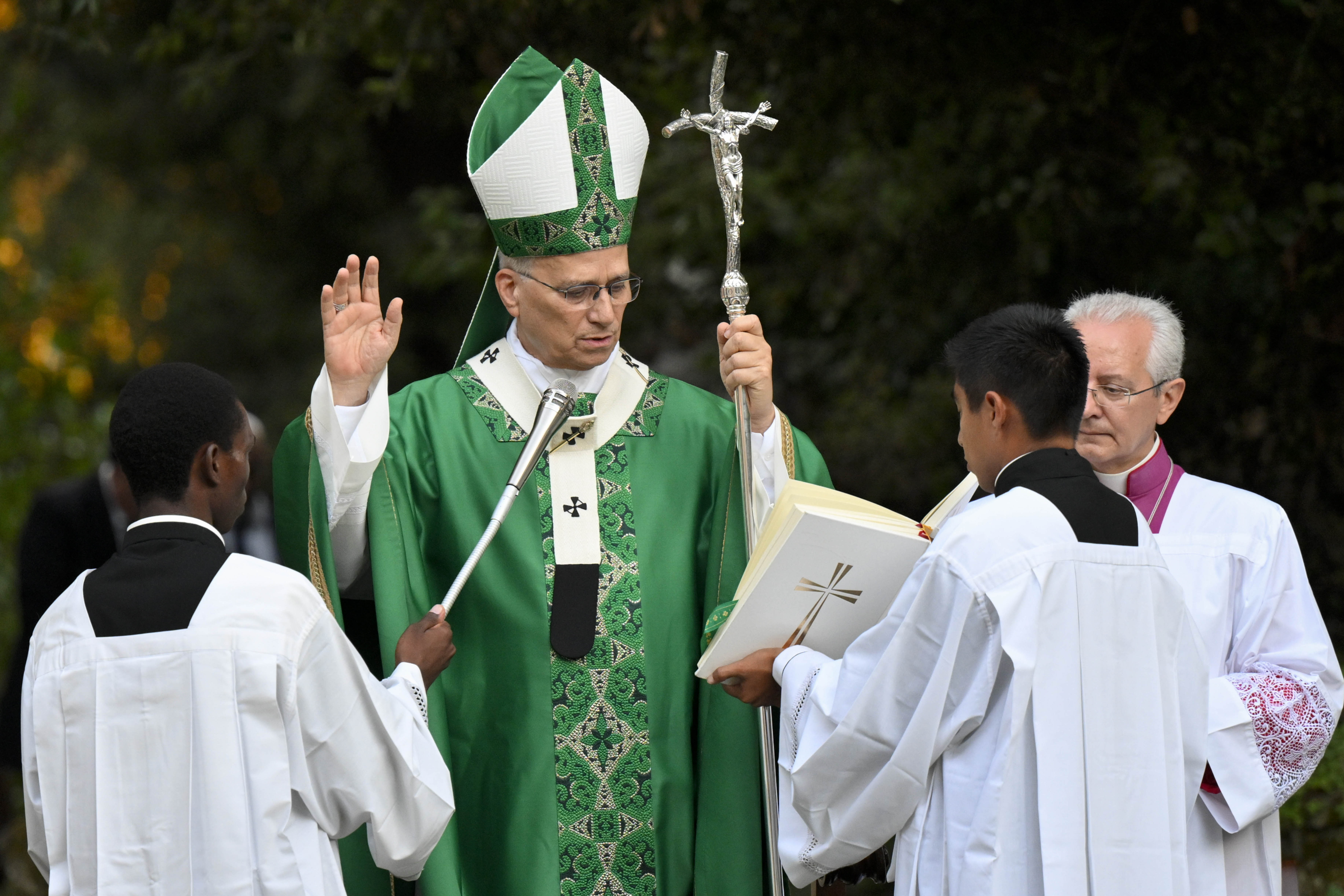
Each Ash Wednesday, dozens of people crowd the doors of the Church of Sant'Anselmo, perched on the Aventine — one of Rome's seven hills — to witness the penitential procession that moves solemnly along the roughly 200 meters (656 feet) separating it from Santa Sabina.

This year, the tradition of the Station Churches, rooted in the first centuries of Christianity, takes on special significance: It will be the first time Pope Leo XIV presides over it.

It lasts less than five minutes, but it is not a mere ceremonial transfer. The short route liturgically marks the beginning of Lent and underscores the Aventine's strong monastic presence: the Benedictines at Sant'Anselmo and the Dominicans at Santa Sabina.

"The penitential character of Lent allows us to explore the spiritual dimension of these centuries-old stational liturgies. Lent is marked by themes of baptism and conversion: reorienting our lives toward Christ, making his life fruitful in ours, and striving to imitate him," Father Stefan Geiger, president of the Pontifical Liturgical Institute, told EWTN News.

Martyrs as models of life

Along that path, martyrs occupy a privileged place because, Geiger said, they "serve as exceptional models of this way of life."

"The method of the early Church was not based on theoretical instruction but on the concrete example of a life lived for Christ, offering an invitation to realign one's life completely with him," he added.

Santa Sabina's role as the destination is no accident. It is a "Station Church," a key concept in the Roman Church's tradition.

"It is the church the pope goes to on a specific occasion to celebrate the liturgy with the faithful," the Benedictine priest explained.

The practice goes back to the early Church, when Christianity began organizing public worship in Rome. After the Edict of Milan in 313, when the emperor Constantine granted freedom of worship, Christian communities grew quickly, leading to a multiplication of places for Sunday celebrations known as "tituli" — early parish-like churches.

"These 'titular churches' represented their respective parishes, dividing the growing number of faithful into smaller units," Geiger said.

But this expansion in urban contexts posed a theological and pastoral challenge, he said: "From very early on, there was concern about how to maintain and visibly express the unity of the local Church. At that time, the ideal of the local Church was still the community gathered around its bishop. However, this became increasingly difficult to sustain, especially in urban settings, and it threatened to obscure visible unity."

Stational liturgies arose in the fourth century

In that context, stational liturgies emerged in the fourth century as a tangible sign of ecclesial communion. The pope, as bishop of Rome, would regularly "station" at a specific titular church, preside over the liturgy there, and in doing so confer upon it a "precedence over other liturgies," Geiger explained.

A century later, the Roman tradition added a decisive element: the penitential procession.

"In the fifth century, a uniquely Roman custom developed: a penitential procession toward the stational church, which began at a gathering church — the 'collecta' — where penitential antiphons and the Litany of the Saints were sung," he said.

The route culminated in a triple invocation of the "Kyrie eleison" ("Lord, have mercy") — one of Christianity's oldest and most fundamental liturgical prayers — and an intense silent prayer before the altar, during which clergy prostrated themselves.

"It is a gesture we still see today in the liturgy of Good Friday. The procession concluded with a silent prayer and a prostration of the clergy before the final prayer, since the Kyrie had been sung during the litanies," he added.

From medieval solemnity to modern eclipse

During the early Middle Ages, this pattern was adopted and enriched with an ever more solemn ceremonial.

"The pope traveled on horseback from St. John Lateran — then the papal residence — and was received ceremonially at the Station Church, vested in liturgical garments. Then he entered the church accompanied by acolytes carrying seven torches, and only then did the celebration begin," Geiger recalled.

At the end of the liturgy, the deacon solemnly announced the next Station Church and, if applicable, the church of the collecta, to which the faithful responded with "Deo gratias."

Over time, however, the tradition weakened. During the period when seven popes resided in Avignon, France (1309–1377), it virtually disappeared from Rome.

After the capture of Rome in 1870 — the final milestone of the Italian Risorgimento, when troops of the Kingdom of Italy breached the Aurelian Walls near Porta Pia — stational liturgies were officially prohibited in 1870 as part of a general decree banning all processions.

Contemporary recovery

The revival of the tradition came after the Lateran Pacts, the 1929 concordat defining civil and religious relations between the government and the Church in Italy.

The Pontifical Academy of Martyrs — which seeks to keep alive the legacy of the early witnesses of the Christian faith — promoted the restoration of stational liturgies, especially through its first director, Carlo Respighi.

"Even today, the academy is responsible for overseeing these celebrations, and its website lists the Station Churches of Lent," Geiger said.

In any case, the president of the Pontifical Liturgical Institute noted that today the pope generally presides over only two stational liturgies: Ash Wednesday at Santa Sabina and Holy Thursday at St. John Lateran.

"Before the liturgical reform, the Missal listed about 89 stational liturgies in 42 Station Churches. The origins of each of the 'titular churches' are no longer known, but they are closely linked to the martyrs, who have a special significance in the memory of the city of Rome," he said.

As every year, the Benedictine community of Sant'Anselmo is preparing carefully for the event. The occasion takes on added meaning as it will be the pontiff's second visit there during his first year in office: The monks previously welcomed Leo XIV on Nov. 11, 2025, on the feast of their church's dedication.

This story was first published by ACI Prensa, the Spanish-language sister service of EWTN News. It has been translated and adapted by EWTN News English.
Full Article

The behind-the-scenes series can be seen on EWTN+, EWTN.com, EWTN's YouTube Channel, and on EWTN's broadcast channel.

After making its way across Europe where over 400,000 people viewed it, "Bernadette, The Musical" is making its debut in the U.S. on Feb. 19 at Chicago's Athenaeum Center for Thought and Culture.

Ahead of the musical's U.S. premiere, EWTN Studios announced a partnership with Castletown Media to release an exclusive four-part series, "Bernadette, The Musical: Miracle in the Making," telling the behind-the-scenes story of how the original French production was adapted for U.S. audiences.

The musical tells the true story of St. Bernadette Soubirous of Lourdes — the 14-year-old girl who, in 1858 in Lourdes, France, encountered a series of apparitions believed to be the Blessed Virgin Mary.

The behind-the-scenes series takes viewers through performers' auditions, rehearsals, and spiritual reflections that helped the cast portray the true story of Bernadette. The series also dives into how the production was adapted for an American audience — including the creative choices, artistic collaboration, and translation decisions.

"Being part of a project like 'Bernadette, The Musical' allows us to bridge the profound beauty of live theatrical expression with the boundless reach of digital storytelling. It's a reminder that art in all its forms — physical and digital — connects humanity through story, wonder, and shared experience," said Peter Gagnon, president of EWTN Studios, in a press release.

Pierre Ferragu, lead producer of the musical, added: "Our collaboration with EWTN Studios brings this extraordinary story to life for a global audience, opening access for those who are unable to attend in Chicago while honoring the musical's emotional and artistic integrity."

The first episode of "Bernadette, The Musical: Miracle in the Making" made its debut on EWTN's streaming platform EWTN+ on Feb. 11, the feast of Our Lady of Lourdes, and is now available on EWTN+, EWTN's YouTube channel, and ewtn.com. The series broadcasts on the EWTN channel on cable and satellite March 3 through March 6 at 5:30 p.m. ET.

In an interview with EWTN News, Ferragu shared that he hopes that by telling this story it's "opening a door to anyone on a path of conversion — be it for very faithful, very devout and practicing Catholics, or people who are not religious at all."

"I hope everybody will take that story and explore that path of 'Here is the story of Bernadette. What do I take from it? Did she lie? Did she tell the truth? What did she really see? What does that mean to me?' And hopefully by bringing that story to the audience, we can plant a seed in every heart."

Full Article

Cardinal Pietro Parolin, Vatican secretary of state, announced that the Holy See "will not participate in the Board of Peace," promoted by the U.S. president to address Gaza and other conflicts.

Cardinal Pietro Parolin, Vatican secretary of state, announced on Feb. 17 that the Holy See "will not participate in the Board of Peace," an initiative promoted by U.S. President Donald Trump to address various conflicts around the world, such as the one in Gaza.

The Holy See "will not participate in the Board of Peace due to its particular nature, which is clearly not that of other states," the cardinal told reporters after a meeting in Rome with the Italian government at Palazzo Borromeo on the occasion of the anniversary of the Lateran Pacts, which in 1929 recognized the sovereignty of Vatican City State.

When asked about Italy's participation as an observer on the Board of Peace, Parolin stated: "There are some points that leave one somewhat perplexed. There are critical points that need to be explained."

"The important thing is that an attempt is being made to provide an answer. However, for us, there are some critical issues that need to be resolved," the cardinal said, according to Vatican News, adding that "one concern is that, at the international level, it is primarily the U.N. [United Nations] that manages these crisis situations. This is one of the points on which we have emphasized."

On Jan. 21, Parolin had told reporters that the Vatican was evaluating whether or not to participate in Trump's Board of Peace, a question that has now been decided.

Trump's Peace Board seeks to address global conflicts, with a particular focus on the Gaza Strip, as an independent body separate from the United Nations. More than 25 countries have announced their participation, including Argentina, El Salvador, Paraguay, Belarus, Bulgaria, the United Arab Emirates, Hungary, Egypt, and Morocco.

Parolin also spoke on Feb. 17 about the war in Ukraine, saying that "there is great pessimism," since "neither side seems to have made any real progress toward peace, and it is tragic that after four years we are still at this point."

This story was first published by ACI Prensa, the Spanish-language sister service of EWTN News. It has been translated and adapted by EWTN News English.
Full Article

"In stepping back from digital excess, we reclaim interior silence, deepen relationships, and rediscover God's presence in daily life," the Catholic Bishops' Conference of the Philippines said.

The Catholic Bishops' Conference of the Philippines has issued guidance for Catholics to go beyond fasting from food this Lent by committing to a fast from social media.

"In our present time, fasting must also address the new realities shaping human life. One of the greatest influences today is digital media," said the Feb. 13 pastoral message from Archbishop Gilbert A. Garcera of Lipa, president of the Catholic Bishops' Conference of the Philippines. "Thus, we invite the faithful to undertake a digital media fasting as a contemporary expression of conversion and renewal."

The pastoral message delivered on behalf of the conference came before Ash Wednesday on Feb. 18, which will mark the start of Lent.

The message noted fasting has historically meant abstinence from food, "an act of repentance and spiritual focus." However, the bishops pointed out that engagement with social media, and other forms of online entertainment, serves as a significant source of distraction in today's context that "weakens our interior life."

"True fasting, as Jesus teaches, is not an external performance but an interior conversion," the bishops said. "Digital media fasting, therefore, invites a rediscovery of silence, prayer, contemplation, and authentic relationships. It is not meant to punish the body but to free the heart."

The bishops offered practical ways to carry out a social media fast this Lent, such as avoiding phone use before waking up and going to sleep, limiting screen time, observing 24-hour and weekend fasts, and replacing screen time with prayer, service, reading, or conversation.

"Digital media fasting is not anti-technology," the letter said. "Rather, it asks: How can Christ guide our use of media?"

The bishops stressed the need to approach Lent joyfully, and "not with gloomy faces," noting the fruit of fasting from screen time is a closer relationship with God, greater mental clarity and focus, and renewed appreciation for creation at large.

"In stepping back from digital excess, we reclaim interior silence, deepen relationships, and rediscover God's presence in daily life," the letter concluded. "Entrusting this pastoral invitation to the intercession of Mary, Mother of the Church, we encourage all dioceses, parishes, families, and communities to promote media fasting during Lent and beyond."

Full Article

The longtime activist was a fixture in U.S. politics for decades, including two presidential runs.

Jesse Jackson, whose decades of activism included work in the Civil Rights Movement, two runs for the White House, and multiple meetings with Pope John Paul II, died on Feb. 17. He was 84 years old.

His family announced his passing in a statement on social media. They described him as a "servant leader" with an "unwavering belief in justice, equality, and love." Jackson had suffered health issues for several years, including a diagnosis of Parkinson's disease in 2017.

Born Jesse Burns in Greenville, South Carolina, on Oct. 8, 1941, Jackson was adopted by his mother Helen's subsequent husband Charles Jackson, though he maintained a close relationship with his birth father, Noah Robinson.

Taunts from local children about his out-of-wedlock birth reportedly instilled in Jackson a motive to succeed; he further cited his biological father's example of a "strong healthy ego" and "sense of dignity" that led him to push for civil rights in what was then the heavily segregated Southern U.S.

He was a member of the "Greenville Eight" who protested the city's segregated library system in 1960. A protege of Martin Luther King Jr., he participated in the Selma-to-Montgomery marches and played early roles in the Southern Christian Leadership Conference. Jackson was present at King's assassination at the Lorraine Motel in Memphis on April 4, 1968.

He founded the social justice organization Operation PUSH — now Rainbow/PUSH — in 1971. He would eventually mount two campaigns for U.S. president, one in 1984 and one in 1988, both of which he lost.

Earlier in his career Jackson had been an outspoken pro-life advocate, at one point even endorsing amending the U.S. Constitution to ban abortion, though in later decades he would pivot to aggressive support of abortion.

He met with Pope John Paul II on three separate occasions in the 1980s and 1990s. In 1982 he urged the pontiff to advocate on behalf of Haitian refugees in the U.S., describing John Paul II as "the dominant force and moral authority in the world" at the time.

He met with the pope again in 1985 and reportedly asked him to visit South Africa to protest apartheid, and again a third time in 1999 to urge the pontiff to advocate on behalf of three imprisoned CARE humanitarian workers in a Belgrade prison.

Jackson is survived by his wife of 64 years, Jacqueline Lavinia Brown, and their five children. He is also survived by a daughter, Ashley, born to one of his former staffers in 1999.

In a famed speech at the 1984 Democratic National Convention in San Francisco, Jackson reflected on his political career and acknowledged that he was "not a perfect servant" but "a public servant doing my best against the odds." He told the crowd: "As I develop and serve, be patient: God is not finished with me yet."

"For leaders, the pain is often intense," he said at the time. "But you must smile through your tears and keep moving with the faith that there is a brighter side somewhere."

Full Article

Bad Bunny's halftime show at Super Bowl LX drew mixed reactions. For some, it was a Latino triumph while for others it contained obscene lyrics that did not represent the best of Latin America.

Bad Bunny's halftime show at Super Bowl LX drew mixed reactions. For some, it was a Hispanic or Latin American triumph with nothing objectionable, while for others, it was a spectacle with obscene lyrics and dances that did not represent the best of Latin America.

In an interview with EWTN News, Father Mario Arroyo, who holds a doctorate in philosophy from the Pontifical University of the Holy Cross in Rome, observed that the event was the setting for a "political message" in which Bad Bunny asserted "that the United States is a multicultural nation" with some 70 million Latinos.

According to various sources, the Puerto Rican artist chose his stage name based on a photo of himself when he was a boy in a bunny outfit with an angry look on his face.

"That is also a political message that confronts the political agenda of current President Donald Trump," Arroyo added.

The priest considered the show an expression of "the Latino community in the United States that has felt harassed by the measures taken by the U.S. administration," sparking protests against violent raids by Immigration and Customs Enforcement (ICE).

In separate incidents last month, ICE agents killed two people in Minneapolis, Renee Good and Alex Pretti. ICE raids led to the arrest of some 400,000 people in 2025, of whom less than 14% had violent criminal records, according to CBS News.

When Bad Bunny received the Grammy Award for Best Urban Music Album on Feb. 2 for "Debí tirar más fotos" ("I should have taken more photos"), he began his acceptance speech by saying "ICE out."

It's not Latin America's 'best act'

After clarifying that he is not a fan of Bad Bunny or reggaeton, because it is "a style of music that sexualizes women a lot" and degrades "human behavior," Arroyo lamented that the artist's show was not Latin America's "best act" but rather a "vulgar spectacle wIth nothing uplifting about it."

The priest noted that "there is a moral principle that says the end does not justify the means; it's a basic principle," even though Bad Bunny's intention was "to send a positive message," highlighting various images of Puerto Rico and Latin America.

Super Bowl LX, in which the Seattle Seahawks defeated the New England Patriots at Levi's Stadium in Santa Clara, California, on Sunday, Feb. 8, was the second most-watched in history, surpassed only by the 2025 game, according to data by the Nielsen audience ratings company.

As for the halftime show, according to Nielsen, the average viewership was 128.2 million, more than seven million fewer than last year's Kendrick Lamar show, which averaged 133.5 million viewers.

In addition to Bad Bunny, the show featured Lady Gaga and Ricky Martin, along with other celebrities who appeared during the performance, such as actors Jessica Alba and Pedro Pascal, and singer Karol G.

"I think the goal of the NFL is more economic than political: to broaden the spectrum of people who enjoy and are interested in American football," Arroyo told EWTN News.

President of the Puerto Rican Bishops' Conference weighs in

Bishop Eusebio Ramos of Caguas, president of the Puerto Rican Bishops' Conference, also spoke out about the show.

"Certainly, one can have something to say about the musical genre, and I clearly state that I am not expressing my support for it but hearing the voice of a young man who prioritizes a language of love fills us with joy," Ramos told the Italian news agency SIR.

"There is no doubt that the words of Benito, of this singer, have touched hearts, have reminded us of Christian values, such as fraternity and the primacy of love," the prelate added, referring to Bad Bunny, whose real name is Benito Antonio Martínez Ocasio.

Ramos said that "it gives us hope to hear the message of someone who, at this moment when the world order has broken down in so many ways, calls for tearing down walls, challenging the collective conscience."

After commenting that Bad Bunny "has his own political vision," the Puerto Rican bishop emphasized that "he is undoubtedly a voice that reminds us of the value of the dignity of every human being, who must be respected. The current wave of deportations, on the contrary, disregards that dignity."

Regarding the political situation of Puerto Rico, a territory of the United States whose people are American citizens but lack voting representation in the U.S. government, the bishop commented that "for 125 years we have suffered, in practice, colonialism. The United States is the superior interlocutor; we, the Puerto Ricans, are at an inferior level. An unjust relationship, tainted by sin. But Puerto Rico has survived, has kept its identity and culture alive."

Regarding President Donald Trump's critical reaction to Bad Bunny's performance, the bishop said: "I wasn't surprised; it's his style." The U.S. president called the halftime show "absolutely terrible, one of the worst ever!" and also said on Truth Social that "nobody understands a word this guy is saying and the dancing is disgusting."

'Not all success has value,' Puerto Rican senator says

Puerto Rican independent and pro-life senator Joanne Rodríguez-Veve, a mother of two, also commented on her compatriot's performance.

"I believe Bad Bunny is not a musical phenomenon but a political phenomenon within the culture," she told ACI Prensa, the Spanish-language sister service of EWTN News. "His message, with its clear woke undertones, made him an icon of the cultural left," she added.

After commenting that "there is no doubt that Bad Bunny is not alone" and that there are many economic interests surrounding him, Rodríguez said that, "ironically, Bad Bunny, the favorite son of capitalism — an economic platform without which he would not have achieved his much-venerated personal success — is the new idol of the political left. It turns out that, when it suits them, capitalist success is good."

After acknowledging that "Bad Bunny's achievements are undeniable," such as his Grammy Awards and his Super Bowl halftime performance, the senator clarified that "we would fall short in our capacity for reflection if the value of something or someone were measured solely by success. Success in saying what? Success in promoting what? Success in exhibiting what? No, not all success has value. That's the point."

"As a Puerto Rican woman, I do not feel represented by anyone who objectifies women and portrays us to the world as animals at a bacchanal," the senator emphasized.

"He can wave the single-starred [Puerto Rican] flag" and "sing about what happened to Hawaii in Hawaii (loss of native cultural identity and heritage), and it won't be enough. Because," she pointed out, "Puerto Rican identity is simplicity and bravery, but it is also the elegance of the jíbaro [traditional peasant], the mother who gives birth to the homeland, the hardworking family, the children who await the Three Kings, and knees bent before God," she maintained.

Junk food isn't the best for the soul

Arroyo also drew attention to the stark contrast between Bad Bunny's Super Bowl performance and the recent opening ceremony of the Milan Cortina 2026 Winter Olympics, where Andrea Bocelli and Laura Pausini sang: "It was a show of great human and cultural quality … and of course, an artistic level infinitely superior to Bad Bunny's music, which, in my opinion, is garbage."

"That Olympics show was watched by only 21 million people. That is to say, more than six times as many people watched the Super Bowl," he lamented, adding that it seems people prefer to feed their soul with "junk food."

The priest encouraged teaching children "to be discerning" about what they see and to "critically evaluate what they are communicating to us and try to understand what they want communicated and what the underlying intentions are."

This story was first published by ACI Prensa, the Spanish-language sister service of EWTN News. It has been translated and adapted by EWTN News English.

Full Article

The Vatican will open new parts of St. Peter's — including the full terrace — and roll out a "SmartPass" digital entry system as it marks the basilica's 400th anniversary.

As the Basilica of St. Peter approaches the 400th anniversary of its consecration, the Vatican has announced a slate of liturgical and cultural initiatives — including opening parts of the basilica complex that have never been accessible to the public and rolling out a new digital entry system designed to better manage crowds.

St. Peter's Basilica was consecrated on Nov. 18, 1626, by Pope Urban VIII. Vatican officials presented the anniversary program on Monday, highlighting plans intended to ease visitor pressure inside the basilica while improving security and preserving an atmosphere of prayer.

"We want to lighten the weight of the crowds in the basilica and foster deeper spiritual recollection," said Cardinal Mauro Gambetti, archpriest of St. Peter's Basilica, "while at the same time offering new spaces to get to know St. Peter better through themed itineraries."

Among the most significant measures is the opening of the entire terrace of the basilica to visitors; currently, only about one-third is accessible. The newly opened terrace areas will feature a permanent exhibition on the history, construction, and ongoing maintenance of St. Peter's.

Gambetti also said the restoration area currently located on the terrace will be reconfigured and expanded. The space will double and continue to be managed by the Fabric of St. Peter, he said, totaling about 100 square meters (roughly 1,075 square feet) and moving to the opposite side from its current location.

The Vatican also foresees the future opening of the large galleries of the Gregorian and Clementine domes, with educational proposals designed especially for children and young people.

To improve crowd management, officials announced a new digital access system — SmartPass — integrated into the basilica's official website, along with a network of sensors to monitor visitor presence in real time and enhance security.

Gambetti described the initiative as a new "ecosystem" meant to safeguard the basilica's sacred character while welcoming the millions of pilgrims and tourists who continue to come to the heart of Christianity.

A look 'beyond the visible'

The cardinal stressed that the anniversary is not being treated merely as a historical commemoration but as an opportunity to renew the basilica's spiritual meaning.

Built over the remains of the original Constantinian basilica, the current church stands as "the living memory of our faith in Jesus Christ, supported by Peter's profession of faith," Gambetti said, calling it "at the same time a door open to all who seek God." He also recalled the transition from the earlier basilica to the present one, promoted by Pope Julius II during the Renaissance.

Gambetti pointed as well to the collaboration of the Italian energy company Eni, which is supporting conservation and "enhancement" projects tied to the anniversary.

Program of events

The spiritual program begins Feb. 20 with the inauguration of a new permanent Stations of the Cross inside the basilica, created by Swiss artist Manuel Durr, winner of an international competition launched in 2023.

On Saturday afternoons, the basilica will also host brief 30-minute "spiritual elevations" featuring prayer and polyphonic chant for those present.

Three "solemn pastoral lectures" — historical-cultural, theological-liturgical, and pastoral-spiritual — are planned for March 24, May 26, and Oct. 13 on the meaning of the basilica's dedication. A spiritual meditation on St. Peter in light of the Gospel will be given by the preacher of the Papal Household, Father Roberto Pasolini, OFM Cap.

Additional initiatives include the urban itinerary "Quo Vadis," tracing the footsteps of Sts. Peter and Paul through Rome, and the theatrical production "Pietro e Paolo a Roma" by Michele Aginestra, planned around the June 29 feast of the apostles.

The celebrations are set to culminate Nov. 18 with a solemn Mass to be celebrated by Pope Leo XIV on the exact 400th anniversary of the basilica's consecration.

Eni's technical work

During the presentation, Eni executive Claudio Granata said the company's technical work for St. Peter's has involved an 18-month process, much of it devoted to study and planning. He recalled Eni's earlier restoration of the basilica façade beginning in 1999 — the first deep cleaning since architect Carlo Maderno completed it in 1612.

This time, Granata said, the scale is larger: Measurements were carried out across approximately 80,000 square meters, covering the entire basilica, including outer areas. The analysis includes visible surfaces — such as the façade, columns, and roofs — as well as "invisible" elements like the foundations, resulting in a permanent monitoring system and a comprehensive digital model.

Eni research and development director Annalisa Muccioli said the project was guided by respect for the basilica's historical, artistic, and spiritual character. The effort included 4,500 work hours across day and night shifts, as well as extensive historical study and technical documentation. Using techniques intended to "see without altering," she said the team employed methods such as geophysical investigations, laser scanning, and advanced photogrammetry.

Muccioli described the result as a dynamic model integrating architectural geometry, subsurface geology, and real-time data — a tool meant to support the Fabric of St. Peter in future conservation and planning.

This story was first published by ACI Prensa, the Spanish-language sister service of EWTN News. It has been translated and adapted by EWTN News English.

Full Article

To mark Temperance Sunday and the Lenten season, Armagh Archdiocese Auxiliary Bishop Michael Router welcomed the rewording of Ireland's traditional Confirmation Pledge.

To mark Temperance Sunday and the Lenten season, Armagh Archdiocese Auxiliary Bishop Michael Router welcomed the rewording of Ireland's traditional Confirmation Pledge to explicitly include vaping and cigarette smoking. The renewal comes directly from feedback from school pupils to the Irish Bishops' Drugs Initiative.

Router, who is liaison bishop with the Irish Bishops' Drugs Initiative, said in his Feb. 15 Temperance Sunday message: "I warmly welcome the rewording of the Confirmation Pledge to explicitly include vaping and cigarette smoking, alongside alcohol and illicit drugs. This development reflects a thoughtful and prayerful response to the lived realities of young people today."

In Ireland, the pledge has been a feature of confirmation since the 1930s. Every year, around 40,000 young people receive the sacrament of confirmation. The news of the pledge renewal has attracted mainstream media interest in Ireland.

Router explained to EWTN News the specific concerns about vaping: "The main impetus would have come from the worsening situation in regards to drugs and alcohol abuse in Ireland over the past number of years. The Irish Bishops' Drugs Initiative facilitator ... goes around to schools and parishes delivering vital education on drugs, particularly. And in his rounds of schools, he was beginning to get questions from students themselves about vapes."

He added: "They were becoming aware of the addictive nature of them and the destructive side effects that were happening. Parents began contacting us as well, looking for information. We had a couple of heartbreaking stories about teenagers who have developed psychosis and depression and even suicidal ideation as a result of using some of these vapes."

As a result of these concerns, the Irish Bishops' Drugs Initiative was instrumental, along with other bodies, in having the vaping substance hexahydrocannabinol (HHC) banned in Ireland.

Router explained to EWTN News that the pledge came into being in Ireland because of the widespread abuse of alcohol in the 19th century and the early 20th century.

"It was formally linked with confirmation from the 1930s onwards, and it was very successful in countering alcohol abuse. We wanted to relaunch the pledge because it had fallen into abeyance a little bit across the country. We wanted to give it a new push and to add in things that are answering some of the challenges that young people have today."

The bishop said in his Temperance Sunday message: "The renewed Confirmation Pledge ensures that this long-standing tradition remains relevant and meaningful. It offers young people a moral framework and spiritual support as they navigate adolescence, while situating personal choice within the wider context of family, faith, and community. Addiction thrives in isolation. By involving families, schools, parishes, and the wider faith community, the pledge becomes a shared commitment to support and hope."

Router stressed to EWTN News the importance of education and understanding for young people to respond meaningfully to substance misuse. 

"Education is hugely important. Drug use is everywhere. It's in every small village, in every rural area, in every city, and in every town in the country. And it's so easy to access. We have a module for schools and parishes to educate young people at that age about the dangers involved."

He explained that this education program is open to all, whether they intend to take the pledge or indeed are being confirmed or not.

Router highlighted in the wording of the pledge the importance of family support and positive peer pressure: "The new wording of the pledge says I will listen to you and respect my parents and guardians who care for me and want to keep me safe. I will support my friends and peers in making good and healthy choices too."

In his message, Router invited the faithful in Ireland to pray for those who struggle with addiction, to support families and communities affected by its consequences, and to renew their commitment to building a culture of care and moderation.

"Addiction, in its many forms, continues to exact a devastating toll on individuals, families, and communities. The human cost, seen in suffering, broken relationships, mental and physical health problems, criminality, and social upheaval, is beyond calculation. Yet the Gospel calls us away from despair and condemnation to compassion and accompaniment."

Router told EWTN News that with other countries experiencing similar drugs, substance and alcohol abuse, the pledge in Ireland could inspire other initiatives.

"I think other countries definitely could learn from that, and it might be a moment to educate. This is a moment when young people take it seriously and are willing to listen to the issues and whatever information you have to offer. Couple that with the gifts of the Holy Spirit that they receive, you have a real opportunity to make an impression that we pray will stay with them through their adolescent years."

Router pointed to the historic work of the Pioneer Total Abstinence organization in promoting temperance in Ireland. "Huge numbers of people became members of the Pioneer Total Abstinence Association from the '30s into the '70s and I think a lot of that was to do with the pledge. It's been kind of neglected a little bit in recent decades. Hopefully, with a new focus on it and a wider reach, it may help to counter the problems we are facing at the moment."

Here is the new wording of the Confirmation Pledge:

Dear God,

Because I want to live a good and happy life with you,

I promise not to drink alcohol until I am at least 18 years of age.

Help me not to use drugs, vapes, cigarettes,

or anything that could harm my body or mind.

I will listen to and respect my parents and guardians,

who care for me and want to keep me safe.

I will support my friends and peers in making good and healthy choices too.

O Holy Spirit, give me the strength, courage, and joy to keep this promise every day.

Amen.

Full Article

Facebook Twitter Instagram YouTube Soundcloud

Public Inspection File | EEO

© 2015 - 2021 Spirit FM 90.5 - All Rights Reserved.