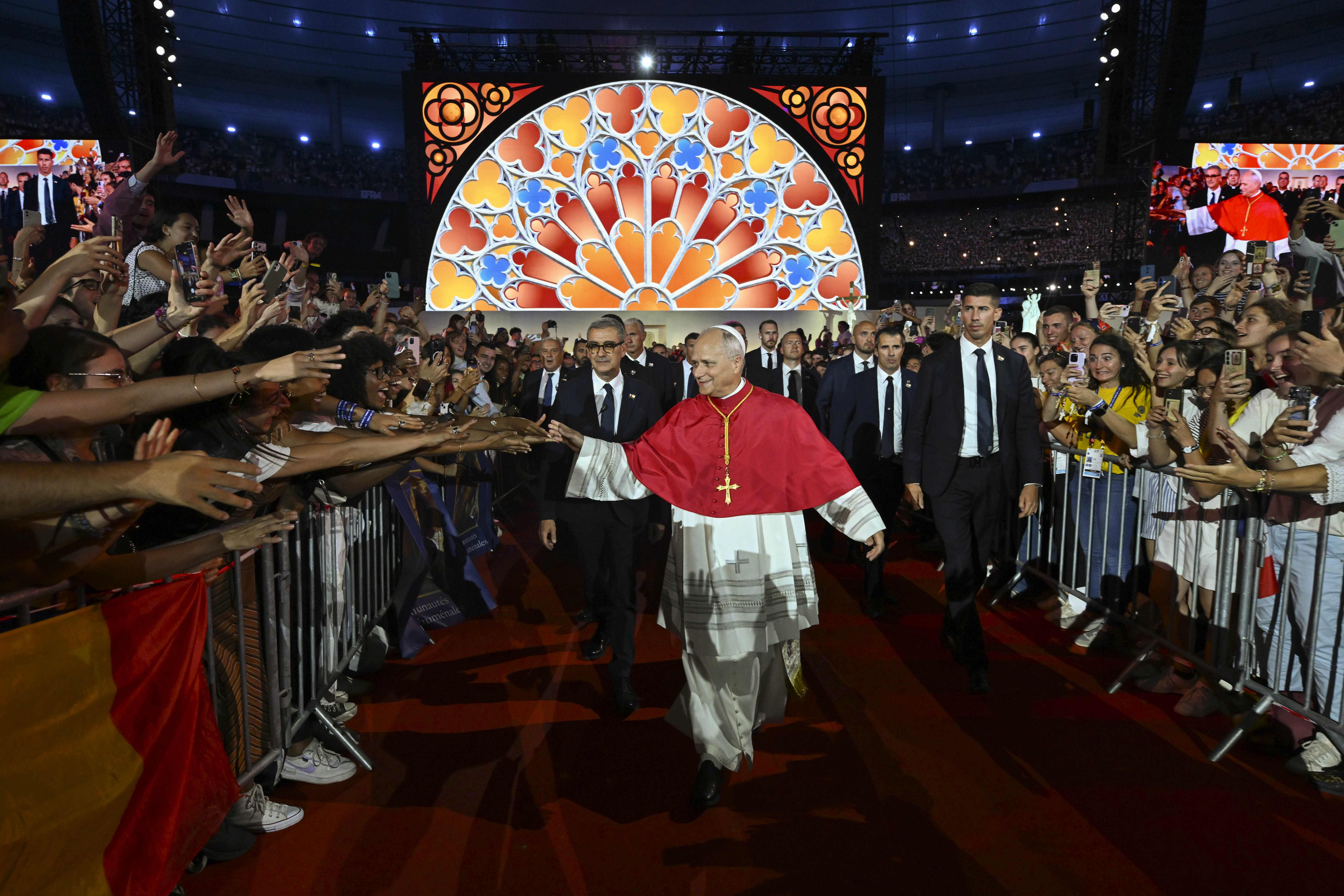
Leo visited a center offering support and integration to immigrants in the Archdiocese of Paris, on the second day of his Sept. 25-28 journey in France.
PARIS — Pope Leo XIV listened to the stories of faith and hope of two migrants to France at an integration center in the Paris archdiocese on Saturday.
France is one of the European countries with the highest influx of immigrants — a highly divisive political issue that is also tied to next year's presidential election, with anti-immigration politician Marine Le Pen the current front-runner.
Roughly 8 million immigrants live in France, representing 11.6% of France's total population in 2025, according to the French national statistics institute.
Leo visited the Bakhita House, a center offering support and integration to immigrants in the Archdiocese of Paris. The pope's visit falls on the fifth anniversary of the center, which offers educational workshops in sewing, cooking, visual arts, and computer skills.
Named for St. Josephine Bakhita — a child victim of abduction and slavery from Sudan — the day home has welcomed 2,500 people of 84 different nationalities since opening its doors in late September 2021. It is run by five permanent staff members and 100 volunteers.
"The name of your center … which refers to St. Bakhita, inspires us to recognize the fundamental role of women in building a civilization of love, which is an alternative to a culture that tears communities apart and leaves cities sick with loneliness," the pope said Sept. 26.
The pope heard from a 31-year-old Nigerian woman named Blessing, who described the way her life has changed since receiving the help and friendship of the association Aux Captifs, la Libération, a Catholic charitable organization that helps the homeless and people in situations of prostitution.
Blessing described a complicated life in which she "was forced to do things I did not want to do." But through the assistance she received, she left that life behind and began to work in a restaurant.
"God has an important place in my life. Without God, nothing is possible," she said. "Even through the difficulties I have experienced, I never doubted his presence, and I knew that one day he would open a new path for me. Sometimes I wish God could erase everything like a magician, but I know that he will do everything in his own time."
The pope also heard from 35-year-old Meysam, a refugee from Afghanistan. Through Bakhita House, he was able to improve his French and his sewing skills. He is now a volunteer with the house: "I go on two street outreaches each week to meet undocumented exiles and refugees. It is a way of giving back what I myself received."
Pope Leo thanked everyone who works at the center, "as well as all those throughout France who carry out this service in similar institutions."
"Continue to bear witness to that care for one another which, through fraternal welcome, programs of formation, and dialogue with the city, elevates the spirit and makes the world more humane," he said.
"May St. Bakhita, together with the great witnesses of charity who have shaped the presence of the Church in France, especially during periods of tumultuous change, intercede on your behalf."
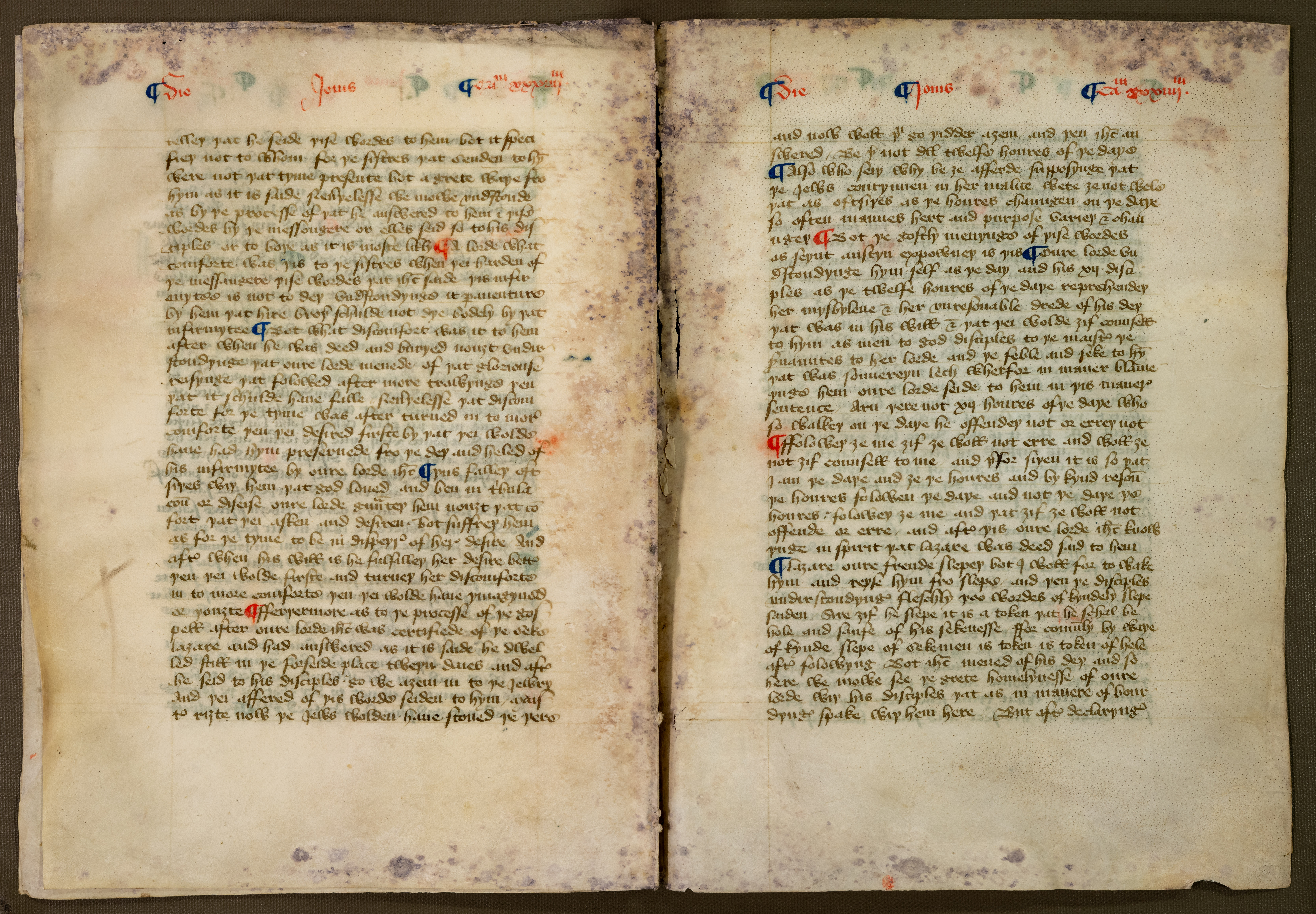
An incomplete manuscript of "The Mirror of the Blessed Life of Christ" has been reconnected with several long-lost pages thanks to work by two English researchers.
Not many literary works in medieval Europe could lay claim to the status of "bestseller." Among them was "The Mirror of the Blessed Life of Christ."
That text, which was translated by English monk Nicholas Love from a 14th-century devotional work, enjoyed immense popularity among English Catholics in the years leading up to the Reformation; a few hundred surviving manuscripts attest to the public's love of the book.
One incomplete manuscript of the work, meanwhile, has finally been reunited with several long-lost pages thanks to recent work by English researchers Katie Walter and James Wade.
The two professors, who teach at the University of Sussex and Girton College at the University of Cambridge, respectively, recently published their findings in the journal Notes and Queries in which they detailed what Wade described as their successful effort to "piece together the history" of the manuscript.
Wade told EWTN News that it was known for years that the East Sussex public records office held fragments of a "Mirror" manuscript, though "no one knew where."
Pages 8-9 of the "Keep Fragment," showing thread binding, from Chapter 34, depicting an account of the raising of Lazarus. | Credit: Courtesy of the Trustees of the Firle Estate Settlement and the University of Sussex
The researchers eventually identified the manuscript pages in the archive. Further investigation revealed that a fuller "Mirror" manuscript held at the Beinecke Rare Book and Manuscript Library at Yale University was missing those exact pages.
That copy in the Beinecke archive had been known to scholars for years as having been owned by John Gage. A royal courtier in Tudor-era England, Gage's life was "almost cut in half by the English Reformation," Wade said.
"Half of his life he spent as a Catholic who was considered orthodox by the Church and the state," Wade said. "After the Reformation, he remained a Catholic and he didn't convert."
Such individuals were known as "recusants." Wade said that though Gage lived in post-Reformation England the rest of his life, he "refused to convert, he lived his life, didn't go into exile, wasn't executed, and didn't lose his job."
Gage is a notable historic figure, Wade said, in no small part because he worked for the king even as a practicing Catholic.
"There were plenty of people at the time of the Reformation who kept their Catholic faith," the researcher said. "But Gage was an administrator who was tasked with orchestrating the dissolution of the monasteries, which meant physically going into monastic houses and basically claiming all their properties for the Crown."
The "Mirror" manuscript is the only book historians can verify that Gage actually owned, Wade said. It likely came into his possession at the time of the dissolution of the monasteries.
The book would have been seen as heretical in post-Reformation England, as it affirms the validity of numerous sacraments including confession and the Eucharist.
Gage's signature is found in the manuscript, along with the names of two nuns who historians think owned the book prior to it coming into Gage's possession.
The book stands as a testament not just to its popularity during the time of its publication but also to Gage's faith during a period of extraordinary persecution of the Church — a persecution in which Gage himself took some part even as he maintained that faith.
Wade told the University of Cambridge that Gage may have gone to a monastic library and brought the book home. "Another [possibility] is that someone else smuggled it out, and it briefly circulated from hand to hand until Gage acquired it."
"The key thing is," Wade said, "he kept it safe when he was meant to destroy books precisely like this one."
Here is a roundup of recent pro-life and abortion-related news.
Prayer vigils led by the pro-life group 40 Days for Life are underway this week, from Sept. 23 - Nov. 1, across the nation.
40 Days for Life is a pro-life group that leads prayer vigils outside abortion clinics across the U.S. and around the world. The group prioritizes prayer and fasting, nonstop prayer vigils and community outreach. The group's most well-known event is likely their Lenten vigil campaign, but 40 Days for Life operates year-round.
For the current campaign, the group will rally against abortion pills, according to Shawn Carney, President and CEO of 40 Days for Life.
"We are saving more babies from abortion pills than ever before by offering abortion pill reversal," Carney told EWTN News. "We are also going on offense with a national billboard campaign that warns against the abortion pill and offers abortion pill reversal — including in some of the most pro-abortion cities in the country, like San Francisco, Philadelphia, and Boston."
When asked about what inspires people to join 40 Days for Life, Carney highlighted how the group saves lives.
"There is very little you can do in life that will literally save the life of another human being," he said. "There is nothing like it, and it is beautiful to see that it has been done nearly 27,000 times."
"People get involved in 40 Days for Life because it is proven," Carney continued. "It is proven to be peaceful. It is proven to deepen our spiritual lives. And it is proven to save babies."
"We have not only saved babies, but helped their mothers with medical care and follow-up," Carney said. "Former Planned Parenthood workers have said the no-show rate for an abortion appointment can go as high as 75 percent when we are outside praying."
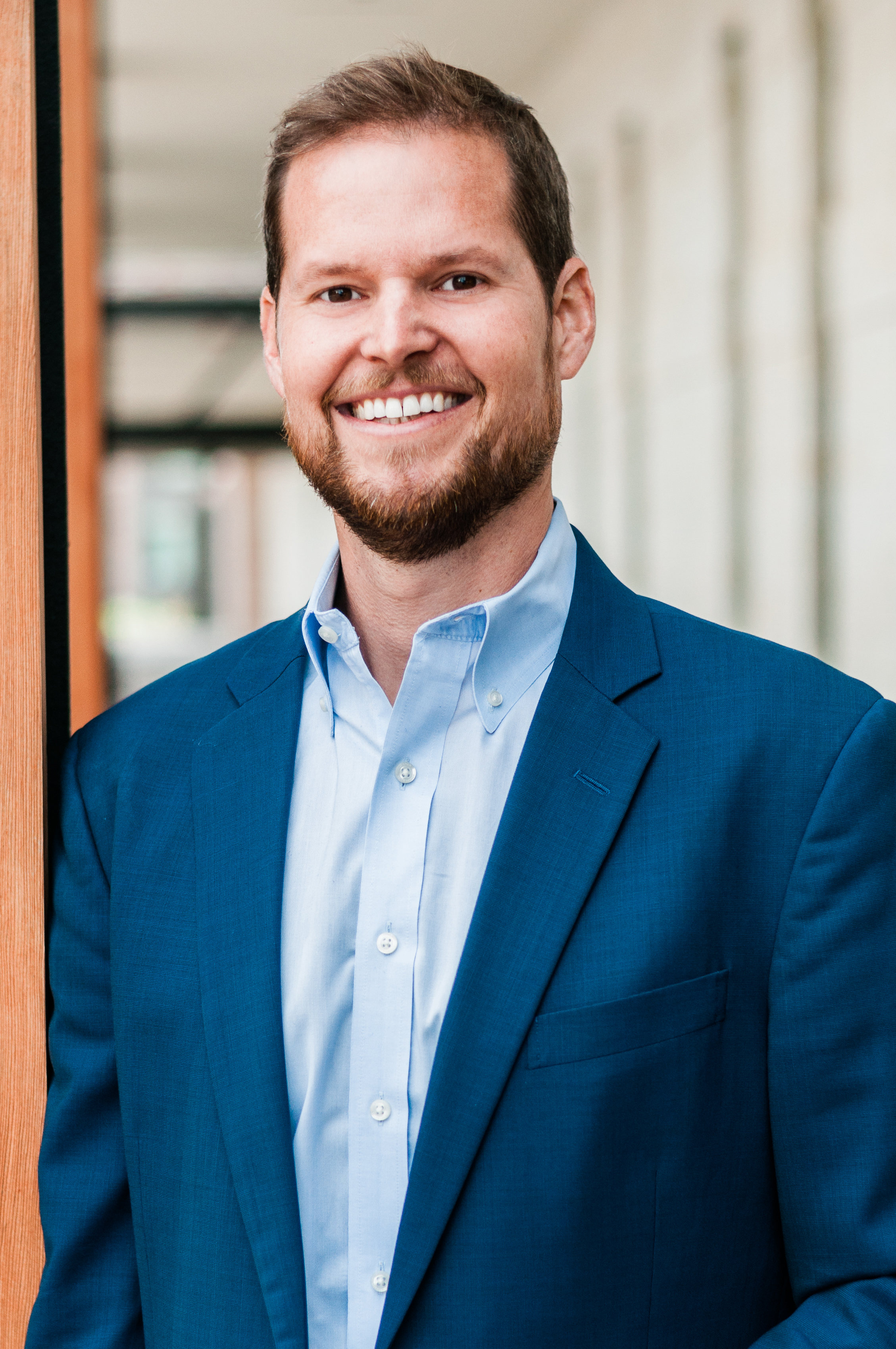
Shawn Carney heads 40 Days for Life, a pro-life group that operates prayer vigils across the nation. | Photo courtesy of 40 Days for Life
Local leaders can volunteer to help lead vigils in their communities.
"One of the most beautiful things about 40 Days for Life is how many babies are born and named after the local 40 Days for Life leader — and in some cases, that local leader becomes the child's godfather or godmother," Carney said.
"It is beautiful, and it is one of the reasons demand for 40 Days for Life is at an all-time high," he said.
Man who poisoned pregnant girlfriend, killing baby, sentenced to six months
An Ohio man, Hassan-James Abbas, was sentenced to six months in prison after he allegedly forced abortion pills into his pregnant girlfriend's mouth in December 2024.
Jona Affholder was hospitalized and ultimately lost her baby.
Pro-life leader Marjorie Dannenfelser spoke out against the short sentence, saying U.S. law is behind on abortion poisonings, in an interview with Fox News Digital.
"The fact that this guy got only six months in prison for his crime says a lot about the state of our culture right now," Dannenfelser said. "This was a very much wanted pregnancy. She could support the baby on her own and didn't need his help. But he had other ideas in mind."
Virginians on both sides of abortion ballot measure raise funds
Abortion advocates have raised over $2.8 million to advocate for an abortion amendment in the state constitution, while opponents of the referendum have raised more than $400,000.
According to the Virginia Public Access Project, so far Virginians for Reproductive Freedom, a group largely funded by Planned Parenthood organizations and the American Civil Liberties Union, has raised over $2.8 million to advocate for the amendment.
The proposed abortion amendment would establish a "fundamental right to reproductive freedom, including the ability to make and carry out decisions relating to one's own prenatal care, childbirth, postpartum care, contraception, abortion care, miscarriage management, and fertility care."
The amendment, if passed, could jeopardize already-existing laws protecting unborn children as well as Virginia's parental notification law. Virginia's Catholic bishops have strongly opposed the amendment, as it could lead to unlimited abortion and would likely overturn parental involvement laws and cut safeguards for women.
Monsignor Joseph Buh ministered to poor immigrants and indigenous people in Minnesota in the latter half of the 1800s and early 1900s.
The Diocese of Duluth, Minnesota officially launched a formal canonization cause for the 19th century Slovenian-born missionary priest, Monsignor Joseph Buh, who now holds the title of "servant of God" in the Catholic Church.
"It is humbling to know that we stand in a moment of history that the Holy Spirit has chosen to be able to bring forth Monsignor Joseph Buh, not only for days past, but for the present moment, as we are experiencing once again a Catholic revival in the Diocese of Duluth," Bishop Daniel Felton said at the opening of the Sept. 22 Mass for Buh's cause for canonization.
Felton celebrated the Mass at the Cathedral of Our Lady of the Rosary in Duluth. He was joined by a representative of the Slovenian government, a representative of the Catholic Church in Slovenia, representatives for local indigenous communities, and representatives of the Slovenian American community.
A person's official cause for canonization typically begins at the local level, with the diocesan bishop launching the investigation. In June, Felton consulted with the U.S. Conference of Catholic Bishops (USCCB), which voted to support Felton's inquiry into Buh's cause.
Buh, who was born in 1833 and died in 1922, ministered to poor immigrants and indigenous people, including the Ojibwe, and helped establish more than 50 parishes in the area. If Buh were canonized, he would be the first saint from Minnesota.
"As Monsignor Buh is with us, he would be the first one to say, 'this isn't about me — it's about the way that God chose me to bring the healing, to bring the hope, to bring the joy of Jesus to others,'" Felton said. "And so we too acknowledge tonight, it's not about us. It's all about Jesus."
In his homily, Felton said there is no better description of Buh than "servant of God," which now is his official title. He said, "that was his one desire, [it] was to be a servant of God." He said Buh "wanted to be a disciple of Christ, just growing closer to Jesus in all ways."
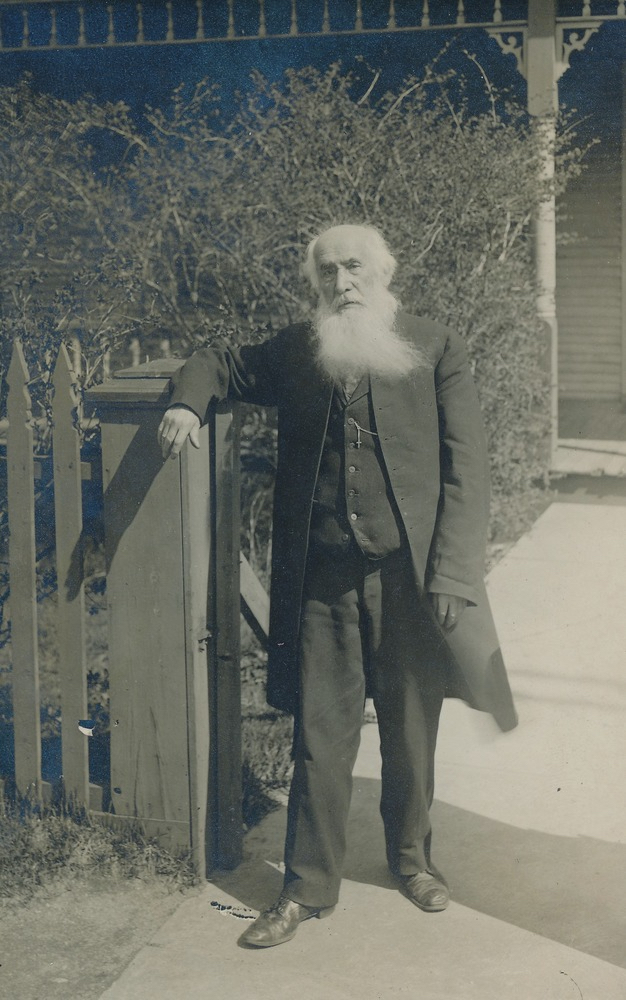
Monsignor Buh was a Slovenian priest and missionary who served for over 50 years. After his death, Bishop Anthony McNicholas of Duluth said that Buh's "zeal for souls was ever a burning fire" and that "the whole church of America is indebted" to him. | Credit: Photo courtesy of Diocese of Duluth
Felton referenced the Gospel reading of the Pentecost, when the Holy Spirit descended on the apostles and "would carry them to the place that the Holy Spirit desired for them." He said in the early 1900s, "that same Spirit was hovering over the Diocese of Duluth in a great moment of revival."
The bishop noted that Buh, when ministering to the indigenous communities and others, would always live with that community and learn the language, "and it was only when he knew that language, the language of the people, that ultimately he would know their hurts and their pains, he would know how they were filled with despair, he would know their tribulations in life."
"And only when he actually knew that in his heart and he could speak that language of the people, only then secondly, did he always begin to talk about Jesus, to put Jesus on center stage, to say Jesus is healing to your hurts, Jesus is hope to your despair, Jesus is joy to your tribulations," Felton said.
Now that Buh is a servant of God, the diocese will perform an inquiry into his life and submit its findings to the Vatican's Dicastery for the Causes of Saints, which will determine whether to move forward with his cause.
The Archdiocese of New York and the Diocese of Rochester will each be given a significant relic for veneration in the dioceses.
For Archbishop Fulton Sheen's beatification in St. Louis, teenager James Fulton Engstrom presented Cardinal Luis Tagle, the main celebrant, with a first-class relic of Sheen: the mandible, the jawbone that forms the chin and lower jawline and is the only moving bone in the human skull.
Engstrom was the recipient of the miracle in 2010 for Sheen's beatification. Minutes after being born, he was not breathing nor could emergency workers or hospital staff help him. He was dead for 61 minutes — and as doctors were about to record his time of death, James came to life. As the Church has officially proclaimed, through Sheen's intercession, the baby began breathing and was healed of any abnormalities that could occur in a way medical science could not explain.
The mandible was chosen because of Sheen's speaking prowess.
"Using the jawbone is very significant because of his ability to communicate the faith," Bishop Louis Tylka of Peoria, Illinois, Sheen's home diocese, told the National Catholic Register, a sister publication of EWTN News.
"And, of course, his ability to proclaim the faith, to speak out, the faith to preach and to teach" was paramount for Sheen, Tylka, who concelebrated the beatification Mass, said.
"It's pretty common for the one who was healed, if they're available, to have some part to play," Msgr. Jason Gray, the executive director of the Archbishop Fulton J. Sheen Foundation in Peoria, Illinois, told the Register.
Part of preparing for a beatification or canonization is obtaining first-class relics of the new blessed or saint. Msgr. Gray explained how the Diocese of Peoria obtained these first-class relics that are always parts or fragments of the body.
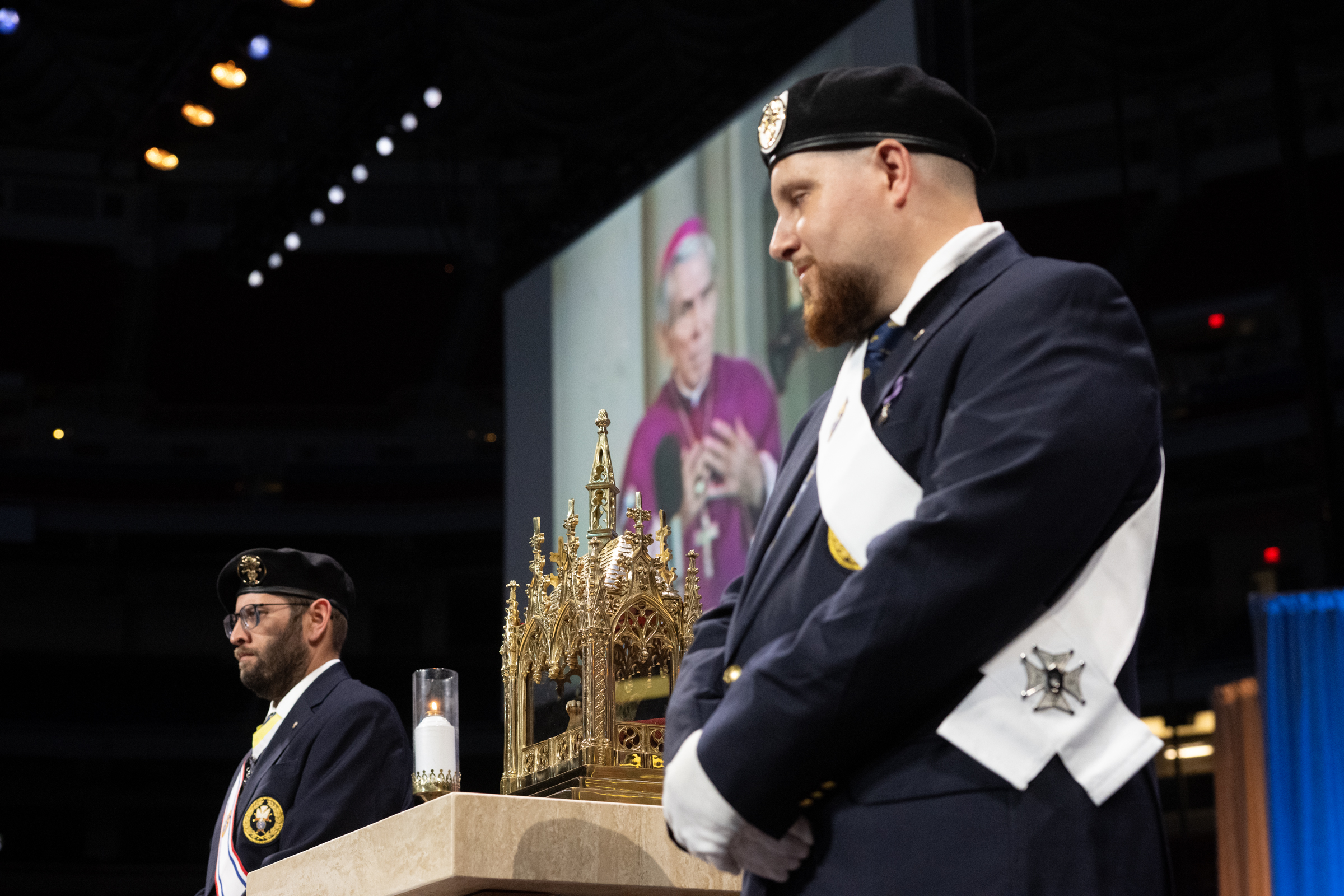
Knights of Columbus stand beside the reliquary containing the jawbone of Blessed Fulton Sheen at The Dome at America's Center in St. Louis on Sept. 24, 2026. | Credit: Jeff Bruno for EWTN/National Catholic Register
Now-Blessed Fulton Sheen died on Dec. 9, 1979.
"The important thing is to know that he's been buried for 47 years at this point, and the body does decompose," Msgr. Gray noted. "In his case, we're not dealing with an incorrupt body, so after 47 years, essentially, all the soft tissue had decomposed. When we did the actual canonical recognition, which is always done in a very respectful way and following the norms that are laid out by Rome, and we did open the casket, essentially, it was just bones. Pretty much everything else had disintegrated. We were able to take some bone that we could use for first-class relics."
The diocese received permission from Rome to take something more sizable because Bishop Tylka wanted to make sure that there was a significant relic given to the Archdiocese of New York, where Sheen served as an auxiliary bishop from 1951 until 1966, and to the Diocese of Rochester, New York, where Sheen served from October 1966 to October 1969. "Both [Rochester] Bishop John Bonnici and [New York] Archbishop Ronald Hicks have been very happy to have that news," Gray said.
Gray described those relics as the longest bones in the palm area of both right and left hands (the second metacarpal bone of the index finger).
"Those are going to be given to Rochester and New York," he said. "They will have a significant relic."
Tylka explained that they were "taking the relics from particularly his right hand because he was right-handed. It was always an iconic image of him writing, especially the 'JMJ' on the blackboard as part of his" "Life Is Worth Living" television program. It seems a significant opportunity to use bones from his right hand. That was such a familiar and iconic image of him that so many people knew."
"The reality is that although Fulton Sheen was a priest of the Diocese of Peoria, his episcopal ministry and much of his life centered around being in New York," noted Tylka to the Register.
"And, of course, he was the diocesan bishop of Rochester. So it seems important to me that those two dioceses, in particular the Archdiocese of New York and the Diocese of Rochester, each have a significant relic for their use and veneration in the diocese. And knowing that they've been supportive of our efforts to move the beatification forward and the cause of Fulton Sheen, I just thought it would be an important gesture that I, myself, as the bishop, would go and present those relics."
Tylka will personally present the relics to Bishop Bonnici in Rochester next Tuesday and to Archbishop Hicks in New York next Thursday.
"Each of those dioceses are planning celebrations on those days," he said. "They both have great devotion and support of the cause for Fulton Sheen, so they'll be the first two dioceses to receive a relic, a substantial relic," Tylka explained.
He elaborated on the particular choice of relics for these two dioceses. "Knowing that Fulton Sheen was so demonstrative in not only writing 'JMJ,' but often he would make his gesture pointing up to heaven, each of them will receive a bone from his hand. One gets the left and one gets the right."
In addition to these bones, Msgr. Gray explained another longer bone was also taken to prepare small relics. Each will be in a theca (small round reliquary) in which a tiny chip of bone is placed with the inscription ex ossibus Beati Fultoni Sheen — from "the bones of Blessed Fulton Sheen." None could be distributed until Sept. 24.
Gray clarified these relics are not for private collections but meant for public veneration. Requests from Catholic institutions such as a parish, seminary, religious house, convent or shrine must include a testimonial letter from a diocesan bishop.
"We need to know that this is a legitimate request from an institution that will respectfully preserve the relic and that it is meant to be made available for veneration by the faithful," he said.
Second-class relics — an item the blessed or saint owned, wore or touched, such as a shirt or book or pieces of these — are available from the foundation, which has a number of Sheen's vestments (ex indumentis, "from the clothing"). Such second-class relics can be given to private individuals.
"That's perfectly fine," Gray said. "We just ask people to make some sort of a donation because it takes us time to prepare these things — either a relic card, where we actually tape the fragment of vestment inside a holy card; or if people have contributed and been more generous, we've prepared an actual theca with a fragment of cloth in it from the vestments of Fulton Sheen."
"We have an ample supply, so there's no difficulty in honoring that," he said. Because of the many requests the foundation receives, "we do ask people to be a little patient because we're trying to fulfill them as best we can." (People may make requests and include a donation by mail to the Archbishop Fulton J. Sheen Foundation, 419 NE Madison Ave., Peoria, IL, 61603, or via the website CelebrateSheen.com.)
There are also third-class relics — items like holy cards, religious medals and rosaries that have been touched to a first-class relic.
"Right now, the principal means of creating a third-class is by touching something to the tomb," explained Msgr. Gray of the current resting place of Bishop Sheen's mortal remains in a side chapel at the Cathedral of St. Mary of the Immaculate Conception in Peoria. "The tomb itself is a first-class relic." People touch their "rosaries and holy cards all the time when they come to Peoria and make a visit in front of the tomb."
During the beatification at St. Louis' The Dome at America's Center, more than one first-class relic was available for the faithful to venerate.
Another major relic will also travel to Rome — and will be presented to Pope Leo XIV. "That is planned," Tylka confirmed to the Register. "I've received confirmation that I will be given an audience to do so on Oct. 5."
Because Leo grew up only about 168 miles from Peoria, he might have visited Bishop Sheen's home diocese and cathedral church growing up.
"Quite possibly," said Tylka. "He grew up in the south suburbs of Chicago, as I did. And certainly, as an Augustinian, we did have a parish where the Augustinians were serving for a part of some time. So it's very likely that he probably could have come down for a visit."
This article was first published by the National Catholic Register, an EWTN News sister publication, and has been adapted for EWTN News English.
Given that divorce invariably affects the children involved, a new program in Spain provides a setting where children can be heard, have any pain they feel acknowledged and receive the help they need.
According to a study presented in 2024, in Spain much like in many other countries, "the approximate probability of a marriage ending in divorce is around 50%." This is a reality that affects the society at large, and one from which the Catholic Church is not exempt.
The same study also found that in Spain specifically, the percentage of couples marrying in the Catholic Church is down 83% since 1975.
To address the high divorce rate, the Family Guidance Center (COF, by its Spanish acronym) of the Diocese of Cuenca has developed the Niño equilibrista (Child Equilibrist) program which, following a mutual support group model, provides care for the children of separated and divorced parents.
Marta Guillén Tena, director of the COF, explained in an interview with ACI Prensa, the Spanish-language sister service of EWTN News, that the program's name alludes to the "balancing of loyalties" that a child must deal with when their parents separate, a process that also often involves a legal dispute in which the child is caught in the middle.
"They need to have enough freedom and awareness to know that they can love both their father and their mother equally," she noted. The children "basically need to feel heard and have their pain acknowledged," as well as to convey to them that their parents, "come what may, will always be their parents."
The situation of these children poses a challenge for the Church, given that it preaches the sanctity of marriage and its indivisible unity. What the children go through also presents difficulties when it comes to explaining to them the concept of God the Father.
"Child Equilibrist," Guillén added, is a broad concept that also refers to adolescents, young people, and even adults who "can identify that child equilibrist that they carry in their hearts."
'It seems like they don't notice, but they do'
The origins of the project lie in a common response from parents seeking help at the Cuenca Family Counseling Center (COF) when they are asked about their children. "What the parents conveyed to us was that their children were doing fine," the director explained.
However, the reality is that "children, it seems like they don't notice, but they do" pick up on what is happening around them, which is why the center launched this special, year-long program.
The program is designed to provide these children with tools to communicate with their parents, peers, and other key figures such as grandparents, teachers, or catechists. They are taught to distinguish between what happens within their family and what defines them as individuals.
'No one is going to judge them'
Teresa Sarabia, coordinator of the Cuenca Family Guidance Center and the program itself, explained that the children are also helped to "understand the grieving process and what they are going through," to manage their emotions, and to address their relationship with God and the concept of forgiveness, "since they sometimes waver between assigning blame and forgiveness," Sarabia indicated.
"This is a setting of absolute confidentiality where all the children and their parents are free to express themselves openly. No one will judge them. We welcome them with authenticity and sincerity — nothing is feigned. We do this out of love, for the greater glory of God, not for our own greater glory," Guillén explained.
For the time being, the program involves adult children partly because, at times, one parent will not give consent, but also because "we felt it was the most urgent priority, since they are the ones who will soon be starting families of their own," Sarabia noted.
The coordinator said that the focus is the child, "but the idea is to work with the whole family," so parents are kept informed of the path their children are on, "so that they can talk about it at home later. The idea is to build bridges between them and make this something that can be discussed openly."
A program for the Church
The program for "The Child Equilibrist" was launched after eight years of preparation involving numerous experts from Spain and abroad. The aim is for the program to be widely adopted and to serve "to give visibility to the very specific pain experienced by these children, regardless of their age. We want them to know that their pain matters to us," Guillén emphasized.
At the same time, the goal is for other dioceses to adopt it as well: "This is not a program we want to implement solely for ourselves. We are part of one Church, and everything we do is for the whole Church," she concluded.
This story was first published by ACI Prensa, the Spanish-language sister service of EWTN News. It has been translated and adapted by EWTN News English.
Pro-life groups responded to a recent lawsuit claiming that Texas abortion law is to blame for Tierra Walker's death.
A lawsuit is targeting Texas' law against abortion, saying a 37-year-old woman was a casualty of the law — but pro-life physicians disagree.
Tierra Walker, 37, died of preeclampsia in December 2024 after multiple hospitalizations due to her high-risk pregnancy. She suffered from high blood pressure, seizures, severe pain, and deep vein thrombosis. Two days before she died, doctors sent her home from the emergency room, saying that she was "stable enough."
Her family has since filed a lawsuit dated Sept. 15 against Texas Attorney General Ken Paxton, as well as Walker's doctors, the Texas Medical Board, and the University of Texas health system, claiming that she was denied an abortion that could have saved her life, and blaming Texas's abortion law for her death.
"Tierra Walker is dead and those responsible must be held accountable," the complaint begins. "At every turn, Texas's political and medical establishments not only failed but actively harmed Ms. Walker."
Texas law allows abortions to save the life of the mother; all pro-life states in the U.S. make this exception. Responding to claims that the pro-life law is to blame, pro-life leaders contend that the tragedy was caused by a failure of the medical system.
The head of the American Association of Pro-Life Obstetricians And Gynecologists (AAPLOG), Dr. Christina Francis, says that Walker likely would have survived if she had been given standard medical care — care that is already legal in Texas.
"My heart goes out to Ms. Walker's family, and I hope that this devastating loss is a wake-up call to the medical community and our society to invest in better maternal health care," Francis told EWTN News.
"The tragic death of Tierra Walker highlights significant problems in maternity care in the United States today, including poor healthcare coordination and insufficiently treating severe medical conditions," Francis said. "As healthcare professionals, we take an oath to care for our patients, even when it requires extensive hospitalization and extended monitoring."
"Her death was likely preventable and the result of inadequate medical care; it was certainly not the fault of Texas' abortion law," Francis said.
Francis said that according to court records Walker "needed coordinated, standards-based medical care."
"This would've included controlling her blood pressure more aggressively, diagnostic testing that appeared to be erroneously denied, and continued hospitalization until her condition stabilized," said Francis.
"Preeclampsia at 20 weeks of pregnancy is, by definition, severe," Francis said. "If Ms. Walker had been stabilized immediately and then delivered rather than being sent home, she would likely still be alive today. Texas law would have allowed this standard medical care."
"Induced abortion is not a blanket solution," Francis said. "Better healthcare is."
Susan B. Anthony Pro-Life America spokeswoman Kelsey Pritchard cited failure of medical care, and noted that the lawyer in charge of the case has strong pro-abortion-access ties.
"Tierra Walker's death is tragic and it's clear there was a failure on multiple levels to provide the high-risk pregnancy care she needed," Pritchard said. "SBA Pro-Life America has strongly advocated Med Ed policies that make it clear no law anywhere in the country blocks doctors' duty to act to save lives in pregnancy emergencies."
"The career pro-abortion activist lawyer behind this lawsuit, who boasts about facilitating an out-of-state abortion on the very same day the Dobbs decision came out, and the inclusion of Senate candidate Ken Paxton give away that there is a political agenda separate from families' understandable pain and anger," Pritchard added.
"Attorneys general enforce the law, they don't make it, but Ken Paxton has vigorously upheld state law protecting both unborn babies and women," Pritchard said. "Activist lawyers seeking a test case as a pretense to attack the laws is nothing new, it's how we got Roe v. Wade. That cynical strategy will not succeed in Texas."
"Abortion activists would rather spread fear about pro-life laws than address complex disparities in care, and their misinformation has consequences that put real women in real danger," Pritchard said.
France's Catholic culture and the energy of the country's young people stole the show at a prayer vigil at the national stadium in Saint-Denis, France.
SAINT-DENIS, France — At least 80,000 young Catholics flocked to France's national soccer stadium north of Paris on Friday night to pray with Pope Leo XIV and to hear his message for the Church.
Whether they were lifting their arms in praise-and-worship or silently venerating the relics of saints and the Holy Tunic of Christ, the entire Stade de France was united in prayer before Leo's arrival and throughout an hour and a half-long program.
People from working-class suburbs stood alongside families from the more traditional Catholic milieu associated with the city of Versailles. In the lines outside the stadium, Breton and Vendéan flags — from regions with strong Catholic histories — stood alongside groups with a more popular, charismatic style.
One young woman, 29-year-old Romance Bono, wiped tears from her eyes as the pope entered the stadium to deafening cheers.
"It brought tears to my eyes because it's such an emotional moment," she told EWTN News. "Seeing all these young people cheering for the pope like a rock star, that is the strength of the Church, and it is the future of the Church here. It was very moving."
Young people greet Pope Leo XIV at a prayer vigil at Stade de France on Sept. 25, 2026 in Saint-Denis, France. | Credit: Vatican Media
Soon after Pope Leo's arrival at the stadium, hundreds of young French Catholics staged an artistic performance depicting French saints and the history of the Church in France, including the use of live horses, and culminating in fireworks launched above the stadium.
One 28-year-old volunteer, Jacques-Henri de Livron, told EWTN News that as soon as he heard the pope was coming to France, he decided to take a day off work to see him. He was so afraid of missing the events that he volunteered to make sure he could be in attendance. De Livron grew up in a Catholic environment, but returned to the faith in his twenties after painful deaths among his siblings and close friends. Those experiences, he said, made him recognize its value anew.
"Christianity is really the religion of the human person," he said. "In this age of narcissism, it helps us get out of ourselves, turn toward others and care about them instead of thinking only about ourselves. People often call it a religion of the book, or a religion of revelation. But it's much more than that. It's the religion of the human person."
De Livron also made a point of sharing his surname, which is unusual in France, where anticlerical culture is widespread and religious people usually ask to be identified in press reports only by their first names in order to avoid trouble at work. "I want to be part of a generation that stops being afraid to testify, that gives its name, and isn't afraid of anything," he said.
Pierre-Alain Belaube, 34, described the effort to arrive hours early after a long day at work, and to fight the crowds to enter into the packed stadium, as "200% worth it. It's a privilege to be here."
Belaube described himself as a formerly lukewarm Catholic, whose life was transformed when he read the autobiography of St. Ignatius of Loyola.
"I have the hope that many more young people will open their hearts to God and let him change their life," he said. "I think that such an event can be, for many, the first milestone of a life-changing experience. I hope we will inspire many more young people to get to know Jesus."
Thibault, a religious brother who preferred not to give his last name because he did not have permission from his superiors to speak with reporters, accompanied 400 members from the youth movement of his religious community, the Missionaries of Divine Mercy, to the event.
He told EWTN News that it is very moving to be surrounded by young people "wanting to say, 'Here I am, I'm Catholic and I'm proud to show it.'"
The young religious, who is also studying for the priesthood, said he hopes Leo's visit to France "will contribute to the missionary awakening that needs to happen in France."
While the primarily secular country is seeing a surprising surge in baptisms, he said he thinks "Catholics still find it difficult to go out and meet people, to be missionaries in their daily lives."
"I think this could become a significant moment in the life of the Church in France."
In his message during the prayer, which included religious hymns and a Litany of Saints, Leo invited young people to shun evil and strive for good.
"God is the Lord of history, and no matter what happens, he guides its course toward salvation. In Christ, every evil comes to an end, precisely because that end becomes the beginning of a new and eternal life," he said.
"The work well done, the work that is good, is the redemption that Jesus accomplishes for us," Leo said. "Through his struggle against sin and death, Christ's victory sets us free. He saves us from all evil and invites us to all that is good."
The pontiff also answered the questions of two young French people as part of the evening's program.
Chloé, 25, talked about her involvement in her parish and in a group of young Catholics "eager to live out and share their faith with others." But she lamented that society "is founded on different principles" and sometimes has "no regard for the question of God."
Pope Leo responded that, "It is true, as you say, that the society in which we live seems indifferent to God. But the Lord is not indifferent to us! This is what matters, and what always gives us hope."
Chloé, who is from Saint-Denis, described the vitality of Catholic life there. Saint-Denis is often described as a quartier sensible ("a vulnerable neighborhood"). Her testimony echoed what EWTN News heard from local Catholics in the crowd, including people from immigrant backgrounds, about the life of the Church in their neighborhoods that have a strong Muslim presence.
A young man from Burgundy, named François, also addressed the pope and asked him how young people can discern how the Lord is calling them to serve.
Leo's advice to young people was to keep their hearts open to the suffering of their peers, to follow Jesus, and to draw inspiration from the examples of the saints.
"Even in the face of persecution, these brothers and sisters of ours opened paths of peace. Look to those priests who were passionate about Christ, such as St. Eugene de Mazenod and St. John Mary Vianney. Look to the mystical beauty of St. Thérèse of the Child Jesus; the fervor in charity and mission of Blessed Pauline Jaricot; and the courage of the 50 martyrs of the apostolate who served their brothers and sisters even to the point of sacrificing their own lives during the Second World War," he said.
"These saints changed the course of history by leading many people from hardship to hope, since they first changed their own hearts, transforming them in the light of faith."
The youth vigil was the pope's last event on a packed first day in France. The Sept. 25-28 journey will also take him to Lourdes and Metz.
As Pope Leo XIV makes his way to Lourdes later on Sept. 26 as part of his four-day trip to France, pilgrims, local residents, and business owners in the famous town prepare with excitement.
LOURDES, France — As Pope Leo XIV lands in Paris to begin the first official papal visit to France since 2008, pilgrims, organizers, and business owners in Lourdes are preparing for his arrival in the town expected on Saturday night.
Patrick Vinuales, owner of Hôtels Vinuales — the largest hotel chain in Lourdes — told EWTN News: "The average number of people who would be staying in Lourdes is roughly 20,000. But for the Sunday Mass, there will be something like 150,000 people. We expect altogether an attendance of nearly a quarter of a million people over the weekend."
"What I think is very important is the enthusiasm of people. A lot of people have been calling us saying even if they couldn't come, they were so happy for the pope to come to Lourdes, to reveal more about the message of Our Lady to Bernadette," he told EWTN News.
Tourism is a big business in Lourdes. The town is widely considered to be the area with the highest concentration of hotels in France outside of Paris — rather unusual for a town with a population of 10,000. Hotel owners have been making the most of the increase in numbers.
Joseph Tedesco, owner of the Grand Hôtel Moderne, built in 1896 by the nephew of St. Bernadette, told EWTN News: "Everybody increased their prices… We made a huge effort to welcome individuals, because usually it's mostly big dioceses… but this event made more individuals come and that's a completely different type of business."
For the major ceremonies, tourists will need to have registered in advance, or they won't be allowed into the sanctuary. "The biggest challenge is the people who organized the pilgrimage before they knew the pope was coming. There are a lot of people who don't have their ticket," he said. "Our hotel is in the red area, so it won't be accessible [by car]."
Pope John Paul II visited Lourdes in 1983 and 2004. In 2007, Pope Benedict XVI visited, which Tedesco recalls. "Two months after I bought the hotel 18 years ago, Pope Benedict XVI arrived… We didn't have all this security for sure. But that's maybe because we didn't have the geopolitical problem that we have today."
Pilgrims gather to pray before Pope Leo arrives in Lourdes, France, during his papal trip to France Sept. 25-28, 2026. | Credit: Elliot Hartley
"This visit is, first and foremost, a visit by the Successor of Peter to strengthen his brothers in the faith and to address our society as a whole," said Monsignor Jean-Marc Micas, bishop of Tarbes and Lourdes.
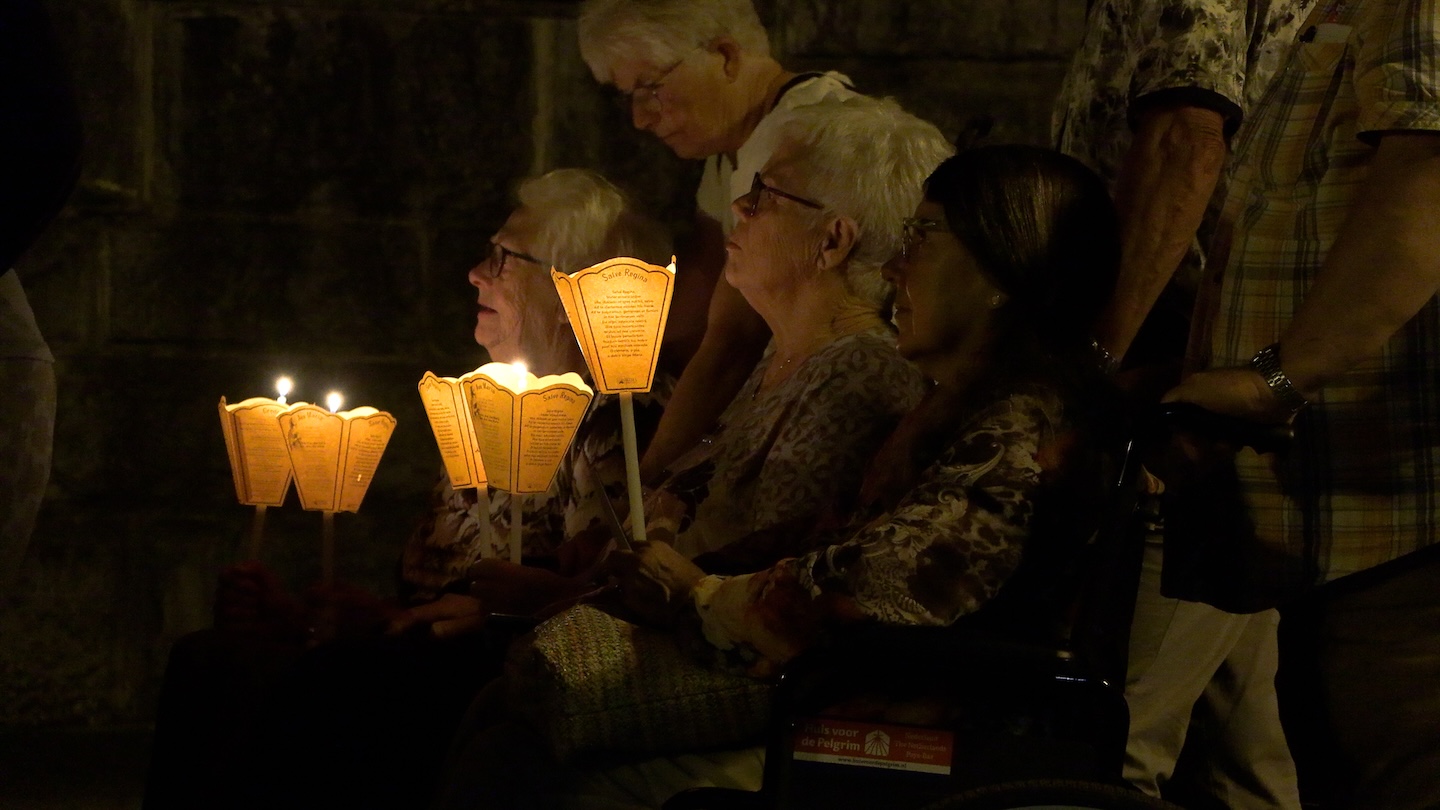
During this visit, Pope Leo will pray at the grotto and take part in the torchlight procession, meet with bishops of the French Episcopal Conference, celebrate Holy Mass, and meet the staff and sick community at Accueil Notre Dame, the main hospital for sick pilgrims.
He also will meet privately with seven survivors of sexual abuse in the Church — a major focus for critics who argue the Church hasn't confronted the problem fully.
The visit also marks an increase in the number of attendees on organized pilgrimage groups. Most visitors to Lourdes come as part of an organized group, often with their local diocese.
Caroline Trainor, a Lourdes organizer for Joe Walsh Tours, told EWTN News she had seen a huge increase in sign-ups. "When they heard that the pope was visiting, they were signing up to come back to be here over the weekend," she said. "So that's really positive for the future because it brings Lourdes back into the spotlight… Even coming in this morning, you can kind of feel this little ripple of excitement."
Lourdes' story can be traced back to 1858, when St. Bernadette Soubirous, a 14-year-old peasant girl, had apparitions of Our Lady in a small cave. A shrine was built there, and the Pyrenean town became a pilgrimage site known for its miraculous healings.
Paul Eaton, president of Ireland's national Carmelite pilgrimage, told EWTN News: "It's just electrifying. You really have to come here to experience it. It's just something else… we're so blessed to have this honor."
"When the news first came out, we thought 'this is not happening!' That increased our numbers, which was fantastic… We're very lucky because we have an awful lot of the same people that come with us every year who are actually hooked... They love Lourdes. They really, really do."
Michael Murphy has been coming on pilgrimage to Lourdes for 19 years. He told EWTN News: "There's a draw that continually brings me back. It's difficult to explain. It's just the serenity and the atmosphere. For the dates and to align with the pope as well, it just made it extra special."
Organized pilgrimages to Lourdes often have two sides. Pilgrims can either join as someone in need of assistance or as a volunteer. Those with learning or physical disabilities spend the week being assisted by volunteers, who help them with their daily needs.
Clíona, a first-time pilgrim, told EWTN News: "I heard people describing Lourdes before, but I never expected it just to be like this. There's something about it. It's like a magical place."
"It's a different experience than I've ever experienced before," Harry Lynch, another first-time pilgrim, told EWTN News. "I wasn't expecting it to be this busy. Everyone's very excited about everything that's about to happen."
Martin has been visiting Lourdes for 20 years from Ireland. He told EWTN News: "We've got more youth coming now than we had years ago, which is great. With the visit of the pope, we're getting two trips in one! There's so much excitement, so much talk about it, and it's a great thing for everyone. Some people don't get the chance to go to Rome, so they're getting a real run for their money this year."
The visit is expected to provide a huge boost to Lourdes' economy. Natasha Afonso, a local souvenir shop owner, told EWTN News: "When tourists found out the pope was coming, many delayed their trips to align the dates. So, we lost a lot of business in the middle [of the] season, but now it's growing again."
"Lourdes is known for its miracles, so it's good for the publicity, for the young people, and the new generations to come."
The prayer service at the famous Gothic cathedral was Pope Leo's first meeting with the Catholic Church of Paris during his Sept. 25-28 visit to France.
PARIS — Pope Leo XIV prayed Evening Prayer at Notre-Dame Cathedral on Friday, becoming the first pope to set foot in the monumental church since it was rebuilt after the 2019 fire that ravaged its roof, nave, and spire.
Less than two years after its reopening, Leo reflected on the iconic cathedral, which, "more than any other [place], has invited the people of Paris for centuries to lift their eyes towards heaven."
"Seven years have passed since the whole world, holding its breath, watched as the cathedral was engulfed in a terrible fire," he said in his homily. "That pain was felt not only by Catholics, nor only by believers."
"In that tragic moment we came to realize that Notre-Dame is more than a monument," the pope said. "The collective effort to rebuild it, and the splendor of the result reveal that the heart of a people beats here, and that here we stand at the living center of a civilization, where past and future embrace, where heaven and earth meet."
Seven years after a devastating fire nearly destroyed Notre-Dame Cathedral, Pope Leo XIV enters the restored cathedral Sept. 25, 2026 and celebrates Vespers in the first papal visit since the 2019 blaze.| Credit: Daniel Ibáñez/EWTN News
The prayer service at the famous Gothic cathedral was Pope Leo's first meeting with the Catholic Church of Paris during his Sept. 25-28 visit to France.
Here Leo spoke to the country's Catholic clergy and religious — the rebuilt church providing a fitting setting for his message that "this Cathedral has been reborn so that you too may be reborn with it in a new impetus towards holiness and daily mission."
Leo addresses France's Catholics at a critical juncture in their history, as they welcome rising numbers of converts. This Easter, France recorded more than 20,000 adult and adolescent baptisms, a 20% increase from the already record-high number in 2025, which saw a 45% increase from 2024 figures.
Despite the encouraging trend, the country continues to grow more secular. The latest data on religious identity in France, in 2019-2020, found that 51% of adults in France say they have no religious affiliation, an 8% increase from a decade before. While 29% of the population identifies as Catholic, the survey found only 8% say they go to Church regularly, according to the Institut National D'Etudes Démographiques.
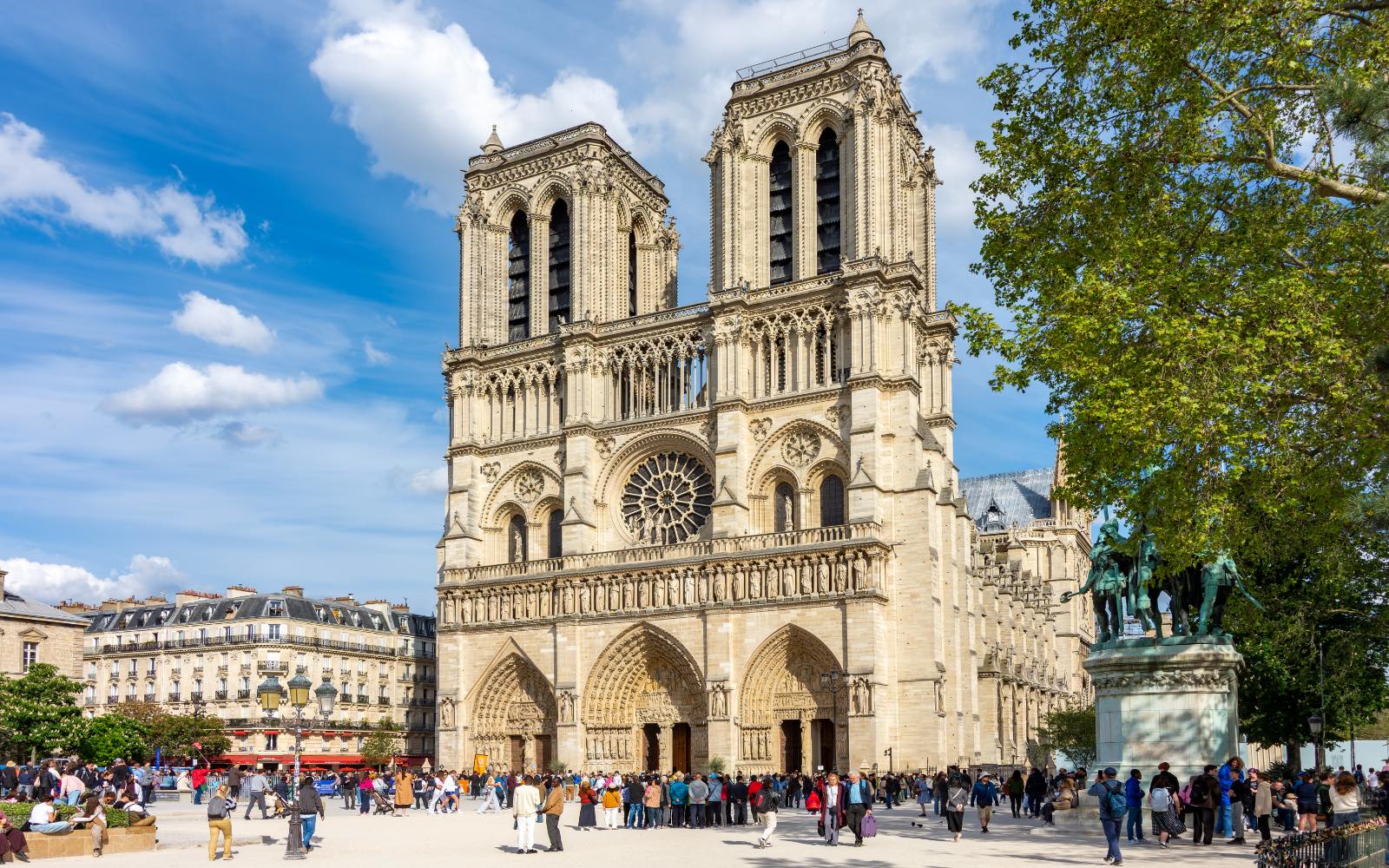
Notre Dame Cathedral in Paris, France | Credit: Mistervlad/Shutterstock
Notre-Dame Cathedral reopened in December 2024, a little over five years after people around the world watched the church's blaze in horror. Restoration work of the Gothic cathedral continued into 2026.
In his homily, Pope Leo reflected on the symbolism of the architecture of the cathedral, the seat of the archbishop of Paris.
"The Cathedral's cruciform layout, where stone and light come together, evokes the meeting of earth and heaven. It gathers and orders the events of history, woven with human joys and sufferings. It holds them together in a symbolic dynamic that transforms these diverse expressions into a living language, uniting them into a whole," he said.
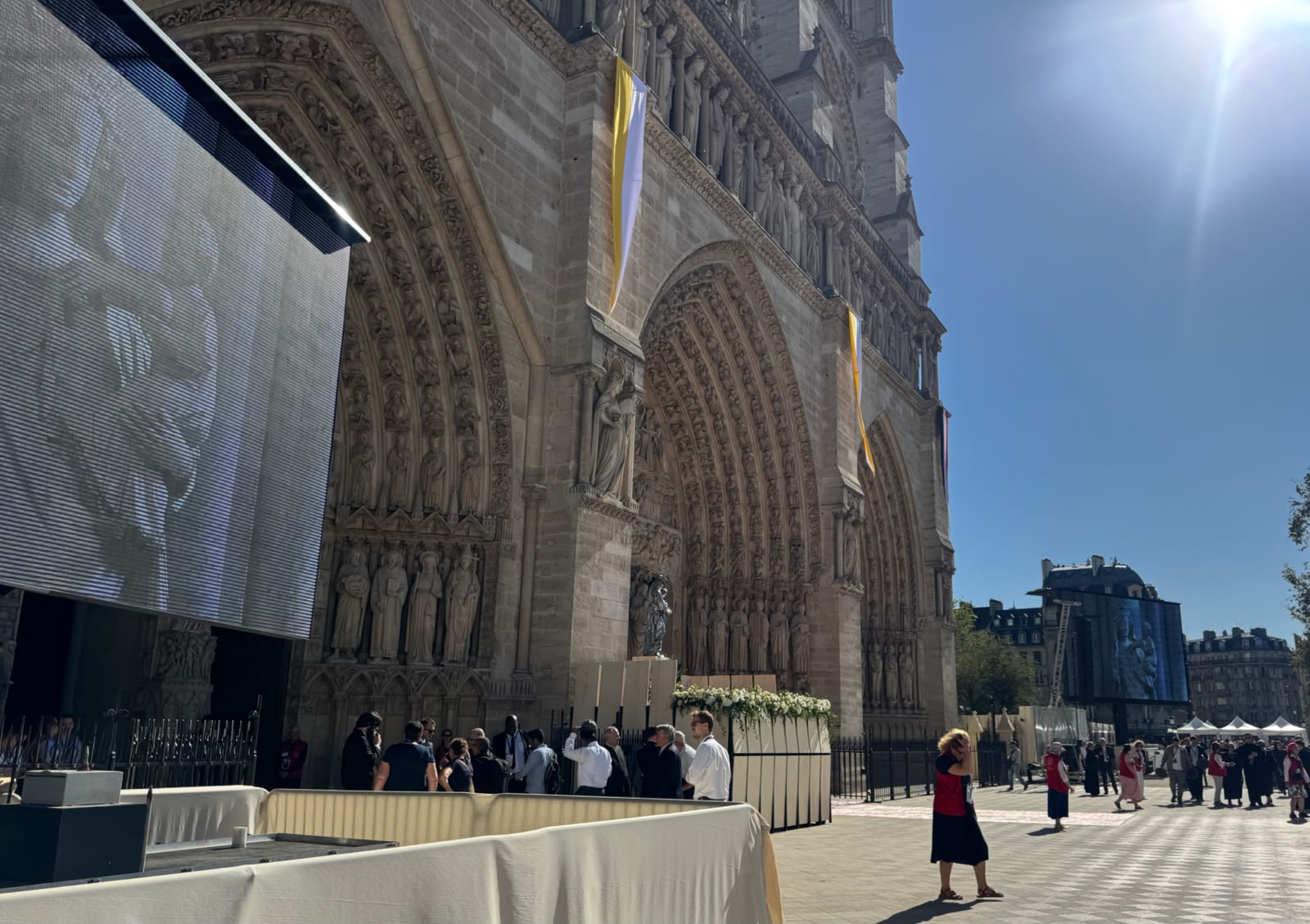
Notre Dame Cathedral in Paris, France, prepares to welcome Pope Leo XIV on Sept. 25, 2026. | Credit: Magdalena Wolinska-Riedi/EWTN News
Before Evening Prayer, Pope Leo approached the cathedral on foot to greet those gathered outside.
Mariana González, 31, was one of hundreds of people who caught a glimpse of Pope Leo as he arrived for Evening Prayer.
González, who with her husband and 7-month-old girl waited around four hours to see the pope, told EWTN News that "it's very special for [Pope Leo] to be here, not only to see him but to listen to the message he has for all the French people, those of us living in France and the whole world." González, who is Colombian-American and lives in Paris, said she believed "his visit will also touch many hearts here and I look forward to seeing all of the fruits his visit will bring."
Local authorities estimated that 300,000 people lined up to greet Leo outside Notre-Dame and along the two-and-a-half mile road from his previous event at UNESCO headquarters to the cathedral, the Vatican said.
Upon entering the cathedral, the pope visited a chapel to pray before the Blessed Sacrament and then venerated a relic of the Crown of Thorns. The cathedral, which just moments before had erupted into applause and cries of "Pape Léon," was silent.
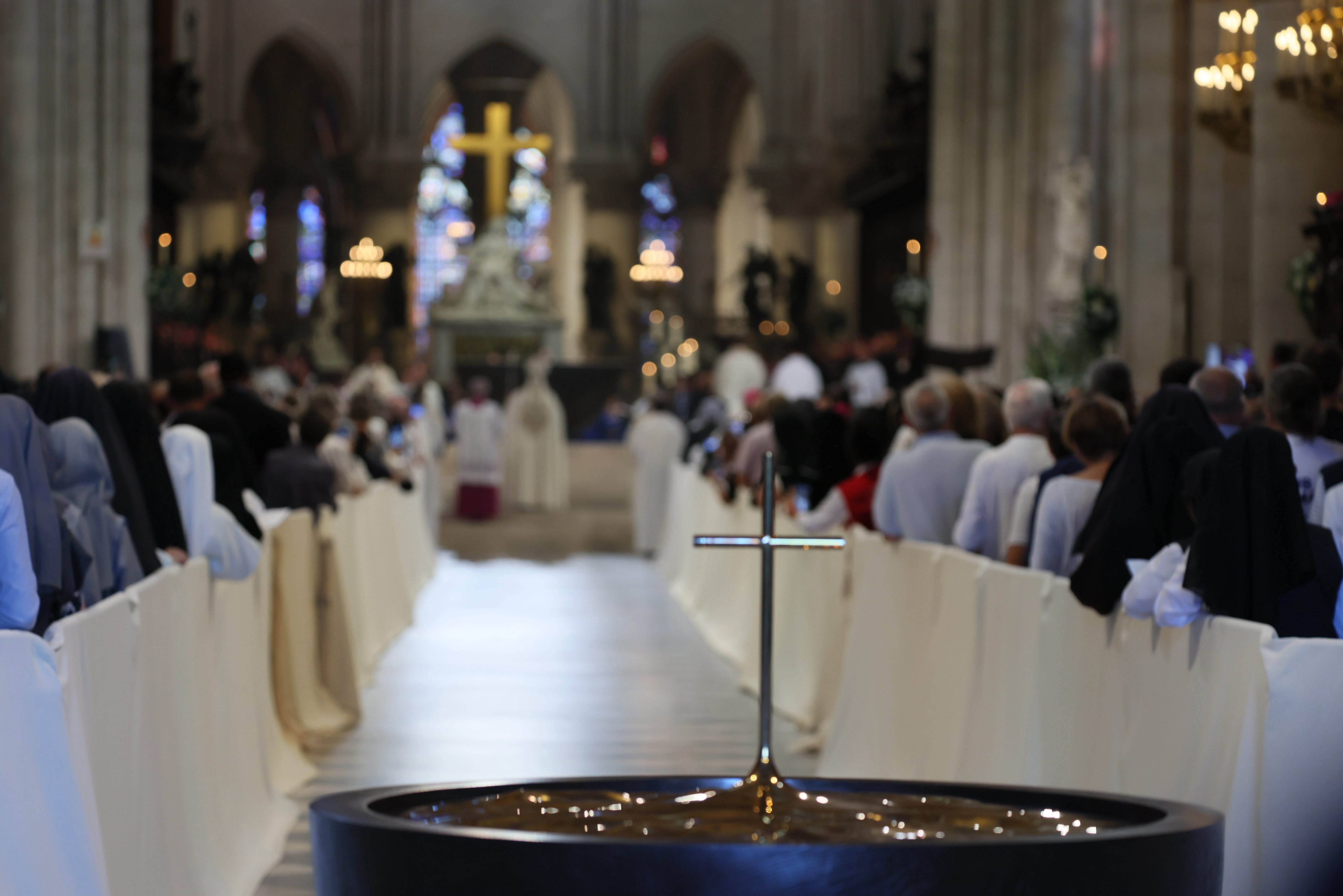
After putting on vestments for the prayer, Leo approached the altar to the dramatic tones of the cathedral's grand organ, the largest pipe organ in France.
"We must not forget that this Cathedral, like every other church, was built for the purpose of prayer and the worship of God," the pope recalled in his homily. "This Cathedral is not merely a stone structure to be admired; instead, it lives by the sacred mystery celebrated within it. Without the liturgy, it would lose its soul."
He encouraged priests and consecrated men and women to never neglect their friendship with Christ, to nurture their interior lives and spend time in personal, silent prayer.
"Your mission flows above all from this intimate relationship with the Lord, who awaits you there," he said.
Reflecting on the cathedral's purpose of prayer and the worship of God, Leo said, "Today, more than ever, we live in an age that seems deprived of fullness, depth and promise. The noble simplicity of song, spoken word and liturgical gesture can be for many a glimmer of hope, an oasis of peace in a hyper-connected and noisy society, where we can experience the presence of the Author of the greatest love."
In his message of welcome to Leo, Archbishop of Paris Laurent Ulrich said, "Just over a year ago, when I took the liberty of inviting you to Paris, you told me that you wanted to see Notre-Dame! … You have come as a pilgrim among all these visitors."