Trappist Bishop Erik Varden of Trondheim will preach the week of spiritual exercises, with two daily meditations beginning Feb. 22.
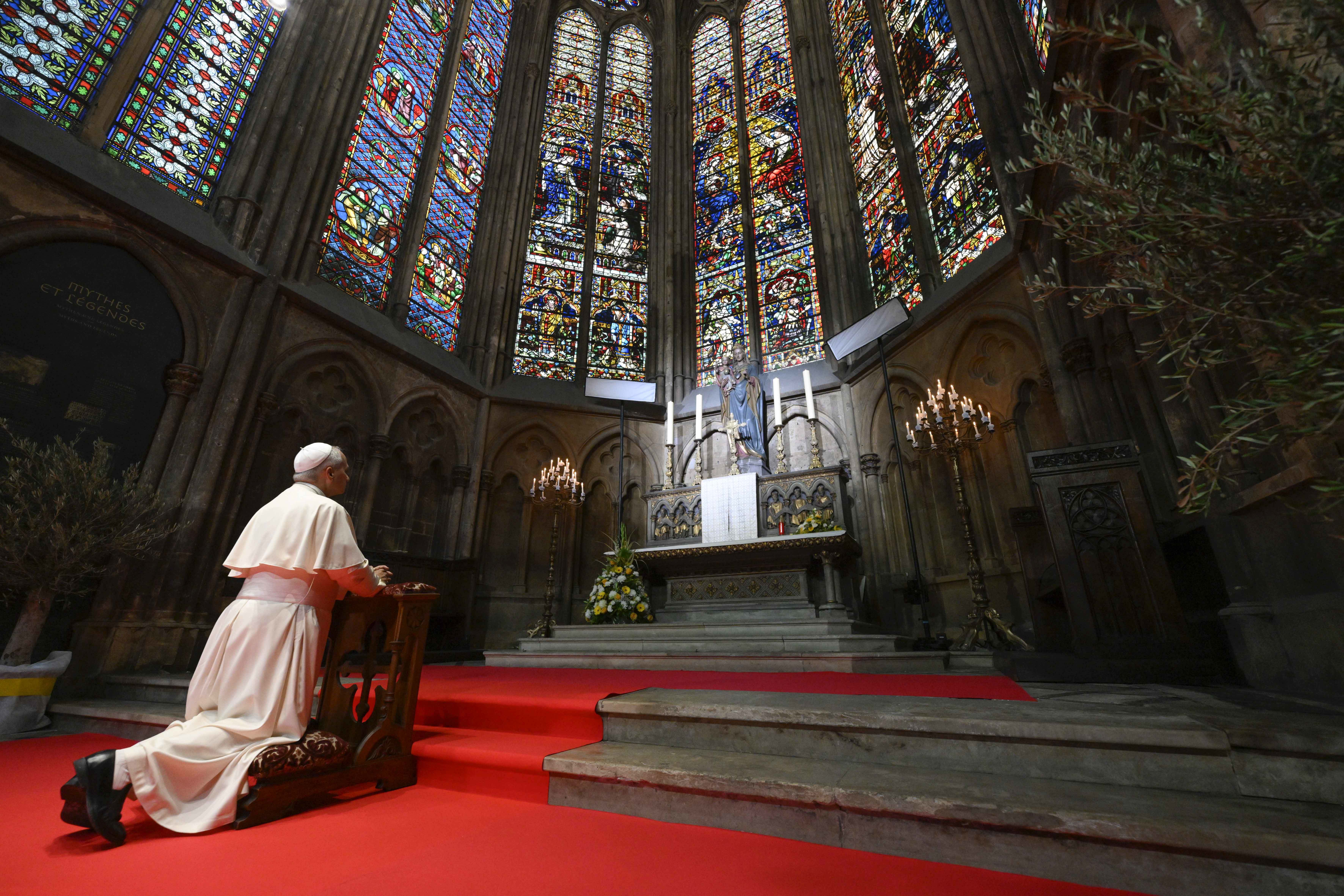
A week of spiritual exercises for Pope Leo XIV and the Roman Curia at the start of Lent will take on a distinctly monastic character, with the retreat returning to the Apostolic Palace but relocating to the Renaissance-era Pauline Chapel, decorated with frescoes by Michelangelo.
In previous years, the retreat was held in the palace's Redemptoris Mater Chapel, known for mosaics associated with Father Marko Rupnik, who has been accused of sexual and spiritual abuse.
The preacher for the exercises will be Archbishop Erik Varden of Trondheim, a Cistercian of the Strict Observance (Trappist). A Norwegian who was baptized as a Lutheran by nonpracticing parents, Varden studied at Cambridge and later converted to Catholicism, a change he has linked to the inspiration of music. He has served as bishop of the Diocese of Trondheim since 2020.
"It is a responsible task. I hope, in one way or another, to be of service," Varden told EWTN News.
A prolific author of spiritual books, Varden will offer two meditations a day. The first is scheduled for Sunday, Feb. 22, at 5 p.m. Thereafter, each morning begins at 9 a.m. with the Liturgy of the Hours, and another meditation follows at 5 p.m. The final session will be on Friday, Feb. 27, concluding with afternoon Eucharistic adoration.
The theme of the retreat is "Illuminated by a Hidden Glory, a Lenten Itinerary," centered on the figure of St. Bernard — described as both idealist and realist — and will also include reflections on the angels of God.
Pål Johannes Nes contributed to this report.
This story was first published by ACI Stampa, the Italian-language sister service of EWTN News. It has been translated and adapted by EWTN News English.
Some Catholic colleges ranked among the best for pro-life support for women, while others were among the worst for their ties to abortion clinics, according to a new report.
Some Catholic colleges ranked among the best for pro-life support for women, while others were among the worst for their ties to abortion clinics, a recent report found.
In an audit of more than 700 Christian colleges and universities, the Christian Schools Project found that 1 in 7 Christian colleges referred students to Planned Parenthood for health care or future jobs, among other pro-abortion "infractions."
The report by Demetree, a branch of Students for Life of America (SFLA), called the Catholic connection to the abortion industry "shocking."
"Most shockingly, a portion of Catholic schools have forsaken their Christian values," the report read, citing the Catechism of the Catholic Church's teaching on abortion.
One in 10 Catholic colleges had ties to abortion clinics, and about 25% of all the infractions were by Catholic universities.
"Despite this, Catholic schools also had 24 'A+' schools: the most of any denomination," the report continued.
The lowest grade an institution could receive was an "F" and the highest an "A+."
Among the Catholic schools receiving an "F" was Villanova University in Pennsylvania — Pope Leo's alma mater, where he was known for his involvement in the pro-life club in his days at the university.
Other Catholic schools that received a "F" included Boston College in Massachusetts; Carroll College in Montana; Loyola Marymount University in California; Sacred Heart University in Connecticut; Santa Clara University in California; Seattle University in Washington; St. Catherine University in Minnesota; University of Detroit Mercy in Michigan; and University of San Diego in California.
Catholic colleges that received a "D" grade included Mount Saint Mary's University in California; Saint Louis University in Missouri; and St. John Fisher University in New York.
Paradoxically, Catholic colleges were also among the best schools for pro-life values and made up more than half of the top 10 best schools in the report.
These schools don't just avoid ties to Planned Parenthood but provide pregnancy support for student mothers in need.
Benedictine College students hold pro-life signs at the 2026 March for Life in Washington, D.C. | Credit: Isabella Wilcox/Benedictine College
The schools that lead
At the center of campus at Benedictine College in Atchison, Kansas, sits a statue of an angel holding a child.
Installed in 2017, the Memorial to the Unborn is one of the "unique" aspects of pro-life culture on Benedictine's campus, according to spokesman Steve Johnson.
Each year, busloads of students travel to Washington, D.C., for the March for Life. But before they leave, they place roses before the memorial.
Before Benedictine College students head off to the March for Life in Washington, D.C., they place roses on the campus memorial for unborn children. | Credit: Isabella Wilcox/Benedictine College
The student-led pro-life group, Ravens Respect Life, is a "major player" for the culture on campus, according to Johnson. The club helps fundraise for the local pro-life pregnancy resource center, while the campus ministry service team organizes volunteering.
The pro-life culture is woven into classes as well, according to Johnson.
"We have a pro-life School of Nursing and our graduates take that position out into the world and the hospitals and clinics at which they work," he said.
The school is also looking to further expand its pro-life medical education.
Every year, busloads of students from Benedictine College in Atchison, Kansas, head to the March for Life in Washington, D.C. | Credit: Isabella Wilcox/Benedictine College
"We are in the process of opening a proposed School of Osteopathic medicine," Johnson said. "This new school will be the most pro-life medical school in the country and will focus on treating the whole person as a human being and not just treating the ailment."
At the University of Mary in North Dakota, a young woman carrying a toddler crossed the stage at graduation, shaking hands with the president, Monsignor James Shea, who gave the beloved baby Lucia a kiss on the cheek.
Katie O'Meara (Chihoski) is one of several students who have received the support they need to complete their education as part of the university's recently-launched maternity home program, the St. Teresa of Calcutta Community for Mothers, at the University of Mary.
Student mom Katie O'Meara (Chihoski) walks the stage with her toddler, Lucia, by her side at commencement in 2024. Father Dominic Bouck, chaplain at the university, is pictured at left. | Credit: Mike McCleary/University of Mary
Per a Jan. 27 announcement, the university has plans for a new residence hall following record enrollment, including a dedicated wing of the future hall for the maternity home.
At UMary, motherhood doesn't have to compete with education.
"This St. Teresa of Calcutta Community for Mothers is a concrete expression of the University of Mary's commitment to building a culture of life," Vice President for Student Development Reed Ruggles told EWTN News. "It ensures that motherhood and higher education are not competing paths but complementary vocations."
As for the March for Life, "we treat it like a pilgrimage," said Ed Konieczka, assistant director of University Ministry at the college.
The university sends hundreds of students each year and even provides scholarships to help with the cost.
Father Dominic Bouck, the University of Mary chaplain and director of University Ministry, told EWTN News that it comes down to formation.
"The University of Mary forms its students for the whole of their lives so that they can learn to live well, then take this formation into their communities after graduation," Bouck said. "We form them to be servant leaders so that they can go out and serve generously to all who need aid. We teach them the sanctity of human life through the Benedictine value of respect for persons and teach them to form community wherever they are at."
"As a Christian, Catholic, and Benedictine institution, the sanctity of human life is core to our beliefs, and we are not afraid to show that in our mission," he continued.
Belmont Abbey College, which also ranked in the top 10, has its own maternity home, MiraVia, as previously reported by EWTN News.
University of Mary students hold a banner at the March for Life in Washington, D.C., on Jan. 23, 2026. | Credit: University of Mary student photographer Regina Turner
Why Christian Schools Project?
Though schools like Benedictine, University of Mary, and others stand out for their pro-life work, the report found that many colleges fall short of their Christian values. Project leaders call on readers to reach out to colleges and encourage them to live out these values.
"It's simple: Either stop promoting abortion or stop claiming to be Christian," said SFLA spokeswoman Mary Mobley.
Over the years of doing Christian Schools Project, researchers have seen growth. Since 2024, "56 infractions have been remedied" thanks to the project, according to organizers.
"For some schools, they may be unaware of their ties to abortion," Mobley told EWTN News. "This report offers a chance for them to cut those ties — and to reaffirm their support for life by promoting pro-life resources."
But the project is about more than just cutting ties with abortion providers.
University of Mary student moms involved with the St. Teresa of Calcutta Community for Mothers, University of Mary's program for moms. | Credit: Photo courtesy of University of Mary
"Being pro-life doesn't just mean being anti-abortion; it means coming alongside women and supporting them, providing them with the resources they need to choose life," Mobley said.
"Humans are made in the image of God, and because of that, they have inherent value and worth — and their lives cannot be disposed of for the convenience of others," Mobley continued.
"It's vital that Christian schools come alongside pregnant and parenting women, showing them that they are valued, loved, and supported — offering them the resources they need to choose life," Mobley said.
University of Mary students attend the 2026 March for Life in Washington, D.C. | Credit: University of Mary student photographer Regina Turner
At his general audience, Pope Leo XIV appealed for renewed nuclear arms-control efforts and asked Catholics to proclaim the Gospel in ways that speak to people's real lives.
Pope Leo XIV warned Wednesday of the grave danger of a "new global arms race" as the New START nuclear weapons treaty between the United States and Russia reached its expiration, urging world leaders not to allow the agreement to lapse without a credible and effective alternative.
Speaking at the conclusion of his general audience at the Vatican, the pope recalled that the treaty — signed in 2010 by then-U.S. President Barack Obama and Russian President Dmitry Medvedev — represented a significant step in limiting the proliferation of nuclear weapons.
"Tomorrow the New START treaty reaches its expiration," the pope said, noting that the agreement had helped contain strategic nuclear arsenals and strengthen international security. He called for "every constructive effort in favor of disarmament and mutual trust," insisting that the current international climate demands urgent action to prevent escalation.
The pope stressed that the world must abandon "the logic of fear and distrust" and instead embrace "a shared ethic capable of guiding decisions toward the common good and making peace a heritage safeguarded by all."
Without a replacement framework, he warned, the end of New START opens a period of growing uncertainty, raising alarms across the international community about the weakening of nuclear arms control mechanisms.
Prayers for Ukraine amid winter hardship
During the same audience, the pope also renewed his appeal for prayers for the people of Ukraine, who he said are being "harshly tested" by continued Russian bombardments, including attacks on energy infrastructure during the winter months.
Citing reports of severe cold and widespread shortages of electricity, heating, and water, he urged the faithful not to forget the suffering of civilians, particularly children, the elderly, and the most vulnerable. The pope expressed gratitude for solidarity initiatives organized by Catholic dioceses in Poland and other countries assisting the Ukrainian population.
Evangelization must speak to real lives
Earlier in his catechesis, Pope Leo XIV reflected on the Church's mission of evangelization, cautioning against the use of language that is "incomprehensible, poorly communicative, or anachronistic," which he said renders the proclamation of the Gospel ineffective.
When the Word of God becomes detached from the concrete lives, hopes, and sufferings of people, he explained, it loses its power to reach hearts. The pope encouraged the Church to adopt "creative methods" that allow the Gospel to take flesh in history.
Continuing his catechetical series on "Dei Verbum," the Second Vatican Council's constitution on divine revelation, the pope described Sacred Scripture as a "privileged space of encounter" where God continues to speak to men and women of every age.
He warned against both fundamentalist readings that ignore the human authors of Scripture and purely technical interpretations that deny its divine origin, emphasizing that a correct understanding must hold both dimensions together.
"The Gospel cannot be reduced to a merely philanthropic or social message," the pope said. "It is the joyful proclamation of the fullness of life and eternal life that God has given us in Jesus."
This story was first publishedin two parts by ACI Prensa, the Spanish-language sister service of EWTN News. It has been translated and adapted by EWTN News English.
The Catholic Church has officially opened the cause for sainthood of Belgian immigrant Adele Brice, an illiterate woman who had visions of the Blessed Mother.
In a decree by a Wisconsin bishop on Friday, the Catholic Church officially opened the cause for sainthood of a Belgian immigrant who had visions of the Blessed Mother.
Adele Brice (1831–1896) couldn't read or write, but she traveled the countryside of Wisconsin on foot teaching children and families about God. Brice is most well known for three apparitions she had, which are the only approved Marian apparitions to have happened in the United States.
Last year, more than 200,000 pilgrims visited the shrine to Our Lady of Champion in Wisconsin, Father Anthony Stephens, the Father of Mercy who serves as a rector of the shrine, told EWTN News.
From the time Brice first received holy Communion as a young girl in Belgium, she felt a calling to religious life. But when her family decided to immigrate to the United States, she went with them, trusting her parish priest who encouraged her to go.
She would never become a religious sister, "but she remained faithful to that fundamental calling," said Bishop David Ricken of Green Bay, Wisconsin, who promulgated the decree on Jan. 30.
"What moves me particularly about her is perseverance," added Father John Girotti, the vicar general and moderator of the curia for the Diocese of Green Bay. "She moved to this country with her parents when she was in her 20s. She didn't necessarily want to come, but she came out of respect for her mom and her dad."
Brice was also blind in one eye because of a childhood injury.
"She had her faith. She loved God. And she persevered," Girotti continued. "Her faith allowed her to move mountains, as Jesus says. And she did. She did great things. She was open to God's will in her life."
In her visions, Mary called her to catechize children, so Brice gave her life to the vocation of education. She wore a habit but was never consecrated as a religious sister. Instead, as a laywoman, she dedicated her life to teaching children the Catholic faith.
Adele Brice. | Credit: National Shrine of Our Lady of Champion
"As soon as she experienced the Blessed Virgin Mary speaking to her, her life was transformed and she went immediately away and for the rest of her life [was] teaching children, caring for children, preaching the Gospel without letting up, often with great poverty, with fire, with famine, with poverty, but with enormous faith," Girotti said. "She kept going. And I think that's a powerful witness to us today to keep the faith and to share it."
After building a chapel and a school in the area where Our Lady appeared, the community would experience a night that Stephens described as "like the Battle of Jericho."
In 1871, as a fire closed in around the property, Brice and others in the community came to pray.
"They just prayed the perimeter of the property where they had a fence set up and the fire burned up to the fence, but it burned around the chapel itself," Stephens said. "The chapel and the school were spared, and it rained the next morning."
Stephens called the shrine "a prayerful place."
Visitors range from devout Catholics to non-Catholics to people who have been away from the Church for a while, and Stephens said he hears lots of "very sincere confessions."
The shrine has seen "little physical healings" and "moral healings," Stephens said, including one woman who was cured after 15 years of painful migraines.
Bishop David Ricken of Green Bay, Wisconsin, issued the decree to open the sainthood cause for Adele Brice on Jan. 30, 2026, at the St. Francis Xavier Cathedral in Green Bay, Wisconsin. | Credit: Photo courtesy of the Champion Shrine
An American saint
As the 250th birthday of the United States approaches, Stephens said it is "really exciting for an American to become a Servant of God."
"Our Catholic identity should form how we live as Americans, and they can very much go together," Stephens said. "And so this is an exciting thing to have one of our fellow countrymen recognized as one who loved God radically and tried to live heroic virtue. We should try to imitate her so that we can live well as Americans."
Ricken said he hopes this is part of a move toward uncovering more American saints. He noted that Pope Benedict XVI had urged the Church in the U.S. to begin the process of investigating sainthood causes.
"We knew that there had to be saints here, but we hadn't, as a Church in the United States, taken the initiative to really take this adventure and go into it," Ricken said.
The prayerful event announcing her cause drew lots of young families, according to Ricken.
Adele Brice (center) with her students. | Credit: National Shrine of Our Lady of Champion
"It was so beautiful to see all the young families here," Ricken said at a press event after the decree. "I thought that was tremendous, especially since Adele was all about children."
"[The] Blessed Mother told her to go out to this wild country and teach the children what is necessary for the faith," Ricken said. "And she's still doing that, obviously, because it happened tonight where all these young children and families came."
A child at Adele Brice's grave in Champion, Wisconsin. | Credit: Photo courtesy of the Champion Shrine
While Edmond Halley is credited as the first to determine that the comet that bears his name reappears cyclically, new research indicates that a medieval monk may have first noted the pattern.
The history of astronomy's most famous comet may need to be revised. New research suggests that six centuries before astronomer Edmond Halley scientifically described in 1705 the periodic appearance of the comet that now bears his name, another person had already understood that it was the same celestial object observed at different times.
It cannot be said, strictly speaking, that Halley was the discoverer of this comet. The British scientist himself acknowledged that he had relied on previous historical records for his conclusions. In any case, he was the first to demonstrate, using the scientific method, that the appearances of 1531, 1607, and 1682 were of a single celestial body that returned periodically, approximately every 76 years.
That deduction marked a milestone in the history of science and contributed decisively to dispelling the view that comets were supernatural omens.
English monk who saw comet 600 years before Halley
However, a recent study suggests that this insight about the recurrence of the phenomenon was already present, in embryonic form, in medieval Europe — specifically, thanks to an English monk who lived in the late 10th and early 11th centuries.
The study, carried out by astrophysicist Simon Portegies Zwart and historian Martin Lewis, identifies Eilmer of Malmesbury — also known as Æthelmær or Oliver of Malmesbury — as a possible previous observer.He was a Benedictine monk who is believed to have seen the comet on two separate occasions, almost eight decades apart, in the years 989 and 1066.
The results are published in the volume "Dorestad and Everything After: Ports, Townscapes & Travellers in Europe, 800-1100," a work dedicated to knowledge and travel in medieval Europe.
According to the authors, Eilmer may have recognized in 1066 the same celestial body he had seen in his youth, an exceptional deduction for his time, based on personal memory and his noting the comet's reappearance over a period of time that was unusual in the Middle Ages.
Comet appeared in the sky in 1066
The appearance of the comet in 1066 is widely documented. It was observed for more than two months in China, where imperial astronomers accurately recorded its trajectory and brightness.
It reached its maximum brilliance on April 22 and, shortly afterward, became visible in the skies of northwestern Europe. Its image was immortalized in the Bayeux Tapestry, the oldest known representation of the phenomenon, woven into that visual narrative of the Norman conquest of England.
The event coincided with the turbulent reign of Harold II, which ended with the defeat of the English at the Battle of Hastings in October of that same year. In the medieval mindset, celestial phenomena were almost always interpreted as omens of impending calamities — wars, epidemics, or the downfall of rulers — and the comet was no exception.
By analyzing Latin and Anglo-Saxon chronicles, researchers have identified up to five supposed appearances of the comet between the late 10th and 11th centuries. In some cases, they point out, it is difficult to separate actual astronomical observation from later symbolic interpretation. A supposed sighting in the year 995, retrospectively linked to the death of Archbishop Sigeric of Canterbury, may be more of a narrative construct with a moral purpose than a verifiable astronomical event.
According to the chronicler William of Malmesbury, one of the most reliable sources from medieval England, Eilmer was already an old man when he saw the comet again in 1066 and identified it as the same one he had observed as a child.
True to the worldview of his time, he interpreted the phenomenon as a dire omen for the kingdom, combining natural observation with warnings of a moral and political nature.
In light of this information, the authors of the study suggest reconsidering, at least from a historical point of view, the exclusive attribution of the discovery to Halley.
Without diminishing the achievements of the 18th-century astronomer, Portegies Zwart emphasized that Eilmer's observation constitutes an early example of astronomical reasoning based on direct experience. "This interdisciplinary approach, combining astronomy, history, and philology, can help us discover that other periodic phenomena were already recognized before the modern era," the researcher notes.
Halley's Comet will be visible again
The year 2061 is when Halley's Comet is next expected to be visible from Earth. In its elliptical orbit, it approaches the sun to within 0.59 astronomical units and moves away to about 36 astronomical units, beyond the orbit of the planet Neptune, completing its journey in approximately 76 years.
When it returns, it will evoke not only the name of Edmond Halley but also that of a medieval monk who, centuries earlier, recognized that this celestial visitor had already passed by before.
This story was first published by ACI Prensa, the Spanish-language sister service of EWTN News. It has been translated and adapted by EWTN News English.
Bishop Stanislav Pribyl, the 54-year-old Redemptorist known for championing Czech-German reconciliation, returns to his hometown to lead the historic archdiocese.
Pope Leo XIV has appointed Bishop Stanislav Pribyl of Litomerice as the new archbishop of Prague, selecting a prelate known for championing reconciliation between ethnic Germans and Czechs to lead the Czech capital's historic archdiocese.
The 54-year-old Redemptorist returns to his hometown to succeed Archbishop Jan Graubner, who submitted his resignation upon reaching the canonical retirement age of 75. The Vatican announced the appointment Feb. 2, and Pribyl will be installed April 25.
Bishop Stanislav Pribyl celebrates Mass at the Cathedral of the Assumption of the Virgin Mary and St. John the Baptist in Litomerice, Czech Republic, in January 2026. | Credit: Jana Chadimová/Clovek a víra
The newly appointed archbishop said his priority is reconciliation and overcoming polarization within the Church and society.
"It is not only a matter of the Church and only of the Prague Archdiocese," Pribyl said in an interview following his appointment. "It often seems that when we come across an idea, we first examine who said or wrote it and then evaluate the content accordingly. Everything is too ad hominem."
Pribyl's episcopal motto is "Pax vobis" — "Peace to you." He said he wants to be a "shepherd who listens, encourages, and connects as a sign of this peace."
The prelate recently declared a Year of Reconciliation in his Diocese of Litomerice marking 80 years since the expulsion of millions of ethnic Germans from Czechoslovakia following World War II.
Addressing contemporary divisions, Pribyl warned that society is influenced by "the algorithms of social networks" where friendship has become "a completely different concept than true friendship between people."
"Christ is above all bubbles and interest groups, and only in him can we truly be one," the bishop said, echoing Pope Leo XIV's papal motto "In illo uno unum" — "In the One, we are one."
Pribyl said the synodal process can help Catholics "talk to each other and listen more" and noted that "where the word fails because we are experiencing an inflation of information, there is also a very powerful act of love."
The newly appointed archbishop sees Catholic faith becoming attractive across Western Europe. "In the Litomerice Diocese, we are seeing more adult baptisms and vocations in which personal testimony and the authenticity of our relationship with Christ are very important, as well as the living environment in the Church," he said.
Born Nov. 16, 1971, in Prague, Pribyl was ordained a priest in 1996 and appointed bishop of Litomerice by Pope Francis on Dec. 23, 2023.
In what may be the first of many such cases, a New York jury awarded millions to a woman "who no longer thinks of herself as a male" who underwent a double mastectomy six years ago at age 16.
A Westchester County, New York, jury awarded $2 million to Fox Varian, a woman who "no longer thinks of herself as a male" who underwent a double mastectomy six years ago at age 16 in what is believed to be the first U.S. malpractice case of its kind to reach a trial verdict.
The jury found a psychologist and a plastic surgeon liable for medical malpractice in performing and supporting the 2019 breast removal surgery on Varian in order to treat gender dysphoria. The award includes $1.6 million for past and future pain and suffering and $400,000 for future medical expenses, according to the Epoch Times.
Varian's lawyers said she no longer thinks of herself as a male and said she sued claiming psychologist Kenneth Einhorn and surgeon Simon Chin failed to meet the standard of care through inadequate psychological evaluation, poor communication between the professionals, and insufficient screening before proceeding with the irreversible procedure.
The case centered on whether the medical team properly assessed her mental health and readiness for "gender-affirming surgery," marking a significant development in the growing number of such lawsuits in the U.S.
Varian's legal team argued that the surgery caused lasting physical and psychological harm, including complications from the procedure and ongoing emotional distress.
According to a statement from her lawyers, "any medical provider who departs from accepted medical standards, regardless of the context of the treatment, should be held accountable in a court of law for the injuries that result."
"This case was not a statement or referendum on the appropriateness of gender-affirming care for adults or minors. Instead, it was about whether physicians adhered to their professional and ethical obligations when providing that care to Fox," the statement continued.
The defendants maintained that the care provided followed accepted medical standards at the time and that Varian had given informed consent. The jury, however, sided with the plaintiff.
Dr. Alfonso Oliva, a board-certified plastic and reconstructive surgeon not involved with the Varian case and a board member at the Catholic Medical Association, told EWTN News that "patients are often not given full information of the risks associated with medical transitions," citing the "very high complication rates" of the surgical transitioning of adolescents and adults.
He said inversion penile vaginoplasty, where male genitalia are transferred to mimic female genitalia, has a 70% complication rate, "a very high number for any procedure, and yet it's tolerated as a norm."
The risk of complications for women who undergo surgery to mimic male genitalia "is 35-40%, which is also very high," Oliva said.
He continued: "There's not full disclosure by medical professionals of what happens to these children after these surgeries. They will likely become sterile, they are highly likely to have sexual dysfunction, especially young boys, many of whom won't have sexual function or the ability to orgasm in the future."
"These are not reversible interventions. Normal brain development, which is not completed until 25, is interrupted through hormone therapy. Problems such as obesity and diabetes, and problems with the skeletal system, which will not develop as it should, are not discussed during medical evaluations. Nor is there a significant psychiatric evaluation of these children, who are suffering, but we don't get to the bottom of the suffering," he said.
Oliva said there is extensive scientific research showing the harms of such interventions on youth, including the 2024 Cass Review, an independent investigation into gender identity services for children and young people commissioned by the National Health Service in the United Kingdom.
The review concluded that the evidence base for the medical procedures, including puberty blockers and hormone treatments, is "remarkably weak."
A Swedish study that measured long-term outcomes of people who underwent sex reassignment surgery showed considerably higher risks than the general population for mortality, suicidal behavior, and psychiatric problems.
"Their risk of suicide 10 years after transgender surgery was found to be 19 times that of the general population," Oliva said of the Swedish study. "If we wait for the initial euphoria after surgery subsides, and we evaluate suicide rates, we see that the surgery itself did not improve the psychological well-being of these patients."
The surgeon said parents are coerced into assenting to the medical treatments because they are "fed the idea that their child will commit suicide if they are not allowed to transition," and this is "not the truth."
Statutes of limitations, statutory caps on damages must be increased, lawyer says
Oliva said the statute of limitations for bringing medical malpractice suits must be extended nationwide. He said it is "only three years" in his home state of Washington.
"In many cases, these young adults don't realize that they made a big mistake until years afterward," he explained.
While New York state does not impose a statutory cap on damages in medical malpractice cases, with no limit on either economic damages or noneconomic damages (e.g., pain and suffering), Marcella Burke, a Houston-based attorney, told EWTN News that "existing statutory caps on medical malpractice damages … are insufficient in most states to provide meaningful compensation to children harmed and insufficient deterrence to the medical establishments and practitioners who perform these procedures."
Burke represents Dr. Eithan Haim in a case against Texas Children's Hospital, which was allegedly performing transgender procedures on children despite a state law prohibiting it.
"I have seen firsthand the profound physical, psychological, and emotional injuries these interventions can cause," she said. "In most states, outdated statutory caps on noneconomic damages in medical malpractice cases — there is a $250,000 cap in Texas — fail to reflect the gravity of these lifelong consequences for children who were too young to give truly informed consent."
"These caps were designed for typical medical errors, not for cases involving irreversible procedures pushed on vulnerable minors amid ideological pressures rather than rigorous, evidence-based standards of care," she said.
"To ensure real accountability and adequate compensation for what has been done to these children, state legislatures must raise or eliminate these caps in a narrowly tailored way for claims arising specifically from gender transition procedures on minors, allowing juries to award damages commensurate with the devastating, long-term harm inflicted."
The surgeon also said that what is needed are clinics that have plastic surgeons, psychiatrists, endocrinologists, and other medical professionals available to help the "tens of thousands" of patients detransition.
"Once they realize, 'Oh my goodness, maybe I made a big mistake,' there's nobody to take care of them medically right now. They're persona non grata at their clinic; looked down on as a failure by their community. They don't know how to get off the hormones, or what to do about surgical problems. No one is really taking care of them," he said.
Several other such lawsuits are pending across the country, though most remain in early stages or have settled out of court.
The DOJ's civil rights division will investigate the "awful crime" at Holy Innocents Catholic School.
Federal officials are investigating after a Los Angeles-area Catholic school was targeted in a major act of vandalism that included the beheading of a statue of the Blessed Mother.
Assistant Attorney General for Civil Rights Harmeet Dhillon said on X on Feb. 2 that the Department of Justice's civil rights division "will open an investigation into [the] awful crime" against Holy Innocents Catholic School in Long Beach.
Cyril Cruz, the principal of the school, told EWTN News that she came into the school early on the morning of Feb. 2 and discovered the vandalism in the hall where the school holds Mass.
"Our statue of the Virgin Mary was smashed, and the tabernacle was removed and thrown to the floor in an apparent attempt to force it open," she said. "The atrium lovingly prepared by the Carmelite Sisters for our scholars was completely destroyed."
"Audio equipment and lighting were ripped from the walls, speakers and instruments loaded onto carts, and the missals our students use daily were soaked and ruined."
Photos shared with EWTN News showed the vandalization in multiple rooms, including the destroyed statue, overturned shelves, scattered papers and Mass materials, and other scenes of destruction.
Destruction is seen at Holy Innocents Catholic School in Long Beach, California, Monday, Feb. 2, 2026. | Credit: Photo courtesy of Holy Innocents Catholic School
Cruz said Los Angeles Auxiliary Bishop Marc Trudeau was scheduled to hold a reparation Mass at the school on Feb. 3.
The pastor of Holy Innocents Catholic Church and School, Father Peter Irving, was also scheduled to lead a Eucharistic procession around the school "as we entrust our community to Christ and respond with prayer, faith, and hope."
Irving told EWTN News that the community was "very sad," though they were "very grateful" that the Blessed Sacrament was "not violated," he said.
"The tabernacle was not breached although it was left damaged," he said. "Investigators said that this was the worst desecration that they have seen."
Missals are tipped over and thrown around at Holy Innocents Catholic School in Long Beach, California, Monday, Feb. 2, 2026. | Credit: Photo courtesy of Holy Innocents Catholic School
The vandalism has received national media coverage. A GoFundMe campaign, meanwhile, had raised nearly $76,000 by the morning of Feb. 3.
That campaign said Trudeau described the incident as "the worst case of vandalism that he's ever seen in the region."
Still, Cruz said, amid the destruction, "our community came together — scholars, families, and Knights of Columbus — to clean, restore, and prepare the hall so that Mass could once again be celebrated."
"Yesterday, our school community gathered in prayer to pray the rosary for healing and also for the conversion and mercy for those who committed this act," she added.
"We are grateful no one was physically harmed, and we are responding as a faith community with prayer, reparation, and trust in Christ," she said.
The English saint, proclaimed a doctor of the Church by Pope Leo XIV in November 2025, is honored every Oct. 9.
St. John Henry Newman, proclaimed a doctor of the Church by Pope Leo XIV in November 2025, has been added to the General Roman Calendar, establishing his optional memorial on Oct. 9.
Since Pope Francis canonized Newman in 2019, the English saint — a convert and a pivotal figure in Catholic thought — has been honored each year on Oct. 9. With his inclusion in the universal calendar, however, his memorial is now proposed for celebration throughout the entire Church worldwide.
Until now, Newman's liturgical celebration was largely limited to local contexts, such as dioceses where he was a patron or communities closely linked to his spirituality. With a recent decree issued by the Dicastery for Divine Worship and the Discipline of the Sacraments in the name of the Holy Father, his memorial is now extended to the whole Church, and priests everywhere may celebrate it using the common liturgical texts.
In an explanatory note released Feb. 3, Cardinal Arthur Roche, prefect of the dicastery, said the decision aims to "present his figure as an extraordinary example of the constant search for the truth that enlightens and saves."
A universal memorial with common liturgical texts
Roche's message also outlined the liturgical texts and biblical readings proposed for Newman's memorial, emphasizing how each reflects key aspects of his life and spirituality.
The Collect prayer, Roche noted, "reveals the essence of the saint's spiritual journey: God guided him with his 'kindly light' until leading him to the peace of his Church."
The first reading, taken from the Book of Sirach, presents a man filled with the spirit of understanding by the Lord's will, reflecting the wisdom that characterized Newman. Psalm 39 (2, 4ab, 7-10) highlights his complete docility to God's will, "even in adverse situations."
The Gospel passage from Matthew (13:47-52) recalls that Newman "became a disciple in search of God's truth," enabling him, as a doctor of the Church, to "bring out of his treasure what is new and what is old."
Finally, the Liturgy of the Hours proposes a passage from "Apologia pro Vita Sua" in which Newman recounts his conversion to Catholicism.
Roche concluded by emphasizing that Newman's "contributions of great theological and ecclesiological significance" continue to inspire the spiritual and intellectual journey of the faithful and that his "constant effort to move beyond shadows and appearances toward the fullness of truth remains a luminous example for every disciple of the risen Lord."
This story was first published by ACI Prensa, the Spanish-language sister service of EWTN News. It has been translated and adapted by EWTN News English.
From Feb. 4–8, the Catholic Church will mobilize with a series of activities in Rome in support of human dignity and peace.
With the theme "Peace Begins with Dignity: A Global Call to End Human Trafficking," the Catholic Church will mark this year's 12th World Day of Prayer and Reflection Against Human Trafficking.
In 2026, the observance coincides with the feast of St. Josephine Bakhita, a universal symbol of the fight against modern slavery.
Established by Pope Francis in 2015, the annual day is coordinated by the international Talitha Kum network, led by women religious and promoted by the International Union of Superiors General (UISG) and the Union of Superiors General (USG).
Numerous ecclesial and civil organizations are also involved, including Caritas Internationalis, the Jesuit Refugee Service (JRS), the Pope John XXIII Community, the Sant'Egidio Community, the Focolare Movement, and other institutions worldwide.
According to United Nations data, some 27 million people worldwide are victims of human trafficking, primarily women, children, migrants, and displaced persons.
Human trafficking takes many forms — from sexual exploitation to forced labor, domestic servitude, and forced marriage — and is increasingly expanding into the digital environment.
Program of events in Rome
Between Feb. 4 and 8, Rome will host formation meetings, awareness-raising activities, and prayer events, culminating with the recitation of the Angelus in St. Peter's Square with Pope Leo XIV.
On Wednesday, Feb. 4, an online formation workshop led by young people will highlight their role in mobilization against human trafficking. In addition, some international delegates of the 12th World Day of Prayer and Reflection Against Human Trafficking will take part in the general audience presided over by the pope in the Vatican's Paul VI Hall.
On Thursday, Feb. 5, the official welcome and opening of the observance will take place at the UISG headquarters, followed by the "Walk for Humanity" and a torchlight procession with an ecumenical prayer vigil at the Basilica of Santa Maria in Trastevere, presided over by Cardinal Fabio Baggio, undersecretary of the Dicastery for Promoting Integral Human Development.
On Friday, Feb. 6, a virtual pilgrimage against human trafficking will connect participants online from all continents in a global journey of prayer, including a message from the Holy Father. A live broadcast will take place from 11 a.m. to 2 p.m. (CET) in five languages on the website www.prayagainsttrafficking.net.
On Saturday, Feb. 7, coinciding with Youth Day, there will be a morning formation workshop led by Professor Silvia Scarpa followed by a public awareness activity in Piazza Pia, just steps from St. Peter's Square.
Finally, on Sunday, Feb. 8, the concluding event will be held in St. Peter's Square with the midday Angelus prayer with Pope Leo XIV. This will be followed by the celebration of Mass in St. Peter's Basilica, presided over by Cardinal Vincent Nichols, who served as archbishop of Westminster and primate of England and Wales from 2009 to 2025, together with Father Mario Zanotti.
A global call to action
"Human trafficking remains a deep global wound that violates human dignity and disrupts the peace of our societies, especially in a world torn by conflicts, wars, and forced displacement," said Sister Abby Avelino, coordinator of the world day and of the Talitha Kum network.
In a statement, she called for placing peace and human dignity at the heart of this year's observance and appealed to all people of goodwill "to go beyond awareness and unite in concrete actions to put an end to this crime."
"Our commitment is to walk closely with victims and survivors, listen to their voices, and advocate for systemic change that addresses the root causes of trafficking and builds a world based on peace, justice, and dignity for all," she said.
Organizers also encouraged participation on social media by sharing posts on Feb. 8 using the official hashtag #PrayAgainstTrafficking.
This story was first published by ACI Prensa, the Spanish-language sister service of EWTN News. It has been translated and adapted by EWTN News English.